

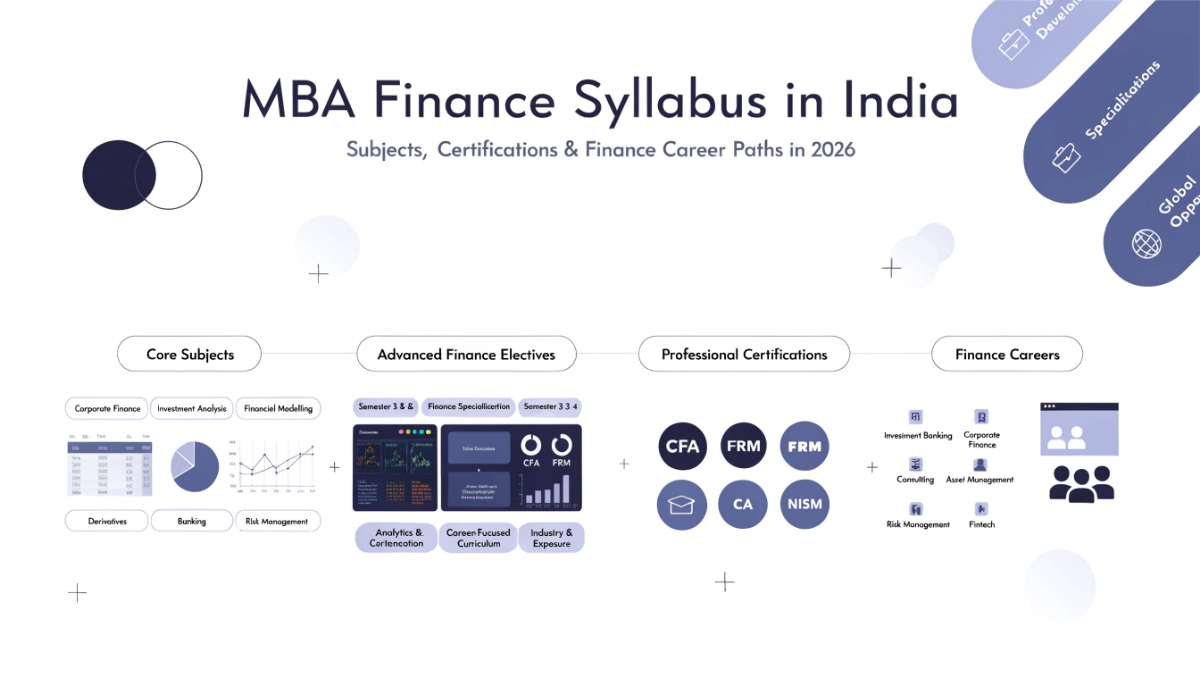
The MBA Finance syllabus is the most career-focused and technically demanding specialisation in any Indian MBA programme and it is the track that most students target when they are aiming for investment banking, corporate finance, private equity or financial consulting careers. Understanding the MBA Finance syllabus in detail before you choose your specialisation helps you match the subject depth to your actual career goals rather than picking Finance by default because it sounds prestigious.
The Finance specialisation in India is offered across all major B-schools including the IIMs, XLRI, FMS Delhi, SPJIMR, NMIMS and MDI and while the core MBA Finance syllabus is broadly similar across institutions the depth of electives and the quality of faculty matter enormously. This guide covers the complete MBA Finance syllabus semester by semester, the key subjects you will actually study, the certifications that complement the degree and the jobs this specialisation realistically leads to in India.
Why Finance Is the Most Demanding MBA Specialisation
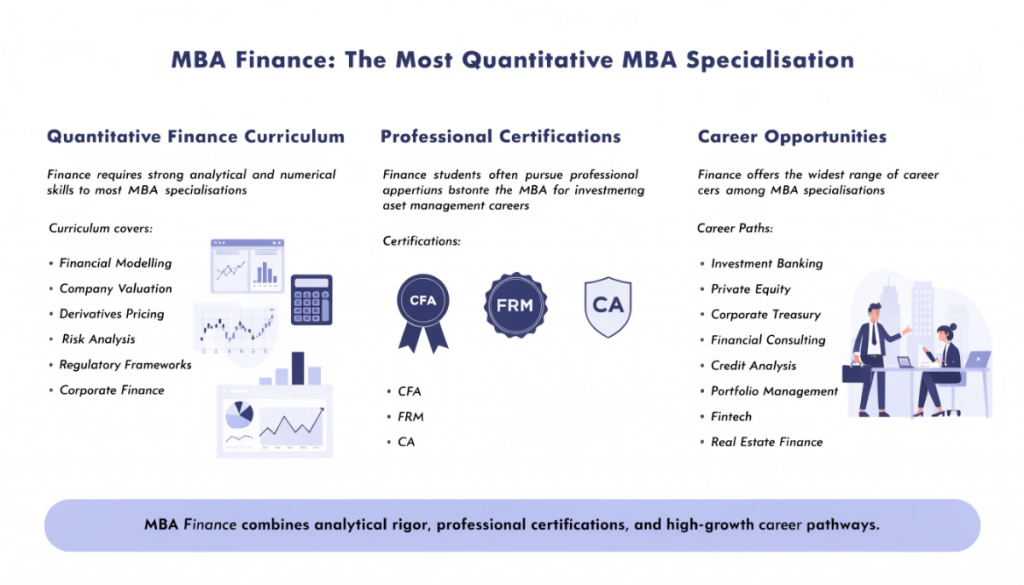
The MBA Finance syllabus is heavier on quantitative content than any other MBA specialisation. While Marketing depends more on consumer insight and HR leans on behavioural theory, Finance requires you to build financial models, value companies, understand derivatives pricing and interpret complex regulatory frameworks. This is not a criticism of other specialisations but it does mean that students who choose Finance without comfort with numbers often find the second year significantly more difficult than they expected.
It is also the most directly connected to external professional certifications. The CFA, FRM and CA qualifications all complement the Finance MBA and employers in investment banking and asset management specifically look for candidates who are at least pursuing one of these alongside their degree. This means this specialisation effectively prepares you for two learning streams simultaneously if you are serious about the most competitive roles in the sector.
Finance as a specialisation also has the widest range of career outcomes of any MBA track. Marketing typically leads to brand management, digital marketing or sales leadership roles. The MBA Finance syllabus opens doors to investment banking, corporate treasury, private equity, credit analysis, financial consulting, portfolio management, real estate finance and fintech roles. That breadth is one of the primary reasons Finance remains the most oversubscribed specialisation at most Indian B-schools year after year.
The Core Foundation: First Year Subjects That Feed Into Finance
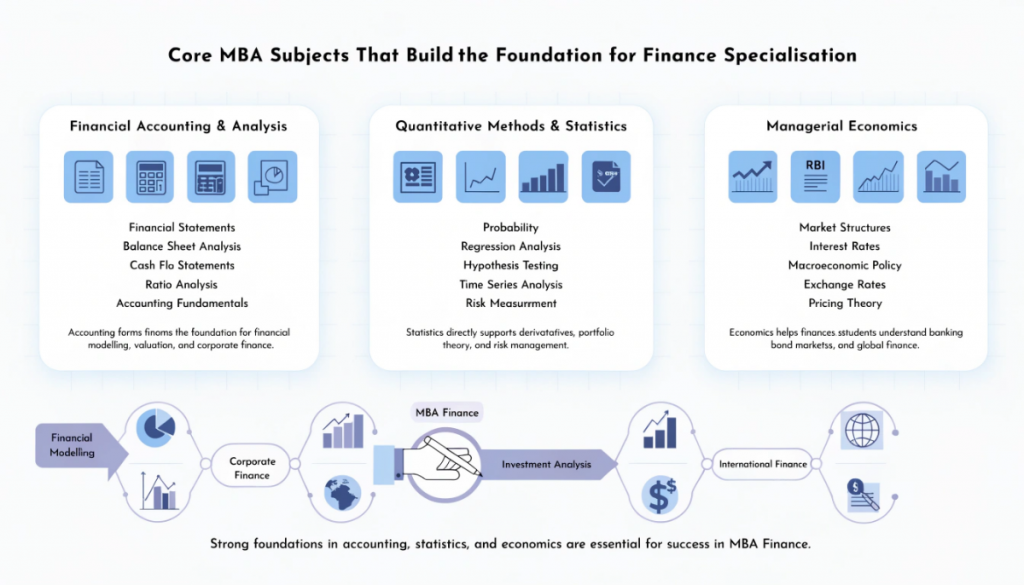
Before getting into the specialisation subjects it is worth understanding which first-year core subjects directly feed into the MBA Finance syllabus and matter more for Finance students than for those in other tracks.
Financial Accounting and Analysis
This is the most directly relevant first-year subject for Finance students. Financial accounting covers the preparation and interpretation of financial statements including the balance sheet, profit and loss account and cash flow statement. For students who will later study financial modelling, company valuation and corporate finance in their second year, a strong foundation in accounting is non-negotiable. Students who skip over first-year accounting content and treat it as a box-ticking exercise typically struggle in the valuation and modelling subjects that form the core of the MBA Finance syllabus in year two.
Quantitative Methods and Statistics
Statistics and quantitative methods feed directly into the MBA Finance syllabus subjects on derivatives pricing, portfolio theory and risk management. Concepts like probability distributions, regression analysis, hypothesis testing and time series analysis all appear in advanced Finance electives in year two. Students who build genuine statistical fluency in semester one find that the quantitative Finance subjects in the specialisation make significantly more sense than those who treat statistics as a general education requirement with no direct application.
Managerial Economics
Understanding market structures, pricing theory, interest rate mechanics and macroeconomic policy transmission is directly relevant to both the Banking and Financial Institutions subject and the International Finance subject in the MBA Finance syllabus. Macroeconomics in particular becomes very concrete in Finance when you are studying how RBI rate decisions affect bond prices, how exchange rate movements affect cross-border deals and how credit cycles drive the financial system.
Semester Three and Four: The Full MBA Finance Syllabus Breakdown
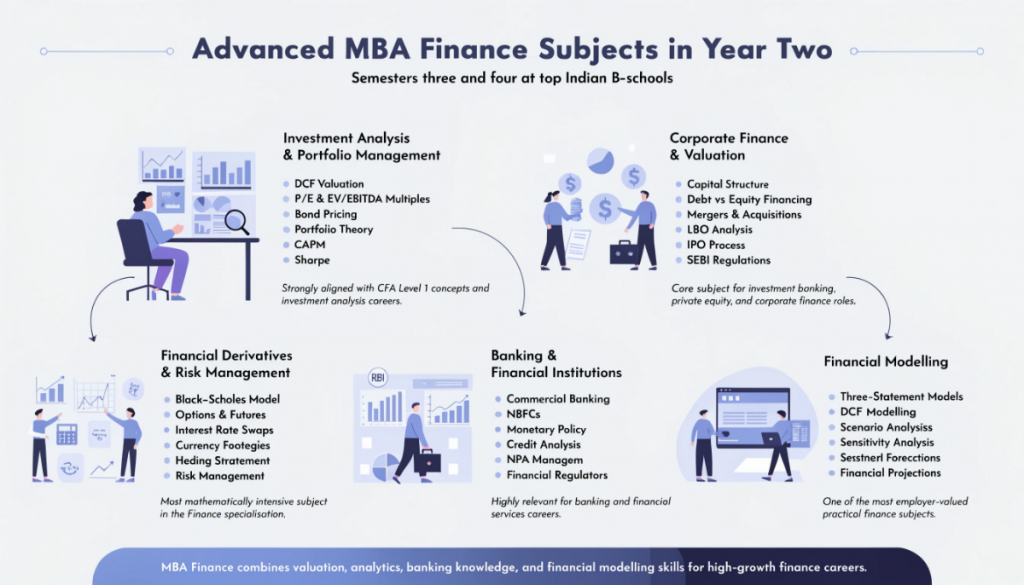
The MBA Finance syllabus in year two is where the specialisation content begins. Here is the complete subject breakdown across semesters three and four at most Indian B-schools offering Finance as a specialisation.
Investment Analysis and Portfolio Management
This is typically one of the first Finance electives students encounter and it is one of the most directly CFA-aligned subjects in the MBA Finance syllabus. It covers equity valuation using DCF, P/E and EV/EBITDA multiples, fixed income analysis including bond pricing and duration, portfolio construction using modern portfolio theory, the Capital Asset Pricing Model and performance measurement using Sharpe and Treynor ratios.
Students who go on to sit CFA Level 1 find that this subject covers roughly 40 percent of the exam content making it one of the most valuable from a certification standpoint.
Corporate Finance and Valuation
This subject is the heart of the MBA Finance syllabus for students targeting investment banking, private equity and corporate finance roles. It covers capital structure theory including the Modigliani-Miller theorem, how companies decide between debt and equity financing, dividend policy, merger and acquisition transaction structuring, leveraged buyout analysis and the IPO process in India including SEBI’s ICDR regulations. The practical component of this subject at good B-schools involves building valuation models for real listed Indian companies which is the closest the MBA Finance syllabus gets to actual investment banking work.
Financial Derivatives and Risk Management
Derivatives is one of the most mathematically intensive subjects in the Finance track and it is the subject most directly relevant to treasury, trading and risk management careers.
It covers the pricing of options using the Black-Scholes model, futures contracts and hedging strategies, interest rate swaps, currency forwards and how Indian companies use these instruments to manage foreign exchange and commodity price risk.The FRM certification covers derivatives in significantly greater depth but the programme gives students enough to speak credibly about risk management concepts in finance interviews.
Banking and Financial Institutions
This subject covers the structure of the Indian financial system including commercial banks, NBFCs, cooperative banks, insurance companies and mutual funds, how RBI regulates monetary policy, the credit analysis process at banks, NPA management and the role of SEBI, IRDA and PFRDA in regulating different segments of the financial sector.
For students targeting banking, credit analysis or financial services consulting roles this is one of the most practically relevant subjects in the Finance programme and it is also tested directly in JAIIB and CAIIB examinations for those entering the banking sector.
Financial Modelling
Financial modelling is increasingly offered as a dedicated subject within the MBA Finance syllabus at better B-schools and it is one of the most practically valued subjects by employers. It covers building integrated three-statement financial models in Excel, linking the income statement, balance sheet and cash flow statement, building revenue and cost drivers, constructing DCF valuation models, running sensitivity and scenario analysis and presenting model outputs in a format that is usable for decision-making.
Students who complete a rigorous financial modelling subject in their MBA Finance syllabus are significantly more prepared for the technical expectations of investment banking and consulting interviews than those who only study valuation theory.
Professional Certifications That Work Best Alongside the MBA Finance Syllabus
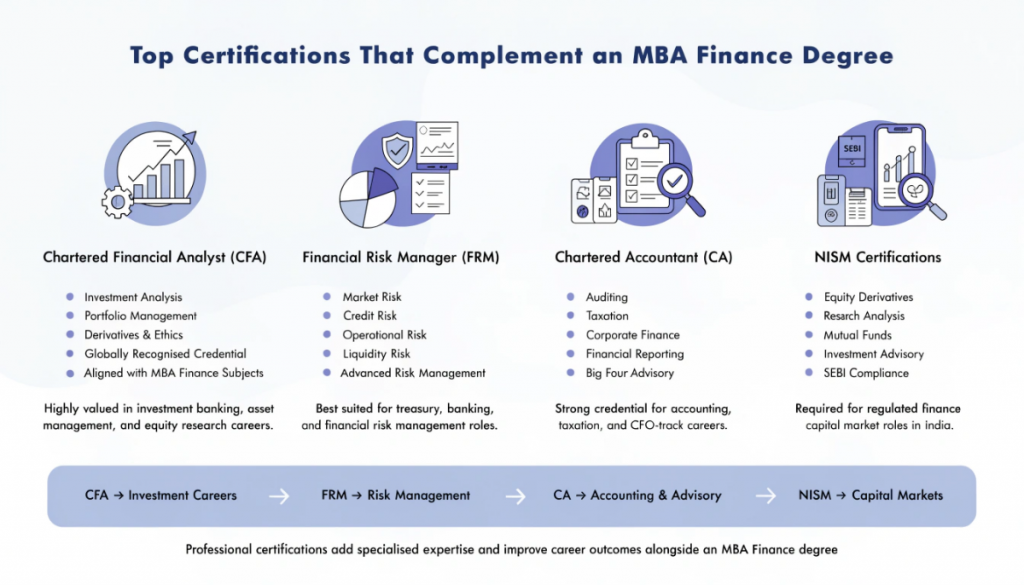
The MBA Finance syllabus is strong but most serious Finance careers in India require or strongly favour one of these professional credentials alongside the degree.
Chartered Financial Analyst (CFA)
The CFA charter from the CFA Institute is the most widely respected investment credential globally and it aligns most directly with the subjects on investment analysis, portfolio management, derivatives and ethics. CFA Level 1 is now offered in February, May, August and November making it feasible to attempt during the MBA. Many IIM and top B-school Finance students target CFA Level 1 in semester two or three and Level 2 during or after the programme. Employers in asset management, investment banking research and portfolio management in India specifically prioritise CFA candidates and the salary premium for CFA charterholders is well documented.
Financial Risk Manager (FRM)
The FRM from GARP complements the derivatives and risk management subjects in the MBA Finance syllabus directly. It covers market risk, credit risk, operational risk and liquidity risk at a depth that goes significantly beyond what the Finance specialisation touches.
For students targeting risk management roles at banks, insurance companies and large corporate treasuries the FRM is the most relevant credential to pursue alongside the MBA. The two-part FRM examination can be completed in one year making it realistic to finish during or immediately after the MBA programme.
Chartered Accountant (CA)
The CA qualification from ICAI is a longer commitment than CFA or FRM but it is the most respected financial credential in India for roles in auditing, taxation, CFO-track corporate finance and Big Four advisory. Some MBA Finance students who already hold a CA qualification use the MBA to transition from audit and tax into investment banking or consulting.
Others begin CA articleship alongside their MBA though the time commitment makes this difficult in practice. The CA’s depth in accounting, taxation and auditing complements the more market-facing subjects in the MBA Finance syllabus.
NISM Certifications
The National Institute of Securities Markets offers a range of certifications covering equity derivatives, mutual fund distribution, research analysis and investment advisory that are mandated by SEBI for professionals working in regulated capacities in Indian capital markets.
For MBA Finance students targeting roles at broking firms, AMCs, investment advisors or SEBI-registered entities the relevant NISM certifications are legally required in addition to the academic MBA Finance syllabus. Series VIII for equity derivatives and Series XV for research analysts are the most relevant for Finance MBA graduates.
Jobs the MBA Finance Syllabus Actually Prepares You For
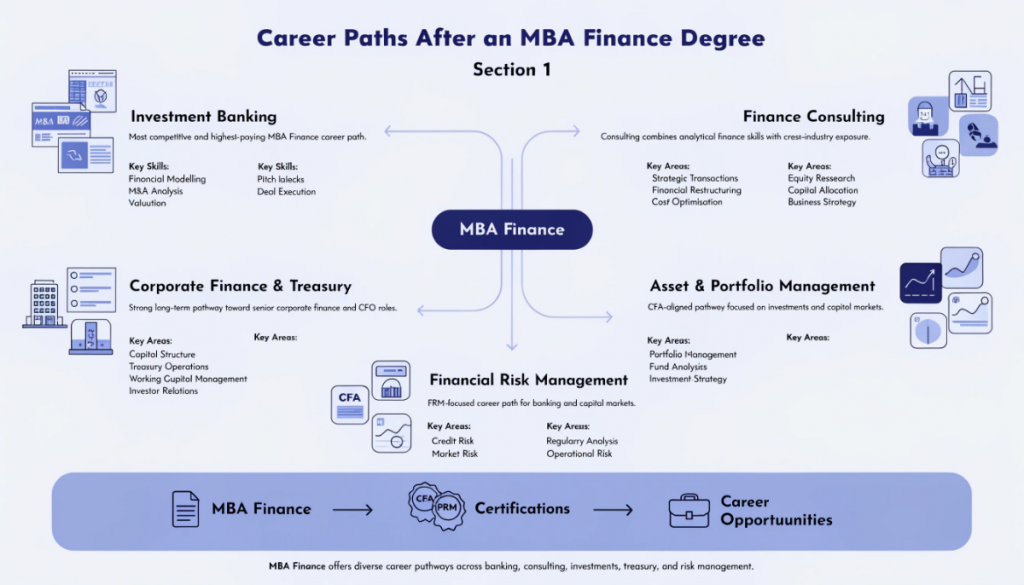
The MBA Finance syllabus is broad but each set of subjects within it prepares you most directly for specific career tracks. Here is an honest breakdown.
Investment Banking
Investment banking is the most competitive and highest-paying destination for MBA Finance graduates in India. The subjects in the Finance track that are most directly relevant are Corporate Finance and Valuation, Financial Modelling and M&A electives. IIM and top B-school graduates with strong modelling skills, a CFA Level 1 or 2 and internship experience at a bank or advisory firm are the strongest candidates for these placements.
The role involves financial modelling, pitch deck preparation, deal execution support and client relationship work at the analyst and associate levels.
Corporate Finance and Treasury
Corporate finance roles at listed Indian companies and MNCs include financial planning and analysis, capital structure management, treasury operations, working capital management and investor relations.
These roles align directly with Financial Management, International Finance and Banking in the programme. They are more accessible than investment banking at the campus placement stage and offer strong long-term career paths to CFO-level positions. FMCG, manufacturing, technology and conglomerate groups are the primary recruiters for corporate finance roles from MBA Finance programmes.
Consulting with a Finance Focus
Management consulting firms including McKinsey, BCG, Bain, Deloitte and KPMG recruit heavily from top MBA Finance programmes in India. Finance consulting roles involve advising companies on strategic transactions, financial restructuring, cost optimisation and capital allocation. The MBA Finance syllabus subjects most relevant here are Strategic Management, Corporate Finance and the M&A elective. Consulting careers from Finance MBA programmes are valued both for the analytical rigour and the industry exposure they provide across multiple sectors in a short time.
Asset Management and Portfolio Management
Mutual fund companies, portfolio management services firms and insurance investment teams are the primary asset management employers for MBA Finance graduates in India. Investment Analysis, Portfolio Management and Derivatives subjects are the most directly relevant.
Mutual fund houses including HDFC AMC, SBI MF, Kotak AMC and Mirae Asset recruit MBA Finance graduates for research analyst, fund management assistant and product roles. The CFA is specifically valued in this sector and many asset management employers actively prefer candidates who are already progressing through the CFA programme.
Financial Risk Management
Risk management roles at banks, NBFCs, insurance companies and large corporates require the derivative pricing, credit analysis and regulatory framework knowledge that the MBA Finance syllabus specifically covers.
Credit risk, market risk and operational risk analyst roles are among the most consistent campus placement opportunities from Finance MBA programmes at IIMs, NMIMS and MDI. The FRM certification significantly strengthens candidacy for dedicated risk management roles and many banks have explicit preferences for FRM candidates in their risk division hiring.
What Separates a Strong MBA Finance Programme From an Average One
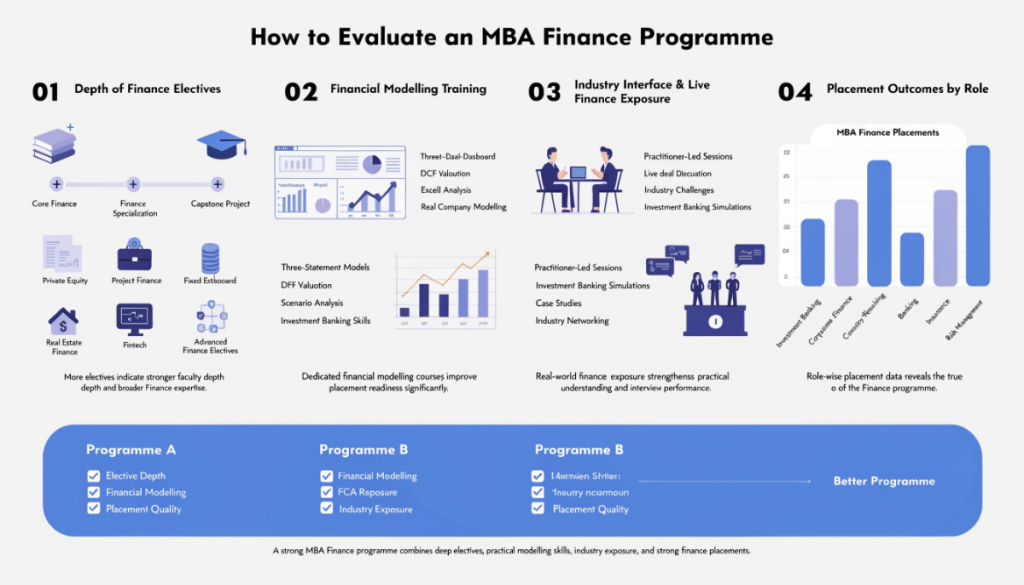
Not all MBA Finance syllabuses are equal in practice. Here is what to specifically evaluate when comparing Finance specialisation programmes.
Depth of Electives Beyond the Core Six Subjects
A strong MBA Finance syllabus offers 10 to 15 or more elective subjects within the Finance track in year two beyond the core compulsory subjects. Electives in areas like private equity, project finance, real estate, fixed income and fintech signal that the institution has faculty with genuine industry expertise across multiple Finance sub-disciplines.
A programme offering only 4 to 5 Finance electives in year two is delivering a significantly narrower programme than the brochure suggests and graduates enter the job market with shallower Finance depth.
Financial Modelling as a Dedicated Subject
At the best Indian B-schools financial modelling is a separate dedicated subject in the MBA Finance syllabus where students build real models from scratch rather than just studying valuation theory. At weaker programmes financial modelling is either not offered as a standalone subject or is covered superficially within the corporate finance course.
Since financial modelling is one of the most specifically tested skills in investment banking and consulting interviews this distinction in the MBA Finance syllabus has a direct impact on placement outcomes. Ask specifically whether your target programme offers a standalone financial modelling course.
Industry Interface and Live Transactions
Top B-schools bring real-world Finance practitioners into the Finance curriculum through practitioner-taught electives, investment banking simulations, live deal case studies and competitions like CFA Institute Research Challenge. These industry interfaces give students context for the theoretical subjects and direct access to professionals who make hiring decisions. A Finance programme taught entirely through textbooks produces graduates who understand Finance theory but struggle to demonstrate practical application in placement interviews.
Placement Record in Specific Finance Roles
When evaluating an MBA Finance syllabus based on placement outcomes ask for the breakdown by specific role type rather than the overall average package. Knowing how many Finance graduates went into investment banking, how many into corporate finance, how many into consulting and how many into banking roles gives you a much clearer picture of what the programme actually delivers than a single average package number.
Consistently placing in investment banking and top consulting firms signals a materially different Finance education than those whose Finance graduates primarily go into retail banking or insurance.
Conclusion
The MBA Finance syllabus in India in 2026 is one of the most comprehensive and career-relevant specialisation tracks available in a postgraduate business programme. The core subjects of the MBA Finance syllabus including Investment Analysis, Corporate Finance and Valuation, Financial Derivatives, Banking and Financial Institutions, Financial Modelling, International Finance and Taxation give graduates a strong foundation across every major Finance domain.
The Finance MBA is most powerful when complemented by a professional certification like the CFA or FRM and when chosen at an institution with genuine elective depth, strong modelling courses and consistent placement in banking and consulting. Choosing the right programme based on these specific criteria rather than brand alone will make a significantly bigger difference to your Finance career trajectory than the degree itself. The MBA Finance syllabus works best when you treat it as a starting point not the finish line.

Book Your
Free Session
Connect with our experts and get personalised guidance for your career, course selection, and future goals.
📖 Sources & References
✓ Verified 2026Verified MBA Finance syllabus structure, valuation subjects, certification pathways and Finance career insights based on 2026 business school and industry standards.
- Shoolini Online MBA Finance MBA Finance curriculum structure, online learning model and industry-focused electives
- IIM Ahmedabad MBA Finance electives, valuation coursework and case-based management education
- SPJIMR PGDM Finance Finance specialisation structure, industry projects and experiential Finance learning
- NMIMS School of Business Management MBA Finance electives, analytics integration and placement-focused curriculum
- CFA Institute Investment analysis, portfolio management and globally recognised CFA certification
- GARP FRM Certification Financial Risk Manager certification covering derivatives and risk management frameworks
- ICAI Chartered Accountant Accounting, taxation and auditing standards relevant to Finance careers in India
- NISM Certifications SEBI-mandated certifications for derivatives, research analysis and capital markets roles
- SEBI India Indian capital market regulations, IPO framework and securities market governance
- Reserve Bank of India Banking system regulation, monetary policy and financial institution oversight in India
