

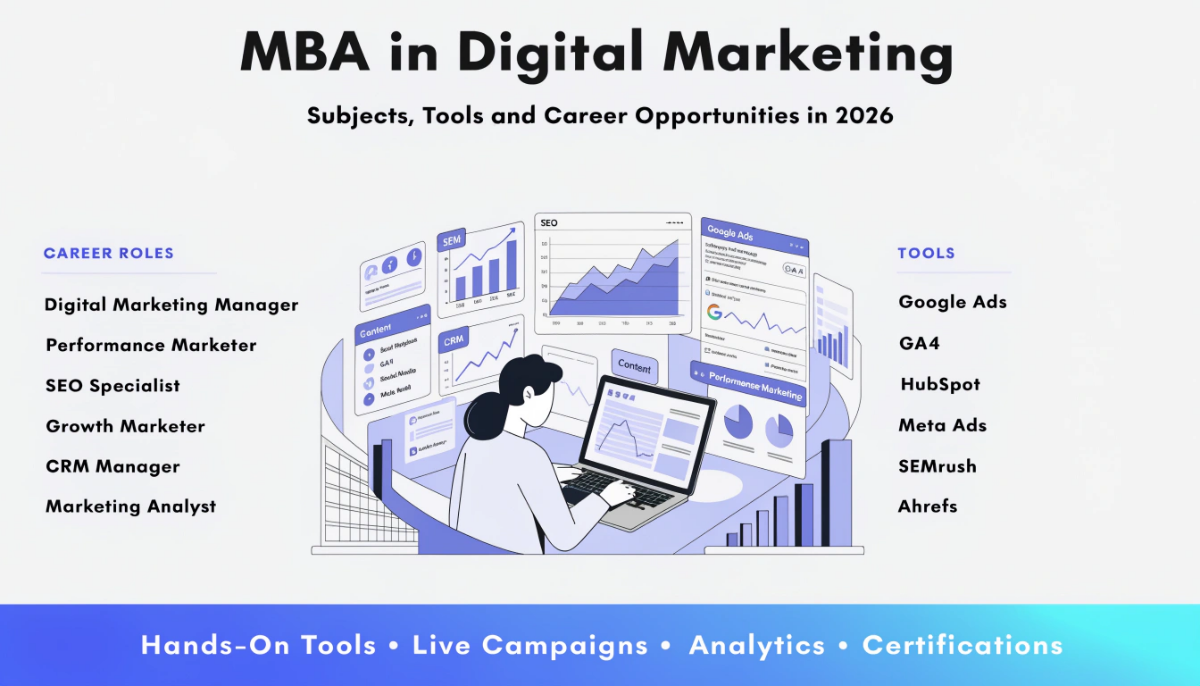
MBA in digital marketing is among the fastest growing specialisation choices at Indian B-schools in 2026 and it is driven by a straightforward reality: India has over 900 million internet users and every business from FMCG to fintech needs professionals who understand how to reach and convert customers through digital channels.
The MBA in digital marketing covers everything from performance marketing and SEO to analytics, content strategy and brand management across digital platforms making it one of the most practically grounded MBA specialisations available.
Unlike most MBA tracks where the impact of what you learn takes months to see in the real world, digital marketing is a field where campaigns run live, data comes back in hours and the connection between what you study and what you do on the job is immediate. This guide covers the full MBA in digital marketing syllabus semester by semester, the tools and certifications that complement the degree and the specific jobs this specialisation leads to in India in 2026.
What Makes the MBA in Digital Marketing Different From a General Marketing MBA
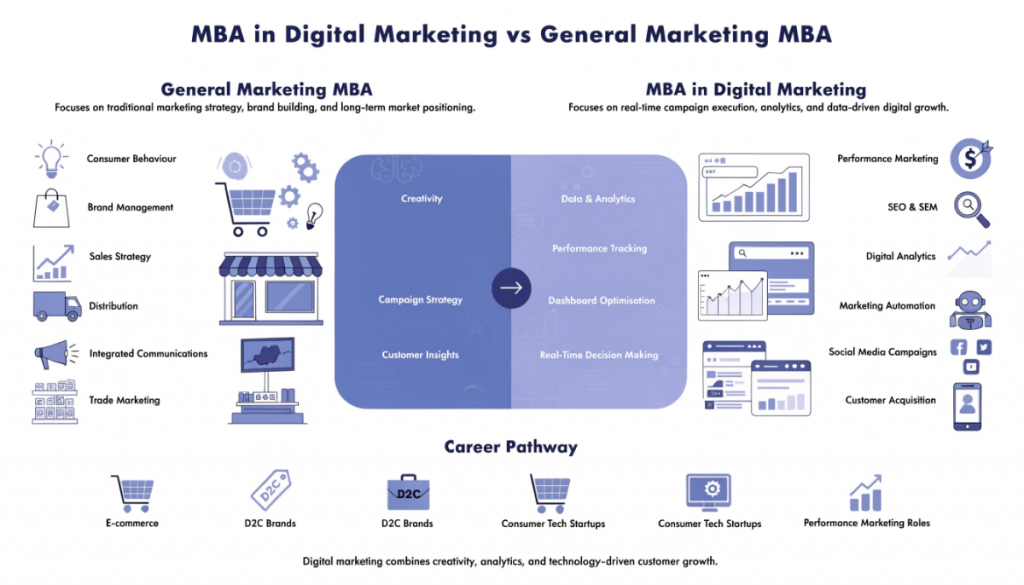
A general Marketing MBA covers consumer behaviour, brand management, sales strategy, distribution and integrated communications. The MBA in digital marketing covers all of those but adds a second layer of depth specifically in data-driven customer acquisition, performance marketing, search engine optimisation, marketing technology platforms and digital analytics that a general marketing track simply does not have room for.
In India the distinction matters practically. A general Marketing MBA graduate going into a consumer goods company will spend years building brand management and trade marketing skills before they touch digital. An MBA in digital marketing graduate entering an e-commerce company, a D2C brand, a digital agency or a consumer tech startup is expected to run campaigns, interpret dashboards and make channel allocation decisions from day one. That immediate practical accountability is what the MBA in digital marketing is specifically designed to prepare students for.
The specialisation also sits at the intersection of creativity and data in a way that no other MBA track does. You need to understand why a customer behaves the way they do and then use that understanding to build a campaign, measure its performance with the right metrics and optimise it in real time. Students who can hold both the strategic and the analytical side of this together are the ones who move fastest in digital marketing careers after their MBA.
Year One: Core Subjects That Build the Foundation
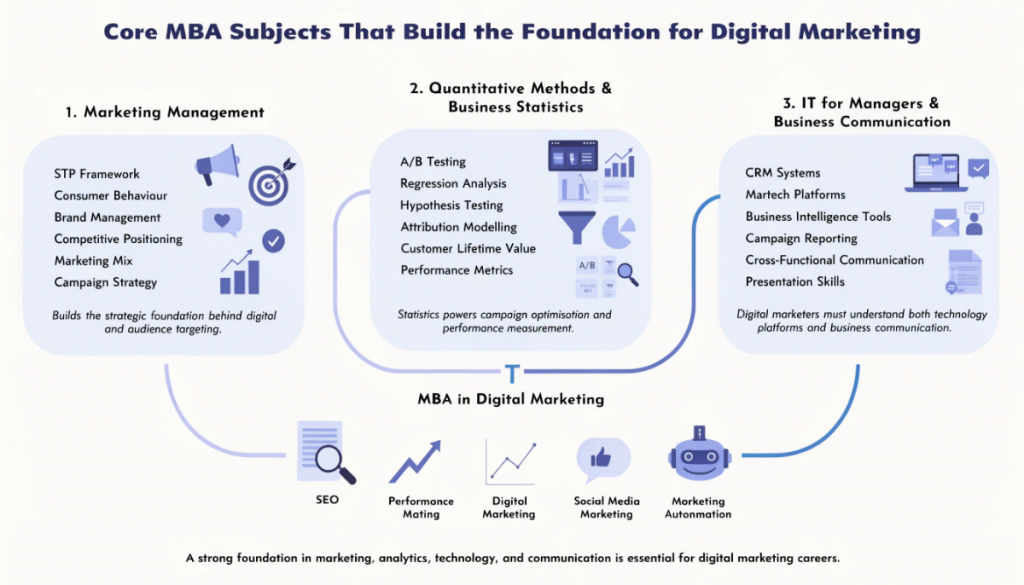
The first year of any MBA programme including the MBA in digital marketing covers compulsory core subjects that every student studies regardless of their chosen specialisation. Several of these directly feed into the digital marketing subjects in year two.
Marketing Management
Marketing Management in semester two is the single most important first-year subject for students targeting the MBA in digital marketing. It covers the STP framework of segmentation, targeting and positioning which is the strategic foundation behind every digital campaign, the 4Ps and their modern digital equivalents, consumer decision-making psychology, brand management fundamentals and competitive positioning. Every digital channel you will study in year two whether paid search, social media or content marketing ultimately executes a targeting and positioning strategy that Marketing Management teaches you to build correctly.
Quantitative Methods and Business Statistics
Statistics is the analytical backbone of digital marketing. A/B testing, attribution modelling, cohort analysis, regression-based forecasting and customer lifetime value calculations all require comfort with statistical concepts. Students who treat the first-year statistics course as an irrelevant theoretical requirement consistently struggle with the analytics and performance measurement subjects in the second year.
Probability, hypothesis testing and regression are not abstract in a digital marketing context. They are the tools you use to decide whether a campaign result is real or just noise.
IT for Managers and Business Communication
IT for Managers introduces students to the digital tools and platforms that modern businesses run on including CRM systems, ERP platforms and business intelligence tools. For MBA in digital marketing students this subject introduces the concept of martech stacks and how data flows between systems.
Business Communication is equally relevant because digital marketing roles require constant cross-functional communication with product, engineering, finance and sales teams. The ability to present campaign performance data clearly to non-marketing stakeholders is a skill that pays off throughout a digital marketing career.
The Full Second Year Syllabus: Every Subject in the MBA in Digital Marketing
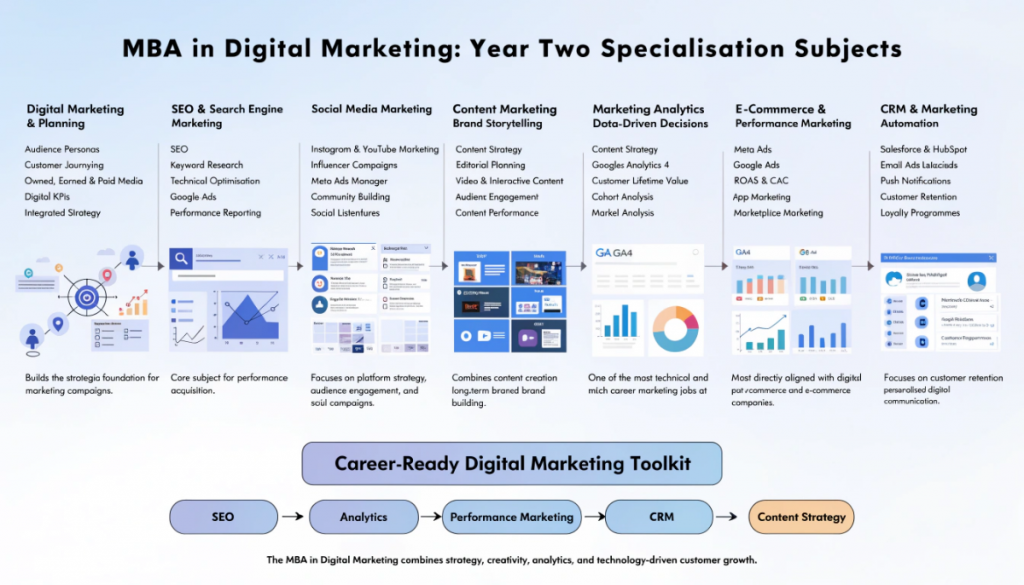
The second year is where the MBA in digital marketing specialisation subjects begin. Here is the complete subject breakdown covering both the core digital marketing subjects and the common electives across institutions offering this track.
Digital Marketing Strategy and Planning
This is typically the first and most foundational subject in the second year. It covers how to build a full digital marketing strategy from scratch including defining target audience personas, mapping the customer journey across digital touchpoints, setting channel-specific KPIs aligned to business objectives and building integrated campaigns across owned, earned and paid media.
Students who do this subject well can walk into any marketing role and immediately structure a digital strategy brief which is one of the most valued capabilities at every level of a digital marketing career in India.
Search Engine Optimisation and Search Engine Marketing
SEO and SEM together form the core of performance-driven customer acquisition in India and they are typically covered in a combined subject or as two closely linked modules in the MBA in digital marketing. SEO covers keyword research, on-page and technical optimisation, content strategy for organic discovery, link building principles and local SEO for businesses with geographic relevance.
SEM covers Google Ads campaign structure including Search, Display, Shopping and Performance Max campaigns, keyword bidding strategy, Quality Score mechanics, ad copywriting and campaign performance reporting. Students who leave this subject with hands-on platform experience in Google Ads and a working knowledge of Google Search Console are significantly more job-ready than those who only study the theory.
Social Media Marketing and Community Management
This subject covers organic and paid social media strategy across the major platforms relevant to Indian consumers including Instagram, Facebook, YouTube, LinkedIn and increasingly Moj and Josh for regional language audiences.
Topics include social media content planning and calendar management, algorithm mechanics on each platform, influencer marketing strategy and measurement, community building and engagement management, social listening and reputation monitoring and paid social campaign execution including Meta Ads Manager. The MBA in digital marketing places strong emphasis on understanding how different platforms serve different stages of the marketing funnel rather than treating all social media as the same channel.
Content Marketing and Brand Storytelling
Content marketing covers the strategy and execution of content that attracts, engages and converts audiences without relying on paid distribution. Topics include building a content strategy aligned to business goals, understanding different content formats including long-form articles, video, podcasts, infographics and interactive tools, editorial planning and production workflows, content distribution across owned and earned channels and measuring content performance using engagement and attribution metrics.
The brand storytelling component of this subject is where the MBA in digital marketing connects most directly to traditional brand management principles covering how brands build consistent narratives across multiple digital touchpoints over time.
Marketing Analytics and Data-Driven Decision Making
Marketing analytics is one of the most technically demanding subjects in the MBA in digital marketing and it is also one of the most career-defining. It covers Google Analytics 4 for website traffic and conversion analysis, marketing attribution models including last-click, first-click, linear and data-driven attribution, customer lifetime value calculation, cohort analysis, funnel analysis and the basics of marketing mix modelling.
At stronger B-schools this subject also introduces students to tools like Python or R for marketing data analysis and to SQL for pulling data from CRM and ad platform databases. Students who come out of this subject genuinely proficient in Google Analytics 4 and comfortable with basic attribution modelling are among the most in-demand MBA in digital marketing graduates in the Indian job market.
E-Commerce and Performance Marketing
Performance marketing is the engine of customer acquisition at every Indian e-commerce company and consumer tech startup and this subject is the most directly job-ready component of the MBA in digital marketing.
It covers the full performance marketing funnel from awareness through consideration to conversion and retention, Meta Ads and Google Ads campaign optimisation at scale, affiliate marketing and partnership models, app marketing including UAC and Apple Search Ads, retargeting and audience segmentation strategy and marketplace marketing on Amazon, Flipkart and Meesho.The subject also covers e-commerce specific metrics including ROAS, CAC, LTV, blended MER and payback period which are the language of every performance marketing conversation in Indian consumer internet companies.
CRM, Marketing Automation and Customer Retention
This subject covers how companies use technology to manage relationships with existing customers and turn one-time buyers into loyal repeat purchasers.Topics include CRM platform selection and implementation including Salesforce, HubSpot and Zoho CRM which are the most widely used in India, email marketing strategy and deliverability, push notification and SMS marketing for mobile-first Indian consumers, marketing automation workflows and drip campaign design, customer segmentation for personalised communication and loyalty programme design.
For students targeting roles at D2C brands, fintech companies or SaaS businesses this subject is particularly relevant because retention marketing is where the most measurable and commercially significant work happens.
Digital Marketing Electives at Top Institutions
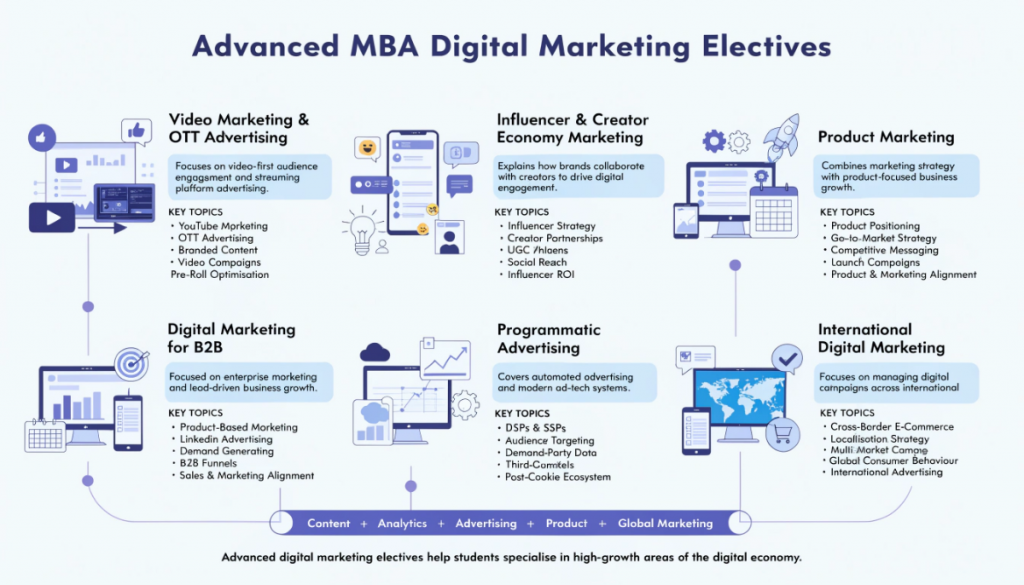
Beyond the core subjects stronger institutions offers elective choices covering:
Video Marketing and OTT Advertising: YouTube marketing strategy, connected TV advertising, branded content and pre-roll campaign optimisation
Influencer and Creator Economy Marketing: Micro and macro influencer strategy, creator partnerships, UGC campaigns and measuring influencer ROI
Product Marketing: Positioning, launch strategy, competitive messaging and working at the intersection of marketing and product management
Digital Marketing for B2B: Account-based marketing, LinkedIn advertising, demand generation and sales-marketing alignment in B2B contexts
Programmatic Advertising: DSPs, SSPs, DMPs, audience targeting using third-party data and the post-cookie advertising ecosystem
International Digital Marketing: Cross-border e-commerce, localisation strategy and managing digital campaigns across multiple markets
Tools You Will Actually Work With During the Programme
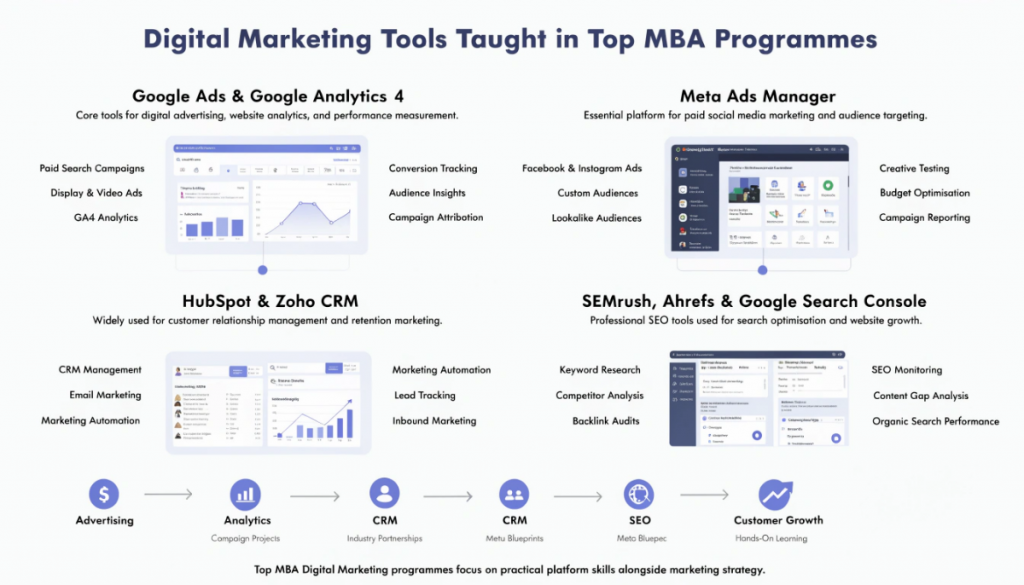
The MBA in digital marketing at the best Indian institutions does not just teach you what these tools are. It gives you hands-on time with them through live campaign projects, Google and Meta simulation environments and industry partnerships. Here are the platforms that appear most consistently across strong MBA in digital marketing programmes.
Google Ads and Google Analytics 4
These two platforms together are the most fundamental tools in digital marketing and every MBA in digital marketing student should graduate with genuine working proficiency in both. Google Ads covers paid search, display, video and shopping campaigns. GA4 covers website analytics, event tracking, audience building and conversion attribution. The Google Career Certificates and Google Skillshop certifications are directly relevant here and several institutions formally integrate these into the curriculum giving students a third-party verified credential alongside their degree.
Meta Ads Manager
Meta Ads Manager is the primary tool for paid social campaign execution on Facebook and Instagram which remain the largest digital advertising platforms by reach in India.
Understanding campaign structure, audience targeting using custom and lookalike audiences, creative testing frameworks, budget optimisation and campaign performance interpretation is expected of any mid-level digital marketing professional in India. Meta Blueprint certifications are widely recognised and complement the MBA in digital marketing effectively for students targeting performance marketing or social media roles.
HubSpot and Zoho CRM
HubSpot is used extensively in the MBA in digital marketing context for teaching CRM, email marketing and marketing automation because it offers a free tier that students can use for live projects. Zoho CRM is the dominant mid-market CRM in India and understanding its structure is valuable for students targeting roles at Indian startups and SMEs. HubSpot Academy offers free certifications in inbound marketing, email marketing and CRM management that are widely recognised as supplementary credentials alongside the degree.
SEMrush, Ahrefs and Google Search Console
SEO tools are a practical component of most institutions and SEMrush and Ahrefs are the most commonly used professional platforms for keyword research, competitor analysis, backlink auditing and content gap identification. Google Search Console is a free tool that shows how a website is performing in organic search and every digital marketing professional in India is expected to know how to interpret its data. Several MBA in digital marketing programmes have institutional access to SEMrush or Ahrefs enabling students to work on real websites during their coursework
Certifications That Strengthen an MBA in Digital Marketing Profile
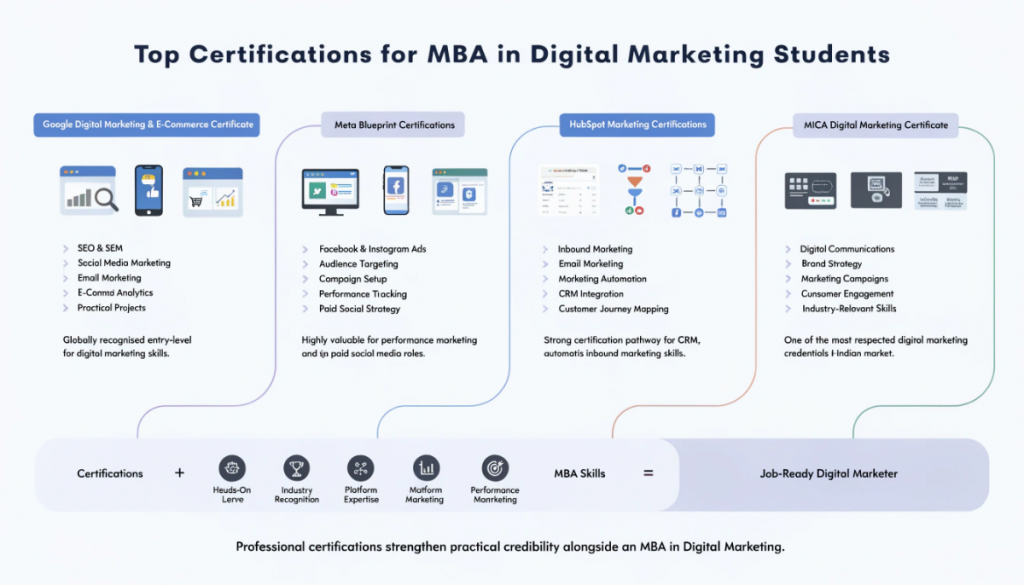
The degree opens doors but certifications close the gap between academic knowledge and job-ready credibility. These are the ones that matter most in the Indian market.
Google Digital Marketing and E-Commerce Certificate
Google’s Professional Certificate in Digital Marketing and E-Commerce offered through Coursera is one of the most recognised entry-level credentials in the field globally. It covers the core subjects of the MBA in digital marketing including SEO, SEM, social media, email marketing and e-commerce analytics through a structured seven-course programme. For students who complete this alongside their studies provides a Google-backed verification of practical skills that employers specifically look for when shortlisting candidates for digital marketing roles.
Meta Blueprint Certifications
Meta Blueprint offers certifications in Facebook and Instagram advertising at both associate and professional levels.The Meta Certified Digital Marketing Associate is the most relevant for students entering roles where paid social is a primary channel.
The certification specifically covers campaign setup, audience targeting, creative best practices and performance measurement in Meta Ads Manager. At companies where Meta is a primary acquisition channel interviewers frequently ask candidates to walk through their Meta Ads Manager experience and holding a Blueprint certification provides credible evidence of that capability.
HubSpot Marketing Certifications
HubSpot Academy’s certifications in Inbound Marketing, Content Marketing, Email Marketing and Marketing Automation are free, widely recognised and directly aligned with the subjects covered in the MBA in digital marketing.
The Inbound Marketing certification in particular is valuable because it ties together the customer journey mapping, content strategy and CRM integration concepts that span multiple subjects in the digital marketing MBA curriculum. Several Indian B-schools formally recommend or integrate HubSpot certifications into their MBA in digital marketing programme as a required component of coursework.
MICA Digital Marketing Certificate
MICA Ahmedabad is one of the most respected institutions for communications and digital marketing in India and its post-graduate and short-term programmes in digital marketing are recognised by employers across the industry.
For students who want to supplement their degree with a credential specifically from India’s top marketing communications institution the MICA digital marketing programme provides both knowledge depth and brand recognition in the Indian market. MICA’s full-time PGDM in Communications is a standalone alternative to the MBA in digital marketing but its certificate programmes are practical supplements for those already in a general MBA programme.
Conclusion
The MBA in digital marketing is one of the most practically relevant and career-ready MBA specialisations available in India in 2026. The syllabus covers digital strategy, SEO and SEM, social media, content marketing, analytics, performance marketing, CRM and marketing automation giving graduates a genuinely broad and job-ready toolkit across every major digital channel.
The specialisation is strongest at institutions that combine rigorous analytics teaching with live campaign experience, hands-on tool access and placement records at consumer internet companies, D2C brands and top digital agencies. Complementing your degree with Google, Meta and HubSpot certifications significantly strengthens your candidacy in a job market that is moving fast and where demonstrable platform skills matter as much as the degree itself.

Book Your
Free Session
Connect with our experts and get personalised guidance for your career, course selection, and future goals.

📖 Sources & References
✓ Verified 2026Verified MBA in Digital Marketing syllabus, martech tools, certification pathways and digital marketing career insights based on 2026 industry and academic standards.
- Shoolini Online MBA Online MBA curriculum, digital marketing specialisation and industry-oriented learning structure
- Google Skillshop Google Ads, Analytics and Search certifications used across digital marketing programmes
- Google Career Certificates Digital Marketing and E-Commerce certification covering SEO, SEM and analytics
- Meta Blueprint Facebook and Instagram advertising certifications for paid social marketing roles
- HubSpot Academy Inbound marketing, CRM, email marketing and automation certifications
- SEMrush Academy SEO, keyword research and competitive analysis learning resources for marketers
- Google Analytics Help GA4 documentation covering analytics, attribution and website performance tracking
- MICA Ahmedabad Digital marketing and strategic communication programmes recognised in India
- LinkedIn Marketing Labs B2B marketing, LinkedIn advertising and demand generation learning modules
- Shopify India Blog E-commerce marketing, D2C growth and digital customer acquisition insights