

MBA in business analytics is one of the most in-demand specialisations at Indian B-schools in 2026 and the demand is coming from every direction simultaneously. Companies across banking, retail, healthcare, logistics and technology are building analytics teams faster than the talent market can supply them and the gap between the number of analytics roles available and the number of people genuinely qualified to fill them remains wide.
The MBA in business analytics trains students to bridge that gap by combining the management framework of a traditional MBA with technical skills in statistics, machine learning, data visualisation and decision science. If you are trying to understand what this specialisation actually covers, which institutions offer it well in India, what tools you will work with and where it takes you after graduation this guide covers all of it clearly.
Why Business Analytics Became a Full MBA Specialisation
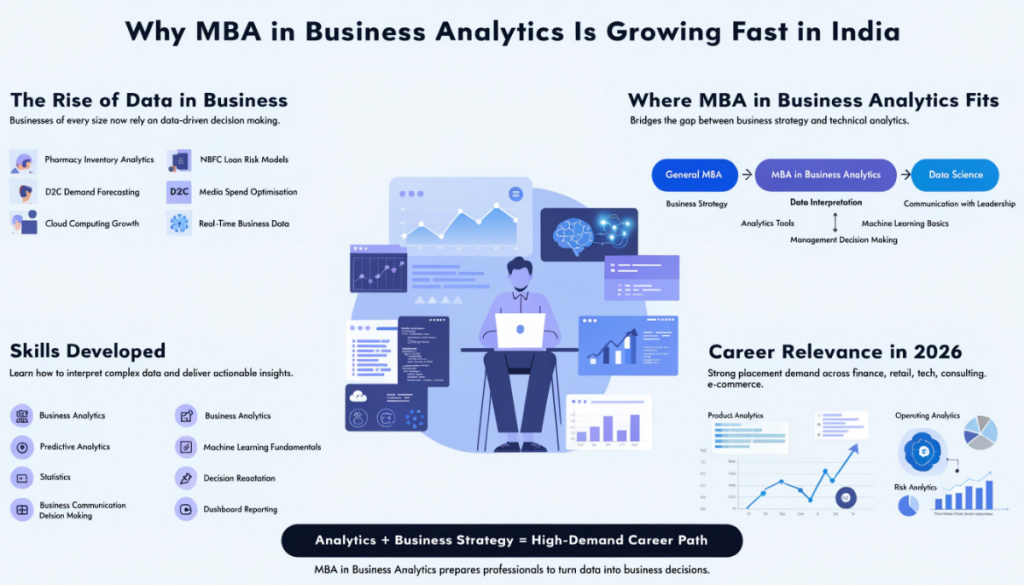
Business analytics was not a standalone MBA specialisation five years ago in India. It existed as a module within quantitative methods or as a short elective within the Operations track. What changed is the volume and accessibility of data that businesses now generate combined with the rise of affordable cloud computing that makes processing that data feasible at every scale of organisation. A neighbourhood pharmacy in Bengaluru now uses data to manage inventory.
Regional NBFC uses machine learning models to score loan applications.A mid-size D2C brand uses predictive analytics to forecast demand and plan media spend.
Analytics is no longer the exclusive domain of large tech companies and that democratisation of data work created a genuine market for managers who can both understand the business problem and work with the data tools to solve it.
The MBA in business analytics sits in a specific position in the market. It is not a pure data science programme where graduates spend most of their time writing Python code and building models. It is not a general MBA where analytics is a one-semester module.
It is deliberately positioned between the two producing graduates who understand enough about statistics and machine learning to work productively with data science teams while also having the management training to translate analytical outputs into business decisions and communicate them to senior leadership. That positioning is exactly what most Indian organisations need in 2026 and it is why placement outcomes from strong MBA in business analytics programmes are consistently strong.
First Year Subjects That Matter Most for Analytics Students
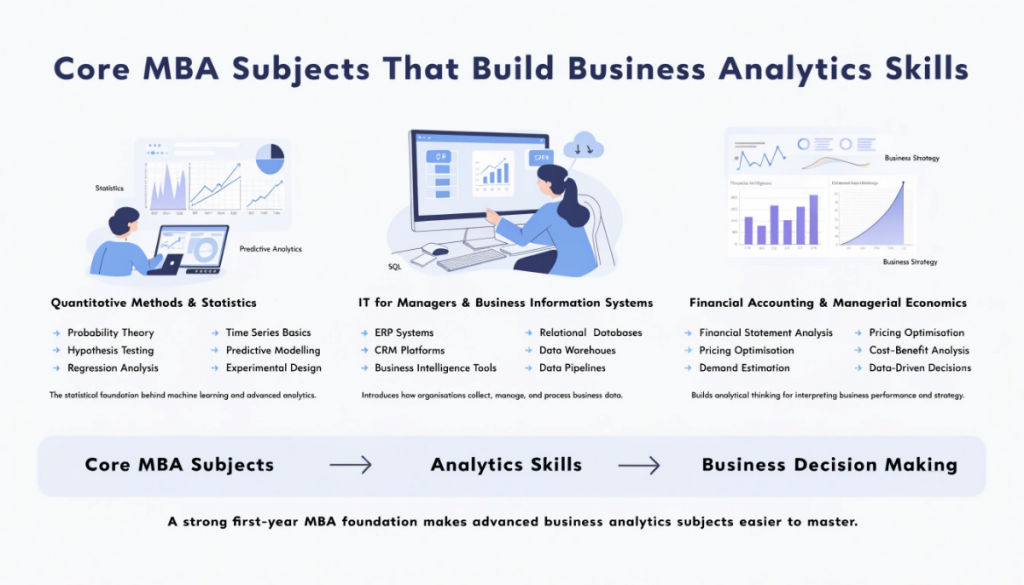
The first year of any MBA programme is largely compulsory core subjects and several of these directly build the foundation for the MBA in business analytics specialisation work in year two.
Quantitative Methods and Statistics
This is the single most important first year subject for students targeting the MBA in business analytics. Probability theory, descriptive and inferential statistics, hypothesis testing, regression analysis and time series basics are all foundational to the advanced analytics subjects in year two.
Students who take this subject seriously and build genuine statistical intuition find that machine learning, predictive modelling and experimental design in the second year make significantly more sense.
Students who treat it as a general education requirement consistently struggle when the technical analytics electives begin. The statistics course in an MBA in business analytics programme is not an obstacle to clear. It is the first real subject of the specialisation.
IT for Managers and Business Information Systems
This subject introduces students to how organisations store, manage and use data including database architecture, ERP systems, CRM platforms and business intelligence tools. For MBA in business analytics students this is where they first encounter the infrastructure behind data analytics including relational databases, data warehouses and the concept of a data pipeline.
Understanding how data moves from a transaction system to an analytics platform is directly relevant to the SQL and data engineering concepts that appear in the specialisation’s second year subjects.
Financial Accounting and Managerial Economics
These two subjects are more relevant to the MBA in business analytics than most students initially expect. Financial accounting teaches students how to read and interpret structured numerical data in a business context which is exactly the skill needed when working with sales data, cost data and operational metrics in analytics roles. Managerial economics introduces the framework of data-driven decision-making under constraints including demand estimation, pricing optimisation and cost-benefit analysis all of which appear in applied analytics projects in year two.
The Complete Second Year Syllabus: Every Subject That Defines the Specialisation
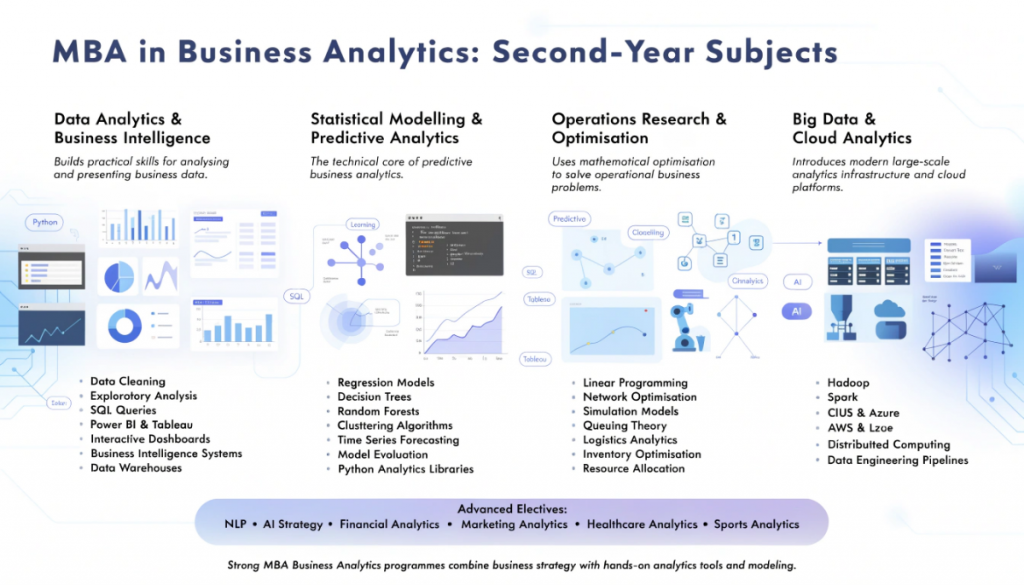
The second year is where the MBA in business analytics specialisation subjects begin in earnest. Here is the full breakdown across semesters three and four at institutions offering this track in India.
Data Analytics and Business Intelligence
This is typically the first and most foundational subject in the MBA in business analytics second year. It covers the full analytics workflow from data collection and cleaning through exploratory analysis to visualisation and reporting. Students learn to use tools like Excel for advanced data manipulation, SQL for querying relational databases and Power BI or Tableau for building interactive dashboards.
The business intelligence component covers how organisations structure their analytics infrastructure including data warehouses, data marts and the role of BI platforms in making data accessible to non-technical decision makers. Graduates who can build a clean dashboard in Tableau or Power BI and present it convincingly to a business leadership team are genuinely valuable from day one in most Indian analytics roles.
Statistical Modelling and Predictive Analytics
This subject moves beyond descriptive analytics into predictive modelling covering linear and logistic regression, decision trees, random forests, clustering algorithms including K-means and hierarchical clustering, time series forecasting using ARIMA and exponential smoothing and model evaluation metrics including accuracy, precision, recall and RMSE.
At stronger institutions this subject is taught using Python with libraries including Pandas, NumPy, Scikit-learn and Matplotlib giving students practical experience building and evaluating models rather than just understanding the theory. This subject is the technical core of the MBA in business analytics and the one that most directly differentiates strong programmes from weaker ones depending on how much hands-on modelling work students are required to do.
Operations Research and Optimisation
Operations research covers the mathematical optimisation techniques that analytics professionals use to solve resource allocation, scheduling, logistics and supply chain problems. Topics include linear programming, integer programming, network flow models, simulation and queuing theory. At Indian B-schools this subject is particularly relevant for students targeting analytics roles in manufacturing, logistics, e-commerce operations and consulting where optimisation problems appear directly in client work.
The Excel Solver, Python PuLP library and introductory R optimisation packages are the tools typically used in this subject within the curriculum.
Big Data Technologies and Cloud Analytics
As data volumes have grown the analytics ecosystem has moved beyond what traditional relational databases and desktop tools can handle. This subject covers the architecture of big data systems including Hadoop, Spark and distributed computing frameworks, cloud analytics platforms on AWS, Google Cloud and Azure, data lake concepts and the basics of data engineering pipelines.
At the management level the programme treatment of this subject focuses on understanding what these technologies do and when they are appropriate rather than on building infrastructure from scratch. Students learn enough to participate in architecture discussions with technical teams and to evaluate vendor claims about analytics platform capabilities.
Electives Available in Business Analytics
Beyond the core subjects stronger MBA in business analytics programmes offer elective choices covering:
Natural Language Processing for Business: Text analytics, sentiment analysis, chatbot design and applications of LLMs in business contexts
AI Strategy and Ethics: How organisations govern AI deployment, bias in algorithmic decision-making and responsible AI frameworks
Healthcare Analytics: Clinical data analysis, patient outcome prediction and analytics applications in hospital operations and insurance
Financial Analytics: Credit risk modelling, fraud detection, algorithmic trading basics and analytics in BFSI sector contexts
Supply Chain and Logistics Analytics: Demand sensing, route optimisation, inventory analytics and digital twin applications
Marketing Analytics: Customer lifetime value modelling, attribution analytics, A/B testing and personalisation at scale
Sports Analytics: Performance data analysis, team strategy optimisation and analytics applications in Indian cricket and football contexts
Tools You Will Actually Use: What the Technical Stack Looks Like
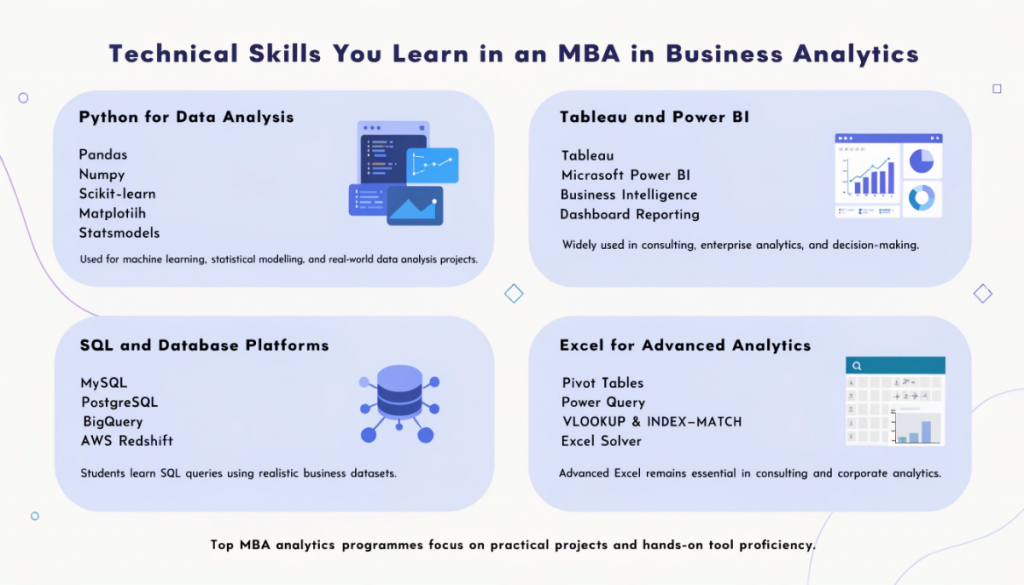
The MBA in business analytics at the strongest Indian institutions is not just about knowing that these tools exist. Students get hands-on time with them through structured coursework and live industry projects. Here is the core technical stack.
Python for Data Analysis
Python is the dominant analytics programming language globally and it is increasingly the primary technical tool in top Indian institutions. Core libraries include Pandas for data manipulation, NumPy for numerical computation, Scikit-learn for machine learning, Matplotlib and Seaborn for visualisation and Statsmodels for statistical modelling.
The depth of Python instruction varies significantly between programmes. At the strongest institutions students write Python from scratch for data analysis projects. At weaker ones Python is introduced briefly without enough practice to develop genuine working proficiency. When evaluating programmes specifically ask how many hours of Python instruction and practice projects are included in the curriculum.
Tableau and Power BI
Tableau and Power BI are the two most widely used business intelligence platforms in Indian enterprises and both are specifically taught at most serious programmes. Tableau is dominant in consulting, FMCG and large enterprise environments while Power BI is the standard in organisations running Microsoft infrastructure. Both platforms now offer official certification programmes and Tableau Desktop Specialist and Microsoft Power BI Data Analyst certifications are recognised by employers across analytics-heavy sectors in India as credible evidence of practical BI skills.
SQL and Database Platforms
SQL is non-negotiable in analytics and the programme teaches it primarily through MySQL and PostgreSQL which are the most commonly used open-source relational databases in Indian startups and mid-market companies.
BigQuery on Google Cloud and Redshift on AWS are introduced in the cloud analytics subject for students who will work with large-scale cloud data warehouses. The practical emphasis in the SQL component at the best programmes is on writing queries that answer real business questions from realistic datasets rather than abstract query exercises.
Excel for Advanced Analytics
Despite the rise of Python and BI tools Excel remains the most universally used analytics tool in Indian businesses and the MBA in business analytics treats it seriously rather than dismissing it as basic. Advanced Excel within the curriculum covers pivot tables and pivot charts, Power Query for data transformation, VLOOKUP and INDEX-MATCH for data integration, the Data Analysis Toolpak for statistical calculations and Excel Solver for optimisation problems.
In consulting and corporate finance environments complex Excel models are a daily work product and graduates who are genuinely advanced in Excel alongside their Python and Tableau skills are more immediately productive than those who treat Excel as outdated.
Certifications That Add Real Value to an MBA in Business Analytics
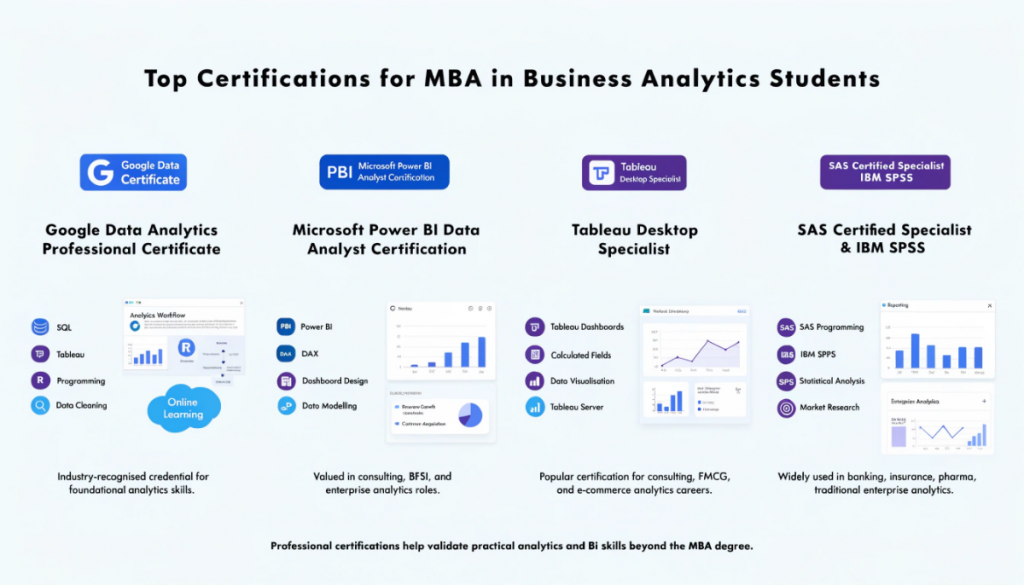
Certifications complement the degree by validating specific technical skills with third-party credentials that employers recognise independently of the institution name on the MBA.
Google Data Analytics Professional Certificate
Google’s Data Analytics Professional Certificate offered through Coursera is one of the most recognised entry-level analytics credentials globally. It covers data cleaning, SQL, R programming, Tableau and the analytics workflow from question formulation through insight presentation.
For MBA in business analytics students it provides a Google-backed validation of foundational analytics skills that supplements the academic degree with an industry-recognised credential. Several Indian B-schools now formally recommend or integrate this certificate into their MBA in business analytics curriculum as a required or strongly recommended component.
Microsoft Power BI Data Analyst Certification
The Microsoft Certified: Power BI Data Analyst Associate certification is directly relevant to students who want to validate their BI skills for corporate analytics roles. It covers data modelling in Power BI, DAX formula writing, dashboard design and publishing reports to Power BI Service. In India specifically this certification is valued at BFSI companies, large manufacturing groups and consulting firms that run analytics operations on Microsoft infrastructure. Holding this certification alongside the degree provides a concrete technical differentiator in a crowded analytics hiring market.
Tableau Desktop Specialist
The Tableau Desktop Specialist certification validates foundational Tableau skills including connecting to data sources, building calculated fields, creating visualisations and publishing to Tableau Server or Tableau Public. For MBA in business analytics graduates targeting analytics roles at consulting firms, FMCG companies and e-commerce organisations where Tableau is the BI standard this certification directly validates platform proficiency.
Tableau certifications are among the most frequently mentioned technical credentials in Indian analytics job postings at the manager level.
SAS Certified Specialist or IBM SPSS
SAS and IBM SPSS remain widely used in specific analytics-heavy sectors in India particularly in banking, insurance, pharmaceuticals and market research. The SAS Base Programmer certification and IBM SPSS Statistics credentials are specifically valued at these employers and complement this specialisation for students targeting roles in BFSI analytics, pharma data management or consumer insights research.
While Python has largely replaced SAS and SPSS in pure technology environments they remain dominant tools in traditional enterprise analytics functions where legacy systems and regulatory data requirements favour established statistical platforms.
Where MBA in Business Analytics Graduates Actually End Up in India
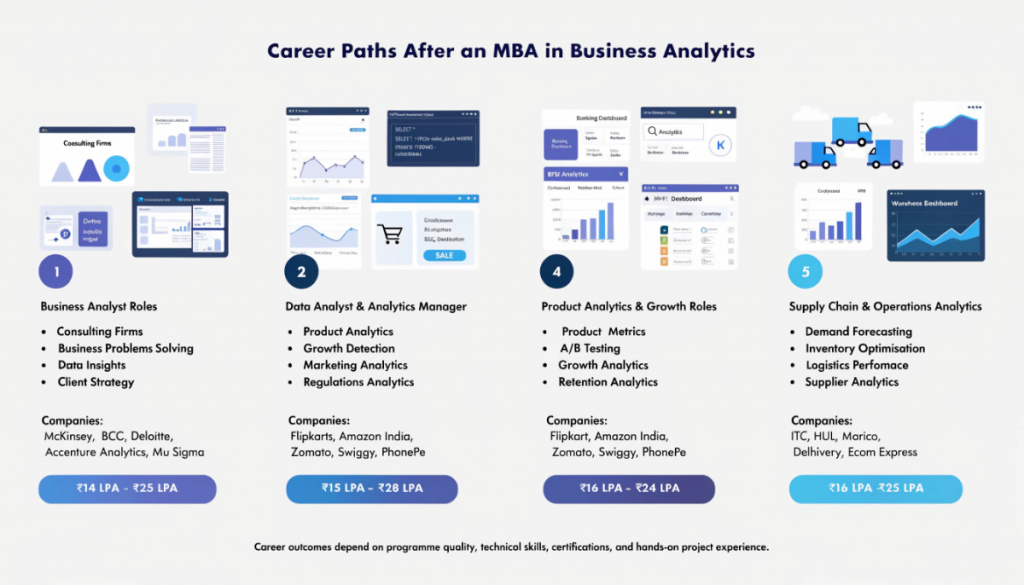
This is the section that matters most for most applicants and the honest answer is that outcomes vary significantly by institution quality, technical depth of the programme and individual student initiative with tools and certifications. Here are the most common career paths.
Business Analyst at a Consulting or Technology Firm
Business analyst roles at consulting firms including McKinsey, BCG, Deloitte, Accenture Analytics and Mu Sigma are among the most sought-after placements for MBA graduates in this track in India. These roles involve translating business problems into analytical frameworks, working with large datasets to identify patterns and insights and communicating recommendations to senior client stakeholders.
At the top consulting firms starting packages for MBA graduates in this track range from Rs 14 lakh to Rs 25 lakh per year depending on the firm and the programme. The analytical rigour and problem-structuring skills from the MBA in business analytics are particularly valued at consulting firms over pure technical coding ability.
Data Analyst or Analytics Manager at a Consumer Internet Company
Consumer internet companies including Flipkart, Amazon India, Zomato, Swiggy, Meesho, PhonePe and Razorpay are consistently among the largest recruiters of analytics-focused MBA graduates in India. The roles combine SQL-heavy data analysis with business stakeholder management and cover areas like product analytics, growth analytics, marketing analytics and operations analytics. Starting salaries at these companies for MBA graduates in this track range from Rs 15 lakh to Rs 28 lakh per year at the senior analyst or manager level with strong performers moving to associate director roles within three to five years.
Analytics Roles in BFSI
Banks, insurance companies, NBFCs and fintech firms are among the largest analytics employers in India. Analytics roles in this sector cover credit risk modelling, fraud detection, customer segmentation, cross-sell propensity modelling and regulatory reporting analytics. Companies including HDFC Bank, ICICI Bank, Bajaj Finserv, Paytm and CRED specifically recruit from this specialisation for these roles.
The combination of statistics and machine learning knowledge from the programme with the financial domain context from the MBA’s core curriculum makes graduates from this specialisation particularly well suited to BFSI analytics roles.
Product Analytics and Growth Roles
Product analytics roles work at the intersection of data analysis and product management and they are among the highest-paying entry points for MBA graduates in this track in India. These roles involve defining metrics for product features, building dashboards to track product health, running A/B experiments to test product changes and working closely with product managers and engineers to interpret data and make product decisions.
At funded startups and mid-size technology companies product analytics roles start at Rs 16 lakh to Rs 24 lakh per year for MBA graduates with strong SQL and Python skills. The growth manager variant of this role which adds acquisition and retention analytics to the product analytics function is even more commercially accountable and typically commands higher compensation.
Supply Chain and Operations Analytics
Manufacturing, logistics, FMCG and e-commerce companies hire MBA in business analytics graduates for supply chain analytics roles covering demand forecasting, inventory optimisation, supplier performance analytics and logistics network modelling. Companies including ITC, HUL, Marico, Delhivery and Ecom Express specifically look for analytics-capable MBA graduates who understand both the quantitative methods and the operational context of supply chain decision-making. These roles are among the most accessible from this specialisation because the combination of operations management from the core MBA curriculum and analytics from the specialisation directly matches what these employers need.
Conclusion
The MBA in business analytics is one of the strongest career bets in Indian management education in 2026 because it sits precisely at the intersection of two trends that are not going away: the explosion of business data and the persistent shortage of professionals who can turn that data into decisions. The syllabus covers statistics, machine learning, SQL, Python, data visualisation, optimisation and big data technologies giving graduates a broad technical foundation that is reinforced by the management framework of the core MBA curriculum.
The best programmes in India offering this specialisation deliver genuine hands-on tool experience alongside the theory, integrate live industry projects into the curriculum and place consistently in consulting, consumer internet, BFSI and supply chain analytics roles. Choosing an institution based on placement depth in analytics roles rather than overall average package is the most reliable way to ensure the MBA in business analytics delivers the career outcomes it promises.

Book Your
Free Session
Connect with our experts and get personalised guidance for your career, course selection, and future goals.

📖 Sources & References
✓ Verified 2026Verified MBA in Business Analytics syllabus, analytics tools, certifications and career insights across India based on 2026 curriculum and industry demand trends.
- Shoolini Online MBA MBA in Business Analytics curriculum, specialisations and online learning structure
- Google Data Analytics Certificate Industry-recognised analytics certification covering SQL, Tableau and data analysis
- Microsoft Power BI Certification Official Power BI Data Analyst certification for dashboarding and business intelligence
- Tableau Certifications Tableau Desktop Specialist certification and BI visualisation learning paths
- AWS Cloud Analytics Big data, cloud analytics and enterprise data lake architecture concepts
- Google Cloud BigQuery Cloud-based SQL analytics platform used in enterprise data workflows
- IBM SPSS Statistics Statistical analysis software widely used in BFSI, healthcare and market research analytics
- SAS Certifications Enterprise analytics and statistical modelling certifications for analytics professionals
- Python Documentation Official Python learning resources for data analysis, machine learning and automation
- McKinsey Analytics Insights Industry insights on AI, analytics transformation and data-driven business strategy