

The MCA syllabus in India has gone through a significant restructuring over the past three years and in 2024 the University Grants Commission reduced the MCA programme from three years to two years making it a four-semester postgraduate degree aligned with the National Education Policy 2020. If you are deciding between MCA and other postgraduate technology programmes understanding the MCA syllabus in detail is the most useful starting point because what you study directly determines the jobs you qualify for and the salary range you can target.
The MCA syllabus covers computer science fundamentals alongside software engineering, database management, cloud computing, data structures and increasingly artificial intelligence and machine learning in its specialisation tracks. This guide breaks down the complete MCA syllabus semester by semester covers the major specialisation options available at top Indian universities and tells you exactly where this degree takes you in the current job market.
The New Two-Year MCA: What Changed and Why It Matters
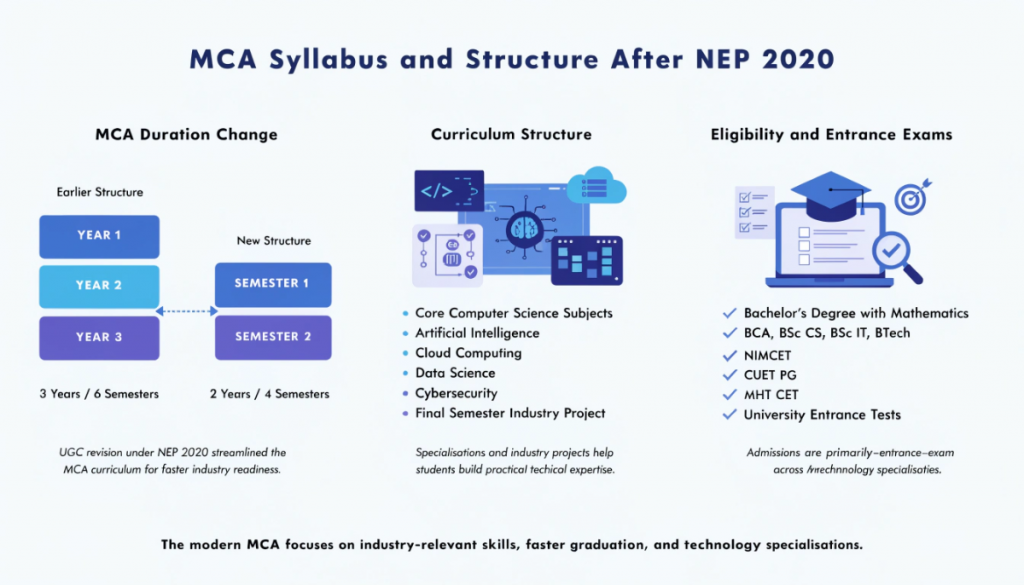
Before 2024 the MCA was a three-year six-semester programme. The UGC’s revision under NEP 2020 brought it down to two years and four semesters making it comparable in duration to an MBA or an MTech in most disciplines. This change matters for two reasons.
First it means the MCA syllabus now needs to cover the same essential computer science content in significantly less time which has pushed institutions to streamline their curricula and focus on the subjects that are most directly relevant to industry. Second it reduces the opportunity cost of pursuing the degree by a full year which has made the MCA more attractive relative to a three-year programme for students who want to enter the workforce sooner.
The revised programme is structured around a core set of compulsory subjects that run through the first two semesters and a specialisation-heavy second year where electives in areas like artificial intelligence, cloud computing, data science and cybersecurity allow students to build depth in a specific technology domain.
Most universities also include a mandatory project or dissertation in the final semester which is the most directly industry-facing component of the entire programme and the one that most directly influences campus placement outcomes.
Eligibility for the MCA in India requires a bachelor’s degree with Mathematics either at 10+2 level or at the undergraduate level and most universities admit students through entrance examinations including NIMCET for NITs, CUET PG for central universities, MHT CET for Maharashtra institutions and university-specific tests at institutions like Delhi University, Pune University and VTU. BCA graduates with Mathematics are the most common applicants for the MCA but BSc Computer Science, BSc IT and even BTech graduates apply when they want a more application-focused postgraduate qualification.
Semester One and Two: The Technical Foundation Every MCA Student Covers
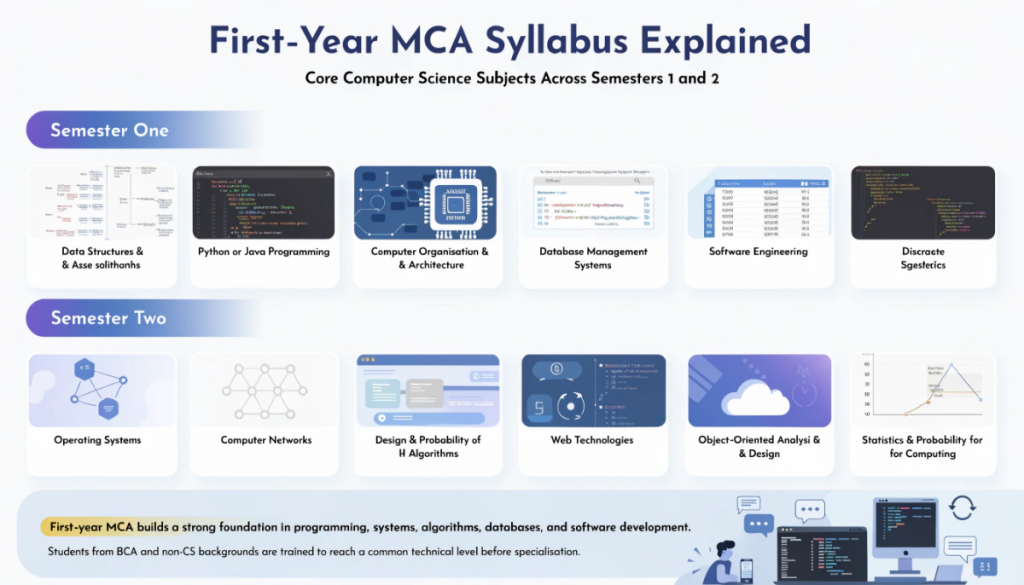
The first year of the MCA syllabus is almost entirely compulsory core subjects designed to establish a rigorous computer science foundation regardless of a student’s undergraduate background. Here is the complete subject breakdown.
Semester One
Semester one of the MCA syllabus typically covers the following core subjects across most Indian universities including NITs, central universities, state universities and private institutions:
Data Structures and Algorithms: Arrays, linked lists, stacks, queues, trees, graphs, sorting algorithms including quicksort and mergesort, searching algorithms and algorithm complexity analysis using Big O notation
Programming in Python or Java: Object-oriented programming concepts, classes and objects, inheritance, polymorphism, exception handling, file handling and basic data manipulation using the primary programming language of the institution
Computer Organisation and Architecture: CPU design, instruction sets, memory hierarchy, cache memory, pipelining, input-output systems and assembly language basics
Discrete Mathematics: Set theory, graph theory, combinatorics, propositional logic, predicate logic, relations and functions and their applications in computer science
Database Management Systems: Relational model, entity-relationship diagrams, SQL including DDL and DML commands, normalisation up to BCNF, transaction management and concurrency control
Software Engineering: Software development lifecycle, requirement engineering, system design models including waterfall and agile, software testing methodologies and project management basics
Semester Two
Semester two of the MCA syllabus builds on the first semester foundation and introduces more advanced technical subjects:
Operating Systems: Process management, CPU scheduling algorithms, memory management including paging and segmentation, deadlock detection and avoidance, file systems and I/O management
Computer Networks: OSI and TCP/IP models, network protocols including HTTP, FTP, DNS and SMTP, routing algorithms, network security basics and wireless networking
Design and Analysis of Algorithms: Divide and conquer, dynamic programming, greedy algorithms, graph algorithms including Dijkstra and Bellman-Ford, NP-completeness and approximation algorithms
Web Technologies: HTML5, CSS3, JavaScript, responsive design, server-side programming basics using PHP or Node.js, REST API concepts and web security fundamentals
Object-Oriented Analysis and Design: UML diagrams, design patterns including factory, singleton and observer, system modelling and object-oriented design principles
Statistics and Probability for Computing: Probability distributions, Bayes theorem, statistical inference, regression basics and their applications in data analysis and machine learning
The first year of the MCA syllabus is intentionally broad. A student entering from a BCA background will find much of this familiar and will be consolidating and deepening existing knowledge. A student entering from a non-computer science background like BSc Mathematics will be building genuinely new competencies particularly in programming and systems subjects. Both profiles are common in Indian MCA programmes and the first-year MCA syllabus is designed to bring them to approximately the same technical level before specialisation begins.
Semester Three and Four: Electives, Specialisations and Industry Projects
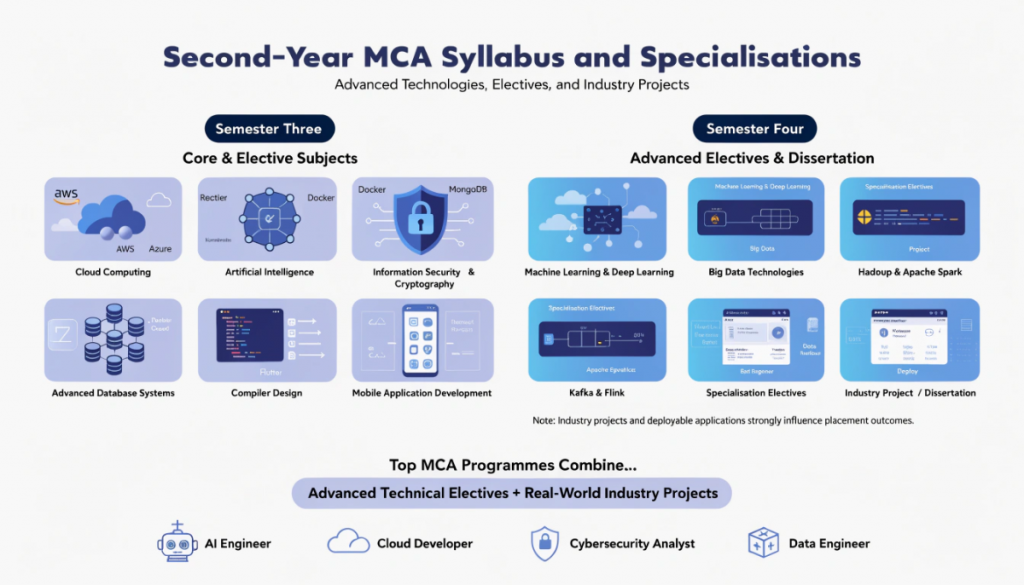
The second year of the MCA is where the curriculum becomes genuinely differentiated between students and institutions. Semester three introduces specialisation-specific electives and semester four is dominated by advanced electives and a major project or dissertation.
Semester Three Core and Elective Subjects
Most universities structure semester three of the MCA syllabus with two to three compulsory subjects and three to four elective subjects from the chosen specialisation track:
Cloud Computing: Virtualisation technology, cloud service models including IaaS, PaaS and SaaS, major cloud platforms including AWS, Azure and Google Cloud, microservices architecture, containerisation using Docker and Kubernetes basics
Artificial Intelligence: Search algorithms, knowledge representation, expert systems, natural language processing basics, computer vision fundamentals and the philosophical foundations of AI
Information Security and Cryptography: Symmetric and asymmetric encryption, hashing algorithms, digital signatures, PKI infrastructure, network security protocols and ethical hacking fundamentals
Advanced Database Systems: NoSQL databases including MongoDB, Cassandra and Redis, distributed database concepts, data warehousing and OLAP, NewSQL platforms and database performance tuning
Compiler Design: Lexical analysis, parsing, syntax-directed translation, intermediate code generation and code optimisation
Mobile Application Development: Android development using Kotlin or Java, iOS development basics using Swift, cross-platform frameworks including Flutter and React Native and mobile UX principles
Semester Four: Advanced Electives and Dissertation
The final semester of the MCA syllabus is the most applied and the most career-defining:
Machine Learning and Deep Learning: Supervised and unsupervised learning algorithms, neural network architecture, convolutional neural networks for image recognition, recurrent neural networks for sequence data and model deployment basics
Big Data Technologies: Hadoop ecosystem, Apache Spark, data lake architecture, real-time data processing using Kafka and Flink and cloud-native big data services
Advanced Elective from Specialisation Track: Subject depends on chosen specialisation area
Project or Dissertation: Full-semester industry project or research dissertation on a real technology problem with external faculty or industry guide supervision
The dissertation or industry project in the final semester of the MCA syllabus is the component that most directly influences placement. Students who complete projects with real companies, build something deployable and document their work well consistently get better placement outcomes than those who treat the project as an administrative requirement. The best MCA programmes in India have formal industry partnerships that channel real project work into the final semester rather than leaving students to find project topics independently.
Specialisation Tracks Available Inside the MCA Programme
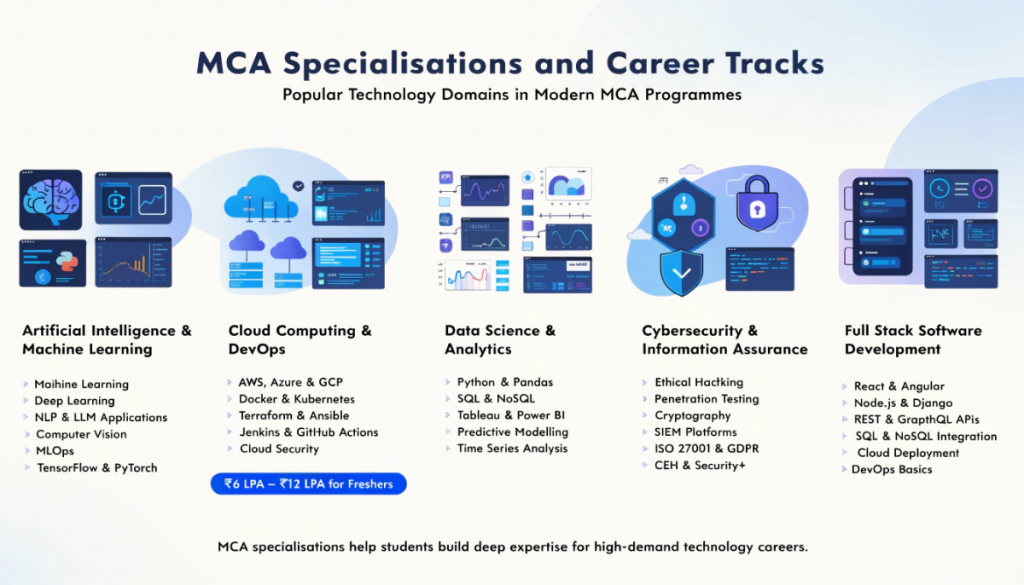
The MCA syllabus at most modern Indian universities allows students to choose a specialisation track in the second year. Here are the most commonly offered tracks and what they cover.
Artificial Intelligence and Machine Learning
The AI and ML specialisation within the MCA syllabus is the most popular track at institutions that offer it and it covers the technical depth that students need for roles in data science, machine learning engineering and AI research.
Core subjects in this track include machine learning algorithms in depth covering ensemble methods, gradient boosting and support vector machines, deep learning covering CNNs, RNNs and transformer architectures, natural language processing covering tokenisation, embeddings, sentiment analysis and LLM applications, computer vision covering image classification and object detection and MLOps covering model deployment, monitoring and retraining pipelines.Python with libraries including TensorFlow, PyTorch, Keras, Scikit-learn and Hugging Face is the primary technical environment for this specialisation track within the MCA syllabus.
Cloud Computing and DevOps
The Cloud and DevOps specialisation in the MCA syllabus is the most directly employment-focused track for students targeting infrastructure, platform engineering and site reliability roles. Core subjects cover advanced AWS, Azure and GCP services, Infrastructure as Code using Terraform and Ansible, CI/CD pipeline design using Jenkins and GitHub Actions, Kubernetes cluster management, monitoring and observability using Prometheus and Grafana and cloud security and compliance.
This track specifically prepares students for cloud engineer, DevOps engineer and platform engineer roles which are among the highest-paying entry-level positions available to MCA graduates in India in 2026 with salaries ranging from Rs 6 lakh to Rs 12 lakh for freshers depending on the employer.
Data Science and Analytics
The Data Science specialisation within the MCA syllabus covers statistical modelling, data engineering and business analytics alongside core machine learning. Key subjects include advanced statistics and probability, data wrangling using Python and Pandas, SQL and NoSQL database querying, data visualisation using Tableau or Power BI, predictive modelling and time series analysis, and the basics of data pipeline construction.
This track is well suited to students who want to work in analytics teams at BFSI companies, e-commerce platforms and consulting firms where the primary deliverable is insight generation from data rather than building production software systems.
Cybersecurity and Information Assurance
The Cybersecurity specialisation in the MCA syllabus covers both offensive and defensive security concepts in depth. Core subjects include network security and intrusion detection, ethical hacking and penetration testing methodologies, digital forensics, cryptography and applied security protocols, application security including OWASP Top 10, security operations and SIEM platforms and regulatory compliance frameworks including ISO 27001 and GDPR.
This specialisation is particularly relevant for students targeting roles in banking, government and defence-adjacent technology organisations where security clearance and deep security domain knowledge are specifically required. CEH and CompTIA Security+ certifications complement this specialisation track directly.
Full Stack Software Development
The Full Stack specialisation within the MCA syllabus focuses on building complete web and mobile applications from front end to back end to deployment. Core subjects cover advanced JavaScript and TypeScript, React or Angular for front-end development, Node.js or Django for back-end development, REST and GraphQL API design, database integration using both SQL and NoSQL databases, cloud deployment using AWS or Azure, testing methodologies and DevOps basics.
This is the most directly employment-relevant track for students targeting software development roles at product companies and startups because the full stack skill set is what most engineering teams in India need at the junior to mid level and the MCA syllabus in this track prepares students to contribute to production codebases from their first week on the job.
Jobs the MCA Opens and What Salaries Actually Look Like
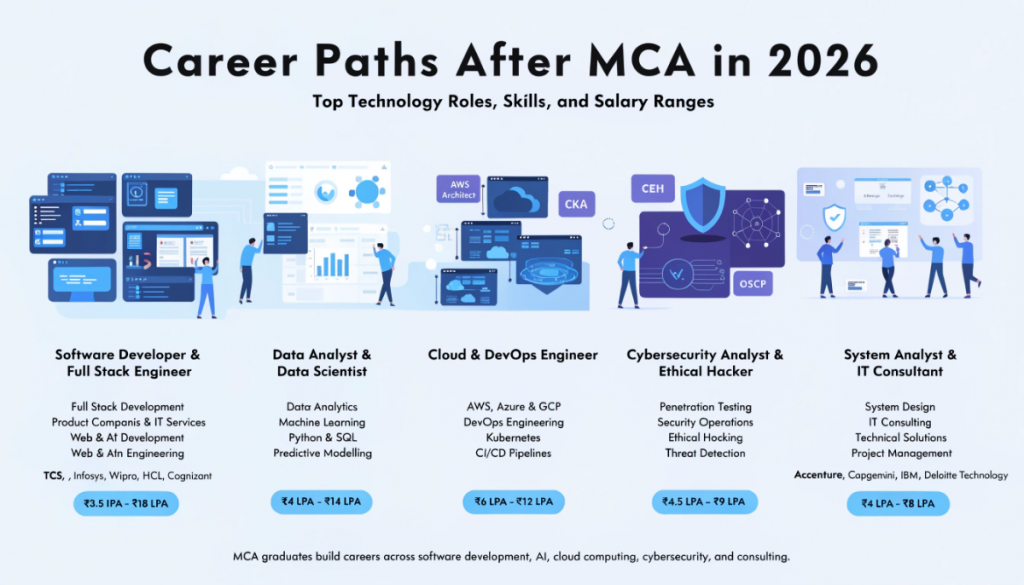
The MCA syllabus prepares graduates for multiple career tracks and the starting salary range in India in 2026 varies significantly depending on which track you target and which employer type you join.
Software Developer and Full Stack Engineer
Software development is the most common career path for MCA graduates in India. At IT services companies including TCS, Infosys, Wipro, HCL and Cognizant starting salaries for MCA graduates range from Rs 3.5 lakh to Rs 6.5 lakh per year.
At product companies including startups funded at Series A and above, the salary range jumps significantly to Rs 8 lakh to Rs 18 lakh for MCA graduates with strong programming skills and relevant project experience. The Full Stack specialisation track specifically prepares students for the higher-paying product company segment of this career path.
Data Analyst and Data Scientist
MCA graduates from Data Science and AI specialisation tracks are increasingly targeting analyst and data science roles at e-commerce companies, BFSI organisations and analytics consulting firms. Entry-level data analyst salaries for MCA graduates in India range from Rs 4 lakh to Rs 8 lakh per year at most organisations.
Data science roles at technology companies require stronger Python and machine learning skills and pay Rs 6 lakh to Rs 14 lakh at entry level. The AI and ML specialisation track specifically builds the technical foundation for data science roles when complemented by practical project experience and Python proficiency.
Cloud and DevOps Engineer
Cloud and DevOps roles are among the highest-paying positions available to fresh MCA graduates in India in 2026. Entry-level cloud engineer salaries at global technology companies, cloud service providers and IT services firms with strong cloud practices range from Rs 6 lakh to Rs 12 lakh per year. AWS, Azure or GCP certifications alongside the MCA syllabus in the Cloud and DevOps specialisation track significantly strengthen candidacy for these roles.
The Certified Kubernetes Administrator and AWS Solutions Architect Associate are the two certifications most frequently asked about in cloud and DevOps hiring processes for MCA graduates.
Cybersecurity Analyst and Ethical Hacker
Cybersecurity is one of the fastest growing job categories in India and MCA graduates from the Cybersecurity specialisation track are well positioned for security analyst, penetration tester and security operations centre roles.
Starting salaries in cybersecurity for MCA graduates range from Rs 4.5 lakh to Rs 9 lakh per year depending on the employer sector with BFSI, government technology and defence-adjacent employers paying above the general market average. The CEH, CompTIA Security+ and OSCP certifications are the most directly valued credentials for cybersecurity roles and each of them complements the programme security subjects effectively.
System Analyst and IT Consultant
System analyst and IT consultant roles involve understanding business requirements and translating them into technical solutions. These roles value the software engineering, systems design and project management content of the programme more than the advanced subjects.At consulting firms including Accenture, Capgemini, IBM and Deloitte Technology system analyst roles for MCA graduates start at Rs 4 lakh to Rs 8 lakh per year.
The combination of technical depth from the MCA syllabus and communication skills developed through group projects and presentations makes MCA graduates particularly well suited to consultant roles that sit between business stakeholders and engineering teams
Conclusion
The MCA syllabus in India in 2026 is a genuinely strong two-year postgraduate programme that covers the full breadth of computer science fundamentals in its first year and offers meaningful specialisation depth in AI, cloud computing, data science, cybersecurity and full stack development in its second year.The shift from three years to two years under NEP 2020 has made the programme more time-efficient without significantly compromising the technical depth that makes MCA graduates competitive in the Indian IT job market.
Choosing the right institution based on NIMCET rank, specialisation depth, project quality and placement record in your target role category is more important than the programme name alone. This degree works best when students go beyond the classroom by building projects, earning cloud or security certifications and developing strong programming skills in Python or JavaScript during the programme rather than waiting until placement season to address technical gaps.

Book Your
Free Session
Connect with our experts and get personalised guidance for your career, course selection, and future goals.

📖 Sources & References
✓ Verified 2026Verified MCA syllabus structure, specialisations, certifications and technology career insights across India based on 2026 academic and industry standards.
- Shoolini Online MCA Online MCA curriculum, specialisation structure and industry-focused learning pathways
- UGC NEP 2020 Guidelines Updated MCA duration framework and higher education reforms under NEP 2020
- NIMCET Official Portal National entrance examination details for MCA admissions across NITs
- AWS Training and Certification Cloud computing certifications and learning paths for DevOps and cloud engineering
- Microsoft Learn Azure Azure cloud infrastructure, DevOps and data engineering training resources
- Google Cloud Training Cloud analytics, Kubernetes and machine learning learning tracks
- TensorFlow Documentation Deep learning framework documentation widely used in AI and ML MCA specialisations
- Kubernetes Documentation Container orchestration and cloud-native deployment concepts for DevOps roles
- CompTIA Security+ Cybersecurity certification covering network security, risk management and security operations
- EC-Council CEH Certified Ethical Hacker programme focused on penetration testing and cybersecurity practices