

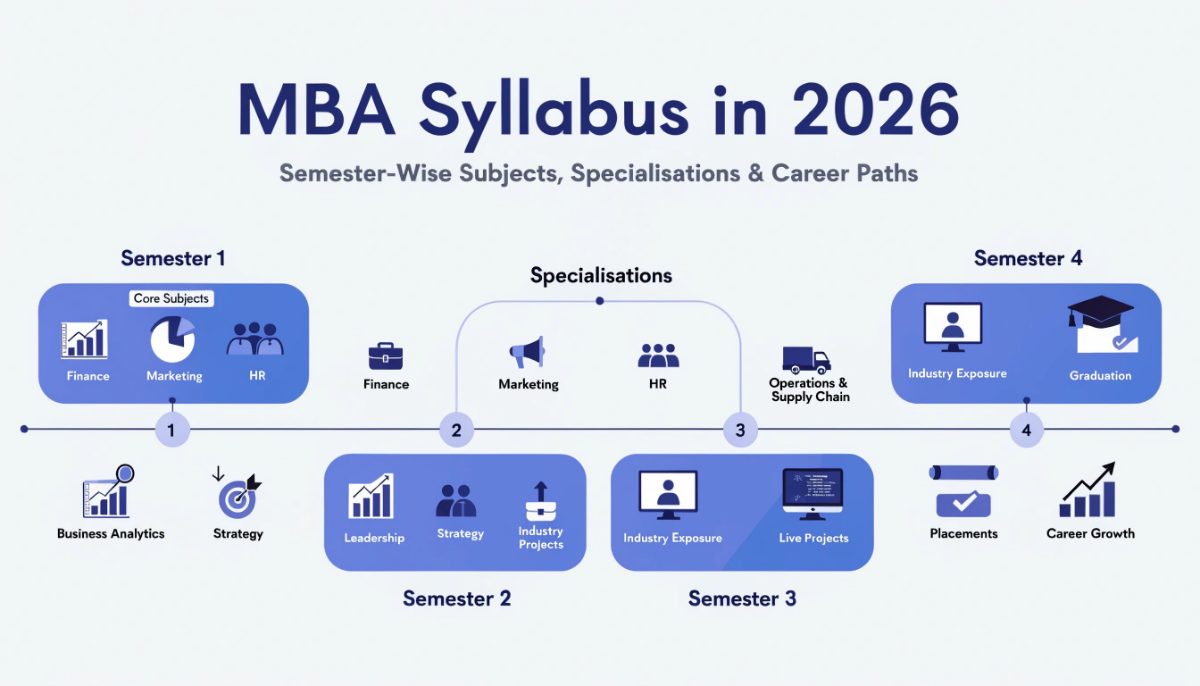
The MBA syllabus in India covers a two-year postgraduate programme divided across four semesters and it is one of the most searched topics among students preparing for CAT, XAT and GMAT. Knowing the MBA syllabus before you apply helps you understand what subjects you will study, which specialisation suits your career goals and how the curriculum at one institution compares to another.
The first year of the MBA syllabus is largely standard across top Indian B-schools including the IIMs, XLRI, SPJIMR and ISB while the second year shifts into specialisation-specific electives that differ significantly between institutions. This guide covers the complete MBA syllabus semester by semester, breaks down the four major specialisations and tells you exactly what to evaluate when comparing programmes in 2026.
The Core Structure Behind Every MBA Programme in India
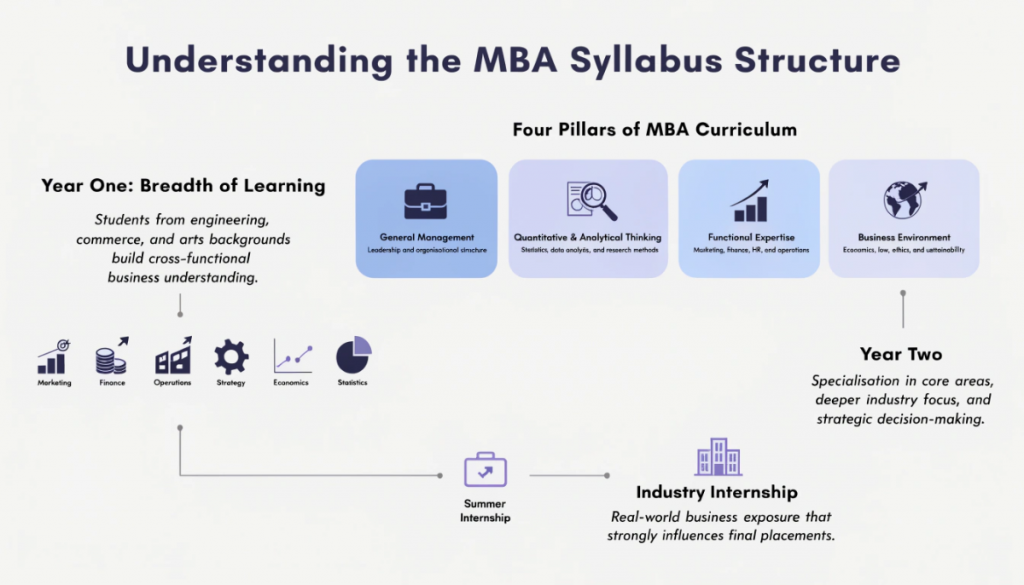
Before diving into individual subjects it helps to understand the logic behind how the MBA syllabus is organised. The two-year programme is intentionally designed to give students breadth in year one and depth in year two. Most students entering an MBA come from one background whether that is engineering, commerce or arts and the first-year MBA syllabus ensures that by the end of it everyone can hold a conversation about marketing, finance, operations and strategy regardless of where they started.
The MBA syllabus across Indian B-schools is typically built around four pillars. First is general management covering how organisations are led and structured. Second is quantitative and analytical thinking covering statistics, data analysis and research methods. Third is functional expertise across the four major business functions. Fourth is business environment knowledge covering economics, law, ethics and sustainability. These four pillars run through the entire MBA syllabus and the subjects in each semester reflect a mix of all four rather than covering one pillar at a time.
The summer internship between year one and year two is not a classroom subject but it is one of the most important components of the entire MBA syllabus structure. It gives students real industry exposure between the two academic years and the internship performance directly influences final placement outcomes at most top institutions.
Year One Subjects: What the MBA Syllabus Covers in Semester One and Two
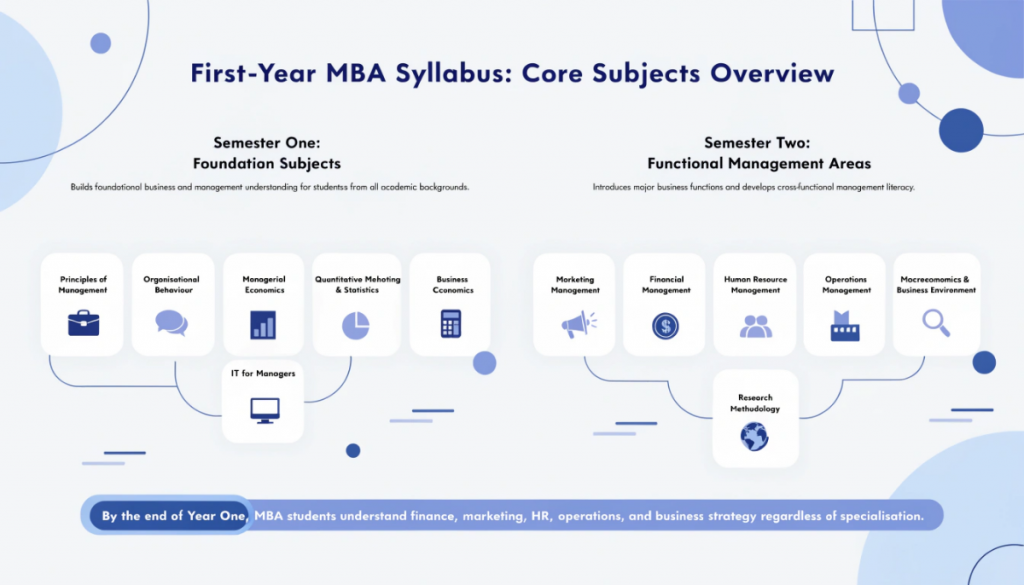
The first year is almost entirely compulsory core subjects. These are non-negotiable regardless of which specialisation you plan to pursue. Here is the full subject breakdown.
Semester One
Semester one introduces the foundational subjects that every management student needs regardless of their background. The MBA syllabus in semester one typically includes:
Principles of Management: Management theories, planning, organising, directing, controlling and the evolution of modern management thinking
Organisational Behaviour: Individual and group dynamics, motivation theories, leadership styles, conflict resolution and organisational culture
Managerial Economics: Demand and supply analysis, market structures, pricing strategy, cost curves and economic decision-making for managers
Financial Accounting and Analysis: Accounting principles, financial statements, balance sheet interpretation, ratio analysis and cash flow statements
Quantitative Methods and Statistics: Probability, descriptive and inferential statistics, hypothesis testing, regression and decision-making under uncertainty
Business Communication: Formal writing, email and report skills, presentation techniques, case discussion method and group communication
IT for Managers: ERP systems, business intelligence tools, digital platforms and the role of information technology in management decisions
Semester Two
Semester two builds on the foundation of semester one and introduces all four major functional areas of management:
Marketing Management: STP framework, the marketing mix, consumer behaviour, brand management, product lifecycle and competitive positioning
Financial Management: Capital budgeting, cost of capital, working capital management, financial leverage, risk and dividend policy
Human Resource Management: Recruitment and selection, training and development, performance appraisal systems, compensation design and employee relations
Operations Management: Process design, capacity planning, quality management frameworks, supply chain basics and production scheduling
Business Law and Ethics: Contract law, company law, intellectual property rights, corporate governance and business ethics frameworks
Macroeconomics and Business Environment: GDP, inflation, fiscal and monetary policy, international trade, balance of payments and macro impact on business
Research Methodology: Research design, questionnaire development, sampling methods, data collection and applying research to business problems
By the end of year one every student has covered all the major functional areas. A student going into Finance will understand marketing well enough to collaborate across functions and a student going into HR will be able to read a financial statement. This cross-functional literacy is the core purpose of the compulsory first year at every serious Indian B-school.
Year Two: Electives, Specialisations and Live Projects
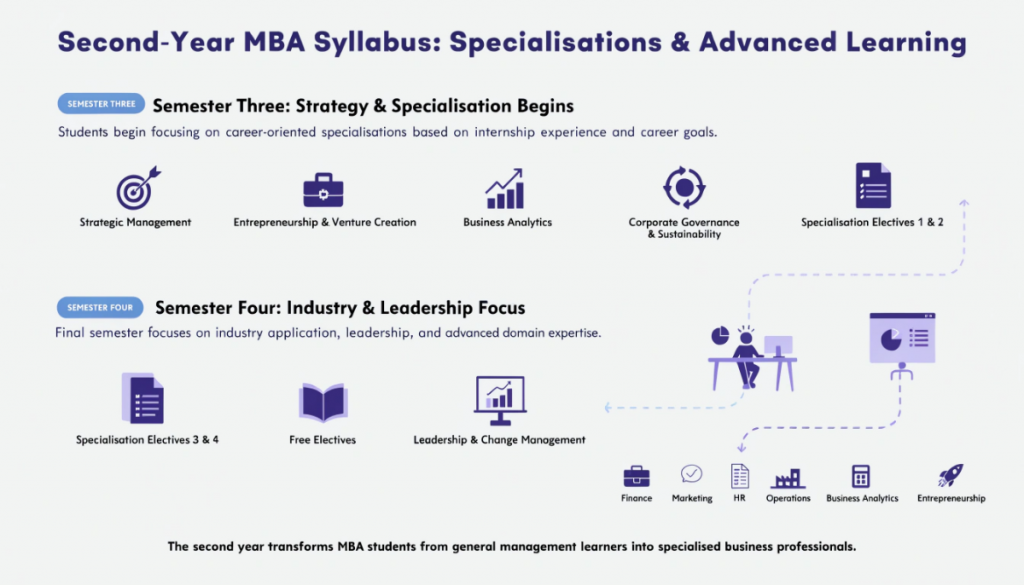
The second year is where the programme becomes genuinely differentiated between students. Specialisation choices are typically made at the end of year one based on summer internship experience, career goals and subject interest. It splits between a small number of continuing core subjects and a larger block of specialisation electives.
Semester Three
Semester three combines a few final compulsory subjects with the first set of specialisation electives:
Strategic Management: Competitive strategy, Porter’s Five Forces, SWOT analysis, corporate strategy, business model innovation and strategic planning
Entrepreneurship and Venture Creation: Startup ecosystems, ideation frameworks, business model canvas, funding stages and scaling a new business
Business Analytics: Data-driven decision-making, Excel and Power BI or Tableau for analysis, introduction to Python or R, and communicating insights to non-technical audiences
Corporate Governance and Sustainability: ESG frameworks, CSR under the Companies Act 2013, sustainability reporting standards and responsible business practice
Specialisation Electives 1 and 2: Advanced subjects specific to your chosen specialisation track
Semester Four
The final semester is the most specialisation-intensive and the most practice-oriented part of the entire programme:
Specialisation Electives 3 and 4: Further advanced subjects within the chosen track
Free Electives: One or two subjects chosen from outside the main specialisation based on individual interest
Industry Project or Dissertation: A live consulting project with a real organisation or a research dissertation on a business problem
Leadership and Change Management: Leading organisational change, transformation models, executive decision-making and building high-performance teams
The Four Specialisations: Subjects, Career Outcomes and Key Differences
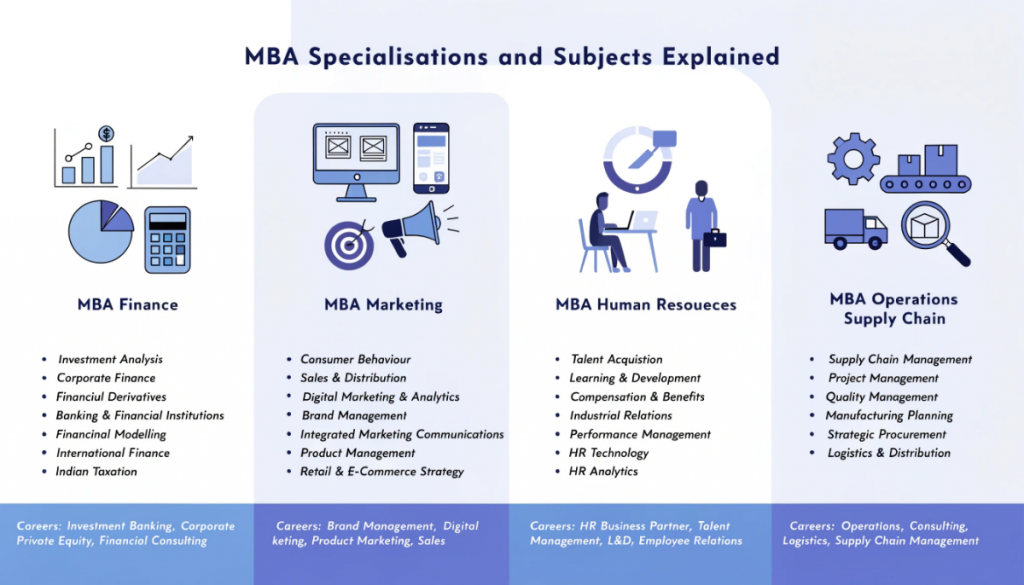
The specialisation you pick inside the MBA syllabus defines your second-year subjects, internship opportunities and the roles you target after graduation. Here is what each of the four major tracks actually covers.
MBA Finance Specialisation
The Finance specialisation is the most popular track across most Indian B-schools and the MBA syllabus for Finance is the most quantitative of all the specialisations. Core subjects in the Finance track include:
Investment Analysis and Portfolio Management: Equity valuation, DCF models, fixed income securities, portfolio theory, risk-return analysis and capital markets
Corporate Finance and Valuation: Capital structure decisions, M&A transaction analysis, LBO modelling and the IPO process in India
Financial Derivatives and Risk Management: Options pricing, futures contracts, interest rate swaps and using derivatives for corporate hedging
Banking and Financial Institutions: Commercial banking operations, credit analysis, RBI regulations and monetary policy transmission
Financial Modelling: Building integrated three-statement models, sensitivity and scenario analysis and financial projections in Excel
International Finance: Foreign exchange markets, currency risk management, international capital flows and cross-border deal structures
Indian Taxation: GST framework, direct tax provisions, transfer pricing and corporate tax planning strategies
Finance specialisation MBA graduates typically target investment banking, corporate finance, private equity, financial consulting and treasury roles. The CFA qualification is commonly pursued alongside or after the Finance MBA syllabus by those targeting asset management and investment research careers.
MBA Marketing Specialisation
The Marketing specialisation MBA syllabus covers both strategy and execution across traditional and digital channels. Core subjects include:
Consumer Behaviour and Market Research: Psychological and social drivers of purchase decisions, qualitative research, surveys, focus groups and insight generation
Sales Force Management and Distribution: Territory planning, sales team design, dealer and channel management and key account management
Digital Marketing and Analytics: SEO, paid search, social media strategy, content marketing, email campaigns and web analytics using Google Analytics
Brand Management: Brand equity measurement, architecture, extensions, revitalisation strategies and managing a brand portfolio
Integrated Marketing Communications: Media planning, advertising strategy, ATL and BTL channels, PR and measuring campaign effectiveness
Product Management and Pricing: New product development, pricing psychology, competitive pricing frameworks and go-to-market planning
Retail and E-Commerce Strategy: Omnichannel models, D2C brand building, marketplace dynamics and customer experience design
MBA Human Resources Specialisation
The HR specialisation MBA syllabus is one of the most respected tracks in India particularly at XLRI, TISS, MDI and SIBM. Core subjects include:
Talent Acquisition and Workforce Planning: Strategic recruitment, employer branding, psychometric tools and manpower forecasting
Learning and Development: Training needs analysis, instructional design, leadership development and coaching methodologies
Compensation and Benefits Management: Job evaluation, salary band architecture, ESOPs, incentive design and total rewards benchmarking
Industrial Relations and Labour Law: Trade union dynamics, collective bargaining, the four new labour codes of 2020 and grievance handling
Performance Management: OKRs, balanced scorecard, continuous feedback systems, forced ranking debates and managing underperformance
Organisational Development and HR Technology: Culture transformation, restructuring, HRMS platforms, people analytics tools and digital HR strategy
HR Analytics: Attrition modelling, engagement data analysis, diversity and inclusion metrics and workforce planning
dashboardsMBA Operations and Supply Chain Specialisation
The Operations specialisation MBA syllabus is quantitative and directly relevant to manufacturing, logistics, consulting and e-commerce careers. Core subjects include:
Supply Chain Management: Network design, demand planning, inventory optimisation, supplier evaluation and global sourcing strategy
Project Management: WBS, critical path method, Gantt charts, risk identification and project management tools including MS Project
Quality Management: Six Sigma DMAIC, Total Quality Management, ISO 9001 and lean manufacturing principles
Manufacturing and Production Planning: MRP and ERP systems, capacity planning, plant layout and production scheduling
Strategic Procurement: Category management, contract negotiation, vendor development and procurement analytics
Logistics and Distribution Management: Warehouse operations, transportation management systems, 3PL partnerships and reverse logistics
How the Curriculum Differs Across Top Indian MBA Colleges
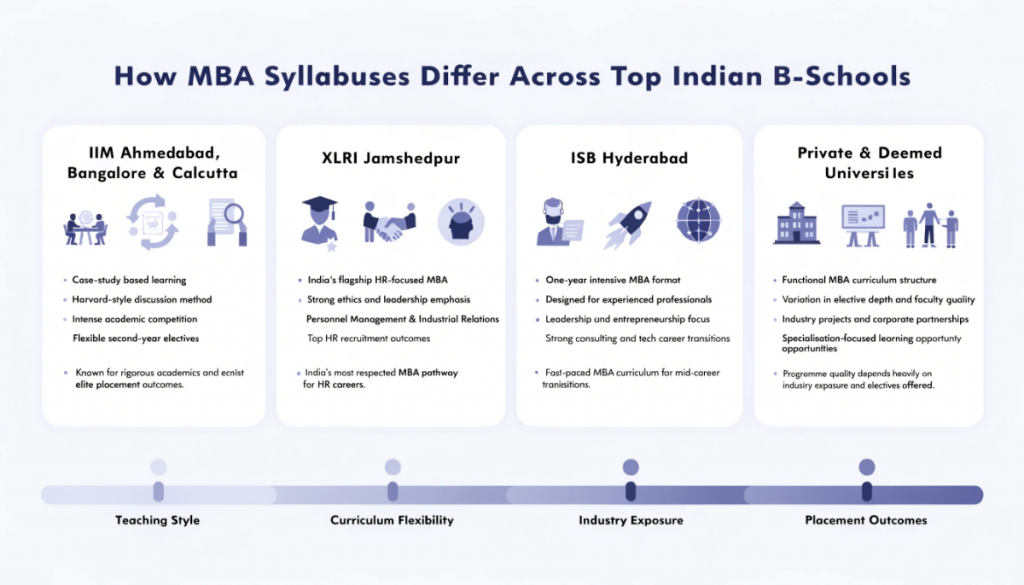
The MBA syllabus on paper looks similar across institutions but the actual depth, pedagogy and career outcomes differ significantly. Here is how the major categories of Indian B-schools differ in practice.
IIM Ahmedabad, Bangalore and Calcutta
The top three IIMs teach primarily through the case discussion method modelled on Harvard Business School. Every session is driven by an 80-page real business case that students analyse and debate in class. Year one is academically intense with relative grading meaning competition within the cohort is constant. Year two offers broad elective freedom including cross-specialisation subjects. Placement outcomes include average packages consistently above Rs 30 lakh with international placements available across consulting, banking and technology.
XLRI Jamshedpur
XLRI runs two flagship programmes. The Business Management programme follows a general MBA syllabus while the Personnel Management and Industrial Relations programme is the most respected HR-focused MBA syllabus in India. XLRI places strong emphasis on ethics, leadership and the human dimension of management throughout its curriculum. The XLRI HR programme is the first choice for students specifically targeting HR careers at top FMCG, consulting and financial services firms.
ISB Hyderabad
ISB offers a one-year Post Graduate Programme that compresses the full MBA syllabus into terms rather than semesters. The programme is designed for candidates with an average of five to eight years of work experience and assumes more real-world context than standard two-year programmes. ISB’s curriculum emphasises leadership, global business and entrepreneurship and its GMAT-based admissions attract candidates targeting consulting, technology leadership and international career transitions.
Private and Deemed Universities
Institutions including NMIMS, Symbiosis, Christ University and Amity offer AICTE-approved MBA programmes with syllabuses structured around the same core functional areas as the IIMs. The elective depth, faculty quality and industry interface vary widely. When evaluating these programmes check specifically how many electives were actually offered in the last two years within your intended specialisation and whether the institution has active corporate partnerships that bring real industry projects into the MBA syllabus structure.
Five Things Worth Checking Before You Choose a Programme
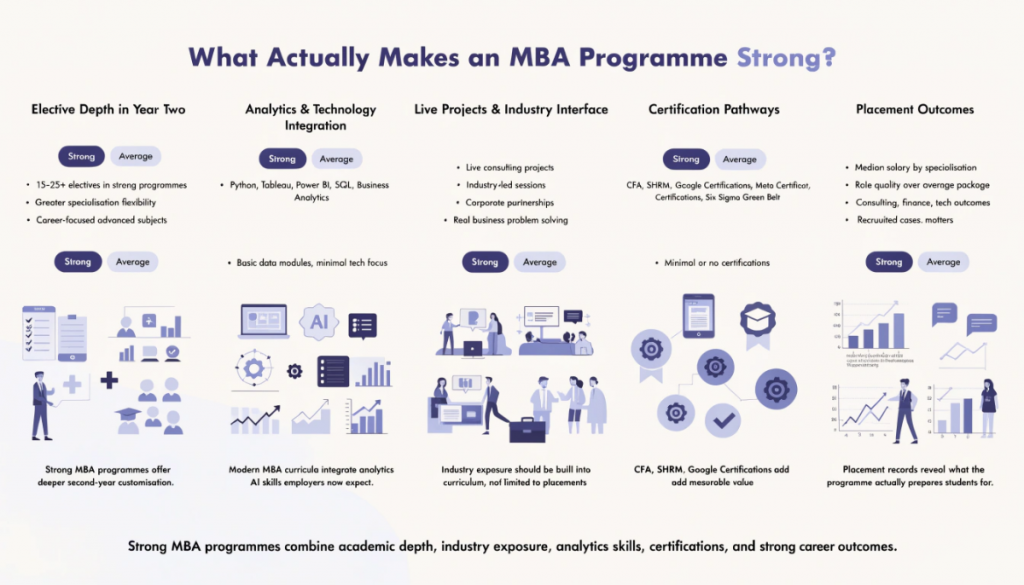
Most MBA brochures look identical. Here is what actually separates a strong programme from an average one when you look past the marketing material.
Elective Depth in the Second Year
A strong MBA syllabus at a top institution offers 15 to 25 or more electives within a single specialisation in year two. A weaker programme offers 4 to 6 which means the second year is effectively a continuation of year one. Ask admissions teams specifically how many electives were actually offered in your intended specialisation in the last two academic years rather than what appears in the prospectus because some listed electives are never run due to insufficient enrolment.
Analytics and Technology Integration
Any MBA syllabus in 2026 that does not include Business Analytics, data visualisation tools and at minimum an introduction to AI or automation in its core curriculum is behind what employers expect. Look specifically for whether Python, Tableau, Power BI or SQL appear in the elective offerings and whether there is a dedicated analytics subject in the compulsory core rather than just a basic statistics course from semester one.
Live Projects and Industry Interface
The best programmes in India build live consulting projects and practitioner-led sessions directly into the curriculum rather than treating them as optional extras. SPJIMR’s DSMP programme, IIM Bangalore’s consulting projects and XLRI’s annual HR conferences are examples of how strong institutions make industry engagement a formal part of the curriculum. If a programme’s only industry exposure comes during placement season you are getting a significantly thinner learning experience than the brochure implies.
Certification Pathways Built Into the Programme
Some top B-schools now formally integrate professional certifications into the MBA syllabus. Finance students pursuing CFA, HR students working toward SHRM certification, Marketing students earning Google or Meta certifications and Operations students completing Six Sigma Green Belt are all examples of structured dual-qualification pathways. If a programme has formal relationships with these certification bodies and builds preparation into the academic calendar it adds measurable credential value on top of the MBA itself.
Placement Record by Specialisation
Overall average placement packages are often misleading because they are pulled up by a small number of very high offers. Ask for the median placement figure by specialisation and by company type.
A Finance MBA syllabus that consistently places students at Goldman Sachs and McKinsey is delivering a very different outcome than one that places primarily at domestic corporate finance teams. The placement record is the most honest signal of what the programme actually prepares graduates for in practice.
Conclusion
The MBA syllabus in India in 2026 is a well-designed two-year curriculum that builds general management capability in the first year and specialisation depth in the second. The core subjects across Semester 1 and 2 cover accounting, finance, marketing, HR, operations, economics and strategy giving every MBA graduate a cross-functional foundation.The second-year MBA syllabus is where specialisation choice matters most because Finance, Marketing, HR and Operations each prepare graduates for fundamentally different career tracks.
When choosing a programme look beyond the core MBA syllabus and evaluate elective depth, analytics integration, live project quality, certification pathways and placement outcomes by specialisation. The strongest MBA syllabus is not the one with the most impressive brochure but the one that is actively delivered through rigorous teaching, genuine industry exposure and a placement outcome that reflects what the curriculum actually prepares you for.

Book Your
Free Session
Connect with our experts and get personalised guidance for your career, course selection, and future goals.
📖 Sources & References
✓ Verified 2026Verified MBA syllabus structure, specialisation curriculum and Indian B-school programme insights based on 2026 academic frameworks and management education sources.
- Shoolini Online MBA Online MBA curriculum structure, specialisations and industry-oriented learning model
- IIM Ahmedabad PGP Curriculum Core MBA curriculum structure, case method pedagogy and elective framework
- IIM Bangalore MBA Programme Semester-wise management subjects, analytics integration and live project structure
- XLRI Jamshedpur Business Management and HRM syllabus structure with ethics-focused curriculum
- ISB Hyderabad PGP One-year MBA-equivalent curriculum designed for experienced professionals
- AICTE MBA Model Curriculum Standard MBA subject framework followed across Indian management institutions
- SPJIMR PGDM Programme Industry-linked curriculum model with specialisation-focused experiential learning
- NMIMS MBA Programme Elective offerings, business analytics integration and corporate exposure model
- CFA Institute Finance specialisation certification pathway and investment management curriculum alignment
- SHRM Certification Professional HR certification pathways commonly pursued alongside MBA HR programmes
