

Almost every prediction problem that deals with numbers instead of categories comes back to regression in machine learning at some point. Whether it is estimating house prices, forecasting sales or predicting how long a delivery will take, regression is usually the technique working quietly in the background.
This blog breaks down what regression in machine learning actually means, the most widely used algorithms under this category, how to pick the right one for a given problem and the mistakes beginners commonly make along the way. By the end you should have a clear practical picture, not just textbook definitions copied from a course syllabus.
What Is Regression in Machine Learning
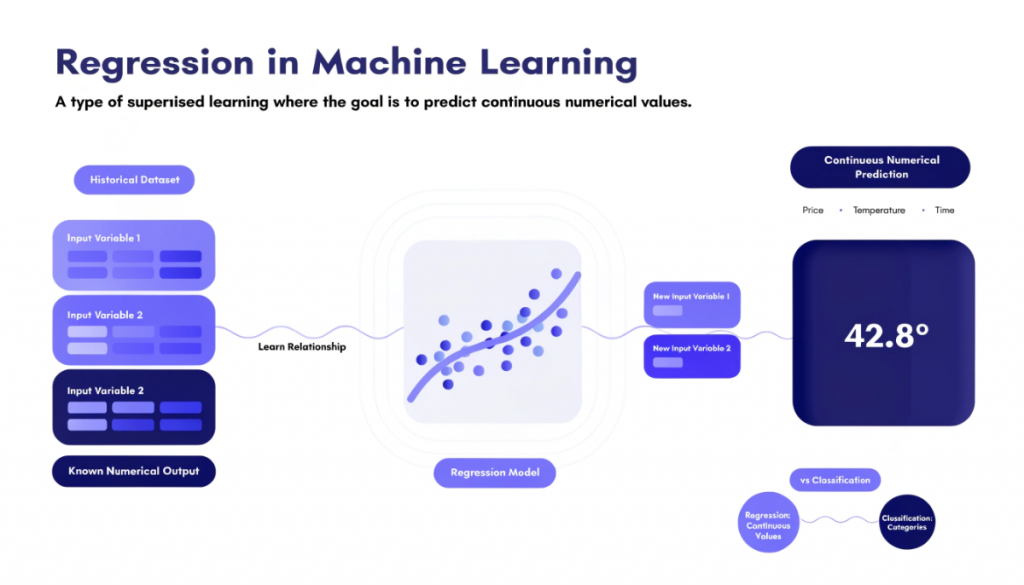
Regression in machine learning is a type of supervised learning used to predict a continuous numerical output based on one or more input variables. Unlike classification, which sorts data into categories like spam or not spam, regression deals with values that can fall anywhere on a scale, like price, temperature or time.
This distinction matters more than it seems at first glance. Choosing regression when your problem actually calls for classification, or the other way around, leads to a model that technically runs fine but never gives you results that make sense for the question you are actually trying to answer.
The core idea is fairly simple. You feed the model historical data where you already know both the inputs and the actual output, and the model learns the relationship between them well enough to predict the output for new, unseen inputs. The strength of that relationship, and how well the model captures it, is what separates a genuinely useful model from a weak one that just looks fine on paper.
Popular Regression Algorithms in Machine Learning Explained
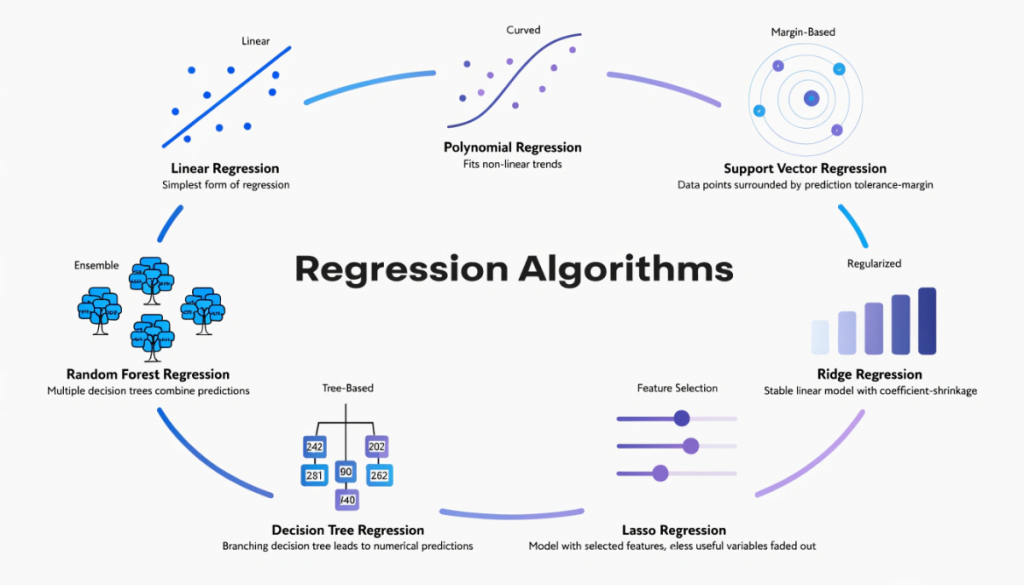
There is no single best algorithm for every problem, which is exactly why so many different regression algorithms exist. Each one makes different assumptions about the data and works better in specific situations.
Linear Regression
This is the simplest and most widely used starting point among regression algorithms in machine learning. It assumes a straight line relationship between the input and output, represented by an equation where the output equals a slope multiplied by the input plus an intercept.
Despite being the oldest technique in this list, linear regression remains popular because it is easy to explain to non technical stakeholders, which matters a lot in business settings where a model’s predictions need to be trusted and understood, not just accurate.
Linear regression works well when the relationship between variables is genuinely close to a straight line, like predicting salary based on years of experience. It struggles the moment the real relationship curves or bends, which is where other algorithms take over.
This is one of the top choices among popular regression algorithms in machine learning when a business needs a model that can be explained clearly to people without a technical background, which happens more often than most beginners expect.
Polynomial Regression
When a straight line clearly does not fit the data well, polynomial regression extends the same basic idea by fitting a curve instead. It models the relationship as a polynomial equation, which can bend and flex to match more complex, curved patterns present in the underlying data.
The tricky part with polynomial regression is choosing the right degree for the curve. Too low and the model underfits, too high and it starts memorizing noise in the training data instead of learning a genuine pattern, which hurts its performance on new data.
Ridge Regression
Ridge regression is a variation of linear regression built specifically to handle situations where input variables are highly correlated with each other, a problem known as multicollinearity. It adds a penalty term that shrinks the model’s coefficients, which reduces overfitting and makes the model considerably more stable on new data.
This algorithm is particularly useful when you have a large number of input variables and suspect that a plain linear regression model might be fitting the training data too closely without generalizing well.
Lasso Regression
Lasso regression works similarly to ridge regression but with one key difference, it can shrink some coefficients all the way down to zero. This effectively removes less useful input variables from the model automatically, which makes lasso regression a genuinely useful tool for feature selection as well as prediction.
This makes it a strong choice when you are working with a dataset that has many input variables and you suspect several of them do not actually contribute much to predicting the output.
Decision Tree Regression
Instead of fitting a mathematical equation, decision tree regression splits the data into branches based on feature values, eventually predicting an output based on which branch a new data point falls into. It handles non linear relationships naturally without needing you to specify a curve shape in advance, which is a genuine advantage over linear and polynomial approaches.
The downside is that a single decision tree can overfit easily, especially with noisy data, since it can keep splitting until it essentially memorizes the training set completely. This is usually managed by limiting tree depth or combining multiple trees together.
Random Forest Regression
Random forest regression builds on decision trees by training many trees on different random subsets of the data and then averaging their predictions. This combination usually performs better and generalizes more reliably than any single decision tree on its own.
The tradeoff is interpretability. A single decision tree is easy to visualize and explain, while a random forest made up of hundreds of trees becomes much harder to interpret directly, even though its predictions are usually more reliable.
It is one of the more popular regression algorithms in machine learning for real world use because it handles non linear relationships well, resists overfitting better than a single decision tree and requires relatively little manual tuning to get reasonable results.
Support Vector Regression
Support vector regression adapts the logic behind support vector machines to predict continuous values instead of categories. It tries to fit a function within a certain margin of tolerance around the actual data points rather than fitting every single data point exactly.
This algorithm tends to perform well on smaller, cleaner datasets and can handle non linear relationships effectively when paired with the right kernel function, though it can become computationally expensive and slow on very large datasets.
How to Choose the Right Regression Algorithm
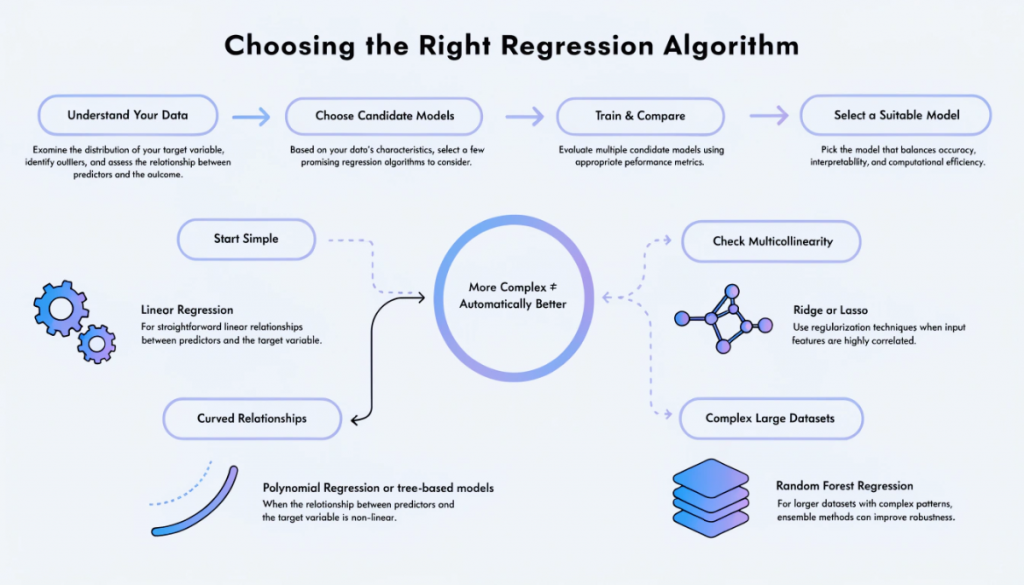
With so many regression algorithms in machine learning available, picking the right one usually comes down to a few practical considerations rather than always reaching for the most advanced option.
It also helps to remember that the best performing model on paper is not always the best choice in practice, especially if a simpler, more interpretable model gets you nearly the same accuracy with far less complexity to maintain later.
- Start simple with linear regression first, since it is fast, easy to interpret and often good enough for problems with a genuinely linear relationship.
- Check for multicollinearity among your input variables, and lean toward ridge or lasso regression if several features are highly correlated with each other.
- If the relationship between variables looks curved rather than straight when plotted, consider polynomial regression or a tree based model instead of forcing a linear fit.
- For larger datasets with complex, non linear patterns, random forest regression is often a reliable default that balances accuracy and ease of use.
- Always compare a few candidate models using proper evaluation metrics rather than assuming the more complex algorithm automatically performs better.
Common Mistakes While Using Regression in Machine Learning
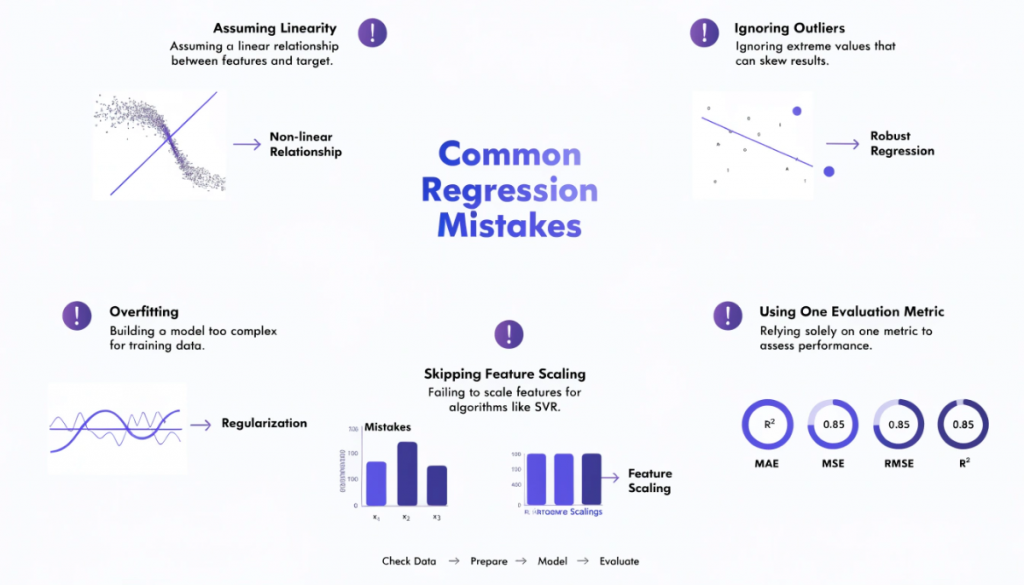
Even experienced practitioners run into avoidable problems when applying regression in machine learning. Watching out for these can save a lot of wasted effort.
Most of these mistakes are not about a lack of technical knowledge, they usually happen because of rushing through the data exploration stage to get to modelling faster, which almost always costs more time later in debugging strange results.
- Assuming a linear relationship without actually checking the data first, which leads to a poorly fitting model that looks reasonable on the surface but performs badly in practice.
- Ignoring outliers, which can heavily distort the fitted line or curve in several regression algorithms, especially plain linear regression.
- Overfitting the model by using too many features or too complex an algorithm relative to the size of the dataset available.
- Not scaling input variables before using algorithms like support vector regression, which are sensitive to the range and scale of the input data.
- Relying only on one evaluation metric, when looking at a combination of metrics usually gives a more honest picture of how well a model is actually performing.
Real World Applications of Regression in Machine Learning
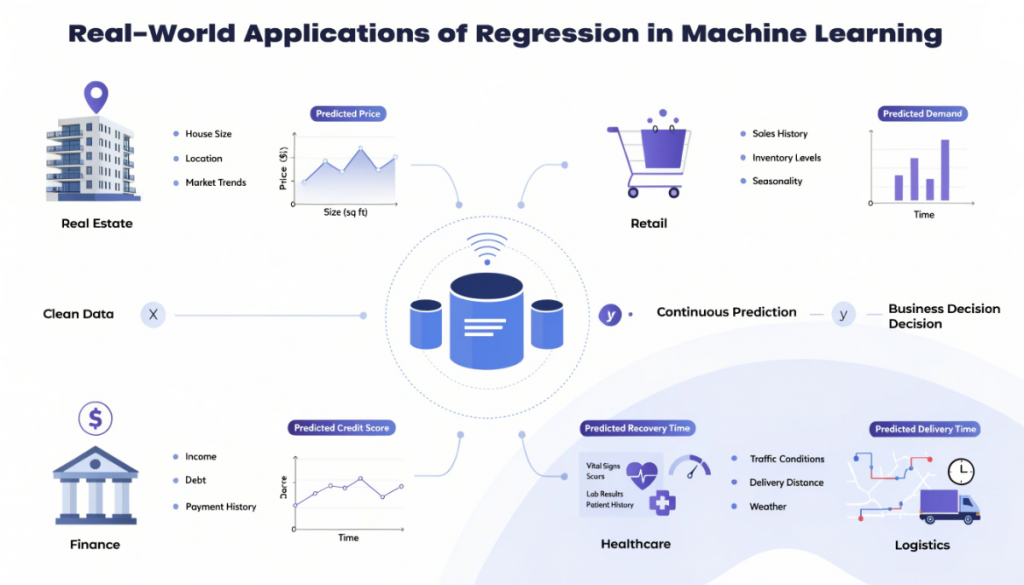
Regression in machine learning shows up across nearly every industry once you start looking for it, quietly powering predictions that businesses depend on daily.
What makes these applications work well in practice is rarely a single perfect algorithm, it is usually a combination of clean data, a thoughtful choice of features and continuous monitoring to catch when a model’s predictions start drifting away from reality over time.
- Real estate platforms use regression to estimate property prices based on location, size and other features.
- Retailers use regression models to forecast demand and plan inventory levels ahead of seasonal spikes.
- Financial institutions use regression to predict credit risk scores and estimate loan default probabilities.
- Healthcare providers use regression models to predict patient recovery time or estimate risk scores based on health indicators.
- Logistics companies use regression to estimate delivery times based on distance, traffic patterns and past performance data.
How to Build a Career Working With Regression in Machine Learning
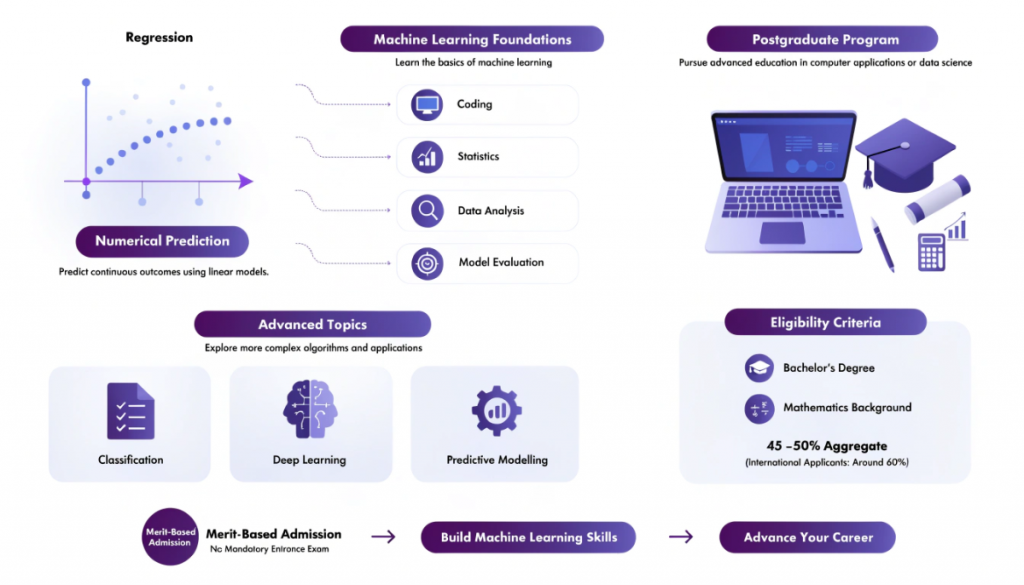
If working with predictive models and data genuinely interests you, machine learning offers a fairly clear career path, and regression is usually one of the first serious techniques anyone learns on that path. Understanding regression well gives you a strong base before moving into more advanced techniques like classification and deep learning, since many of the same underlying concepts around error, fitting and evaluation carry forward directly.
A postgraduate degree focused on computer applications or data science is a common route for students who want structured training in these concepts rather than piecing everything together from scattered online tutorials. Such programs typically combine programming, statistics and machine learning fundamentals in a sequence that builds up properly instead of jumping straight into advanced algorithms without the underlying groundwork.
If you are considering an online postgraduate program in computer applications, most recognized online programs in India follow a fairly similar eligibility pattern.
- A bachelor’s degree of at least three years duration from a recognized university, generally with mathematics as a subject at some stage of education.
- A minimum aggregate as specified by the university in the qualifying degree, which most programs set around 45 to 50%.
- International applicants are generally asked for a slightly higher aggregate, often around 60% in their qualifying examination.
- Reservation of seats as per applicable government policy, which most universities follow for both online and on campus programs.
Since most online postgraduate programs admit students on merit rather than a mandatory entrance exam, this route works well for working professionals who want to formalize their machine learning skills without pausing their career for a full time program on campus.
Conclusion
Regression in machine learning is not just one technique, it is a whole family of algorithms, each suited to slightly different kinds of data and relationships. Starting with linear regression to understand the basics and gradually exploring more advanced options like random forest or support vector regression gives you a practical toolkit rather than a single hammer for every problem.
Whichever algorithm you end up using, the fundamentals stay the same, understand your data first, choose the simplest model that fits it well and always validate your results before trusting the predictions in any real decision making process.

Book Your
Free Session
Connect with our experts and get personalised guidance for your career, course selection, and future goals.
📖 Sources & References
✓ Verified 2026Verified machine learning concepts, regression algorithms, model evaluation, predictive analytics, AI risk management and higher education information based on authoritative sources.
- IBM – Machine Learning Algorithms Overview of supervised learning, regression, linear regression, decision trees, random forests and other machine learning algorithms
- IBM – Classification vs Regression Explanation of the difference between regression and classification and how regression predicts continuous numerical values
- IBM – Model Selection in Machine Learning Guidance on choosing candidate machine learning models, evaluation metrics, training, testing and model comparison
- IBM – Machine Learning Foundational information on machine learning, supervised learning, regression, model training and generalisation
- scikit-learn – User Guide Technical documentation covering linear regression, ridge, lasso, polynomial regression, support vector regression and related machine learning methods
- NIST – AI Risk Management Framework Official framework covering trustworthy AI design, development, use and evaluation across the AI lifecycle
- World Economic Forum – Future of Jobs Report 2025 Research on technology-driven workforce transformation, emerging skills and changing job requirements through 2030
- UGC – Regulations Official higher education regulations and standards relevant to undergraduate and postgraduate degree programmes in India
- UGC – University Regulations Official regulations covering online programmes, Open and Distance Learning and minimum standards for higher education institutions
- Shoolini Online Official information on online postgraduate education and programmes relevant to computer applications, data science and technology careers