

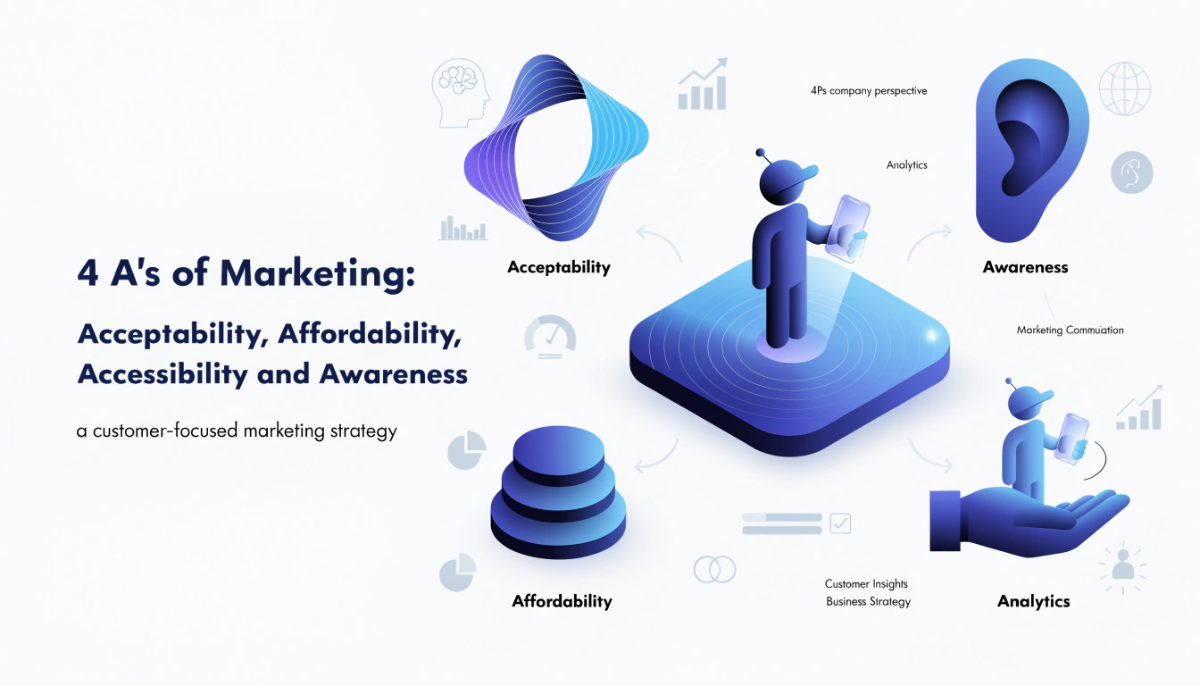
Most people learn the 4Ps of marketing first, product, price, place and promotion, since it is the framework taught in almost every business classroom. But the 4Ps look at marketing from the company’s side of the table, not the customer’s.
The 4 A’s of marketing flip that view around and ask what a customer actually needs to accept, afford, access and know about a product before they ever buy it. In this blog we will break down each of the 4 A’s of marketing in detail, how the framework differs from the traditional 4Ps and how businesses can actually use it to build a genuinely stronger strategy from the ground up.
What Are the 4 A’s of Marketing
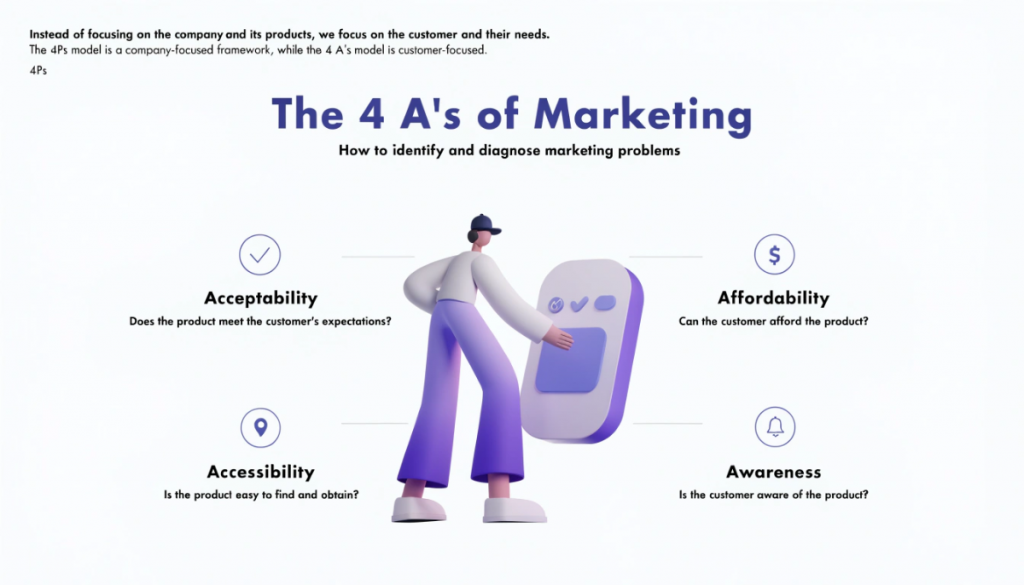
The 4 A’s of marketing is a customer focused framework developed by marketing scholars Jagdish Sheth and Rajendra Sisodia, built around four elements, acceptability, affordability, accessibility and awareness. While the 4Ps describe what a company controls, the 4 A’s describe what a customer actually experiences and weighs before making a purchase decision, which is a fundamentally different angle on the same overall problem.
The core idea behind the 4 A’s of marketing is that a product can tick every box on the company side, right price, right packaging, wide distribution, and still fail if it does not genuinely meet what the customer values. This framework forces businesses to think from the outside in rather than only from the inside out.
It also gives teams a shared, simple vocabulary for diagnosing problems. Instead of vaguely saying a campaign is not working, a team can pinpoint whether the issue sits with acceptability, affordability, accessibility or awareness, which makes the fix far more targeted.
Breaking Down Each of the 4 A’s of Marketing
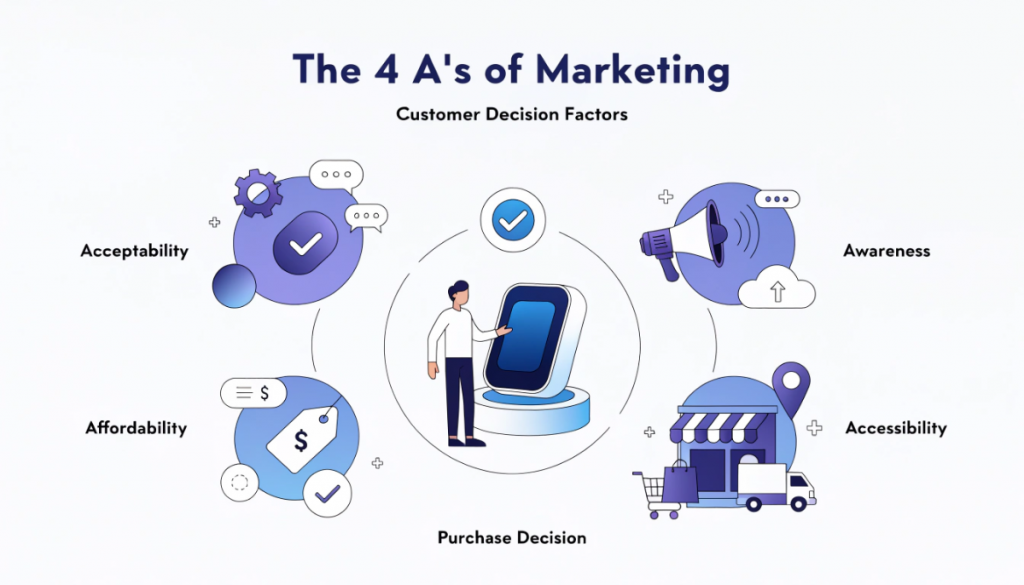
Each of the 4 A’s of marketing addresses a different question a customer is unconsciously asking before they commit to buying something. Understanding each one individually makes the framework far easier to apply in practice.
Acceptability
Acceptability looks at whether a product actually meets what the customer needs and expects, both practically and emotionally. It has two clear sides to it, functional acceptability and psychological acceptability.
Functional acceptability is about whether the product genuinely works well, meaning its quality, performance and usability hold up to what the customer expects. Psychological acceptability is more about perception, whether the product feels right in terms of how it looks, how it is branded and how it aligns with what the customer wants to be associated with. A product can be functionally excellent and still fail on the psychological side if it does not fit how the customer sees themselves.
Think of a fuel efficient car that performs perfectly on paper but still struggles to sell because customers associate its design with an older, less desirable image. That gap between functional and psychological acceptability is exactly what this part of the framework is designed to catch.
Affordability
Affordability covers whether a customer is both willing and financially able to pay for a product, which is a more layered idea than simply setting a low price. It also splits into two dimensions, economic affordability and psychological affordability.
Economic affordability is the straightforward part, whether the price actually fits within what the customer can realistically spend. Psychological affordability is about perceived value, whether the customer feels the price is fair given what they are getting in return. A product can be priced within budget and still feel expensive if the customer does not see enough value behind that price tag.
This is exactly why two products priced identically can perform completely differently in the market. One might feel like a fair deal because of how it is presented and positioned, while the other feels overpriced simply because the value story around it was never communicated clearly.
Accessibility
Accessibility is about how easily a customer can actually find, reach and obtain a product once they have decided they want it. This includes physical availability, whether the product is stocked where customers shop, as well as convenience, whether buying it takes minimal effort.
In the current retail environment, accessibility has expanded well beyond physical stores to include online availability, delivery speed and how easy the checkout process actually is. A product that is hard to find or inconvenient to buy loses customers regardless of how good it is once they finally get their hands on it.
Quick commerce platforms exist almost entirely because of this exact insight, customers consistently choose the more accessible option even when a cheaper or better alternative sits just a little further out of reach.
Awareness
Awareness measures how much a customer actually knows about a product or brand, both that it exists and what it specifically offers to them. This covers general brand recognition as well as deeper product knowledge, understanding features, benefits and how the product compares to alternatives.
A customer cannot accept, afford or access something they do not know exists in the first place, which is why awareness often acts as the starting point that puts the other three A’s into motion. Strong awareness built through consistent, honest communication also builds the trust that makes the other three factors easier to satisfy.
This is also why awareness is not just about reach. A campaign that gets seen by millions but leaves them confused about what the product actually does has technically built recognition without building genuine, useful awareness.
How the 4 A’s of Marketing Differ From the 4 Ps
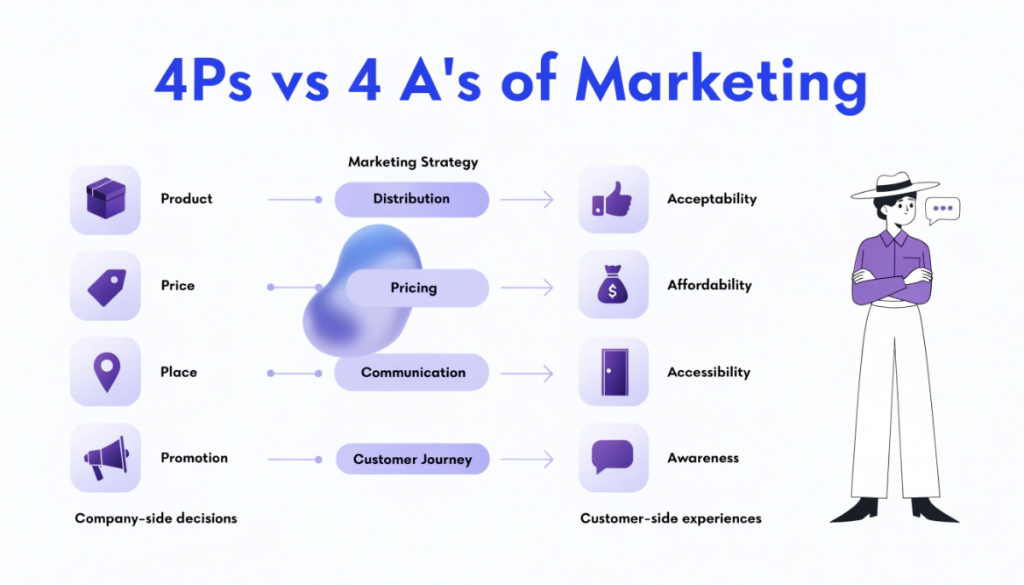
The 4Ps and the 4 A’s of marketing are not competing frameworks, they are complementary, looking at the same marketing decisions from two different angles.
Using both together gives a far more complete picture than relying on either one alone. The 4Ps help you plan what decisions to make, while the 4 A’s help you check whether those decisions actually land the way you intended once they reach a real customer.
- The 4Ps represent decisions a company makes, product, price, place and promotion, while the 4 A’s represent what the customer actually experiences as a result of those decisions.
- Price connects directly to affordability, but affordability goes further by including how the customer actually perceives that price, not just the raw number itself.
- Place connects to accessibility, but accessibility also covers convenience and ease of purchase for the customer, not just physical distribution reach.
- Promotion connects to awareness, but awareness is really about what actually sticks with the customer, not just how much money a company spends trying to get attention.
- Product connects to acceptability, but acceptability also includes the emotional and psychological fit for the customer, not just raw functional quality.
Why the 4 A’s of Marketing Matter for Modern Businesses
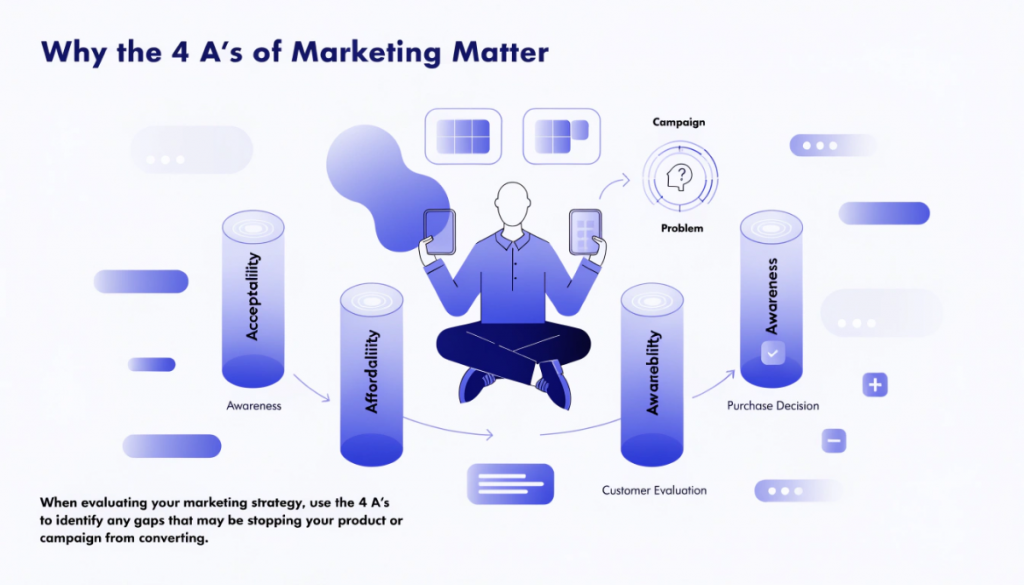
Customers today have more choices and more information than ever before, which makes a purely company centered approach to marketing far less effective than it used to be. The 4 A’s of marketing matter because they force a business to evaluate its strategy through the customer’s actual decision making process instead of assuming a good product will simply sell itself.
This shift matters even more in crowded markets, where the actual product differences between competitors are often small. In those situations, the business that wins is usually not the one with the objectively best product, but the one that scores highest across all four A’s at once.
This framework is especially useful for identifying exactly where a product or campaign is falling short. A business might have excellent awareness through strong advertising but still struggle with sales if accessibility is poor or if the price feels unfair for the perceived value, something the 4Ps alone would not clearly reveal.
Running a quick internal audit against all four A’s, even informally, often surfaces the actual reason behind a stalled campaign faster than reworking the advertising creative again and hoping the numbers improve on their own.
How to Apply the 4 A’s of Marketing in Your Strategy
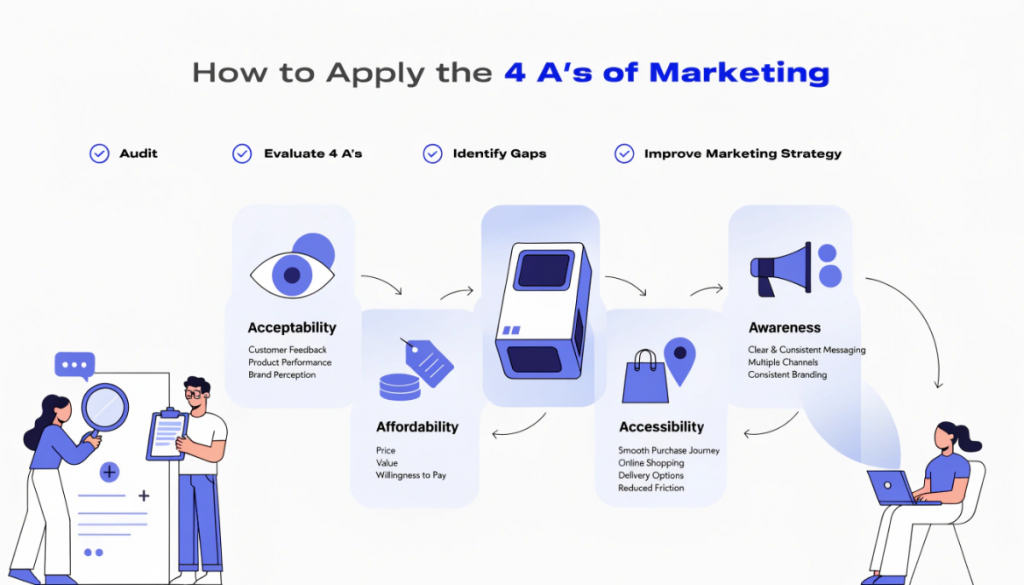
Understanding the framework is one thing, actually using it to improve a real marketing strategy is where it becomes genuinely useful for teams working under real deadlines and budgets.
- Audit acceptability by gathering direct customer feedback on both product performance and brand perception, not just relying on internal quality checks alone.
- Reassess affordability by looking beyond the price tag itself and understanding whether customers genuinely feel they are getting fair value for what they pay.
- Improve accessibility by mapping out every single step a customer takes to actually purchase the product and removing unnecessary friction along the way.
- Strengthen awareness by focusing on clear, consistent messaging across channels rather than just increasing overall advertising spend without a clear plan.
- Review all four A’s together periodically, since a weakness quietly hiding in one area often undermines otherwise strong performance across the other three.
How to Build a Career in Marketing
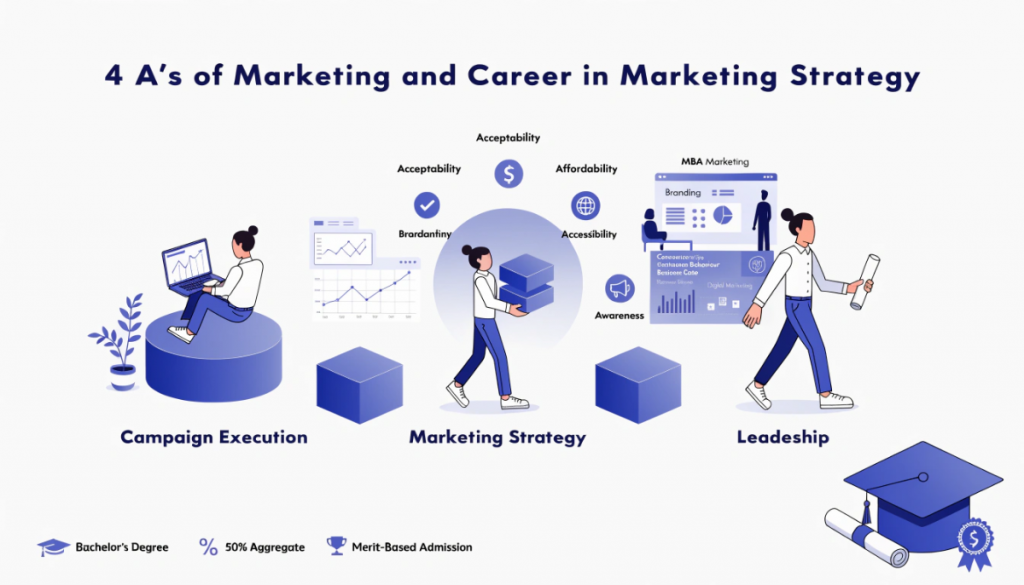
Frameworks like the 4 A’s of marketing are exactly the kind of concept covered in a structured marketing education, and understanding them well is genuinely useful for anyone building a career in this field. If you enjoy thinking about customer behaviour and strategy rather than only execution, marketing as a specialization is worth considering seriously.
Many people build a career in marketing by starting in execution focused roles, running campaigns or managing social media, before gradually moving into strategy work where frameworks like this one actually get applied on a regular, ongoing basis.
An MBA with a marketing specialization typically covers frameworks like this alongside branding, consumer behaviour and digital marketing, giving you both the theory and the practical tools to apply concepts like the 4 A’s in a real business setting. This route works especially well for people who want to move from execution roles into strategy and leadership positions later.
Beyond just learning the framework, structured programs also give you the chance to apply it to real case studies, which tends to build a much sharper instinct for spotting these gaps than reading about the concept alone from a textbook ever could.
If you are considering this route, most recognized online MBA programs with a marketing specialization in India follow a fairly similar eligibility pattern worth knowing before you shortlist programs.
- A bachelor’s degree of at least three years duration from a recognized university in any discipline.
- A minimum of 50% aggregate marks in your qualifying degree, usually relaxed to 45% for candidates from reserved categories.
- International applicants are generally asked for a slightly higher aggregate, often around 60% in their qualifying examination.
- Reservation of seats as per applicable government policy, which most universities follow for both online and on campus programs.
Since most online MBA programs admit students on merit rather than a mandatory entrance exam, this route works well for working professionals who want to build a stronger strategic foundation in marketing without pausing their career for two years, while still gaining a recognized qualification alongside their job.
Conclusion
The 4 A’s of marketing give businesses a genuinely useful lens for evaluating strategy from the customer’s side of the equation, something the traditional 4Ps were never really designed to do on their own. Acceptability, affordability, accessibility and awareness each address a different reason a customer might hesitate or walk away, and reviewing all four together usually reveals gaps that a purely company centered view would miss entirely. Whether you are building a new product strategy or trying to understand why an existing one is underperforming, running it through these four questions is a genuinely practical place to start.
None of the four A’s works well in isolation either. A product that is affordable and accessible but poorly understood still struggles, just as a well known product that nobody can actually reach will underperform no matter how much awareness it builds. Treating all four as one connected system is really what makes this framework worth using in the first place.

Book Your
Free Session
Connect with our experts and get personalised guidance for your career, course selection, and future goals.
📖 Sources & References
✓ Verified 2026Verified marketing frameworks, customer value concepts, marketing strategy, consumer behaviour and higher education information based on authoritative academic, professional, regulatory and institutional sources.
- Routledge – The 4 A’s of Marketing Original book by Jagdish Sheth and Rajendra Sisodia explaining the 4 A’s framework of Acceptability, Affordability, Accessibility and Awareness
- Google Books – The 4 A’s of Marketing Bibliographic and preview information for Sheth and Sisodia’s 4 A’s marketing framework and its customer-value approach
- Coursera – What Are the 4 A’s of Marketing Educational overview of the four dimensions, including functional and psychological acceptability, affordability, accessibility and awareness
- American Marketing Association – Marketing Insights Professional marketing resources covering marketing concepts, customer value, strategy and contemporary marketing practice
- Jagdish Sheth and Rajendra Sisodia – Four A’s Research Research overview of the 4 A’s framework and its customer-value perspective developed by Jagdish Sheth and Rajendra Sisodia
- UGC – Regulations Official higher education regulations, including current minimum standards for undergraduate and postgraduate degrees
- UGC – Online and Distance Education Regulations Official regulations and amendments governing recognised Open and Distance Learning and Online Programmes in India
- Shoolini Online – Online MBA Marketing Management Official information on the online MBA programme, marketing-related specialisations and current eligibility requirements
- Shoolini Online Official information on online higher education programmes and learning opportunities from Shoolini Online