

Choosing a specialization in BBA usually comes down to one question, which subjects will you actually be studying for the next three years. If numbers, markets and financial decision making interest you more than marketing campaigns or HR policies, the finance subjects in BBA are worth a closer look before you commit.
This blog breaks down exactly what you study semester by semester, the core subjects that show up most often, the skills you walk away with and the career paths this specialization actually opens up. No fluff, just what the course covers and why it matters, so you can decide with a clear picture rather than a vague sense of what finance as a specialization even involves in practice.
What Is BBA in Finance and Why It Matters
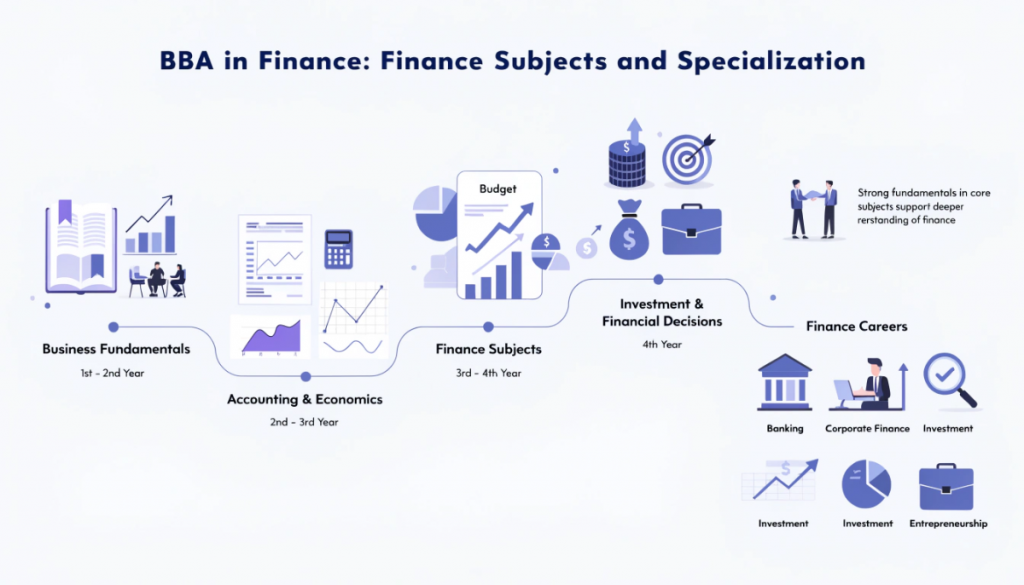
A BBA in Finance is a specialization within the broader Bachelor of Business Administration degree that focuses specifically on financial management, accounting and investment related subjects. The first year or two usually covers general business fundamentals, while the finance subjects in BBA get introduced gradually and take over more fully in the final year of the program.
This structure exists on purpose. Jumping straight into corporate finance or investment banking topics without a grounding in basic accounting and economics would leave most students lost, so universities build up gradually instead of front loading the hardest material into the very first semester.
This specialization matters because finance touches every part of a business, from how a company raises money to how it decides where to spend it. Studying finance subjects in BBA gives you a working understanding of financial statements, budgeting and investment decisions that applies whether you end up in banking, corporate finance, investment roles or even running your own business later on.
It also tends to age well as a choice. Marketing trends shift with platforms and consumer habits, but the core logic behind financial statements, budgeting and investment analysis has stayed largely the same for decades, which means what you learn in these subjects stays relevant well beyond graduation.
Finance Subjects in BBA Semester Wise
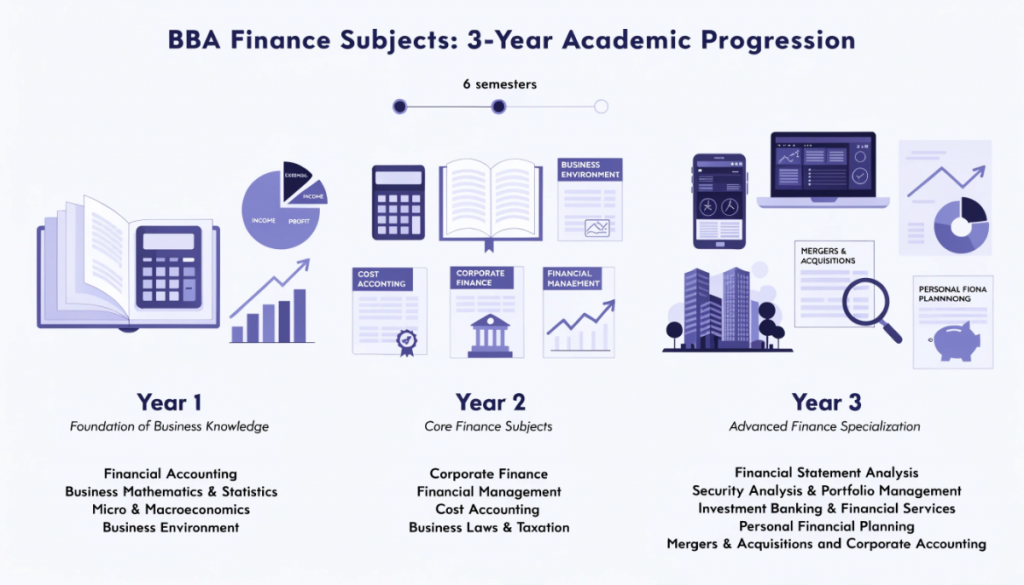
Most BBA programs in India run across six semesters spread over three years, and the finance subjects in BBA are introduced in a fairly logical sequence, starting broad and getting more specialized as you move forward.
Year One: Building the Foundation
The first year rarely dives straight into finance. Instead it builds the base you need to actually understand financial subjects later, covering areas like business communication, principles of management and basic economics.
Do not be discouraged if this year feels more general than expected. Every subject here, even ones that seem unrelated to finance at first glance, ends up supporting how well you grasp the more technical subjects that follow in years two and three of the program.
- Financial Accounting, which introduces the fundamentals of recording transactions and preparing basic financial statements.
- Business Mathematics and Statistics, which builds the quantitative skills needed for financial analysis later in the course.
- Micro and Macroeconomics, which explain how markets, pricing and national economic policy actually work.
- Business Environment, which gives context on the regulatory and economic factors that affect financial decisions.
Year Two: Core Financial Concepts
The second year is where the finance subjects in BBA start becoming more specific and technical, moving beyond general business concepts into subjects that directly prepare you for a finance career.
Students often say this is the year the specialization actually starts to feel real, since subjects like corporate finance require you to apply the accounting basics from year one to genuine business decisions rather than just recording numbers in a ledger.
- Corporate Finance, covering how businesses raise capital, manage debt and make investment decisions.
- Financial Management, which focuses on budgeting, working capital management and financial planning within an organization.
- Cost Accounting, which teaches how to track and control the costs involved in running a business.
- Business Laws and Taxation basics, which cover the legal and compliance side of financial decision making.
Year Three: Specialization and Advanced Topics
The final year is where the finance specialization really takes shape, with subjects that closely mirror what finance professionals actually work on day to day.
This is also usually when internships and placement preparation start overlapping with coursework, so the subjects covered here tend to be the ones you end up discussing most in job interviews right after graduation, especially if you land an internship tied to one of these specialized areas.
- Financial Statement Analysis and Reporting, which teaches how to read and interpret a company’s financial health from its statements.
- Security Analysis and Portfolio Management, covering how investments are evaluated and how portfolios are built and balanced.
- Investment Banking and Financial Services, which introduces how capital markets, mergers and financial services actually operate.
- Personal Financial Planning, which applies financial concepts to individual wealth management rather than only corporate finance.
- Mergers and Acquisitions along with Corporate Accounting, which round out the final year with advanced, real world applicable topics closely resembling actual deal work.
Core Finance Subjects You Will Study in Detail
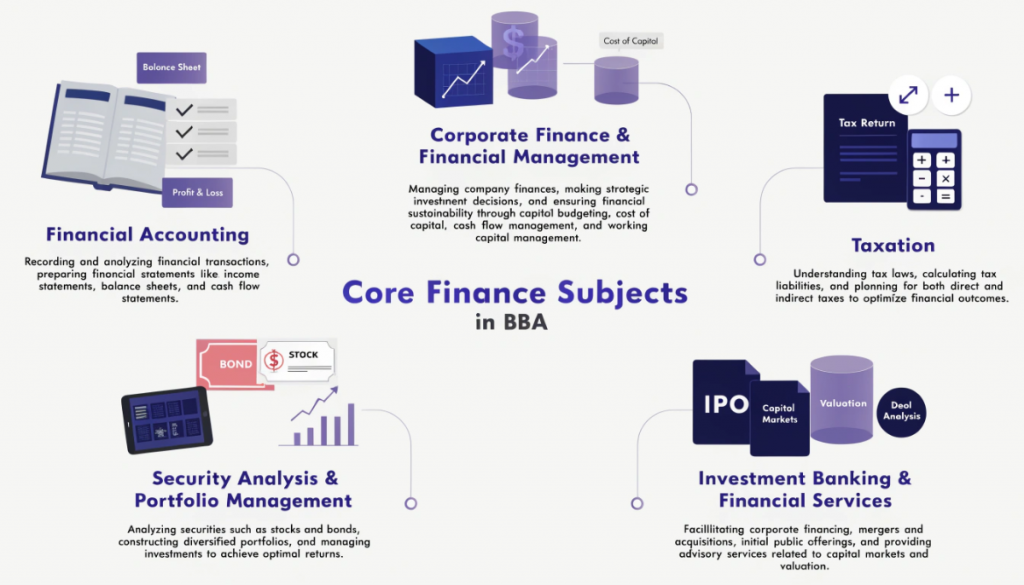
A few subjects show up across almost every BBA finance program regardless of the university, and these are worth understanding a little deeper since they form the backbone of the specialization.
Financial Accounting
This is usually the very first finance subject you encounter, teaching you how transactions get recorded, how ledgers are maintained and how basic financial statements like the profit and loss account and balance sheet are prepared. Everything else in the finance subjects in BBA builds on top of this foundation, so students who take shortcuts here tend to struggle more in later semesters.
Corporate Finance and Financial Management
These subjects cover how companies decide where to invest, how to fund those investments and how to manage cash flow efficiently. You learn concepts like capital budgeting, cost of capital and working capital management, all of which apply directly to real corporate decision making and show up again constantly in later, more advanced subjects.
Taxation
Taxation subjects introduce direct and indirect tax structures, covering how individuals and businesses calculate and file their tax obligations. This is one of the more practically useful subjects since tax knowledge applies to almost every job in finance and accounting, and many students end up using it in their own personal finances long after graduation too.
Security Analysis and Portfolio Management
This subject shifts focus from a company’s internal finances to the broader investment world, teaching you how stocks, bonds and other securities are evaluated and how a balanced investment portfolio is constructed. It is particularly useful if you are interested in careers in stock broking or wealth management, and it is often the subject students find most directly applicable to their own personal investing later, since the same evaluation logic carries over from studying companies to managing your own money.
Investment Banking and Financial Services
This subject introduces how capital markets function, how companies raise funds through IPOs and how mergers and acquisitions are structured. It is one of the more advanced finance subjects in BBA and gives a realistic preview of what investment banking roles actually involve, from valuation exercises to deal documentation and due diligence work.
Skills You Gain From Finance Subjects in BBA
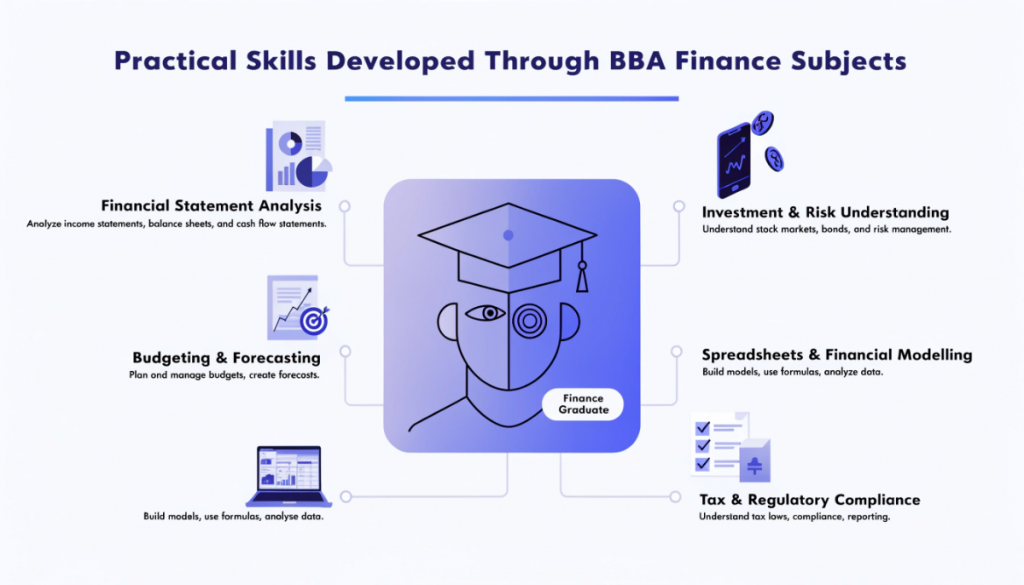
Beyond the theoretical knowledge, studying finance subjects in BBA builds a set of practical skills that employers specifically look for when hiring finance graduates.
These skills tend to matter more than the specific grades you score in any one subject, since interviewers for entry level finance roles are usually more interested in whether you can actually apply what you learned than in reciting textbook definitions.
- Financial statement analysis, letting you assess whether a company is financially healthy just by reading its reports and comparing them against industry benchmarks.
- Budgeting and forecasting skills that apply directly to corporate finance and personal financial planning alike, useful well beyond just a finance job title.
- A working understanding of investment options and risk, useful whether you end up managing company funds or your own money down the line.
- Comfort with spreadsheets and basic financial modelling, which is a baseline expectation in almost every entry level finance role today.
- An understanding of regulatory and tax compliance, which matters across nearly every industry, not just finance specific roles or job titles.
Career Options After Studying Finance Subjects in BBA
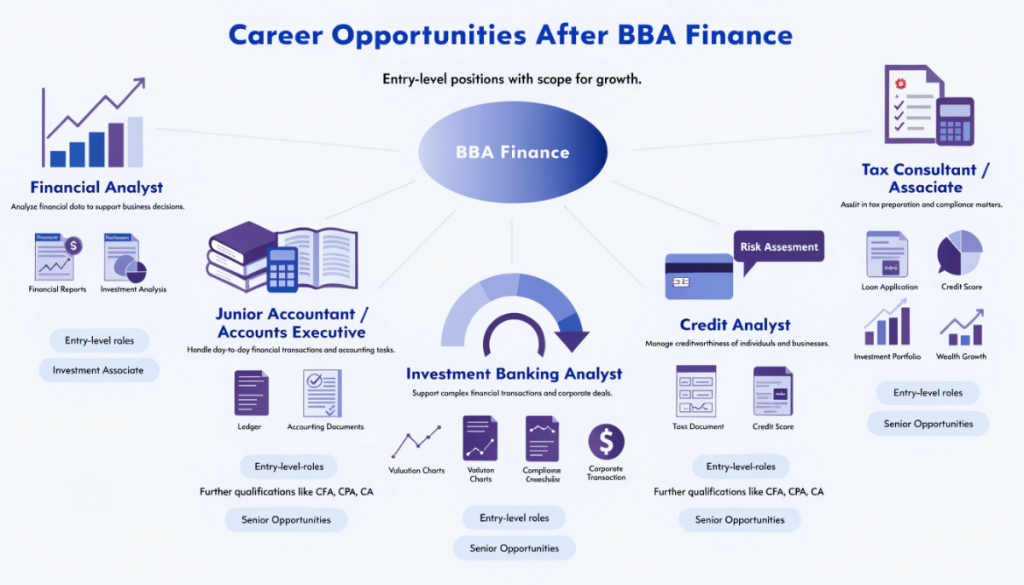
A BBA with a finance specialization opens up a fairly wide set of entry level roles, and many graduates go on to pursue further qualifications like an MBA or professional certifications to move into more senior positions later.
Starting salaries vary quite a bit depending on the company and city, but the roles below give a realistic sense of where a finance specialization typically leads in the first few years after graduation.
- Financial Analyst, evaluating company performance and helping guide investment or budgeting decisions across departments.
- Junior Accountant or Accounts Executive, handling day to day bookkeeping, reconciliation and reporting tasks for a business.
- Investment Banking Analyst, supporting deal teams with research, valuation and documentation work on live transactions.
- Tax Consultant or Associate, assisting individuals and businesses with tax planning and compliance throughout the year.
- Credit Analyst, assessing loan applications and creditworthiness for banks and financial institutions before approval.
- Wealth Management Associate, helping clients plan and manage their personal investment portfolios over time.
Eligibility Criteria and How to Get Started With BBA Finance
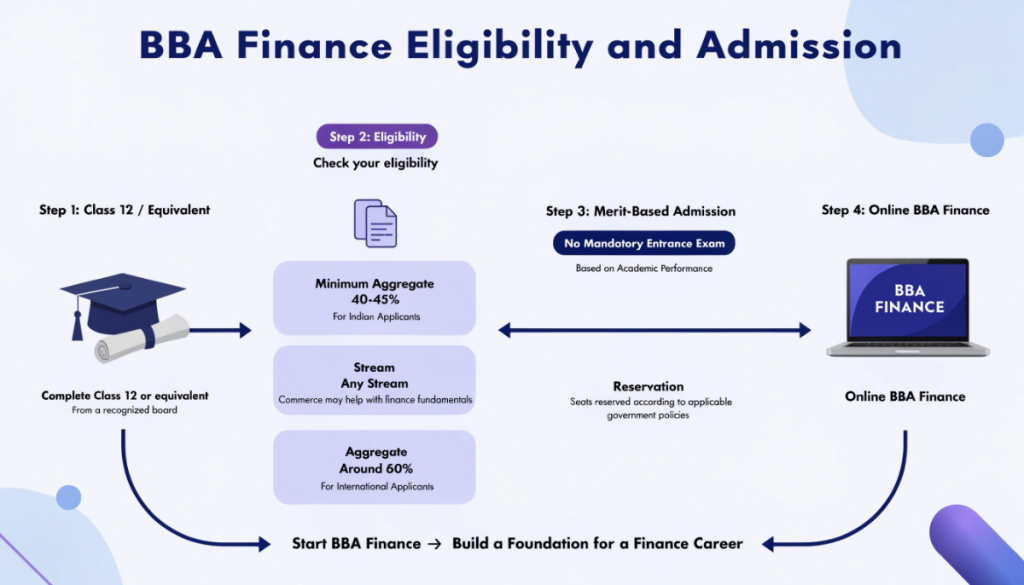
Getting into a BBA with a finance specialization is fairly straightforward compared to postgraduate programs, since most universities admit students right after school based on merit rather than a separate entrance exam.
That said, it is still worth checking the specific admission page of any program you shortlist, since minor variations in eligibility percentage or required subjects can exist even though the overall pattern stays fairly consistent across most universities offering this specialization online.
If you are considering an online BBA with a finance specialization, most recognized online programs in India follow a fairly similar eligibility pattern.
- Completion of class 12 or an equivalent qualification from a recognized board, in any stream, though a commerce background can make the early finance subjects easier to grasp.
- A minimum aggregate of around 40 to 45% in the qualifying examination, which is standard across most online undergraduate business programs and rarely acts as a major barrier for students who have cleared class 12 comfortably.
- International applicants are generally asked for a slightly higher aggregate, often around 60% in their qualifying examination.
- Reservation of seats as per applicable government policy, which most universities follow for both online and on campus undergraduate programs.
Since these programs usually admit students on merit without a mandatory entrance exam, this route works well for students who want to start building a finance career right after school without the added pressure of a separate competitive test. It also means you can plan your application timeline around your class 12 results rather than juggling a separate exam preparation schedule on top of board exams during an already stressful year.
Conclusion
The finance subjects in BBA take you from basic bookkeeping in the first year to fairly advanced topics like investment banking and portfolio management by the time you graduate.
If you genuinely enjoy working with numbers and want a business degree that leads somewhere specific, this specialization gives you a practical head start into banking, corporate finance and investment roles. Go through the semester wise breakdown, see which subjects excite you the most and use that as a real signal for whether this path is the right fit for you.
And if a few of these subjects already sound interesting just from their names, that alone is a fairly good sign this specialization is worth pursuing over a more general business degree that spreads its focus much wider.

Book Your
Free Session
Connect with our experts and get personalised guidance for your career, course selection, and future goals.
📖 Sources & References
✓ Verified 2026Verified information on BBA finance subjects, accounting, financial management, taxation, securities markets, investment concepts, finance careers and higher education.
- ICAI – Institute of Chartered Accountants of India Professional accounting standards, financial reporting guidance and accounting education resources
- ICAI – Accounting Standards Official accounting standards, financial reporting principles and related accounting guidance
- SEBI Investor – Securities Market Education Official resources on securities markets, shares, bonds, mutual funds, investment products and portfolio review
- SEBI Investor – Investor Education Materials Educational resources covering financial planning, securities markets, mutual funds, IPOs and investment awareness
- Income Tax Department – Government of India Official information on income tax provisions, tax compliance, returns and the current income tax framework
- Ministry of Corporate Affairs – Companies Act Official Companies Act provisions covering company accounts, financial statements and corporate reporting
- National Career Service – Financial Analyst Careers Government occupational information relevant to financial analysts and finance-related career roles
- National Career Service – Government of India Government career, employment, internship and skill-development resources for jobseekers
- UGC – University Grants Commission Official higher education regulations and standards relevant to undergraduate degree programmes in India
- Ministry of Education – Higher Education Government information and policy resources relating to higher education in India
- Shoolini Online – BBA Programme Official BBA programme information including finance subject areas, programme structure and eligibility details
- Shoolini Online – BBA Admissions Current BBA admission information including programme duration, entry requirements and Financial Management specialisation