

Every impressive dashboard, recommendation engine or fraud detection model you have ever used started out as a messy pile of raw data and a vague business question.
The life cycle of data science is exactly what turns that mess into something usable, moving through a structured set of stages from understanding the problem to deploying a working model.
Skip a step or rush through it and the final output usually falls apart the moment it meets real world data. In this blog we will walk through every stage of the life cycle of data science, the skills and tools each stage demands and how you can actually build a career around this process if it genuinely interests you.
What Is the Life Cycle of Data Science
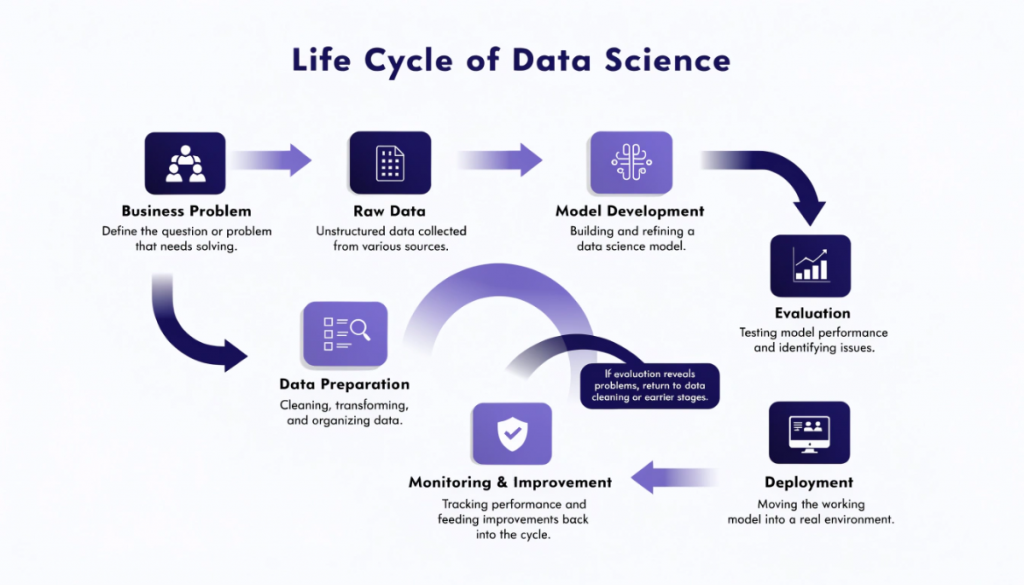
The life cycle of data science refers to the sequence of stages a data scientist follows to turn raw, unstructured data into insights or predictions that actually solve a business problem. It starts with understanding what question needs answering and ends with a working model being deployed and monitored in a real environment.
Unlike a strict one way process, this life cycle is iterative, meaning teams often move back and forth between stages as new problems surface. A model that performs poorly during evaluation might send the team all the way back to data cleaning, and that back and forth is completely normal rather than a sign that something went wrong.
Think of it less like a straight line and more like a loop that tightens with each pass. Early iterations are usually rough, built to test whether an idea even has potential, while later iterations refine the details once the overall approach is proven to work.
Stage by Stage Breakdown of the Life Cycle of Data Science
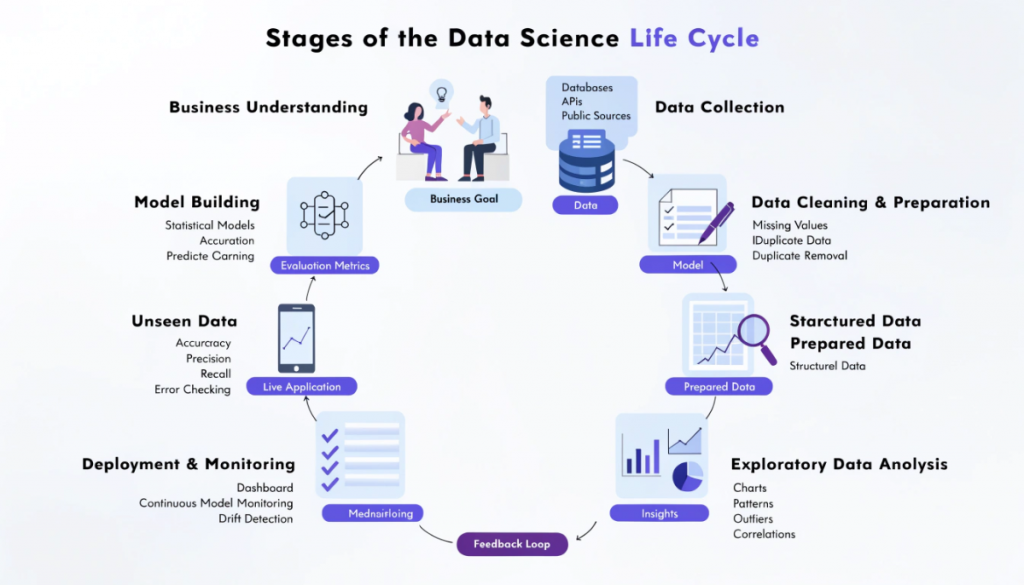
While different companies structure their workflow slightly differently, most versions of the life cycle of data science follow a fairly similar sequence of stages.
Business Understanding
Every data science project starts here, and skipping this step is one of the most common reasons projects fail later. This stage involves talking to stakeholders, understanding what decision the analysis needs to support and translating a vague business concern into a specific, answerable question.
For example, a request to improve customer retention is not yet a data science problem, it is a business goal. Turning it into something workable means defining what retention actually means, over what time period and which customer segment matters most, before any data gets touched.
A data scientist who jumps straight into building models without clearly defining the problem usually ends up with technically sound work that nobody in the business actually needs. Spending extra time here almost always saves far more time later in the process.
Data Collection
Once the problem is clear, the next step is gathering the data needed to address it. This could mean pulling data from internal databases, scraping public sources, using APIs or working with third party datasets, depending on what the project requires.
It is worth deciding early whether existing data is even sufficient or whether new data needs to be collected specifically for this project, since assuming the data will simply be available and usable is a common and costly mistake at this stage.
The quality of data collected at this stage sets a ceiling on everything that follows. No amount of clever modelling later can fully make up for data that was incomplete, biased or collected using the wrong method in the first place.
Data Cleaning and Preparation
Raw data is almost never ready to use straight away. This stage involves handling missing values, removing duplicates, correcting inconsistent formatting and converting data into a structure that analysis tools can actually work with.
This is usually the most time consuming part of the entire life cycle of data science, often taking up more time than the actual modelling. It is also the least glamorous part of the job, but skipping or rushing it almost guarantees problems later.
Exploratory Data Analysis
Before jumping into modelling, data scientists explore the dataset to understand patterns, spot outliers and form early hypotheses about what might be driving the outcome they are trying to predict. This usually involves summary statistics, visualizations and correlation checks.
This stage is also where a lot of genuinely useful insight gets discovered, sometimes even without needing a full model at all. Occasionally a well made chart reveals a pattern so clear that stakeholders can act on it immediately, without waiting for the modelling stage to finish.
Exploratory analysis often reveals problems that were missed during cleaning or surfaces insights that change the entire direction of the project. Skipping this stage and jumping straight to modelling is one of the more common shortcuts that comes back to bite teams later.
Model Building
This is the stage most people associate with data science, where statistical or machine learning models are trained on the prepared data to identify patterns or make predictions. The choice of model depends heavily on the problem, whether that is a simple regression, a classification algorithm or a more complex neural network.
Good model building is not about picking the most advanced algorithm available, it is about choosing the simplest model that solves the problem reliably. A complicated model that nobody on the team can explain or maintain often causes more issues than it solves.
Model Evaluation
Once a model is built, it needs to be tested against data it has not seen before to check how well it actually generalizes. This stage relies on specific metrics depending on the problem, such as accuracy, precision, recall or error rate.
A model that performs brilliantly on training data but poorly on new data is essentially useless in production. This stage exists specifically to catch that gap before the model ever reaches real users or real business decisions.
Deployment and Monitoring
Once a model clears evaluation, it gets integrated into the actual business workflow, whether that means powering a live recommendation system, feeding a dashboard or triggering automated decisions. This stage typically requires collaboration with engineering teams to make sure the model runs reliably at scale.
The life cycle of data science does not end at deployment. Models are monitored continuously since real world data shifts over time, a phenomenon often called model drift, and a model that performed well at launch can quietly degrade months later if nobody is watching.
Skills You Need at Each Stage of the Data Science Life Cycle
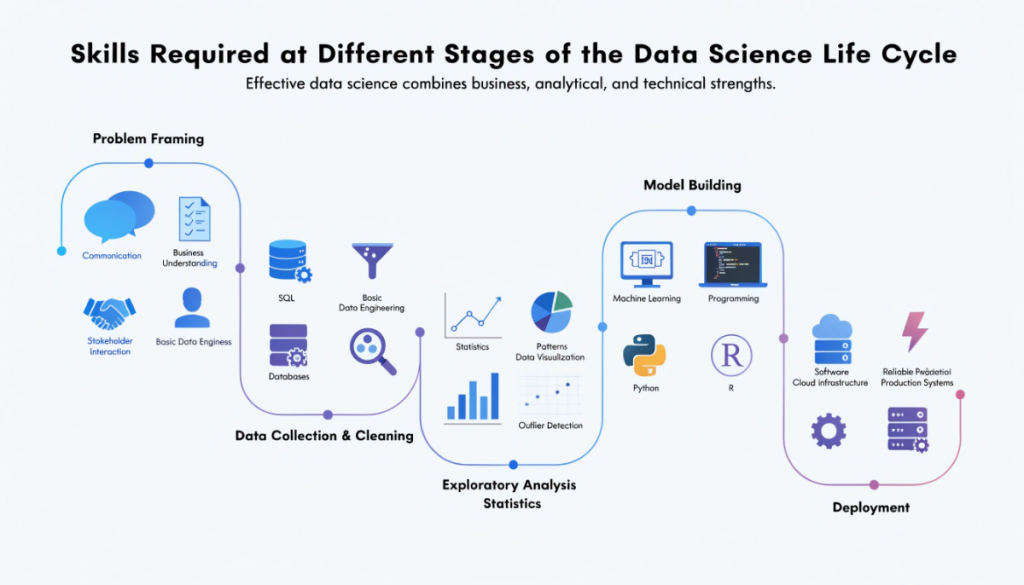
Different stages of the life cycle of data science call for slightly different skills, which is exactly why data science teams usually work best when they combine multiple strengths rather than relying on one generalist to do everything.
- Strong communication and business sense for the problem framing stage, since translating a business concern into a data question is more about listening than coding.
- SQL and data engineering basics for collection and cleaning, since a large chunk of early stage work involves querying and reshaping data rather than modelling it.
- Statistics and visualization skills for exploratory analysis, since spotting genuine patterns instead of random noise takes a solid statistical foundation.
- Machine learning and programming skills, typically in Python or R, for the actual model building stage.
- An understanding of software engineering and cloud infrastructure for deployment, since a model that only works on a laptop is not actually useful to a business.
Tools Commonly Used Across the Data Science Life Cycle
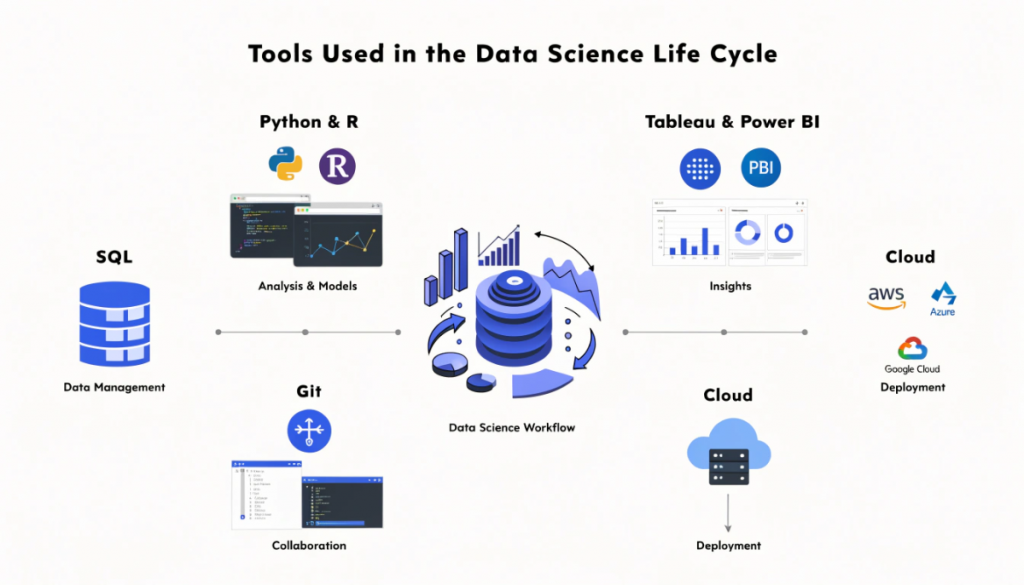
A wide range of tools support different stages of the life cycle of data science, and most working data scientists end up comfortable with a handful of these rather than every tool on the market.
- Python and R remain the most widely used programming languages for analysis and model building, largely due to their extensive libraries.
- SQL is essential for querying and managing data stored in relational databases, which still power most business systems.
- Tools like Tableau and Power BI help turn analysis and model output into dashboards that non technical stakeholders can actually understand.
- Cloud platforms such as AWS, Azure and Google Cloud are increasingly used for storing large datasets and deploying models at scale.
- Version control systems like Git help teams track changes to code and collaborate without overwriting each other’s work.
Why Understanding the Life Cycle of Data Science Matters for Beginners
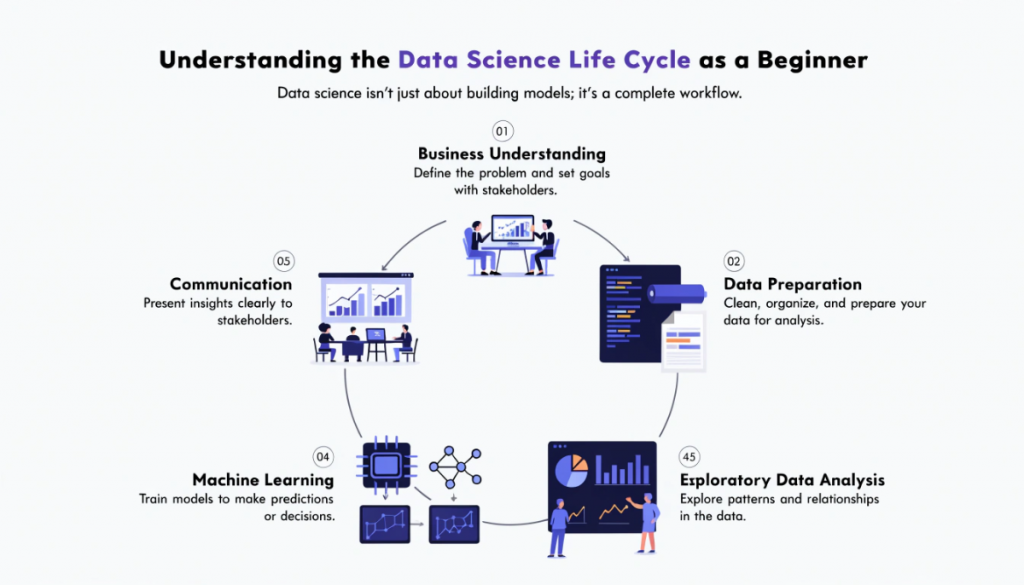
A lot of beginners jump straight into learning machine learning algorithms without first understanding where modelling actually sits within the broader life cycle of data science. This creates a skewed picture of what the job actually involves day to day.
Online courses and tutorials often reinforce this skew too, since a flashy model demo is far easier to package into a short video than the hours spent cleaning data or negotiating what a business stakeholder actually needs. Beginners who only consume this kind of content end up underprepared for the less glamorous reality of the job.
In reality, most working data scientists spend far more time on data cleaning, business understanding and communicating results than on building and tuning models. Understanding the full life cycle early helps beginners set realistic expectations and build a more well rounded skill set instead of only focusing on the flashier parts of the job.
How to Build a Career in Data Science
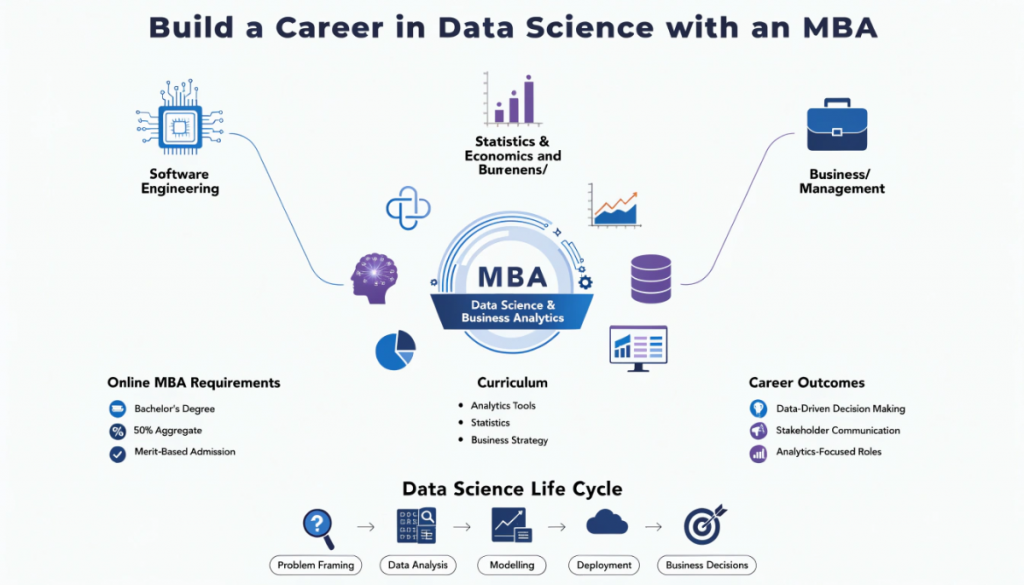
If working through the life cycle of data science sounds appealing, there are multiple paths into the field depending on your background. Some people move in from a software engineering base, others come from statistics or economics, and increasingly, people move in through a business focused route that combines management thinking with technical analysis.
None of these paths is objectively better, they simply suit different strengths. A strong technical background helps with the modelling and deployment stages, while a business focused background often helps more with problem framing and communicating results to stakeholders who are not technical themselves.
An MBA with a specialization in data science and business analytics is one option worth considering if you want to understand both the technical process and the business decisions that data ultimately supports. It typically covers analytics tools, statistics and business strategy together, which suits people who want to sit closer to decision making rather than purely technical implementation.
If you are considering this route, most recognized online MBA programs with a data science specialization in India follow a fairly similar eligibility pattern.
- A bachelor’s degree of at least three years duration from a recognized university in any discipline.
- A minimum of 50% aggregate marks in your qualifying degree, usually relaxed to 45% for candidates from reserved categories.
- International applicants are generally asked for a slightly higher aggregate, often around 60% in their qualifying examination.
- Reservation of seats as per applicable government policy, which most universities follow for both online and on campus programs.
Since most online MBA programs admit students on merit rather than a mandatory entrance exam, this route works well for working professionals who want to move closer to data driven roles without pausing their career for a full time technical degree.
Conclusion
The life cycle of data science is less about any single flashy algorithm and more about a disciplined process that turns messy raw data into something a business can actually act on.
Every stage, from understanding the problem to monitoring a deployed model, plays a role that cannot really be skipped without weakening the final result. Whether you are just starting to learn data science or thinking about a career shift into the field, understanding this full cycle gives you a far more accurate picture of what the work actually looks like day to day, well beyond just building models.
The next time you see a slick dashboard or a spot on recommendation, remember that it likely passed through every one of these stages first, often more than once, before it ever reached you.

Book Your
Free Session
Connect with our experts and get personalised guidance for your career, course selection, and future goals.
📖 Sources & References
✓ Verified 2026Verified information on data science workflows, data analysis, machine learning, deployment, technology skills and data science education based on authoritative sources.
- IBM – Data Science Overview of data science, data analysis, machine learning and the role of data scientists
- IBM – CRISP-DM and Data Science Process Resources covering structured data mining, modelling workflows and the iterative nature of data science projects
- NIST – Artificial Intelligence Risk Management Framework Guidance relevant to developing, evaluating, deploying and monitoring trustworthy AI and machine learning systems
- Python Documentation Official documentation for Python programming used widely in data analysis, automation and machine learning
- Microsoft – Power BI Official resources on data visualisation, business intelligence, dashboards and analytics
- AWS – Machine Learning Information on machine learning infrastructure, cloud services, model deployment and scalable data workloads
- Google Cloud – Data Science and Machine Learning Resources explaining data science, machine learning workflows, analytics and cloud-based data solutions
- World Economic Forum – Future of Jobs Report 2025 Research on evolving technology skills, analytical thinking, AI and data-related workforce trends
- National Career Service – Government of India Career information and employability resources relevant to data, technology and analytics careers
- UGC – University Grants Commission Official higher education information and regulatory resources relevant to recognised degree programmes
- UGC Distance Education Bureau Official information on recognised online and open distance learning higher education programmes
- Shoolini Online – MBA Programmes Online higher education programmes and learning options relevant to management, analytics and data-driven careers