

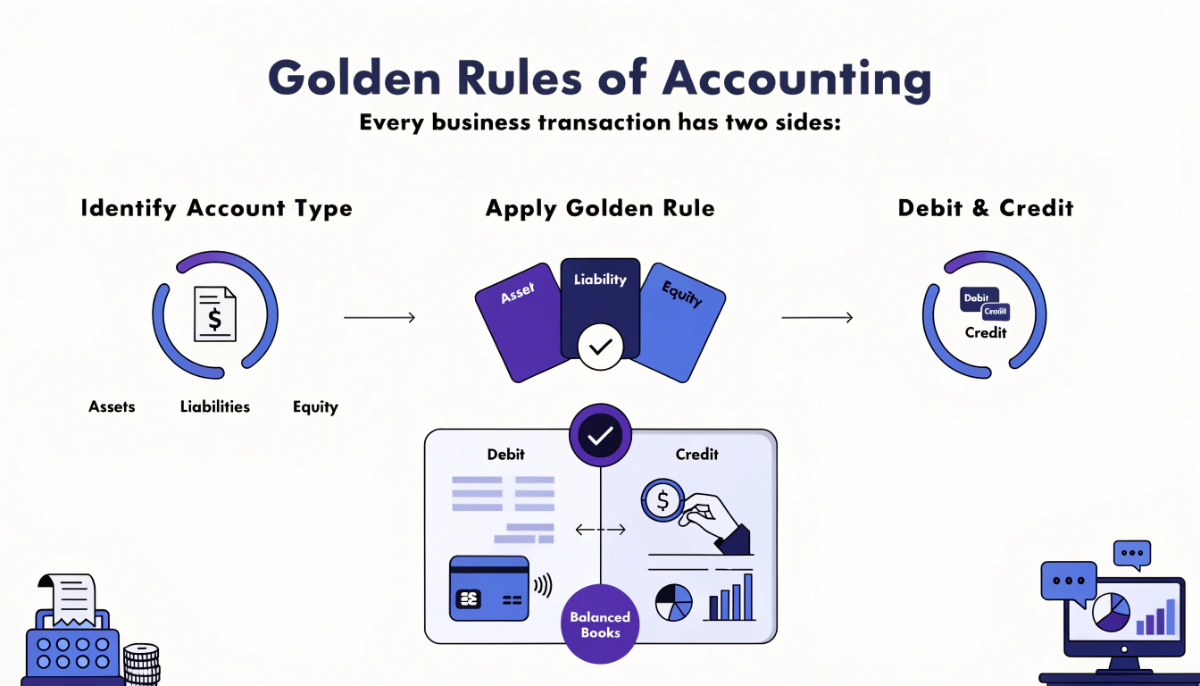
Every commerce student runs into the same wall in their first accounting class, staring at a transaction and not knowing whether to debit it or credit it. The golden rules of accounting exist to solve exactly this problem. They are three simple principles that decide which side of a ledger a transaction goes on, and once they click, the entire subject stops feeling like memorization and starts feeling like logic.
In this blog we will break down what these rules actually mean, the account types they apply to, real examples of how they work and why they still matter even in a world of automated accounting software.
What Are the Golden Rules of Accounting
The golden rules of accounting are three basic principles that guide how a transaction gets recorded in the books using the double entry system. Every transaction in a business has two sides, something is received and something is given, and these rules tell you exactly which account to debit and which one to credit based on what kind of account is involved.
This might sound abstract at first, but it becomes second nature once you have applied it to a handful of real transactions. The trick is to stop thinking of debit and credit as increase and decrease, since that only works for some account types, and instead learn to identify the account category first before deciding how to record the entry.
These rules were not invented to make life difficult for commerce students, they exist because a business needs a consistent method for recording thousands of transactions in a way that always stays balanced. Without a fixed set of rules, two accountants could record the same transaction differently, and the books would never match up. The golden rules of accounting remove that ambiguity completely.
What makes these rules genuinely useful is that they work the same way regardless of the size of the business. A small shop recording a single cash sale and a large company recording thousands of transactions a day both rely on the exact same three principles. This consistency is what makes financial statements comparable across companies and across years, which matters enormously for investors, banks and regulators trying to make sense of a business’s numbers.
The Three Types of Accounts You Need to Know First
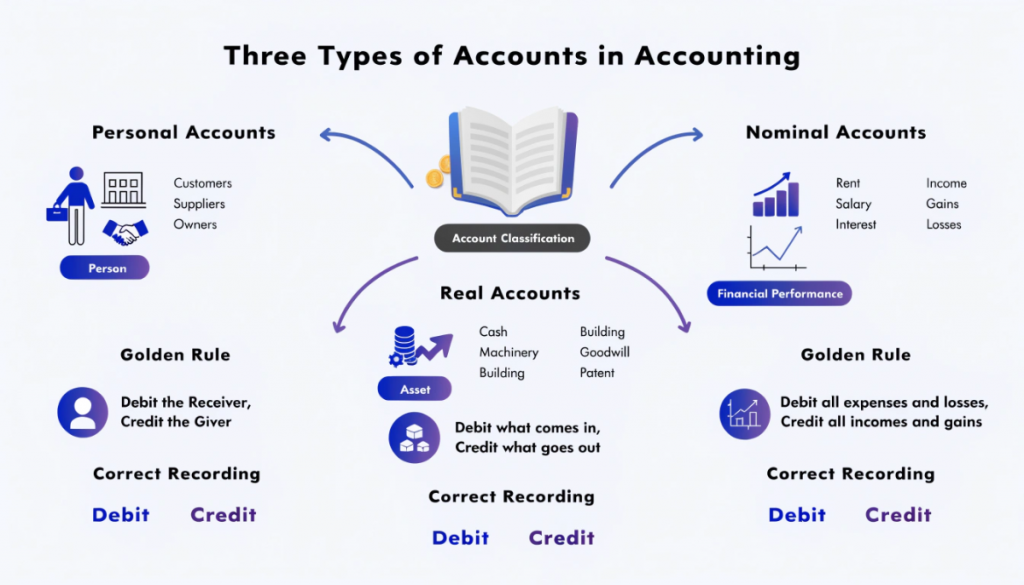
Before the golden rules of accounting make any sense, you need to understand that every account in a business ledger falls into one of three categories. Each golden rule is tied to exactly one of these account types, so getting this classification right is half the battle.
Personal Accounts
A personal account belongs to an individual, a firm or an organization that the business deals with. This includes accounts of customers, suppliers, banks and even the owner of the business themselves. Anytime a transaction involves a person or entity by name, it falls under this category.
Real Accounts
Real accounts relate to assets and properties that a business owns, whether tangible like cash, machinery and buildings or intangible like goodwill and patents. These accounts track what the business has, not who it deals with, and they carry forward their balance from one year to the next instead of resetting.
Nominal Accounts
Nominal accounts cover all expenses, losses, incomes and gains recorded during a financial year. Rent paid, salaries given, interest earned and commission received all fall under this category. Unlike real accounts, nominal accounts are closed and reset at the end of every accounting period, since they only reflect that year’s performance rather than an ongoing balance.
Golden Rules of Accounting Explained With Examples
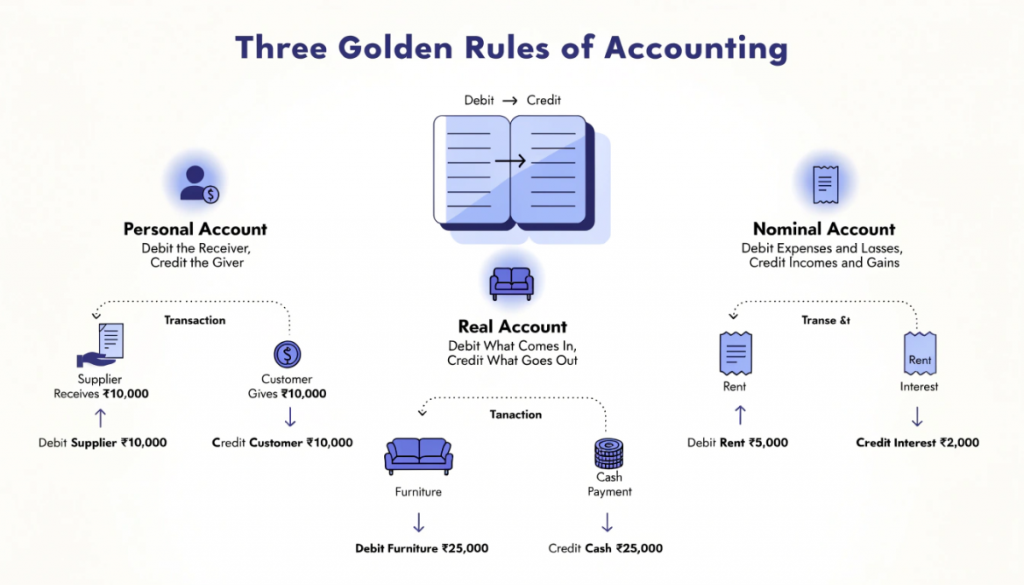
Once you know which category an account belongs to, applying the right golden rule becomes a lot more straightforward. Here is how each rule works with a simple example.
Rule One: Debit the Receiver, Credit the Giver
This rule applies to personal accounts. Whenever a person or organization receives something from the business, their account is debited, and whenever they give something to the business, their account is credited.
For example, if a business pays ten thousand rupees to a supplier named Raj, Raj’s account is debited because he is the receiver of that payment. If the business had instead received money from a customer, that customer’s account would be credited since they are the one giving money to the business. Notice that the business’s own cash account also gets affected in both cases, which is exactly why every transaction always touches two accounts at once.
Rule Two: Debit What Comes In, Credit What Goes Out
This rule governs real accounts, which track the assets a business owns. When an asset enters the business, its account is debited, and when an asset leaves the business, its account is credited.
For example, if a business purchases furniture for cash, the furniture account is debited because furniture is coming into the business, while the cash account is credited because cash is going out to pay for it. This rule makes intuitive sense once you picture assets physically moving in and out of the business, almost like tracking what walks through the front door versus what walks back out.
Rule Three: Debit Expenses and Losses, Credit Incomes and Gains
This rule applies to nominal accounts. Any expense or loss the business incurs is debited, while any income or gain the business earns is credited.
For example, if a business pays rent of five thousand rupees, the rent account is debited since rent is an expense. If the same business earns interest of two thousand rupees on a fixed deposit, the interest account is credited since it counts as income. Applying this rule consistently is what keeps a profit and loss statement accurate at the end of the year, since every expense and every rupee of income needs to be captured correctly before profitability can be calculated with any confidence.
Why the Golden Rules of Accounting Still Matter Today
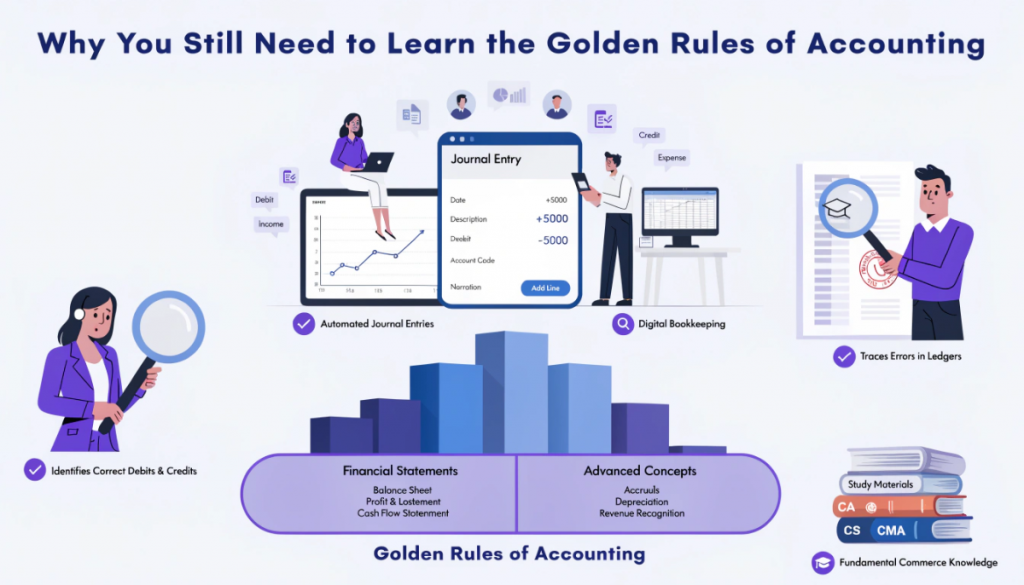
With most businesses now using accounting software that automates journal entries, it is fair to ask whether learning the golden rules of accounting by hand is even necessary anymore. The honest answer is yes, and for a few solid reasons.
- Software can only record transactions correctly if the person entering them understands which account to debit and credit, so the underlying logic still needs to sit with a human.
- Auditors, analysts and finance professionals regularly need to trace errors back to a specific entry, which is impossible without a working knowledge of how the golden rules of accounting classify each transaction.
- Every advanced accounting topic, from preparing financial statements to understanding depreciation, is built directly on top of these three rules, so skipping them creates gaps that show up later.
- Competitive exams and professional courses in commerce, including CA, CS and CMA, test these fundamentals directly since they form the base of the entire subject.
Common Mistakes Students Make With the Golden Rules of Accounting
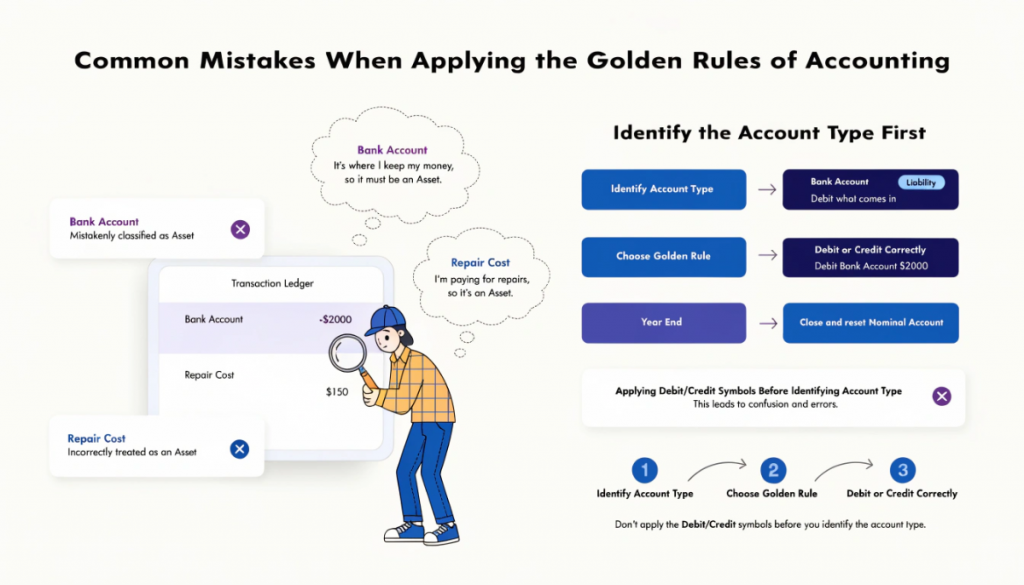
Even students who have memorized all three rules often stumble when applying them to actual transactions. A few patterns come up again and again.
- Misclassifying an account, for example treating a bank account as a real account in every situation when it actually behaves like a personal account in certain contexts.
- Confusing an expense with an asset, such as treating a repair cost as part of the asset’s value instead of recording it as a separate expense.
- Forgetting that nominal accounts reset every year, which leads to carrying forward balances that should have been closed out.
- Applying the rule mechanically without first identifying what kind of account is actually involved, which is usually where the real confusion starts.
The fix for most of these mistakes is the same, slow down and identify the account type first before deciding which side of the entry to debit or credit. Rushing straight to the rule without this first step is where most errors creep in.
How to Build a Career in Commerce and Accounting
If working with numbers and financial records genuinely interests you, commerce as a stream opens up a fairly direct path into accounting, finance and eventually roles like financial analyst, auditor or even chartered accountant. The golden rules of accounting are usually the very first serious concept taught in this journey, and getting comfortable with them early makes everything that follows noticeably easier.
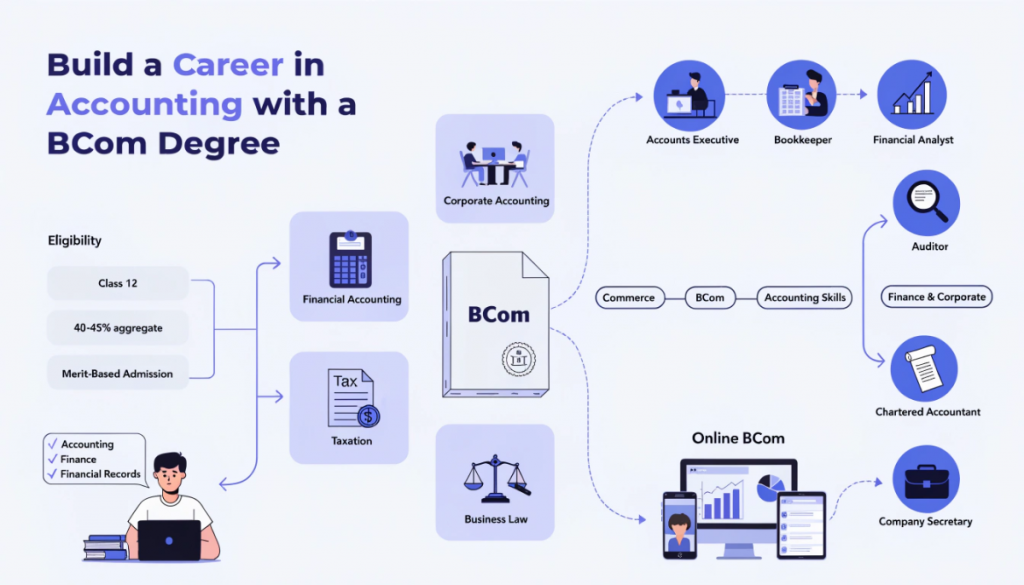
A BCom degree remains the most common starting point for students who want to build a career around these fundamentals. It covers financial accounting, corporate accounting, taxation and business law in a structured sequence, giving you a much deeper grip on concepts that the golden rules of accounting only introduce at a basic level.
Beyond the classroom, this foundation opens up a fairly wide set of career paths once you graduate, from working as an accounts executive or bookkeeper early on to eventually qualifying as a chartered accountant, company secretary or financial analyst with further specialization. Almost every one of these paths still comes back to the same starting point, knowing exactly how to classify a transaction and apply the correct golden rule to it.
If you are considering an online BCom instead of a traditional on campus one, most recognized online BCom programs in India follow a fairly similar eligibility pattern.
- Completion of class 12 or an equivalent qualification from a recognized board, in any stream.
- A minimum aggregate of around 40 to 45% in the qualifying examination, which is standard across most online undergraduate commerce programs.
- International applicants are generally asked for a slightly higher aggregate, often around 60% in their qualifying examination.
- Reservation of seats as per applicable government policy, which most universities follow for both online and on campus undergraduate programs.
Since these online programs usually admit students on merit without a mandatory entrance exam, this route works well for students who want to start building a career in commerce and accounting right after school without added pressure of a separate test, while still gaining a recognized degree that keeps doors open across finance, banking and corporate roles later.
Conclusion
The golden rules of accounting are not just something to memorize for an exam and forget, they are the actual logic that every financial record in the world is built on. Once you get comfortable identifying whether an account is personal, real or nominal, deciding what to debit and credit stops being a guessing game and starts being straightforward. Spend the time to actually understand the reasoning behind each rule instead of memorizing the three lines, and the rest of accounting as a subject becomes far easier to follow.
Whether you are a first year commerce student staring at your first ledger or someone brushing up before a professional exam, going back to these three rules whenever you feel lost is rarely a bad idea. They have not changed in decades and they are unlikely to change anytime soon, which is exactly what makes them worth learning properly the first time around.

Book Your
Free Session
Connect with our experts and get personalised guidance for your career, course selection, and future goals.
📖 Sources & References
✓ Verified 2026Verified accounting principles, double-entry bookkeeping, financial records, professional accounting standards and commerce education information based on authoritative sources.
- ICAI – Institute of Chartered Accountants of India Professional accounting standards, guidance, education and resources for accounting and finance professionals
- ICAI – Accounting Standards Accounting standards and professional guidance relating to financial reporting and accounting practices
- CBIC – Accounts and Records under GST Official requirements concerning maintenance of accounts, records and supporting financial documentation
- Income Tax Department – Maintenance of Books of Accounts Official guidance on maintaining books of accounts and financial records under Indian tax provisions
- Ministry of Corporate Affairs – Government of India Corporate reporting, financial statements, accounting and regulatory information for companies in India
- ICAI – Digital Accounting and Assurance Board Professional resources covering digital accounting, assurance, internal audit, technology and accounting practices
- Tally Solutions – Accounting Resources Practical accounting software resources covering transactions, ledgers, financial reporting and bookkeeping workflows
- National Career Service – Government of India Career information and employability resources relevant to accounting, finance and commerce careers
- Ministry of Education – Government of India Higher education policies and academic information relevant to commerce and professional education
- Shoolini Online – BCom Programmes Online commerce education and undergraduate learning options for students pursuing careers in accounting and finance