
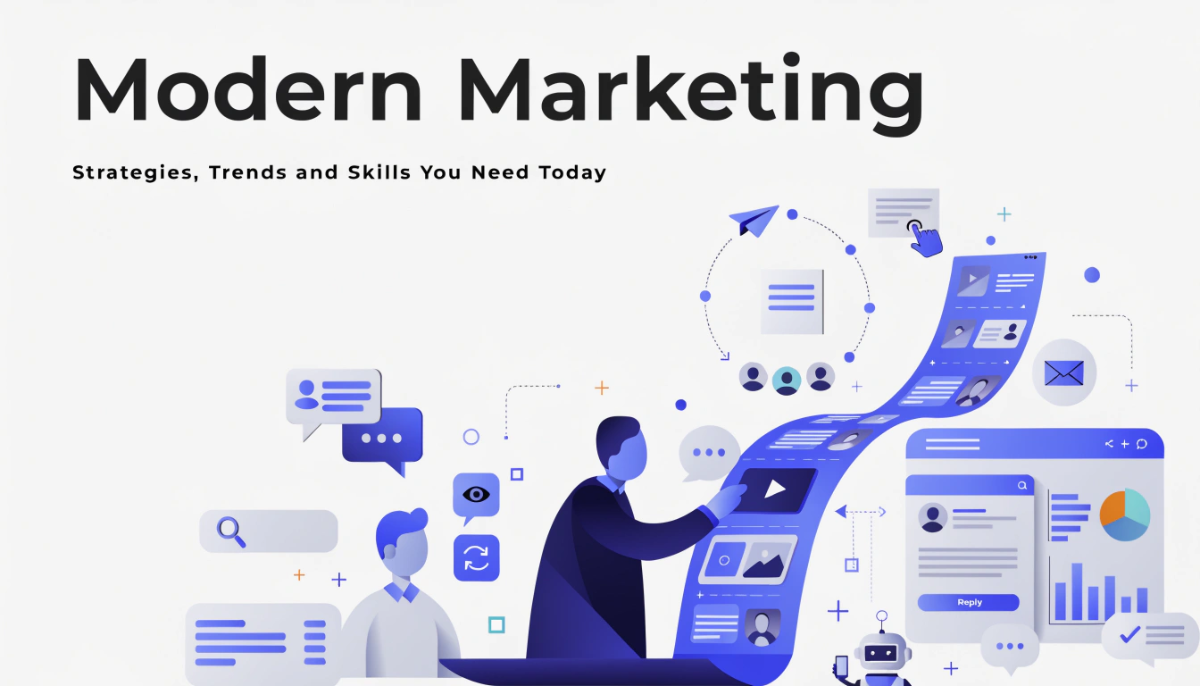
Marketing today looks nothing like it did even a decade ago and the shift has been driven almost entirely by how people research, compare and buy things now.
Modern marketing is less about pushing a message out to as many people as possible and more about showing up in the right place with the right value at the right moment. Brands that still rely purely on traditional advertising are finding it harder to compete with businesses that understand data, digital channels and changing customer behaviour. In this blog we will break down what modern marketing actually involves, how it differs from the old playbook, the channels and skills that matter most today and how you can build a career in this field if it interests you.
What Does Modern Marketing Actually Mean
Modern marketing refers to the practice of reaching and engaging customers using digital tools, data and real time feedback instead of relying only on mass advertising. It covers everything from search engines and social media to email, content and paid campaigns, all working together based on how a specific customer behaves rather than a one size fits all message.
The core idea behind modern marketing is that customers are no longer passive recipients of ads. They research products online, read reviews, compare prices across platforms and often make up their minds before a brand even gets a chance to pitch to them directly. This is why modern marketing puts so much weight on being present at the exact moment someone is searching, comparing or deciding, rather than interrupting them with a generic message.
How Modern Marketing Is Different From Traditional Marketing
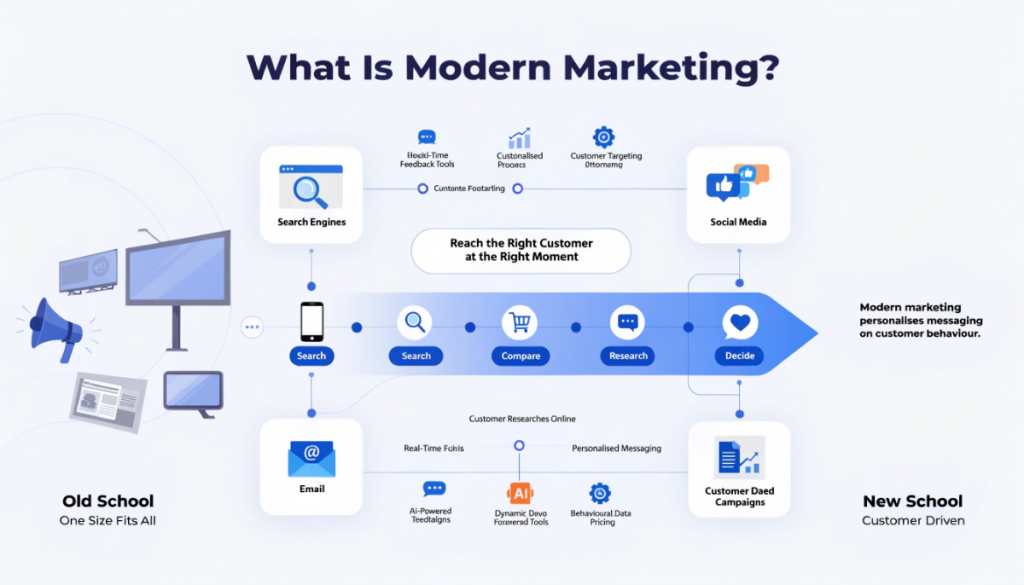
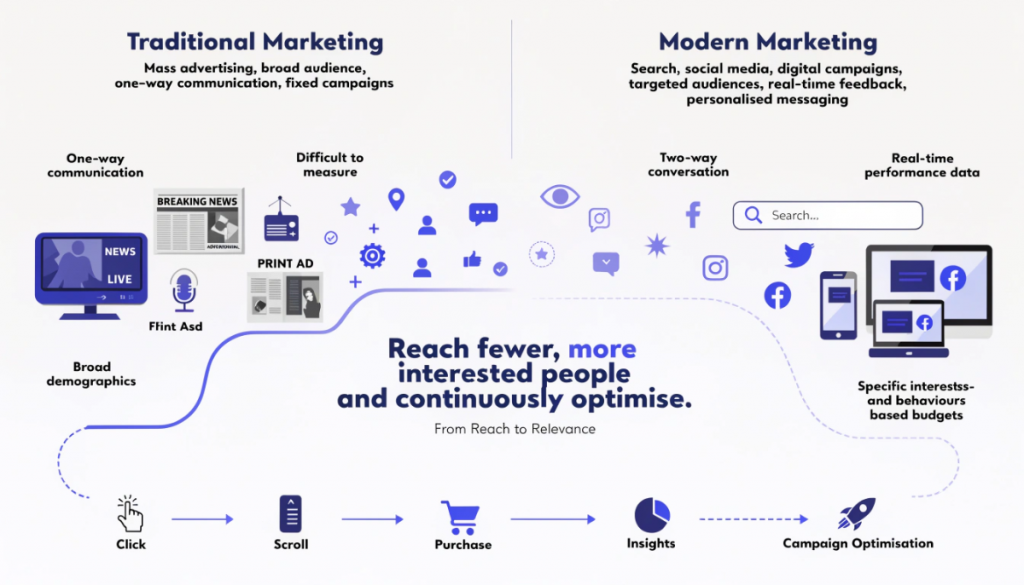
Traditional marketing worked on reach. The more people you could put an advertisement in front of through television, print or radio, the better your chances of a sale. It was largely one directional, the brand spoke and the customer listened, with very little room for immediate feedback or personalization.
This approach was not necessarily wrong for its time, television and print simply had no easy way to know who was actually watching or reading, so casting a wide net made sense. The internet changed that equation completely by giving every click, scroll and purchase a trail that marketers could follow and learn from.
Modern marketing works on relevance instead of pure reach. A campaign that performs well is one that reaches fewer but more interested people, tracks how they respond and adjusts in near real time. Data plays a central role here, every click, scroll and purchase gives marketers information they can use to refine the next message instead of guessing what worked.
- Traditional marketing is largely one way, modern marketing is a two way conversation through comments, reviews and direct messages.
- Traditional campaigns are hard to measure precisely, modern marketing gives near instant data on reach, clicks and conversions.
- Traditional marketing targets broad demographics, modern marketing targets specific behaviours and interests down to an individual level.
- Traditional marketing budgets are fixed for weeks or months, modern marketing budgets can shift daily based on what is actually performing.
Key Channels Used in Modern Marketing Today
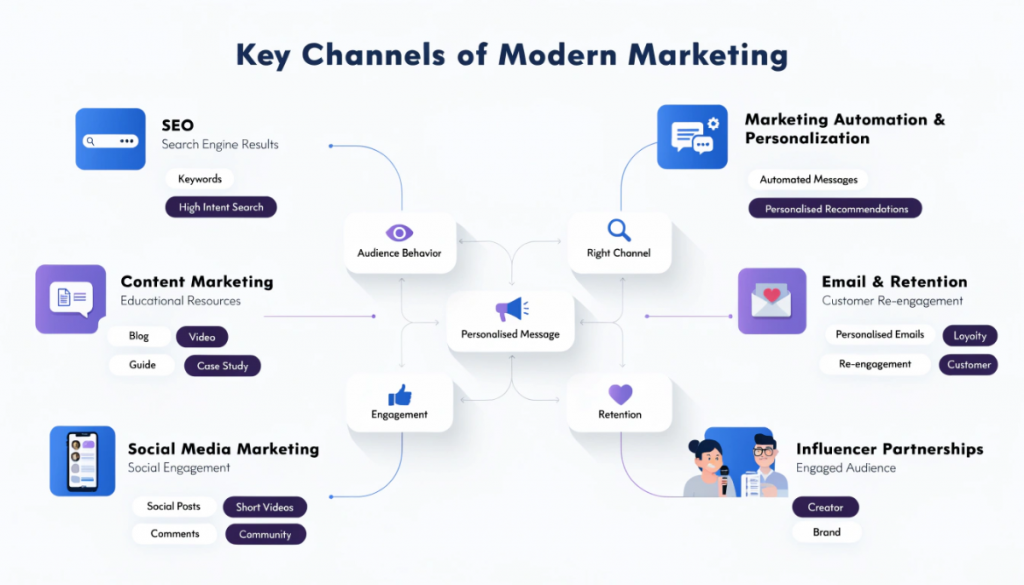
A modern marketing strategy rarely relies on a single channel. Most successful campaigns combine a few of the following, chosen based on where the target audience actually spends their time.
Search Engine Optimization
SEO helps a brand show up when someone is actively searching for a product or a solution, which makes it one of the highest intent channels in modern marketing. Ranking well takes consistent effort around content quality, website structure and backlinks, but the traffic it brings tends to convert better because people are already looking for what you offer.
Content Marketing
Blogs, videos, guides and case studies help a brand answer questions its audience is already asking, building trust long before a sales conversation even starts. Good content marketing is not about promoting a product directly, it is about being genuinely useful so the brand becomes the natural choice when the customer is finally ready to buy.
Social Media Marketing
Social platforms let brands build a personality and stay visible in a customer’s daily routine rather than only showing up during a purchase decision. Different platforms serve different purposes, a short video might drive awareness while a detailed post in a community group might drive trust and conversion.
Influencer and Creator Partnerships
Partnering with creators who already have an engaged audience allows a brand to borrow credibility instead of building it from scratch. This works especially well in modern marketing because recommendations from a familiar face tend to convert better than a direct advertisement, particularly among younger buyers.
Email and Retention Marketing
Getting a new customer is expensive, which is why modern marketing puts real effort into keeping existing customers engaged through personalized emails, loyalty programs and timely reminders. A well segmented email list often delivers a better return than a fresh round of paid ads aimed at strangers.
Email and Retention Marketing
Getting a new customer is expensive, which is why modern marketing puts real effort into keeping existing customers engaged through personalized emails, loyalty programs and timely reminders. A well segmented email list often delivers a better return than a fresh round of paid ads aimed at strangers.
Marketing Automation and Personalization
Automation tools let brands send the right message to the right customer without manually managing every single interaction, whether that is a cart abandonment reminder, a birthday discount or a re-engagement email after a period of inactivity. Personalization at this scale was simply not possible in traditional marketing, where every customer largely received the same message regardless of their individual behaviour.
Skills You Need to Succeed in Modern Marketing
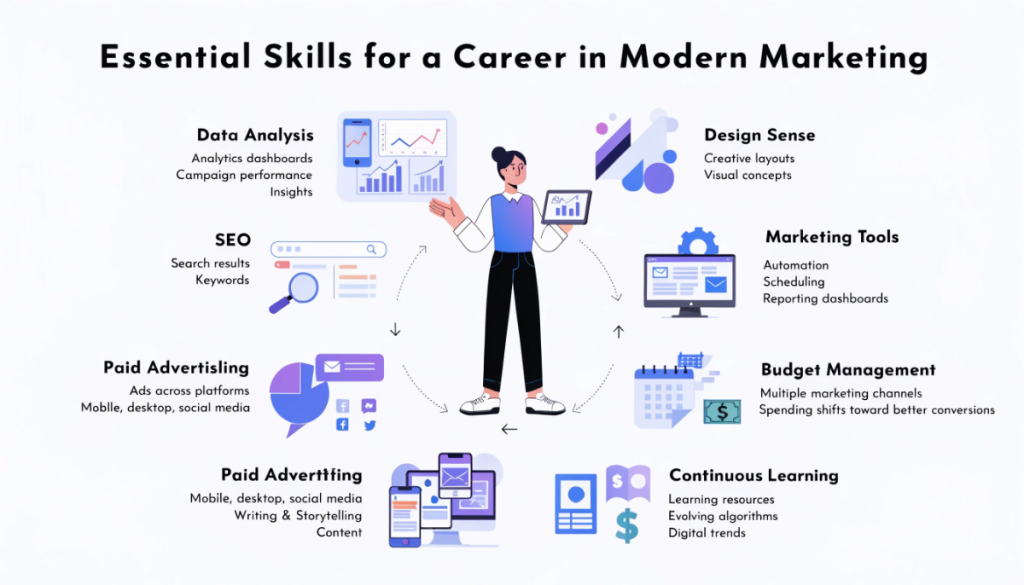
The field has moved well beyond writing catchy taglines. Anyone serious about a career in modern marketing today needs a mix of creative and analytical skills.
- Data analysis to read campaign performance and adjust strategy instead of relying on gut feeling alone.
- Basic understanding of SEO and paid advertising platforms since most campaigns now run across both organic and paid channels together.
- Strong writing and storytelling ability, since content still needs to connect emotionally even when it is backed by data.
- Comfort with marketing tools and dashboards for automation, scheduling and reporting across multiple channels at once.
- Basic design sense to brief creative work clearly, even if you are not the one designing the final visuals yourself.
- Ability to manage a budget across multiple channels and shift spending toward whatever is actually converting rather than what was originally planned.
- Willingness to keep learning, since platforms, algorithms and consumer habits in modern marketing change faster than almost any other business function.
How to Build a Career in Modern Marketing
A lot of people enter modern marketing through hands on experience, internships or by managing social media for a small business before moving into a full time role. That said, formal education still gives you a structured understanding of strategy, consumer behaviour and analytics that is hard to pick up entirely on your own.
Entry level roles usually involve executing campaigns that someone else has planned, writing social captions, scheduling posts or pulling basic performance reports. As you gain experience the role shifts toward planning the strategy itself, deciding which channels deserve budget and why, which is where a deeper understanding of consumer behaviour and analytics starts to matter far more than day to day execution skills.
An MBA with a marketing specialization is one of the more common routes for people who want to move from execution level roles into strategy and leadership positions within modern marketing teams. It typically covers branding, consumer behaviour, digital marketing and marketing analytics, giving you both the theory and the practical frameworks used in real campaigns.
If you are considering this route, most recognized online MBA programs with a marketing specialization in India follow a fairly similar eligibility pattern.
- A bachelor’s degree of at least three years duration from a recognized university in any discipline.
- A minimum of 50% aggregate marks in your qualifying degree, usually relaxed to 45% for candidates from reserved categories.
- International applicants are generally asked for a slightly higher aggregate, often around 60% in their qualifying examination.
- Reservation of seats as per applicable government policy, which most universities follow for both online and on campus programs.
Since most online MBA programs admit students on merit rather than a mandatory entrance exam, this route works well for working professionals who want to move into modern marketing roles without pausing their career for two years.
Whichever path you choose, the fastest way to grow in this field is to actually run campaigns rather than just study them. Even a small budget spent on a real product teaches you more about modern marketing than weeks of reading, since you get to see firsthand how customers respond, where they drop off and what actually gets them to convert.
Core Pillars of Modern Marketing
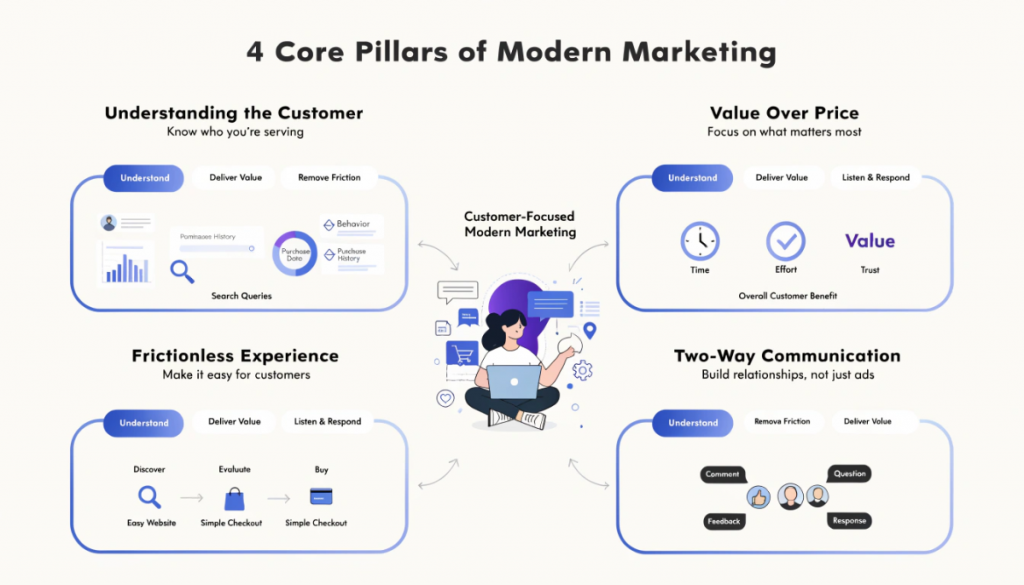
While the tools keep changing, a few core ideas hold up across every modern marketing strategy regardless of the industry. Understanding these pillars helps you evaluate whether a campaign is actually customer focused or just noise.
Understanding the Customer
Every strong modern marketing strategy starts with a clear picture of who the customer actually is, what problem they are trying to solve and what influences their decision. This goes beyond basic age and location data into behaviour, past purchases and the specific questions they search for online. Brands that skip this step usually end up creating content that looks good internally but never actually resonates with the audience it was meant for.
Value Over Price
Customers today weigh more than just the sticker price of a product. They consider the time it takes to get it, the effort involved in the buying process and whether the brand feels trustworthy enough to commit to. Modern marketing frames pricing and offers around the total value a customer receives rather than just competing on who charges less, since a lower price alone rarely wins loyalty in a crowded market.
Frictionless Experience
How easy it is to discover, evaluate and buy a product has become just as important as the product itself. A confusing website, a slow checkout or an app that keeps crashing can undo weeks of good marketing work in a single visit. Modern marketing teams work closely with product and design teams to remove friction at every step of the customer journey, from the first search to the final purchase.
Two Way Communication
Modern marketing treats communication as a conversation rather than a broadcast. Customers expect brands to respond to comments, answer questions on social media and acknowledge feedback publicly instead of staying silent. This openness builds trust faster than a polished advertisement ever could, and it also gives brands direct insight into what their audience actually wants next.
Conclusion
Modern marketing rewards brands that actually understand their customers instead of just shouting louder than everyone else. It blends data, creativity and constant experimentation across channels like SEO, content, social media and email to meet people where they already are.
Whether you are running campaigns for a business or planning a career in this space, the fundamentals stay the same, know your audience, remove friction from their journey and keep the conversation two way instead of one sided. Get these basics right and the channels and tools you use will matter far less than how well you understand the people on the other side of the screen.
The businesses that struggle the most with modern marketing are usually not the ones with small budgets, they are the ones still trying to apply an old playbook to a customer who no longer behaves the way they used to. Start with the customer, let the data guide the channel and treat every campaign as something you refine rather than something you set and forget.
Book Your
Free Session
Connect with our experts and get personalised guidance for your career, course selection, and future goals.
📖 Sources & References
✓ Verified 2026Verified marketing, digital channels, customer behaviour, SEO, marketing technology and future skills information based on authoritative professional and industry sources.
- American Marketing Association – Marketing Definition Professional marketing principles covering value creation, communication, delivery and customer-focused marketing
- Google Search Central – SEO Starter Guide Official guidance on search engine optimisation, website visibility, content and search-friendly practices
- Google Search Central – Search Documentation Official documentation covering Google Search, content visibility, Search Console and evolving search experiences
- World Economic Forum – Future of Jobs Report 2025 Research on changing workforce requirements, technology, analytical thinking, creative thinking and emerging skills
- World Economic Forum – Skills Outlook 2025 Insights into technological literacy, analytical thinking, creative thinking and the changing importance of marketing and media skills
- National Career Service – Government of India Career information, employability resources and professional development guidance for marketing and other business careers
- NASSCOM FutureSkills Industry-focused information on emerging technologies, future skills and workforce development
- UGC – University Grants Commission Official higher education regulations, degree recognition and academic standards in India
- UGC – Distance Education Bureau Official information on recognised and entitled institutions and online and ODL programmes
- Shoolini Online – MBA Programmes Online MBA education and management learning options relevant to marketing and business careers