


BCom is one of the most common degrees students pick right after class 12 and it opens doors in accounting, banking and finance almost immediately.
But a growing number of commerce graduates want more than an entry level job and that is where an MBA after BCom fits in perfectly. It builds on the commerce foundation you already have and adds leadership, strategy and decision making skills on top of it. In this blog we will look at why MBA after BCom makes sense, which specializations suit commerce graduates the most, the eligibility criteria you need to meet and the career paths that open up once you complete the course.
Does an MBA After BCom Actually Make Sense?
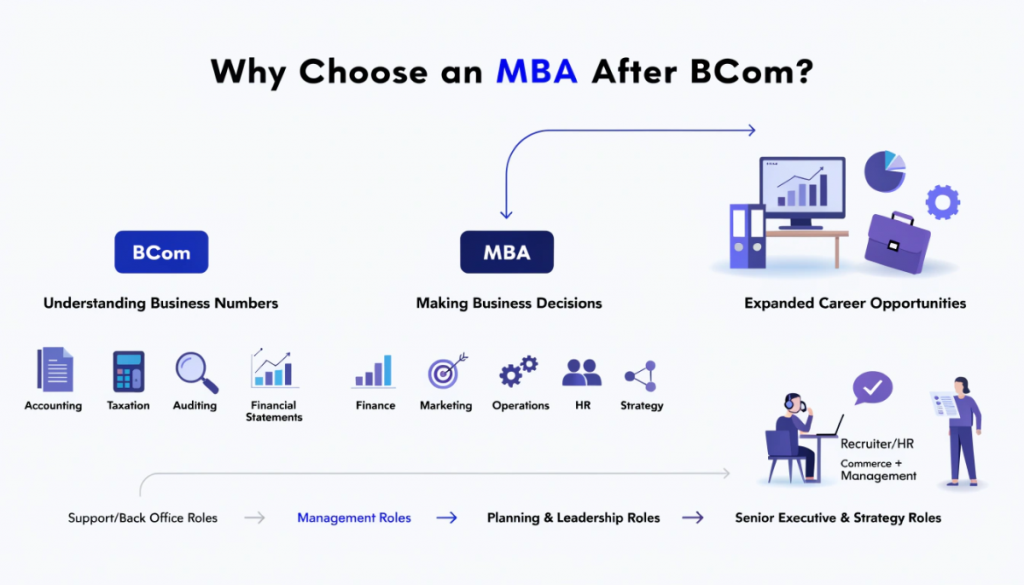
A BCom degree teaches you how numbers work. You understand accounts, taxation, auditing and financial statements in detail. What it does not teach you is how a business is actually run from the top. An MBA fills that exact gap. It takes your commerce base and adds management thinking to it so you can move from recording business decisions to actually making them.
This is why MBA after BCom is such a popular combination among Indian students. The commerce background gives you an edge in core MBA subjects like finance and accounting while the MBA itself widens your scope into marketing, operations, human resources and strategy. You are no longer limited to back office or support roles. You become eligible for roles that involve planning, leading teams and taking business calls.
There is also a practical angle to this. Recruiters hiring for management trainee or leadership development programs almost always prefer candidates with a postgraduate management degree over a plain bachelor’s degree, even if the work itself involves finance. An MBA after BCom essentially tells an employer that you understand both the numbers side of business and the people and strategy side, which is a combination that is hard to find in a fresh graduate.
What Changes When You Move From BCom To MBA
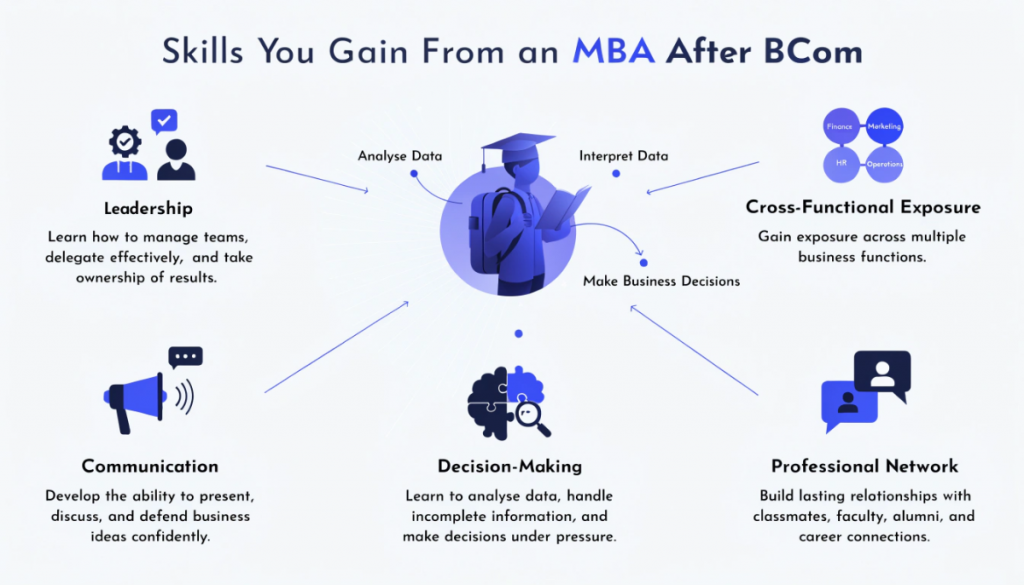
The shift is not just academic, it changes the way you approach problems at work. BCom trains you to look at data and follow set rules. An MBA trains you to interpret that data and decide what to do next. Here is what you gain along the way.
- Leadership skills: You learn how to lead a team, delegate work and take responsibility for outcomes, which is something a commerce degree does not really cover on its own.
- Cross functional exposure: An MBA exposes you to marketing, HR, operations and strategy along with finance so you stop thinking in silos and start understanding how one department affects another.
- Better communication: Case studies, group projects and presentations sharpen how you explain ideas and defend decisions in front of a room, a skill that matters a lot once you reach management level.
- Sharper decision making: You get trained to make calls with incomplete information under time pressure, which mirrors how real business decisions actually get made.
- A wider professional network: Batchmates, faculty and alumni from an MBA program often turn into long term contacts that help with job referrals and business opportunities later.
Best MBA Specializations for Commerce Graduates
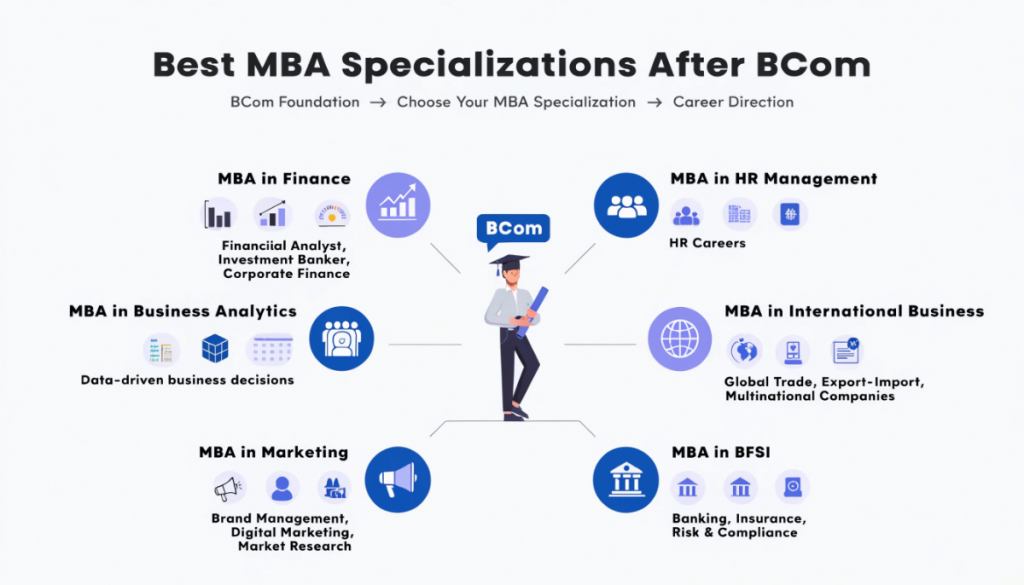
Since BCom already gives you a strong number sense, most graduates lean toward specializations that build directly on that base. That said, an MBA is also a good chance to branch out into something new if a particular field excites you more than accounting does.
MBA in Finance
This is the most natural pick after BCom because your undergraduate subjects already overlap with financial management, investment analysis and risk assessment. It suits students aiming for roles like financial analyst, investment banker or corporate finance manager.
MBA in Business Analytics
If you enjoyed working with numbers and spreadsheets during BCom, business analytics takes that interest further by teaching you to read data, spot patterns and support decisions with evidence rather than guesswork. Demand for this specialization has grown fast across industries.
MBA in Marketing
For commerce graduates who are good communicators and enjoy understanding consumer behaviour, marketing opens up roles in brand management, digital marketing and market research. It is a strong pick if you want to move away from pure numbers work.
MBA in Human Resource Management
HR specialization suits students who are people oriented and want to work on hiring, training and organizational culture rather than balance sheets. It is one of the more stable specializations with consistent demand across every industry.
MBA in International Business
This is ideal if you are interested in global trade, export import operations and working with multinational companies. It pairs well with the accounting and taxation basics that a BCom already gives you.
MBA in Banking, Financial Services and Insurance
Often shortened to BFSI, this specialization is built specifically for the banking and insurance sector and works well for commerce graduates who want to stay close to finance while also learning risk and compliance.
Full Time MBA vs Online MBA After BCom
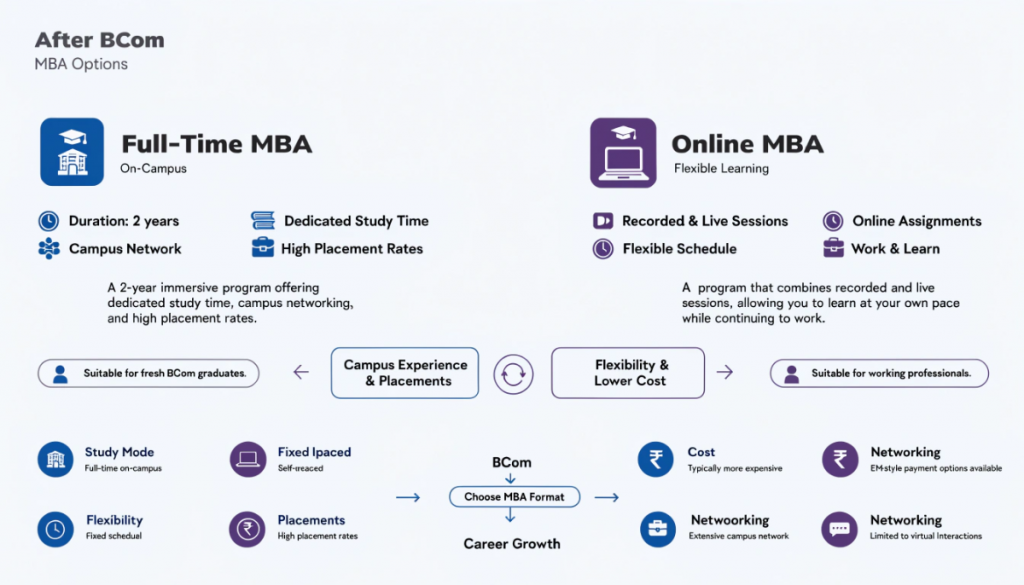
Once you decide to go ahead with an MBA after BCom the next question is usually the format. A full time on campus MBA works best if you can dedicate two years entirely to studies and want the placement support and campus network that comes with it. It suits students who have just finished BCom and do not yet have a job locking them into a city.
An online MBA works better if you are already working or cannot afford a two year break from income. You study at your own pace through recorded and live sessions, submit assignments online and appear for exams either online or at designated centres depending on the university. The degree carries the same academic value as long as the university offering it is UGC approved, and the flexibility lets you apply what you learn at work immediately instead of waiting until graduation.
Cost is another factor worth comparing. Full time MBA programs at reputed colleges can run into several lakhs once you add hostel and other expenses, while online MBA programs are usually priced lower and allow EMI style payment options, which makes the MBA after BCom decision easier for students who are budget conscious.
Entrance Exams You Need for MBA After BCom
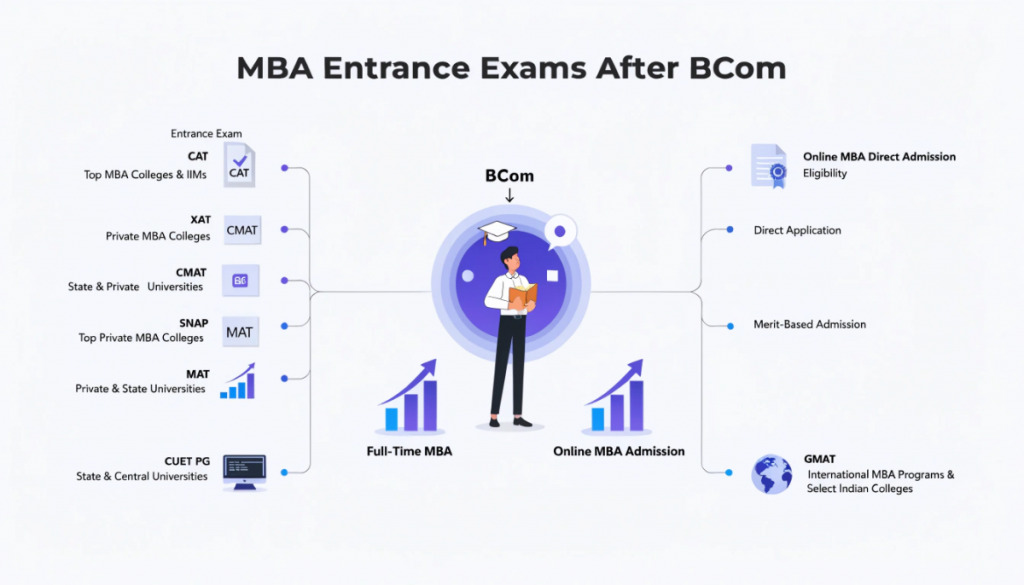
Most full time MBA programs in India ask for an entrance exam score before you can apply. The exam you pick usually depends on the type of college and program you are targeting.
- CAT is the most widely accepted exam for top MBA colleges in India and is conducted once a year by the IIMs.
- XAT, CMAT, SNAP and MAT are accepted by a large number of private and state universities and are generally considered easier to crack than CAT.
- CUET PG has become a common route for MBA admission into several state and central universities.
- GMAT is required mainly if you are applying to MBA programs abroad or to a handful of Indian colleges that accept international scores.
If you are considering an online MBA instead of a full time campus program, many universities offer direct or merit based admission without an entrance exam, provided you clear their own internal eligibility and admission criteria. This route works well for working professionals who cannot take a break to prepare for CAT or similar exams.
Eligibility Criteria for MBA After BCom
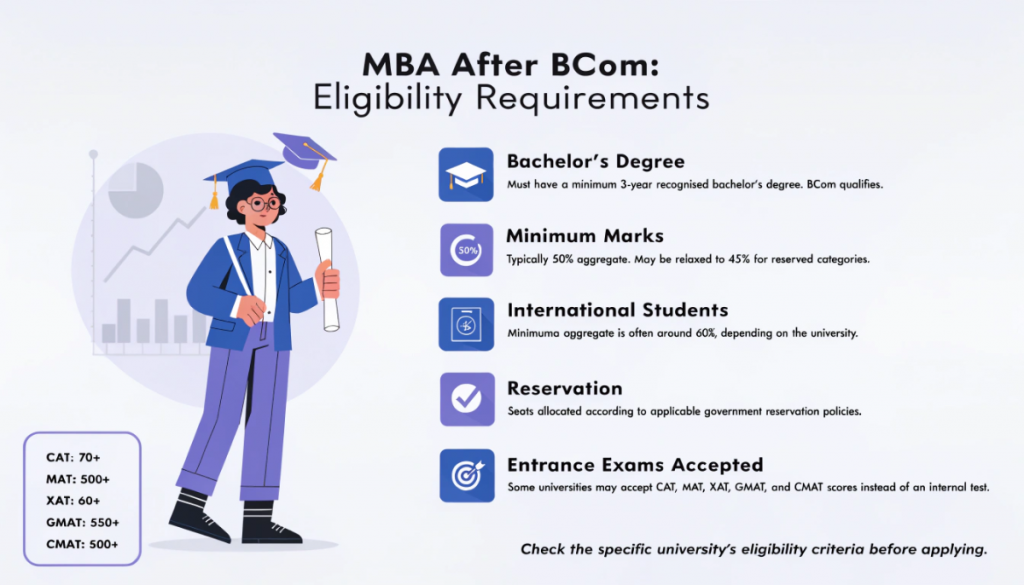
Eligibility rules vary slightly from one university to another but most online and distance MBA programs in India follow a fairly similar pattern. Here is what you can typically expect.
- A bachelor’s degree of at least three years duration from a recognized university, which a BCom already satisfies.
- A minimum of 50% aggregate marks in your qualifying degree, usually relaxed to 45% for candidates from reserved categories.
- International students are generally asked for a slightly higher aggregate, often around 60% in their qualifying examination.
- Reservation of seats as per applicable government policy, which most recognized universities follow for online and on campus programs alike.
Some universities also accept a valid CAT, MAT, XAT, GMAT or CMAT score in place of their own internal admission test, so it is worth checking the specific admission page of the program you are applying to before you assume you need to sit for a fresh exam.
Conclusion
An MBA after BCom is one of the most practical postgraduate choices a commerce graduate can make. It takes the financial foundation you already built during your undergraduate years and adds the management, leadership and decision making skills that employers actively look for in senior roles. Whether you choose finance, marketing, analytics or HR as your specialization, the degree opens up a career path that a BCom alone simply cannot offer. If you meet the eligibility criteria and pick a specialization that matches your interest, MBA after BCom can genuinely change the direction of your career.

Book Your
Free Session
Connect with our experts and get personalised guidance for your career, course selection, and future goals.
📖 Sources & References
✓ Verified 2026Verified higher education, MBA eligibility, online learning, management education and career information based on official regulatory, government and professional sources.
- UGC – University Grants Commission Official higher education regulations, degree recognition and academic standards in India
- UGC – Distance Education Bureau Official information on recognised and entitled institutions and online and ODL programmes
- UGC – Equivalence of Online and Conventional Degrees Regulatory information on the equivalence of recognised online and ODL degrees with corresponding conventional degrees
- Ministry of Education – Government of India National higher education policies, management education frameworks and academic development initiatives
- National Testing Agency – CAT Information Official examination and admission information relevant to postgraduate management education in India
- NASSCOM FutureSkills Industry-focused information on emerging technologies, future job roles, professional skills and workforce development
- National Career Service – Government of India Career information, employability guidance and professional development resources for graduates
- World Economic Forum – Future of Jobs Report Research on business skills, leadership, analytical thinking, technology and changing workforce requirements
- Shoolini Online – MBA Programmes Online MBA education, specialisations and flexible postgraduate management learning options