
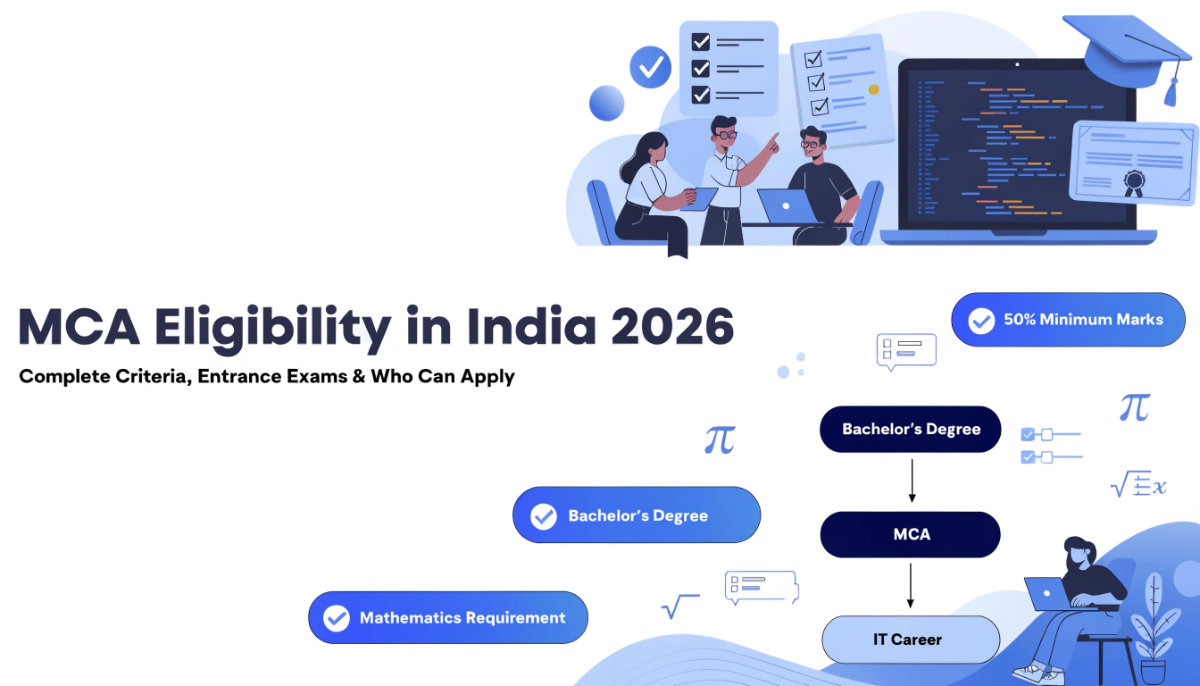
MCA eligibility in India is one of the first things every aspiring student searches for and rightfully so because understanding exactly who can apply, what percentage is required and whether your undergraduate degree qualifies saves weeks of uncertainty before the admission process begins.
The MCA or Master of Computer Applications is now a two-year programme under the National Education Policy 2020 and the eligibility criteria have been updated at most Indian institutions to match this revised structure. The core MCA eligibility requirement across India is a bachelor’s degree from a recognised university with at least 50 percent marks but the specific conditions around Mathematics background, acceptable undergraduate streams and entrance examination requirements vary between on-campus and online programmes.
This guide breaks down the complete MCA eligibility criteria clearly, covers what different undergraduate backgrounds mean for your eligibility and explains how online MCA programmes have opened up access for candidates who may not meet the stricter requirements of NIT-level programmes.
The Core MCA Eligibility Requirements That Apply Everywhere
Before looking at institution-specific or programme-specific criteria, it helps to understand the baseline entry conditions that are consistent across most Indian programmes offering the degree.
Minimum Educational Qualification
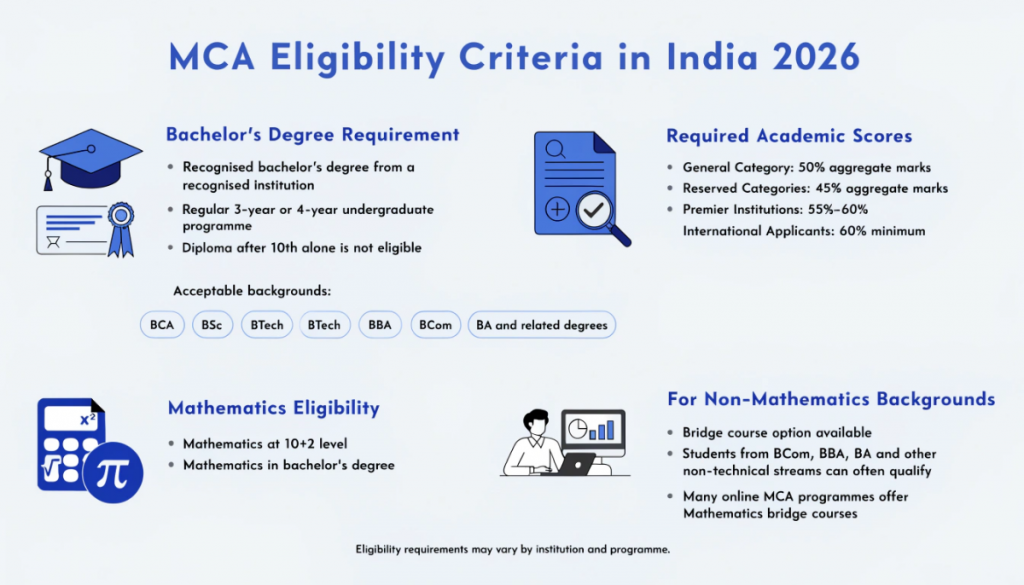
The minimum educational qualification for MCA eligibility across India is a bachelor’s degree from a recognised institution. The degree must be a regular three-year or four-year undergraduate programme. Candidates who hold a three-year diploma after 10th standard are not eligible unless they have subsequently completed a full bachelor’s degree.
The undergraduate degree can be in any discipline including BCA, BSc Computer Science, BSc IT, BSc Mathematics, BTech, BBA, BCom or BA depending on the institution you are applying to.
Minimum Percentage for MCA Eligibility
The minimum percentage required for MCA eligibility varies by programme type:
50 percent aggregate marks in the qualifying bachelor’s degree is the standard minimum for most Indian MCA programmes in 2026
45 percent is the minimum for reserved category candidates including SC, ST and OBC applicants at most institutions
55 to 60 percent is required for competitive on-campus programmes at premier technical institutions
60 percent is the minimum for international students applying to MCA programmes in India
The percentage is calculated on the aggregate of all subjects across all semesters or years of the bachelor’s degree
Mathematics Requirement
The Mathematics requirement is the most frequently asked question in MCA eligibility because it directly affects whether students from non-technical or commerce and arts backgrounds can apply. Here is how it typically works:
Mathematics as a subject at the 10+2 level satisfies the Mathematics requirement at most Indian MCA programmes
Mathematics studied as a compulsory or elective subject during the bachelor’s degree also satisfies the requirement
Candidates who have neither of the above may be required to complete a bridge course in Mathematics before or alongside the MCA programme
A bridge course provision makes online MCA programmes more accessible than on-campus ones for candidates from BCom, BBA, BA or arts backgrounds who did not study Mathematics beyond 10th standard
The bridge course option is particularly important for understanding MCA eligibility in a broader context. Many online MCA programmes explicitly include bridge support for candidates without a Mathematics background as a condition of their eligibility framework.
This means that students from non-technical streams are not automatically excluded from MCA but are required to build this foundational knowledge as part of their programme.
MCA Eligibility Through Entrance Examinations
For competitive on-campus MCA programmes admission is not just about meeting the eligibility criteria but also about clearing an entrance examination. Here is how the major MCA entrance examinations work and what they require.
NIMCET for NIT MCA Admissions
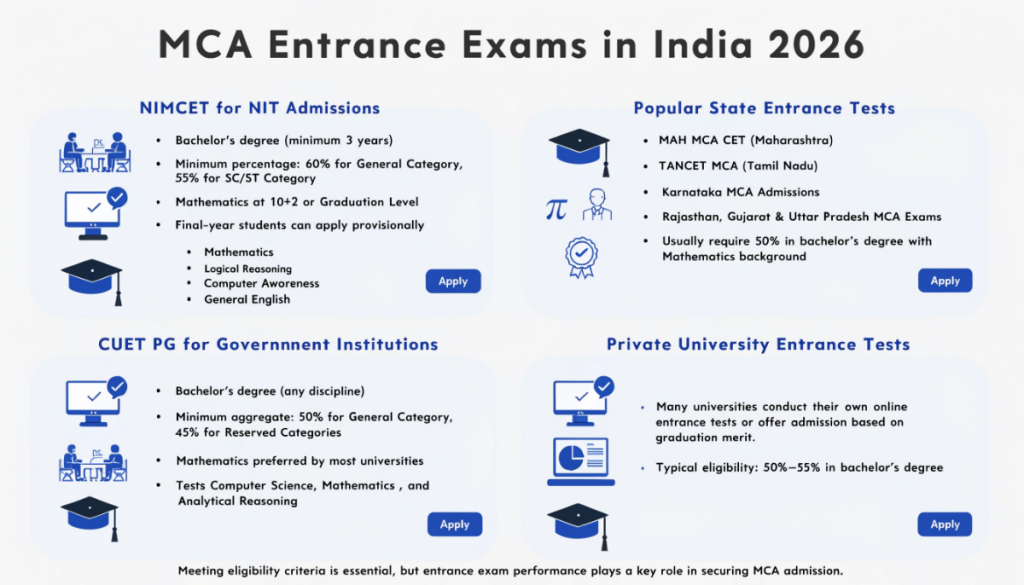
NIMCET is the National Institutes of Technology MCA Common Entrance Test and it is the most competitive gateway to MCA in India. The NIMCET requirements are:
Bachelor’s degree of minimum three years from a recognised university
Minimum 60 percent aggregate marks for general category candidates
Minimum 55 percent for SC and ST category candidates
Mathematics as a compulsory subject at 10+2 level or at the graduation level
Candidates in the final year of their bachelor’s degree can also appear for NIMCET provisionally
NIMCET tests candidates on Mathematics, Analytical Ability and Logical Reasoning, Computer Awareness and General English. The examination is conducted once a year typically in May and scores are valid only for the current admission cycle. Meeting the MCA eligibility criteria for NIMCET is the first step but a competitive score in the examination is what actually determines admission to NIT programmes.
CUET PG for Government Institution MCA Programmes
The Common University Entrance Test for Postgraduate programmes is the standardised admission route for government institutions across India. The requirements for CUET PG are:
A bachelor’s degree from any recognised institution with 50 percent aggregate for general category
45 percent for reserved category candidates
Mathematics at 10+2 or undergraduate level is preferred and specified by most central universities participating in CUET PG
The CUET PG MCA paper tests computer science fundamentals, mathematics and analytical reasoning
State-Level MCA Entrance Examinations
Several states conduct their own MCA entrance examinations with state-specific admission criteria. Common examples across India include:
Maharashtra conducts MAH MCA CET for state MCA admissions requiring 50 percent in any bachelor’s degree with Mathematics at 10+2
Tamil Nadu’s TANCET for MCA requires 50 percent in any undergraduate degree and considers Mathematics performance separately
Karnataka, Rajasthan, Gujarat and Uttar Pradesh each conduct their own MCA entrance examinations with similar eligibility thresholds
Most state-level examinations accept candidates whose MCA eligibility is based on any bachelor’s degree stream as long as the percentage requirement is met
Institution-Specific Entrance Tests
Private universities and deemed institutions conduct their own entrance tests for MCA admission. The MCA eligibility criteria at these institutions typically require 50 to 55 percent in a bachelor’s degree from any discipline.
Some conduct online tests through their own platforms while others conduct admission through merit in the qualifying degree without a separate entrance examination. Online MCA programmes in particular often use a multiple-choice entrance test administered through the institution’s digital portal as part of their streamlined admission process.
MCA Eligibility Based on Your Undergraduate Degree
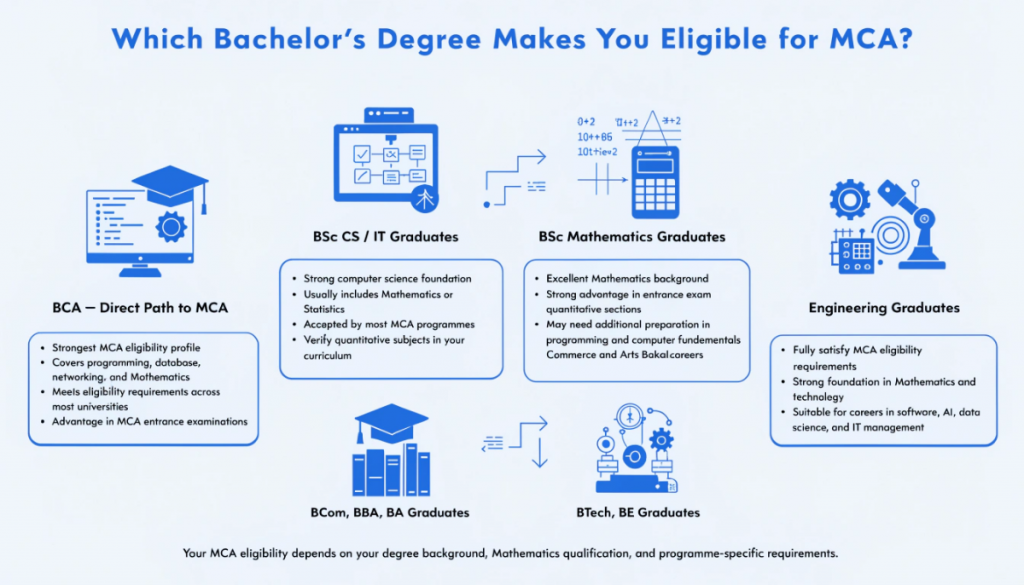
Your undergraduate background determines how smoothly your MCA eligibility is established. Here is a clear breakdown for every common undergraduate profile.
BCA Graduates
BCA graduates have the strongest and most straightforward MCA eligibility profile. The BCA includes Mathematics, data structures, programming, database management and computer networking which directly satisfy both the academic qualification requirement and the Mathematics prerequisite at virtually all MCA programmes.
BCA graduates also have a genuine academic advantage in MCA entrance examinations because the first-year MCA curriculum overlaps significantly with BCA content. If you have a BCA with 50 percent or above your eligibility is typically clear across all programme types without any additional conditions.
BSc Computer Science and BSc IT Graduates
BSc Computer Science and BSc IT graduates are equally well-positioned to apply. Their undergraduate curriculum includes programming, computer networks, databases and usually either Mathematics or Statistics as a subject.
Most universities treat BSc CS and BSc IT graduates as satisfying the Mathematics requirement since these programmes typically include at least one quantitative paper. The one thing to verify is whether your specific BSc programme at your specific institution included a Mathematics or Statistics paper since this varies between institutions and affiliated colleges.
BSc Mathematics Graduates
BSc Mathematics graduates have the strongest possible Mathematics background for MCA eligibility which is a genuine advantage in the quantitative sections of entrance examinations like NIMCET and CUET PG.
The gap for BSc Mathematics students is typically in the computer science and programming sections of entrance tests since their undergraduate programme did not cover these topics. If you are a BSc Mathematics student preparing to apply you should complement your existing Mathematics strength with self-study in C programming, data structures, operating systems and computer fundamentals before appearing for entrance examinations.
BCom, BBA and BA Graduates
BCom, BBA and BA graduates can absolutely pursue MCA but their eligibility depends on one critical factor: whether they studied Mathematics at the 10+2 level. Students who had Mathematics in Class 11 and 12 generally meet the Mathematics prerequisite for MCA eligibility at most programmes.
Those who did not have Mathematics at 10+2 need to look for programmes that offer a bridge course. Online MCA programmes specifically address this by including bridge course support as part of their framework allowing BCom, BBA and BA graduates to pursue MCA without being excluded due to their 12th standard subject choices.
BTech and BE Graduates
BTech and BE graduates satisfy the eligibility bar at every programme type across India without exception. Their four-year engineering degree includes Mathematics, programming and technical subjects that exceed the MCA eligibility requirements.
BTech graduates typically pursue MCA when they want to pivot from their engineering specialisation toward software development, data science, AI or IT management roles. Their strong quantitative background makes them competitive in MCA entrance examinations across all sections.
Online MCA Eligibility: What Changes and What Stays the Same
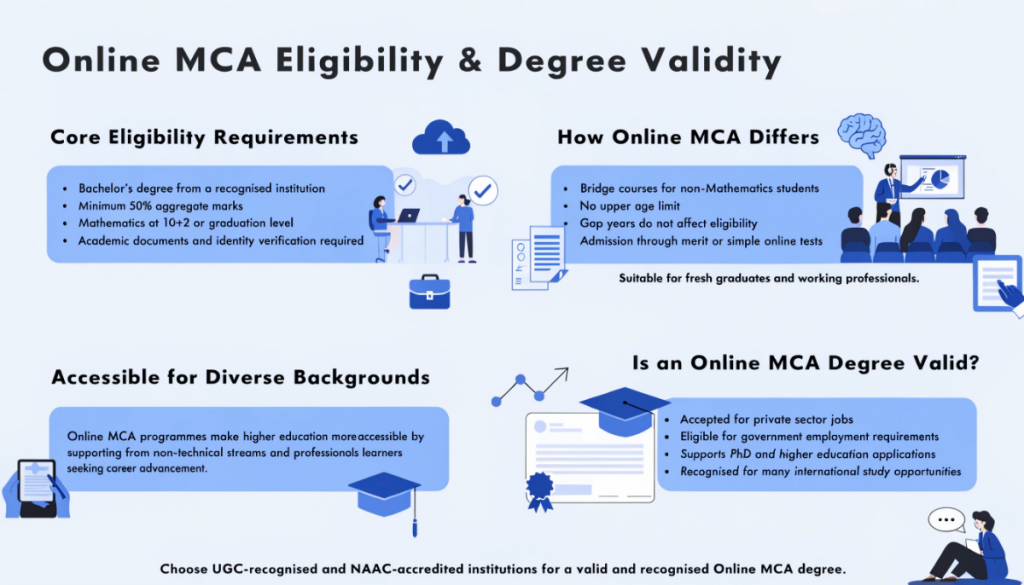
Online MCA programmes approved by UGC from NAAC-accredited institutions have become a genuine and recognised path for students and working professionals who cannot pursue an on-campus MCA. Understanding how MCA eligibility works for online programmes is important because there are meaningful differences from the on-campus route.
The Core Eligibility Remains the Same
The fundamental MCA eligibility requirements for online programmes are identical to those for regular on-campus programmes. You still need:
A bachelor’s degree from a recognised institution
Minimum 50 percent aggregate marks as the standard threshold
Mathematics background at 10+2 or graduation level as preferred or as a bridge course requirement
Valid identity documents and academic certificates
What Online MCA Programmes Do Differently
Online MCA programmes differ from on-campus ones in how they handle specific eligibility conditions:
Bridge courses for candidates without a Mathematics background are formally integrated into online MCA programmes making them accessible to non-technical graduates
There is no upper age limit for online MCA eligibility making it accessible to working professionals at any career stage
Gap years between the bachelor’s degree and MCA application do not affect online MCA eligibility
Many online MCA programmes conduct admission through merit in the qualifying degree or through a simple online entrance test rather than requiring candidates to appear in a national-level examination like NIMCET
Online programmes are open to both fresh graduates and working professionals simultaneously
Is the Online MCA Degree Valid
This is one of the most asked questions about online MCA eligibility and the answer is clear. Online MCA degrees from UGC-recognised and NAAC-accredited institutions are valid for:
Private sector employment across IT services, product companies and startups
Government job eligibility where MCA is specified as a qualifying degree
PhD programme applications at several Indian universities
Higher education applications abroad where UGC-recognised Indian degrees are accepted
Documents You Need to Establish MCA Eligibility
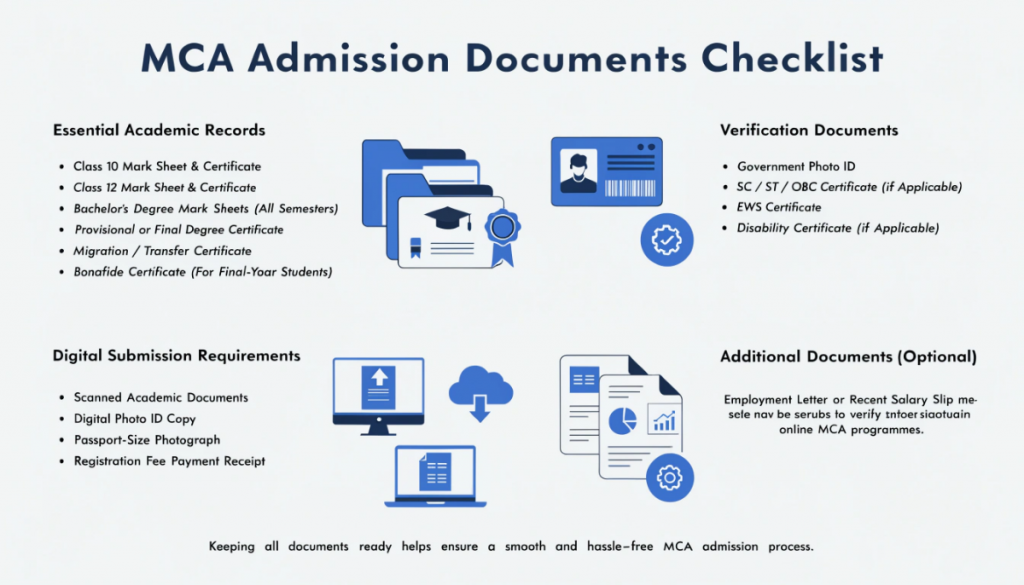
Meeting MCA eligibility criteria is one thing but having the right documents ready for verification is equally important. Missing or incorrect documents are one of the most common reasons for application delays.
Essential Academic Documents
Class 10 mark sheet and passing certificate showing date of birth and subjects studied
Class 12 mark sheet and passing certificate showing Mathematics as a subject if applicable for your claim
All semester-wise or year-wise mark sheets from your bachelor’s degree
Bachelor’s degree provisional certificate or final degree certificate from your issuing institution
Migration or transfer certificate from the last institution you attended
If you are in the final year of your bachelor’s degree a bonafide student certificate stating expected date of completion
Identity and Category Documents
Valid government-issued photo ID such as Aadhaar card, PAN card or passport
Category certificate for SC, ST or OBC category if you are claiming reserved category benefits under MCA eligibility criteria
EWS certificate if applying under Economically Weaker Section reservation
Disability certificate if applicable for persons with disability reservation
For Online MCA Applications
Online MCA admissions are fully digital and documents are submitted as scanned copies. The typical document requirement for online MCA eligibility verification includes:
Scanned colour copies of all academic mark sheets and degree certificates at a specified resolution
Government-issued photo ID in digital format
Recent passport-size photograph in digital format
Payment confirmation for the programme registration fee
For working professionals an employment letter or salary slip may be requested to confirm professional status though this is typically optional rather than mandatory
Common Questions About MCA Eligibility Answered Clearly
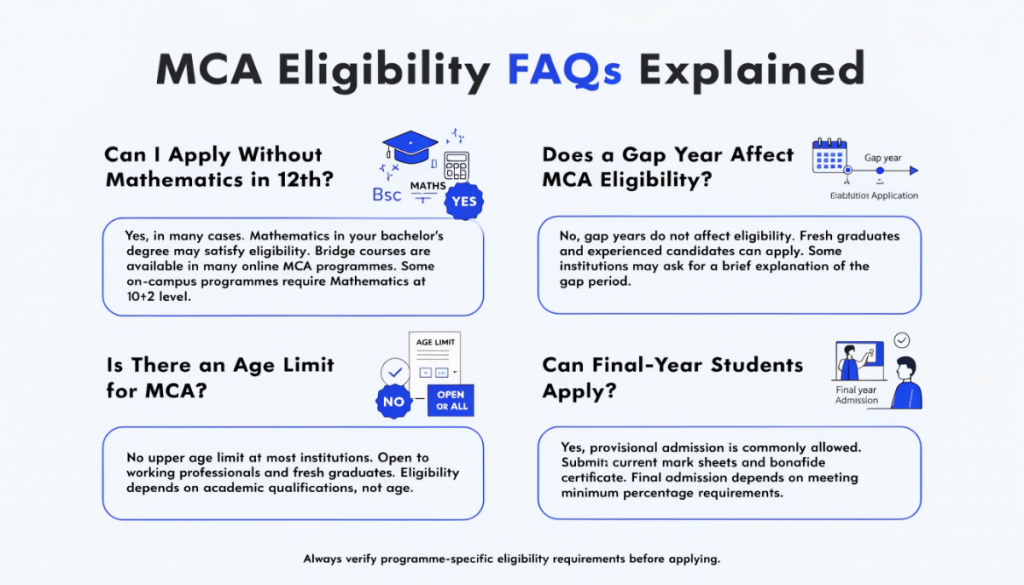
These are the questions most frequently asked by students navigating MCA eligibility for the first time.
Can I Apply for MCA Without Mathematics at 12th Level
Yes you can in most cases but with conditions. If you studied Mathematics as part of your bachelor’s degree programme even as an optional or elective subject that typically satisfies the Mathematics requirement at most institutions.
If you did not study Mathematics at 12th level or in your undergraduate degree you need to look specifically for programmes that offer a bridge course in Mathematics as part of their MCA eligibility framework. Online MCA programmes are generally more accommodating of this situation than competitive on-campus programmes where Mathematics at 12th level is often a strict requirement.
Does a Gap Year Affect MCA Eligibility
A gap year between your bachelor’s degree and your MCA application does not disqualify you at most Indian institutions. There is no rule preventing candidates who graduated one, two or even five years ago from applying for MCA.
If there is a significant gap some institutions may ask for a self-declaration or brief explanation of activities during the gap period as part of the admission form but this does not affect the eligibility itself. For online MCA programmes specifically gap years are entirely irrelevant to the eligibility determination.
Is There an Age Limit for MCA
There is no upper age limit for MCA eligibility in India for the vast majority of programmes. Both fresh graduates and working professionals of any age can apply as long as they meet the educational qualification and percentage requirements.
The minimum threshold is simply the age at which someone could realistically have completed a three-year bachelor’s degree which is typically around 20 to 21 years depending on when they started their schooling.
Can Final Year Students Apply for MCA
Yes. Students currently in the final year or final semester of their bachelor’s degree can apply for MCA at most institutions. They are required to submit their existing mark sheets and a bonafide letter from their current institution as part of the eligibility verification.
Provisional admission is typically granted subject to the condition that the student completes their bachelor’s degree with the required minimum percentage before the MCA programme begins. If the final percentage falls below the MCA eligibility threshold the provisional admission is cancelled.
Conclusion
MCA eligibility in India in 2026 comes down to three core requirements that apply across virtually every programme type: a recognised bachelor’s degree, a minimum of 50 percent aggregate marks and either Mathematics at 10+2 or graduation level or access to a bridge course that addresses this gap.
Competitive on-campus programmes through NIMCET and CUET PG have stricter percentage requirements and tighter Mathematics prerequisites while online MCA programmes offer more accessible entry conditions without compromising on the validity of the final degree.
Understanding your eligibility profile clearly before applying saves time and allows you to target the right type of programme.Whether you are a BCA graduate applying for a top NIT programme through NIMCET, a BCom graduate considering an online MCA with bridge course support or a working professional re-entering education after several years, MCA eligibility criteria are designed to be met by a wide range of candidates and the two-year programme structure under NEP 2020 makes the timeline more efficient than ever before.

Book Your
Free Session
Connect with our experts and get personalised guidance for your career, course selection, and future goals.
📖 Sources & References
✓ Verified 2026Verified MCA eligibility criteria, admission requirements, entrance examinations, online MCA regulations and programme validity references based on recognised educational and regulatory sources.
- UGC India Online and regular postgraduate degree regulations, eligibility norms and higher education guidelines
- Ministry of Education National Education Policy reforms, postgraduate programme structures and academic framework updates
- AICTE Technical education standards, MCA programme guidelines and employability initiatives
- NIMCET Official National MCA entrance examination eligibility, admission process and examination framework
- CUET PG Postgraduate entrance examination eligibility, admission criteria and application guidelines
- National Testing Agency Entrance examination administration, admission procedures and candidate information resources
- National Career Service Career pathways in information technology, software development and computer applications
- NASSCOM Technology sector hiring trends, digital skills demand and future workforce reports
- Shoolini Online Online MCA eligibility guidance, admission support and programme information
- Distance Education Bureau Recognition framework for online and distance learning programmes in India