

If you have just finished class 12 and you are thinking about a management degree, the first thing you should check is the BBA eligibility criteria. Every college sets its own rules for marks, stream and entrance exams so it is easy to get confused about what actually applies to you. This blog breaks down the BBA eligibility criteria in plain language so you know exactly where you stand before you start filling out application forms. We will go through the basic qualification, the percentage required, the stream rules, age limit, entrance exams and a few extra conditions that often get missed.
Basic Qualification Needed to Meet BBA Eligibility
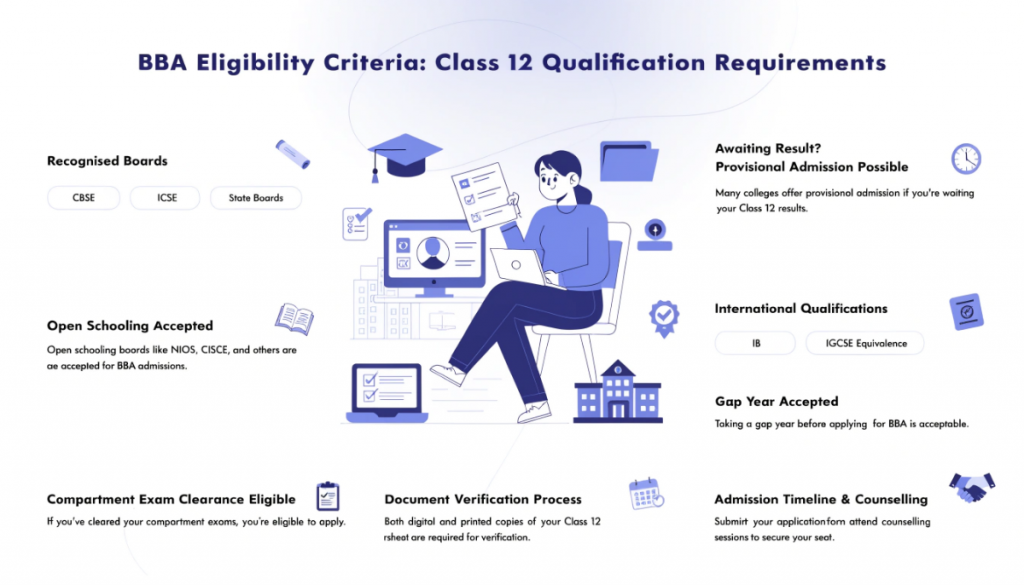
The most important part of BBA eligibility criteria is your class 12 result. Here is what you need to keep in mind on this front:
You need to have passed your 10+2 from a recognised board such as CBSE, ICSE or any state board
It does not matter if you studied at a regular school or through open schooling, as long as the board is recognised the qualification counts
Your board marksheet is the main document and nothing extra is required at the qualification stage in most cases
If you are currently in class 12 and waiting for your result, you can still apply to most colleges as a provisional candidate and submit your final marksheet later, usually before counselling or before the first semester begins
International students or those with foreign board certificates like IB or IGCSE need an equivalence certificate confirming their qualification matches the Indian 10+2 standard, without which the application is usually not processed
A compartment or supplementary exam clearance generally does not affect your BBA eligibility criteria as long as you have a final passing certificate by the time admission closes
A gap year after class 12 does not disqualify you, though some colleges may ask for a simple explanation or affidavit covering the gap period, particularly government institutions
BBA eligibility criteria apply at the time of admission and not at the time you submit your application, so a delayed board result does not stop you from completing your form and paying the fee on time
Most universities build this flexibility into their admission calendar precisely because board results across different states do not all arrive on the same date
It is a good practice to keep a printout and a digital copy of your provisional marksheet ready, since some colleges ask for both during document verification
Minimum Percentage Required Under BBA Eligibility Criteria
This is the part that worries most students the most since the minimum percentage under BBA eligibility criteria is not fixed across the board. Here is how it usually breaks down:
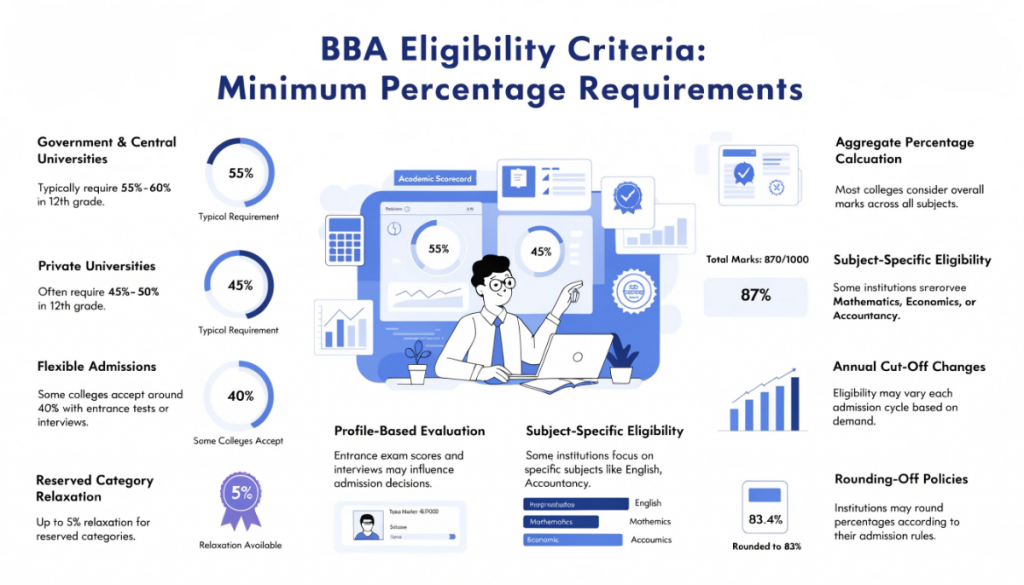
Government colleges and well known central universities usually ask for a higher cut off, often somewhere between 55% and 60%
Private universities tend to be more flexible and many accept students with 45% to 50% aggregate marks
Some colleges offer admission with even lower percentages, sometimes around 40%, especially if the candidate clears an entrance test or performs well in an interview
A 5% relaxation in the minimum percentage is commonly given to candidates from reserved categories such as SC, ST and OBC, depending on the specific university policy
Many private colleges look at your overall profile, including any entrance exam score or interview performance, rather than just the percentage on paper
Most colleges calculate the percentage based on your overall aggregate across all subjects, not just your best four or five subjects
A handful of universities calculate eligibility based on a specific set of subjects relevant to business studies such as English, mathematics, economics or accountancy, so it is worth checking the exact method used by your shortlisted college
The percentage requirement can shift slightly from one admission cycle to the next depending on demand, so checking the current year’s official notification matters more than relying on last year’s numbers
Some colleges round off marks to the nearest whole number while calculating eligibility, so a candidate with 49.6% may still be treated as having met a 50% cut off depending on the institution’s rounding policy
Streams Allowed Under BBA Eligibility Rules
One of the biggest doubts students have around BBA eligibility criteria is whether commerce is compulsory. It is not, and here is why:
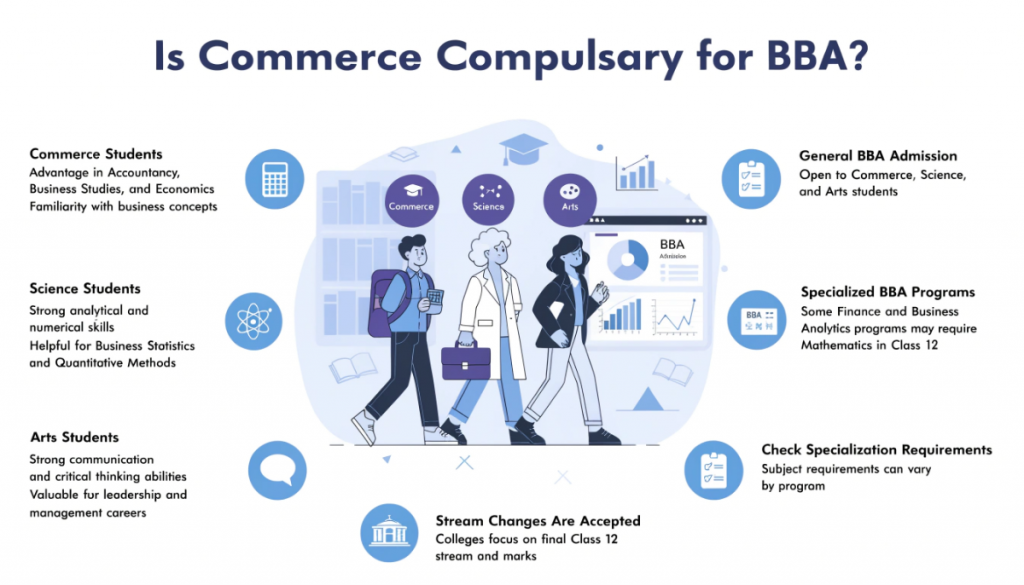
BBA is open to all three streams, commerce, science and arts
Commerce students do get a slight head start because subjects like accountancy, business studies and economics overlap with what they will study in BBA
Science students bring strong analytical and numerical skills which help a lot in subjects like business statistics and quantitative methods
Arts students usually have an edge in communication and critical thinking, both of which matter in management roles later on
While a general BBA accepts any stream, specialised programs like BBA in business analytics or BBA in finance sometimes ask for mathematics as a subject in class 12
If you are eyeing a specific specialisation rather than a general BBA, check the subject requirement for that particular program rather than assuming the general rule applies
A change of stream between class 10 and class 12, for example moving from science to commerce, does not create any complication for BBA eligibility criteria since colleges only look at your final class 12 stream and marks
Does BBA Eligibility Require Mathematics
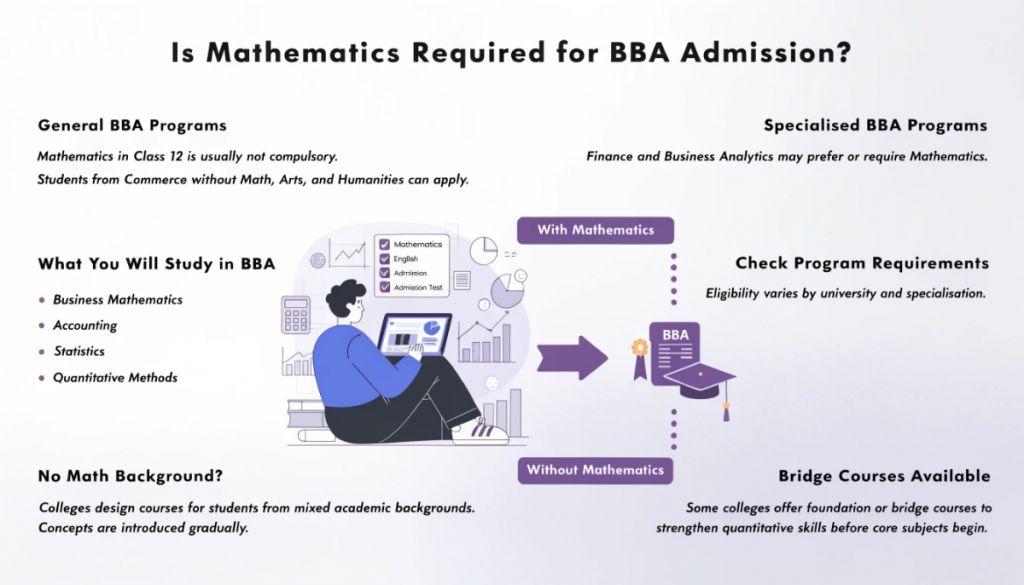
Mathematics is one of those questions that comes up again and again when people search for BBA eligibility criteria. Here is the actual picture:
For most general BBA programs, math in class 12 is not compulsory
Students from commerce without math and students from arts and humanities can apply without any issue
BBA does involve subjects like business mathematics, accounting and statistics during the course, so this part of the syllabus might feel slightly unfamiliar at first if you have not studied math recently
Colleges usually design the syllabus assuming a mixed group of students, some with a math background and some without, so it remains manageable either way
If your target is a quantitative-heavy specialisation such as finance or analytics, some institutes do prefer or require math as a subject in class 12
Math is not a blanket requirement everywhere, but it is sensible to check this one detail if you already know which specialisation you want to pursue
Students who feel weak in math but are interested in a quantitative specialisation can also look at bridge courses some colleges offer in the first semester to help everyone catch up before the core subjects begin
Entrance Exams Linked to BBA Eligibility
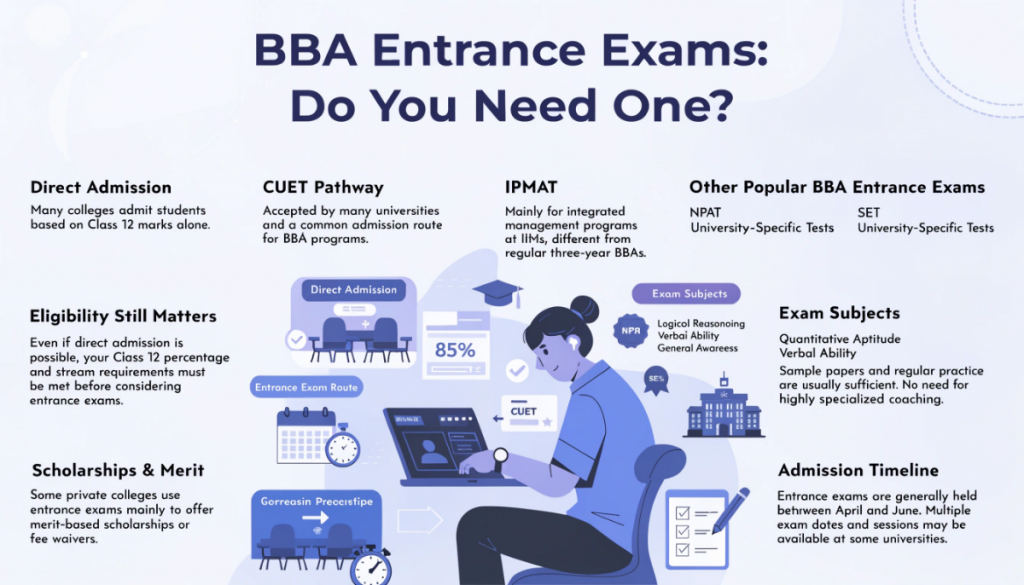
A part of BBA eligibility criteria that trips up a lot of students is the entrance exam requirement. Here is how it works:
Not every college needs an entrance exam, some offer direct admission purely on the basis of class 12 marks while others require you to clear a test first
Common entrance exams accepted for BBA include CUET, IPMAT, NPAT, SET and university specific tests conducted by individual colleges
CUET has become a fairly standard route in recent years since several universities now accept its score instead of running a separate test
IPMAT is mainly relevant if you are targeting the five-year integrated management programs offered by some IIMs, a slightly different track from the regular three-year BBA
If a college requires an entrance exam, your basic eligibility, meaning your class 12 percentage and stream, still has to be met first since the exam is an additional filter and not a replacement for the basic qualification
A good number of private colleges run admission through merit lists based on class 12 marks alone, with the entrance exam being optional and mainly tied to scholarship consideration
Most BBA entrance exams cover quantitative aptitude, logical reasoning, verbal ability and general awareness about current affairs and basic business concepts
None of these sections require specialised coaching the way engineering or medical entrance exams do, a few months of consistent practice with sample papers is usually enough
Entrance exams for BBA are typically held between April and June, after board exams are over but before most colleges close their admission window
If you are applying to more than one college you may end up appearing for two or three different entrance exams in the same season, so checking exam dates early helps avoid clashes
Some universities also conduct multiple sessions or slots for the same exam, which gives you flexibility if one date does not work for you
Documents and Other BBA Eligibility Conditions
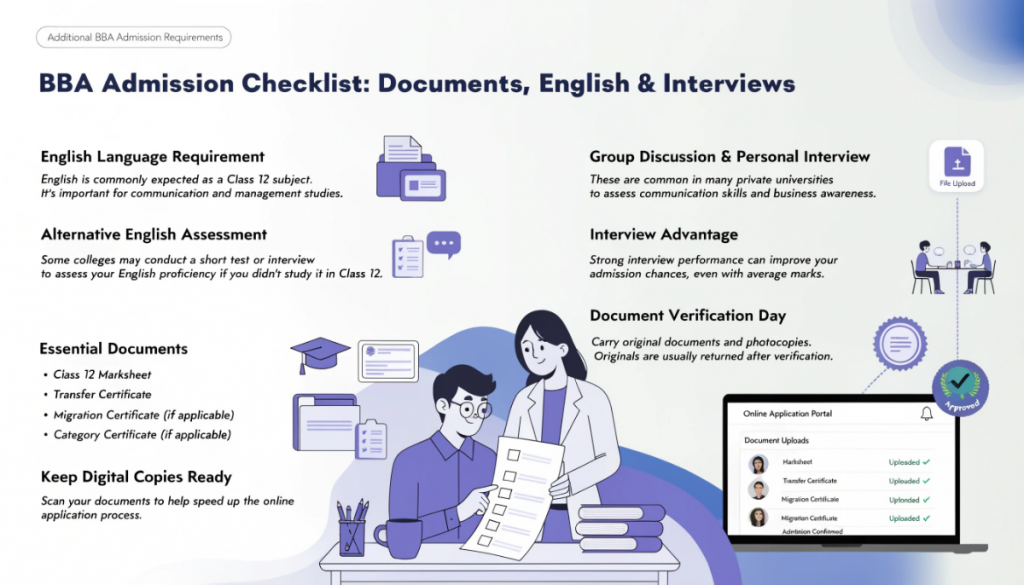
Beyond marks, stream and age, there are a few practical conditions that fall under the broader BBA eligibility criteria checklist:
English is usually expected as a subject in class 12, since the course is taught in English at most institutions and communication skills matter for management roles
If your board exam did not include English, some colleges may ask you to demonstrate proficiency through a short test or interview round
Standard documents to keep ready include your class 12 marksheet, transfer certificate, migration certificate if applicable and category certificate if you are claiming any reservation benefit
Keeping these scanned and ready in advance saves a lot of last minute stress during the admission window
A good number of private universities conduct a group discussion or personal interview round, particularly for candidates whose class 12 percentage is on the borderline
This round is mostly used to judge communication and basic awareness of business concepts rather than to catch anyone out
Students with average marks have often secured admission purely on the strength of a good interview, so this round is worth preparing for rather than dismissing as a formality
It also helps to carry photocopies of every document along with the originals on the day of document verification, since most colleges keep the photocopies for their records and return the originals on the spot
Conclusion
Going through BBA eligibility criteria might feel like a lot of small details at first but once you break it down, it really comes to four or five basic checks. Pass class 12 from a recognised board, meet the minimum percentage your target college asks for, confirm if an entrance exam applies to you and check the age bracket if your college has one. Stream is rarely a barrier and math is not compulsory unless you are aiming for a specific specialisation. Go through the official admission page of each college you are interested in since small variations do exist, but the core requirements stay fairly consistent across most institutions in India.

Book Your
Free Session
Connect with our experts and get personalised guidance for your career, course selection, and future goals.
📖 Sources & References
✓ Verified 2026Verified BBA eligibility criteria, admission requirements, entrance examinations, stream eligibility and undergraduate admission guidelines based on recognised educational and regulatory sources.
- UGC India Undergraduate admission regulations, degree eligibility requirements and higher education guidelines
- Ministry of Education National education policies, admission frameworks and academic qualification standards
- National Testing Agency Entrance examination administration, admission procedures and candidate information resources
- CUET UG Undergraduate entrance examination eligibility, application process and admission guidelines
- AICTE Management education standards, employability initiatives and higher education quality frameworks
- National Career Service Management career pathways, business education insights and employability resources
- NASSCOM Business skills demand, future workforce trends and industry employability reports
- World Economic Forum Future workplace skills, business competencies and graduate employability trends
- Shoolini Online BBA admission guidance, eligibility information and management education resources
- National Education Policy 2020 Undergraduate education reforms, multidisciplinary learning and student progression framework