
MBA eligibility criteria in India has remained largely stable in terms of the core academic requirement but the way candidates qualify has expanded significantly with the rise of online and hybrid MBA formats alongside traditional full time programmes.
If you are planning to apply for MBA in 2026 understanding the exact eligibility requirements before you start filling forms saves you from wasted applications and last minute rejections.
The basic MBA eligibility requirement across most Indian institutes is a bachelor’s degree from a recognised university with at least 50 percent marks but the specific requirements around entrance exams, work experience and minimum percentage vary depending on whether you are applying to a top tier business school, a state university or an online MBA programme. This guide covers the complete MBA eligibility criteria across all these formats so you know exactly where you stand.
The Basic MBA Eligibility Criteria That Apply Across India
Before looking at institute specific requirements it helps to understand the common baseline MBA eligibility criteria that most Indian business schools follow.
Educational Qualification
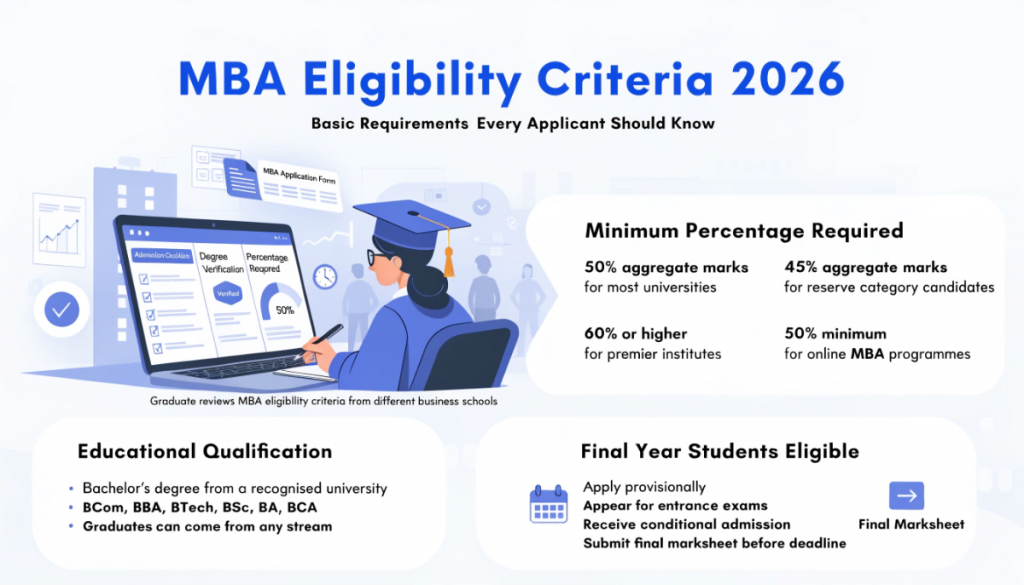
The minimum educational qualification for MBA eligibility in India is a bachelor’s degree from a recognised university. The degree can be in any discipline including BCom, BBA, BTech, BSc, BA or BCA. Most institutes accept graduates from any stream as long as the percentage requirement is met. There is no requirement for a commerce or management background for general MBA programmes in 2026.
Minimum Percentage Required
The minimum aggregate percentage required for MBA eligibility varies between institutions:
Most state universities and private business schools require a minimum of 50 percent aggregate marks in the qualifying bachelor’s degree
Reserved category candidates including SC, ST and OBC applicants are often given a relaxation of 5 percent bringing the requirement down to 45 percent
Top tier business schools including IIMs and other premier institutes set a higher bar often above 60 percent depending on the specific programme
Most online MBA programmes require a minimum of 50 percent for domestic students with a slightly higher requirement for international applicants
Final Year Students
Candidates who are currently in the final year of their bachelor’s degree are also eligible to apply for most MBA programmes under provisional eligibility. This means you can sit for entrance exams and even receive conditional admission but you will need to submit your final degree marksheet within a specified deadline after your results are declared.
MBA Eligibility Through National Level Entrance Exams
Most recognised MBA programmes require candidates to clear an entrance exam as part of the eligibility process. Here is how eligibility works through the major national level exams.
CAT Eligibility for IIMs and Top B-Schools
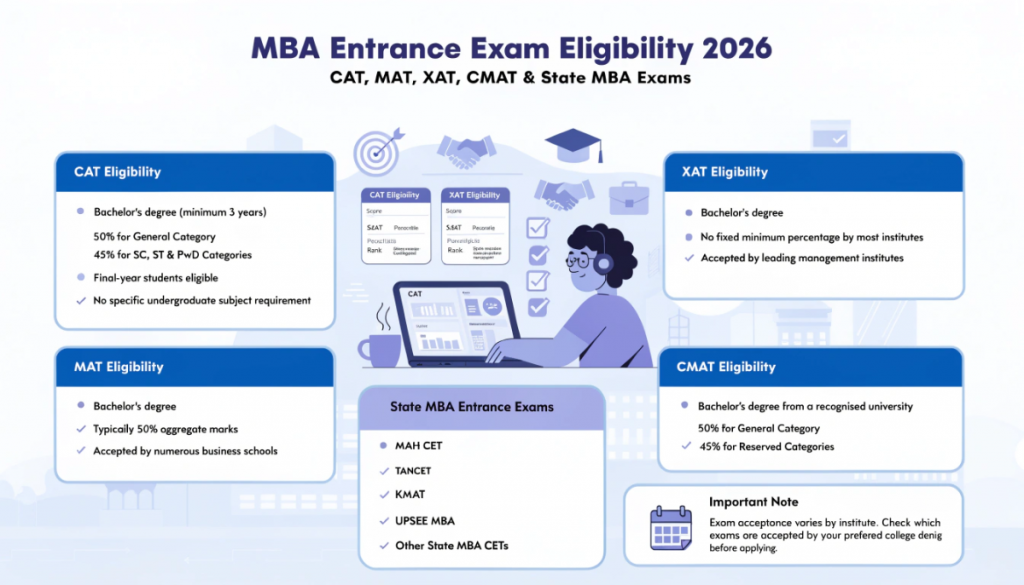
The Common Admission Test or CAT is the gateway to MBA programmes at IIMs and several other top tier business schools across India. The MBA eligibility criteria for CAT are:
A bachelor’s degree of minimum three years duration from a recognised university
Minimum 50 percent aggregate marks for general category candidates
Minimum 45 percent for SC, ST and PwD category candidates
Candidates appearing in the final year of their bachelor’s degree are also eligible to apply subject to meeting other criteria
No specific subject requirement at the undergraduate level
MAT, XAT and CMAT Eligibility
Apart from CAT several other national level exams are widely accepted for MBA admission across private and government institutes:
MAT requires a minimum of 50 percent in graduation and is accepted by a wide network of business schools across India
XAT eligibility requires a bachelor’s degree with no minimum percentage cap specified by most accepting institutes
CMAT eligibility requires a bachelor’s degree from a recognised university with general category candidates needing 50 percent and reserved category candidates needing 45 percent
Each exam has its own difficulty level and acceptance varies between institutes so it is worth checking which exam your target college accepts before you start preparing
State Level MBA Entrance Examinations
Most states in India conduct their own MBA entrance examinations for admission to state university and affiliated college programmes. Examples include:
MAH CET for Maharashtra state MBA admissions requiring 50 percent in bachelor’s degree
TANCET for Tamil Nadu MBA admissions requiring 50 percent in any undergraduate degree
KMAT for Karnataka MBA admissions
UPSEE MBA for Uttar Pradesh MBA programmes
MBA CET conducted by various state boards across Gujarat, Rajasthan and Madhya Pradesh
MBA Eligibility By Undergraduate Background
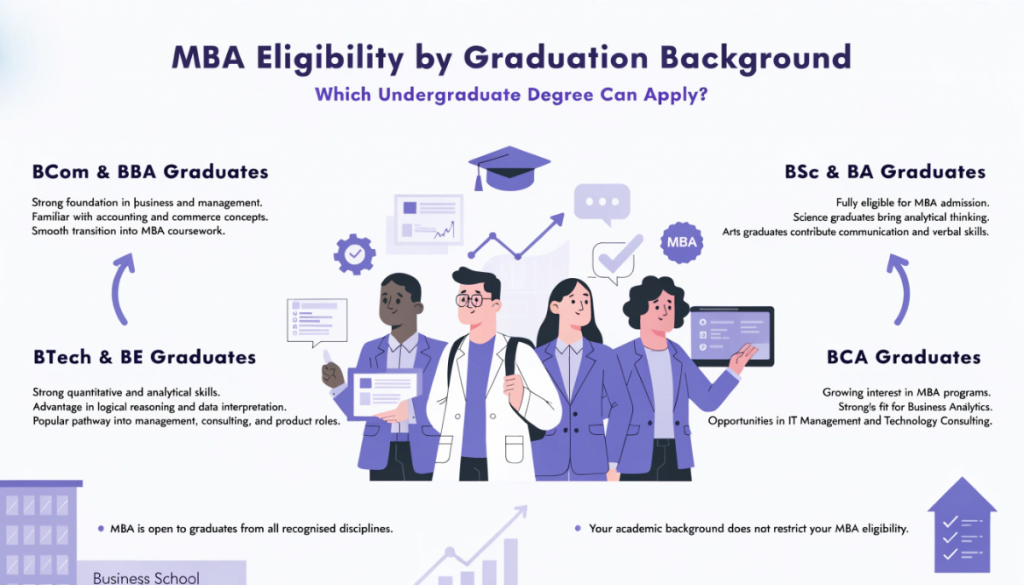
Different undergraduate backgrounds do not usually restrict MBA eligibility but they can influence how prepared a candidate feels for the entrance exam and the coursework. Here is a clear breakdown.
BCom and BBA Graduates
BCom and BBA graduates are the most naturally aligned candidates for MBA since their undergraduate curriculum already covers business fundamentals, accounting and basic management concepts. These graduates typically find the transition into MBA coursework smoother and often perform well in the quantitative and business knowledge sections of entrance exams.
BTech and BE Graduates
BTech and BE graduates are fully eligible for MBA and in fact make up a large share of MBA applicants every year. Their strong quantitative background gives them an advantage in the data interpretation and logical reasoning sections of most entrance exams. Many engineering graduates pursue MBA to pivot toward management roles, product management or consulting.
BSc and BA Graduates
BSc and BA graduates are equally eligible for MBA admission. Science graduates often bring strong analytical skills while arts graduates bring stronger verbal ability which is useful in the reading comprehension and communication heavy parts of entrance exams and group discussions. Neither background puts a candidate at a disadvantage for MBA eligibility.
BCA Graduates
BCA graduates are increasingly applying for MBA particularly in specialisations like business analytics, IT management and technology consulting where their programming and technical background becomes a strong asset alongside management training.
Is Work Experience Mandatory For MBA
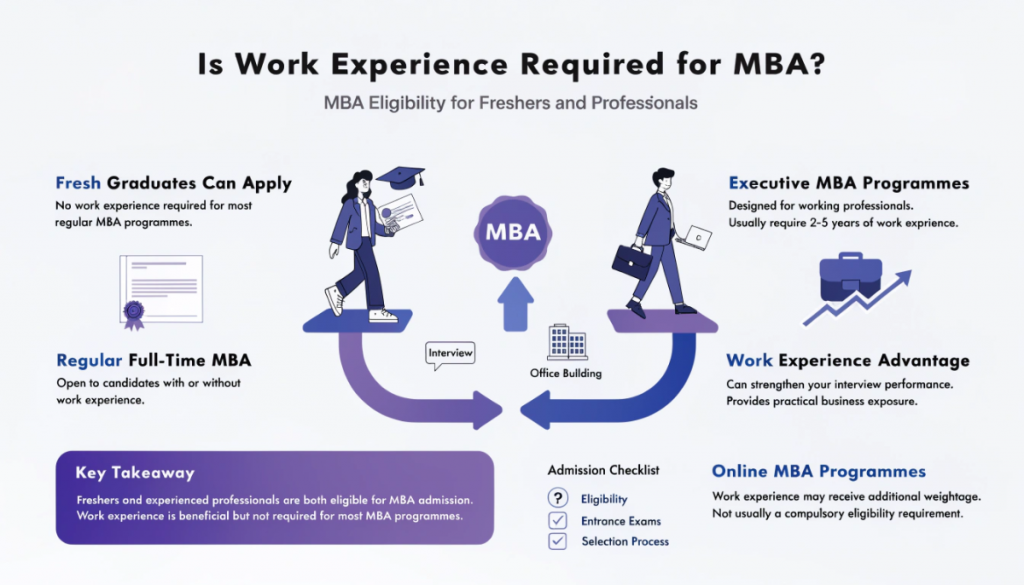
This is one of the most common questions students ask while checking MBA eligibility. Here is a simple breakdown:
Work experience is not mandatory for a regular full time MBA programme
Fresh graduates with zero work experience are completely eligible to apply and get admission into most MBA colleges
Executive MBA programmes designed for working professionals usually require a minimum of two to five years of relevant work experience
For regular MBA programmes having work experience can be an added advantage during the personal interview round but it is never a strict eligibility requirement
Some online MBA programmes give additional weightage to candidates with work experience during the merit based selection process but do not make it compulsory
Age Limit For MBA Programmes
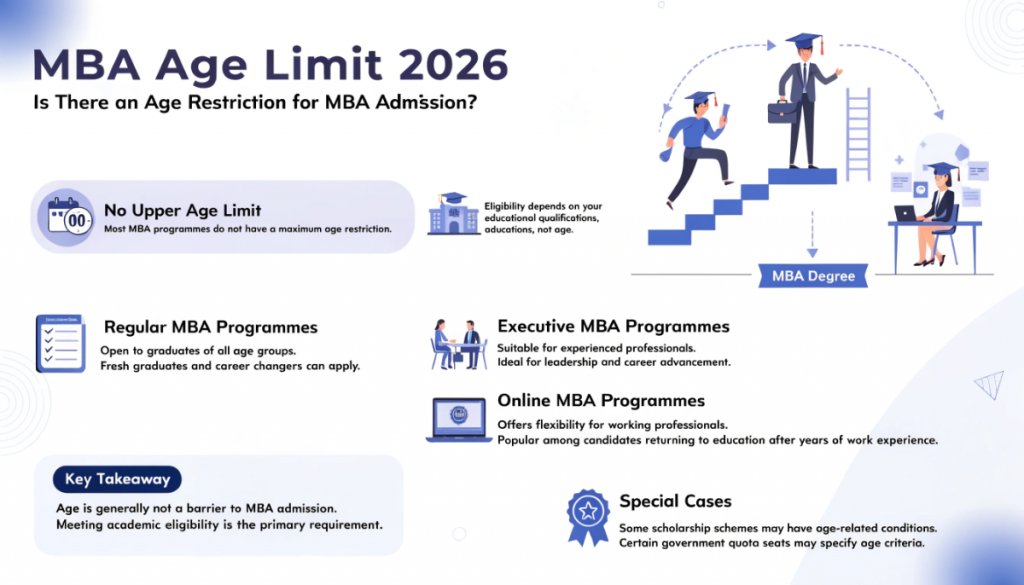
Many students ask whether there is an upper age limit to apply for MBA:
For most regular MBA programmes there is no specific age restriction
As long as you meet the educational qualification you can apply regardless of your age
Executive MBA and online MBA programmes also typically have no upper age limit which makes them especially suitable for professionals returning to education after several years
Some specific scholarship programmes or government quota seats may have an age cap mentioned separately in their guidelines
Documents Required To Prove MBA Eligibility
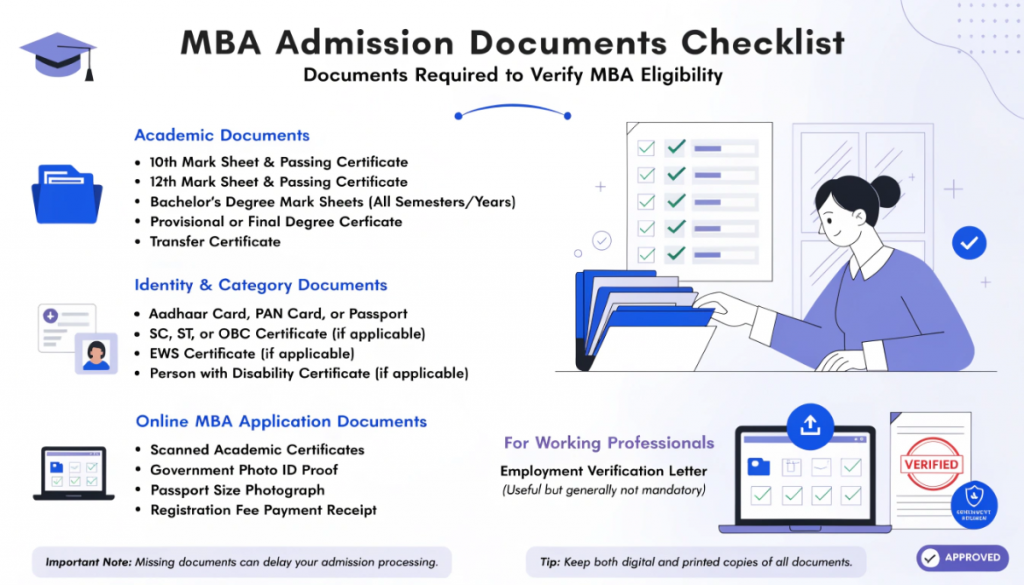
Meeting the MBA eligibility criteria is one part of the process. Producing the right documents to prove eligibility is equally important and missing documents are one of the most common reasons for application delays.
Academic Documents
10th standard mark sheet and passing certificate
12th standard mark sheet and passing certificate
All semester or year wise mark sheets from the bachelor’s degree programme
Bachelor’s degree provisional or final certificate from the issuing university
Transfer certificate from the last institution attended
Identity and Category Documents
Valid government photo ID including Aadhaar card, PAN card or passport
Category certificate including SC, ST or OBC certificate if applicable for reserved category MBA eligibility benefits
EWS certificate if claiming Economically Weaker Section reservation
Person with Disability certificate if applicable
Additional Documents For Online MBA Applications
Scanned copy of all academic mark sheets and degree certificates
Government issued photo ID proof
Recent passport size photograph
Payment confirmation for the registration fee
For working professionals an employment verification letter is useful but not mandatory for MBA eligibility purposes in most cases
Conclusion
MBA eligibility criteria in 2026 requires a bachelor’s degree from a recognised university with a minimum of 50 percent marks in most cases. For competitive programmes at IIMs and top tier business schools through CAT the academic requirements are stricter and the entrance exam difficulty is significantly higher.
For more accessible options including online MBA programmes eligibility is based on the same 50 percent benchmark but with simpler admission processes and added flexibility for working professionals. Choosing the right programme based on your eligibility profile, entrance exam readiness, work experience and whether you need the flexibility of an online format is the most important decision in the MBA admission process.
The degree itself remains genuinely valuable across management, consulting, finance and technology careers regardless of whether you pursue it on campus or through an accredited online provider.

Book Your
Free Session
Connect with our experts and get personalised guidance for your career, course selection, and future goals.
📖 Sources & References
✓ Verified 2026Verified MBA eligibility criteria, entrance examination requirements, admission guidelines, online MBA regulations and management education standards based on recognised educational and regulatory sources.
- UGC India Postgraduate degree regulations, MBA eligibility norms and higher education guidelines
- Ministry of Education National education policies, postgraduate admission frameworks and academic qualification standards
- AICTE Management education standards, employability initiatives and quality assurance frameworks
- CAT Official CAT eligibility criteria, MBA entrance examination structure and admission process information
- National Testing Agency National entrance examinations, candidate guidelines and admission procedures
- CMAT Official MBA entrance examination eligibility, application process and admission information
- MAT Official Management aptitude test eligibility, examination details and admission pathways
- NASSCOM Management hiring trends, business leadership skills and future workforce reports
- Shoolini Online MBA admission guidance, eligibility information and programme support resources
- Distance Education Bureau Recognition framework for online MBA programmes and distance learning regulations