
Artificial intelligence has moved from research labs into everyday products like banking apps and shopping sites and healthcare tools. Companies now need people who can build and run these systems and that demand is why many graduates look at an MCA in artificial intelligence. It is a two year postgraduate program that combines core computer applications with machine learning and data skills. This blog explains what the course covers and who can apply. It also looks at the syllabus and the job roles you can aim for.
What an MCA in Artificial Intelligence Really Is
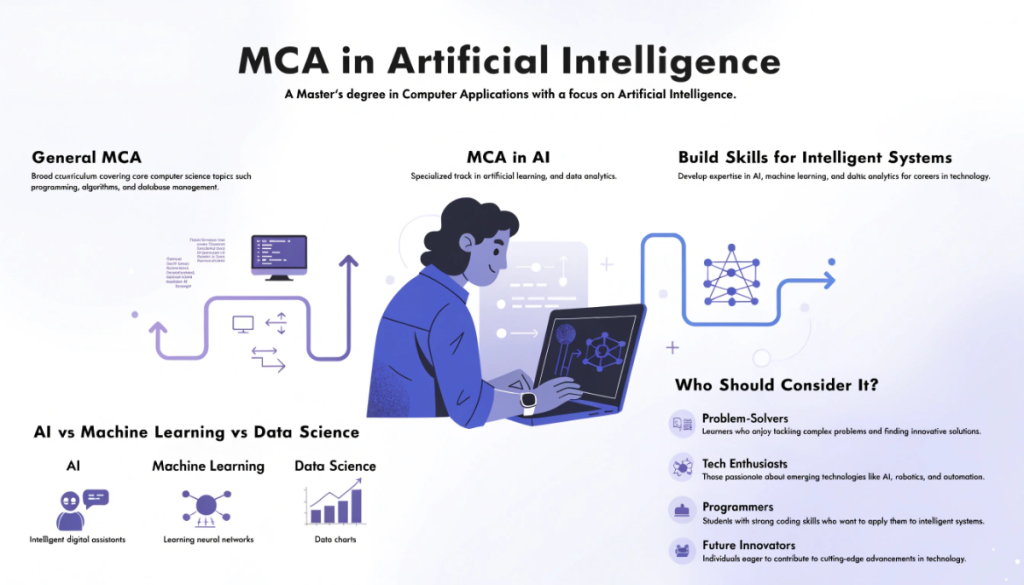
An MCA in artificial intelligence is a Master of Computer Applications program where the main subject area is AI and machine learning. You still learn programming and databases and software design like any MCA student. The difference is that the later semesters focus on building intelligent systems that learn from data.
How It Differs From a General MCA
- A general MCA spreads time across many areas such as web development and networking, which means graduates are broad but not deep in any one field.
- The AI track narrows the focus to machine learning and generative AI and data handling, so you finish with skills that match one clear career direction.
- The first semesters are usually common to all students, which means everyone builds the same programming base before the track begins.
AI, Machine Learning and Data Science: The Simple Difference
- Artificial intelligence is the wider idea of machines doing tasks that normally need human thinking, such as understanding language or recognising images.
- Machine learning is the method where a system learns patterns from data instead of following fixed rules. It is the engine behind most modern AI.
- Data science focuses on collecting and cleaning and analysing data to support decisions, so it overlaps with AI but leans more towards analysis and reporting.
Who Should Consider This Course
Graduates who enjoy problem solving and logic and want a technical career are a natural fit. Working professionals in IT or testing or support often take it to move into AI related roles. Students from non computer backgrounds can also apply because a bridge course helps with the maths needed. You do not need prior coding experience but you should be willing to practise regularly.
Eligibility and Admission for MCA in Artificial Intelligence
The entry rules for an online MCA are fairly open. Most students find that they meet the basic conditions even if they studied a non technical subject earlier.
Academic Requirement
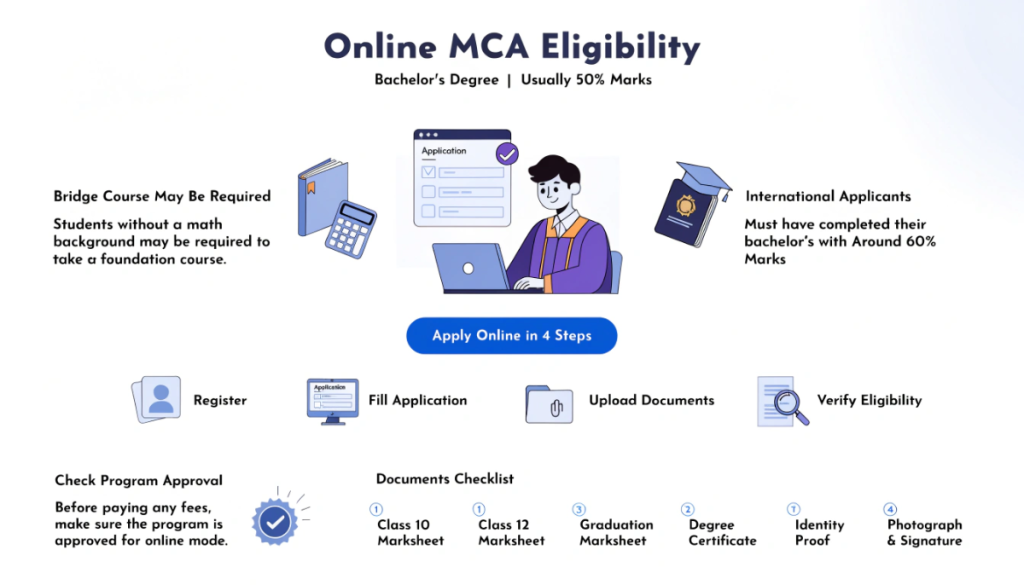
- A bachelor’s degree in any discipline with at least 50 percent marks is the usual requirement, which means graduates from arts and commerce and science backgrounds can all apply.
- The percentage is checked on the qualifying degree, so keep your final marksheets and degree or provisional certificate ready.
Mathematics and the Bridge Course
- Students who did not study mathematics at Class 12 or graduation level are asked to complete a bridge course, which covers the basics needed for the technical papers.
- This makes the program accessible to career switchers, since a missing maths background does not block admission.
International Applicants
Applicants from outside India are generally expected to have around 60 percent marks in their qualifying degree. They use a passport as identity proof instead of an Indian government ID.
Admission Process
- Admission is done online through a simple application where you register and fill in academic details and upload documents.
- There is usually no entrance exam such as CAT or GATE for these online programs, so selection depends on eligibility checks and document verification.
- Documents normally include Class 10 and Class 12 marksheets and graduation marksheets and a degree certificate and identity proof and a photograph and a signature.
- Before paying any fee confirm that the specific program is approved by UGC for the online mode, since that approval makes the degree equal to a regular one for jobs and higher study.
MCA in Artificial Intelligence Syllabus and Skills
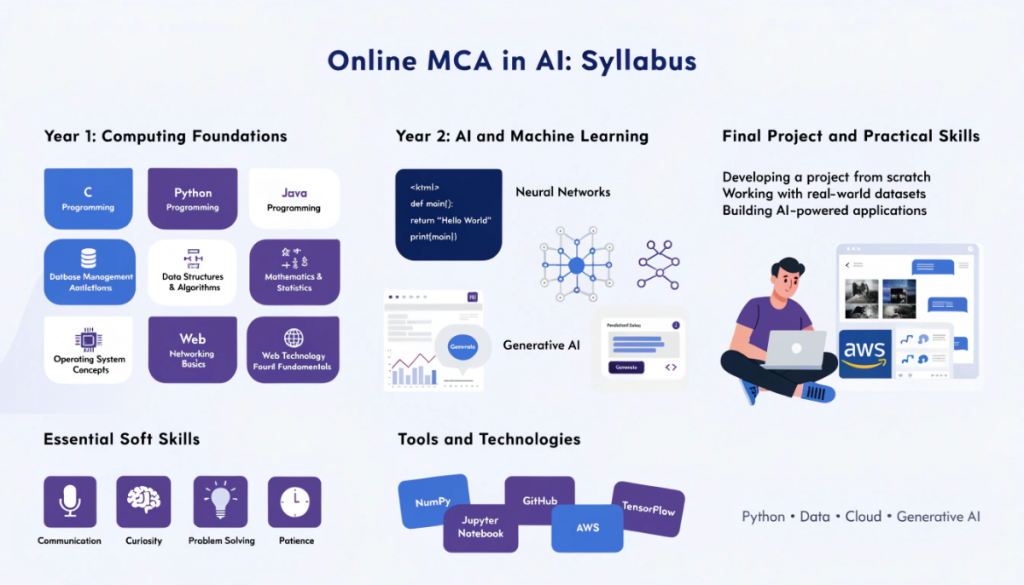
The syllabus runs across four semesters. The early papers build programming and computing foundations. The later papers move into AI and machine learning and a final project.
Foundation Subjects in the First Year
- Programming languages such as C and Python and Java form the base, which means you learn how to turn logic into working code.
- Database management and data structures teach you how to store and organise information. Every AI model depends on this data handling.
- Computational mathematics and statistics give you the tools for probability and linear algebra, which are needed to understand how models work.
- Operating systems and networking and web technology round out the technical base so you can build and deploy full applications.
AI and Machine Learning Subjects
- Machine learning in Python covers regression and classification and clustering, which are the standard methods used in real projects.
- Generative AI introduces how modern language and image models are built and used. It is one of the fastest growing parts of the field.
- Data analytics using Python teaches you to clean and explore data and present findings, so you can support decisions with evidence.
- Related topics such as Internet of Things and DevOps and UX design may appear as electives or supporting areas, which helps you connect AI with real products.
Project Work
The final semester usually includes a project where you build a working solution. This could be a prediction model or a chatbot or a recommendation system. Treat it as your main portfolio piece because recruiters care far more about what you built than about the grade you scored.
Soft Skills That Matter
- Clear explanation of technical ideas to non technical people, since AI engineers often present results to managers and clients.
- Curiosity and patience, because models rarely work on the first attempt and fixing them takes steady effort.
Tools You Will Use Regularly
- Python libraries for data and machine learning, which are the standard tools in nearly every AI job.
- Notebook environments and version control, so your experiments stay organised and can be shared with a team.
- Cloud platforms for training and deploying models, because most companies run AI workloads online.
Career Options After an MCA in Artificial Intelligence
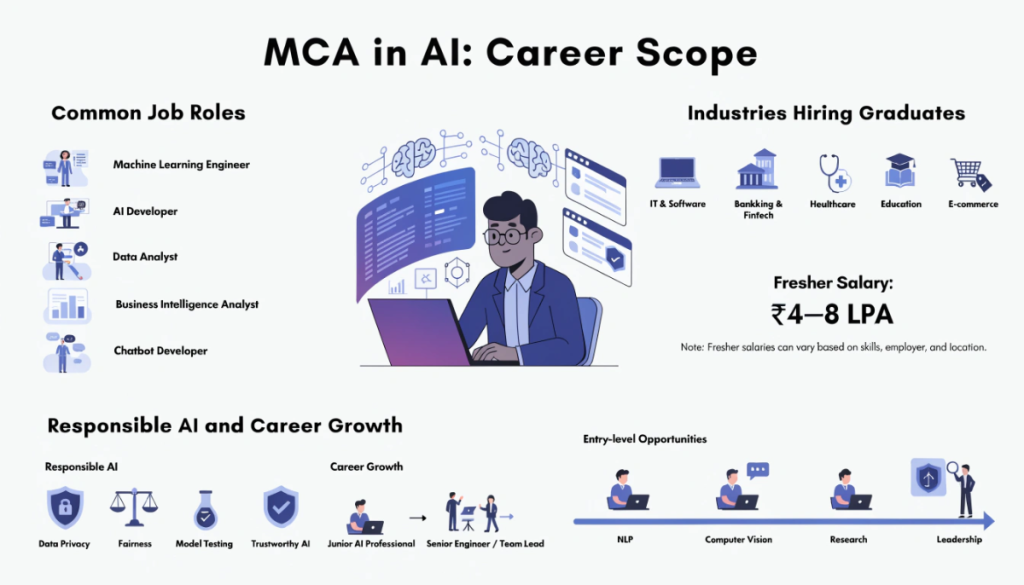
The career scope of an MCA in artificial intelligence is wide because almost every industry is adding AI to its products and processes. The roles below are the most common starting points.
Common Job Roles
- Machine learning engineer roles involve building and testing models and putting them into production, which means strong Python and problem solving matter most.
- AI developer or software engineer roles add intelligent features to applications, so they suit people who like coding and product building.
- Data analyst and junior data scientist roles turn raw data into insights, which makes them a good entry point for graduates who enjoy reports and statistics.
- Business intelligence and analytics roles support managers with dashboards and forecasts, so communication skills help as much as technical ones.
- Automation and chatbot developer roles build systems that handle customer queries and repeat tasks. Demand for them keeps growing.
Industries That Hire for AI Skills
- IT services and product companies hire the largest number of graduates, since they build AI solutions for clients across sectors.
- Banks and insurance and financial technology firms use AI for fraud checks and credit decisions, which creates steady openings.
- Healthcare and education and e-commerce companies use it for diagnosis support and personalised learning and recommendations.
Salary Expectations
Pay depends on skills and employer and city more than on the degree name. Career sites generally show that AI and machine learning roles pay above general software roles at the same experience level. Fresher offers are often in the range of 4 to 8 LPA while experienced engineers in this area can move well past 10 LPA. These are rough figures from salary surveys so check current job listings before you plan around any number.
Responsible AI and Ethics
Employers now expect engineers to think about fairness and privacy and the safe use of data. Courses that cover these topics prepare you for real projects where a wrong prediction can affect people. Knowing how to test a model for bias and explain its results is a skill that makes you more trusted on a team.
Growth Paths
Many graduates move from engineer roles to senior engineer or team lead positions in a few years. Others specialise in areas like natural language processing or computer vision. Some go on to research or doctoral study. In every case continuous learning matters because tools and methods change quickly.
Studying an MCA in Artificial Intelligence Online
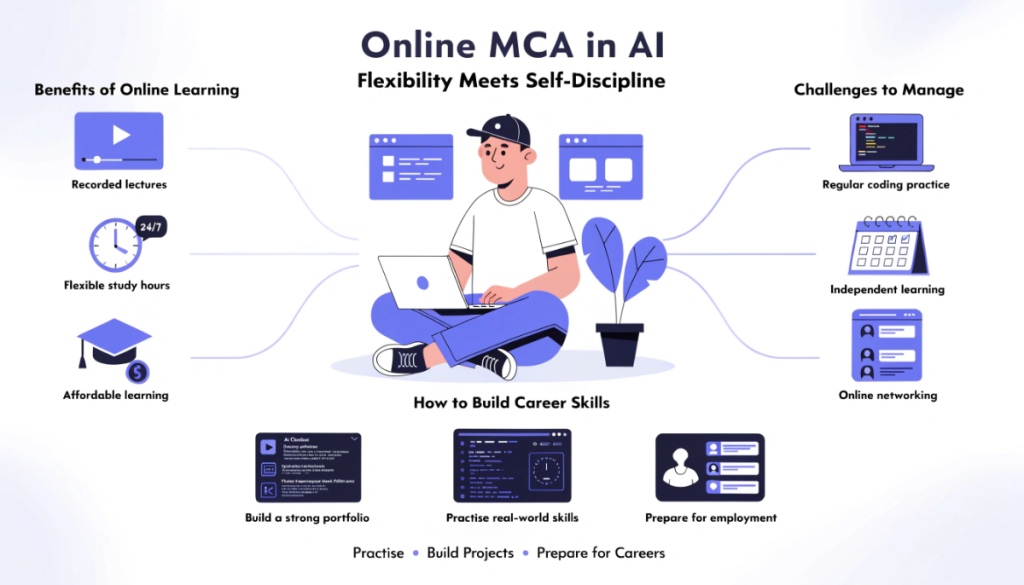
Many students pick the online route because it lets them keep a job or stay at home while studying. It works well when you understand both its strengths and its limits.
What Works Well
- Flexible schedules let you attend live sessions in the evening or watch recordings later, so work and study can run side by side.
- Recorded lectures help with difficult topics like probability and model training, since you can replay them as many times as needed.
- The cost is usually lower than a full time campus program, which means you avoid relocation and hostel expenses.
What You Need to Handle Yourself
- Hands on practice is your responsibility, so set aside weekly time to code and run experiments, since AI skills only grow through practice.
- Self discipline matters because nobody tracks daily attendance. Students who delay study often fall behind before exams.
- Networking takes effort online, so join discussion groups and coding communities to meet people and learn from them.
How to Make the Degree Count
- Build a public portfolio of projects with clear write ups, which gives recruiters something concrete to review.
- Take part in online coding or data competitions, because they show real skill under time pressure.
- Use career support services if the program offers them, such as mock interviews and job matching, since they help with the transition into work.
How to Prepare and Choose the Right Program
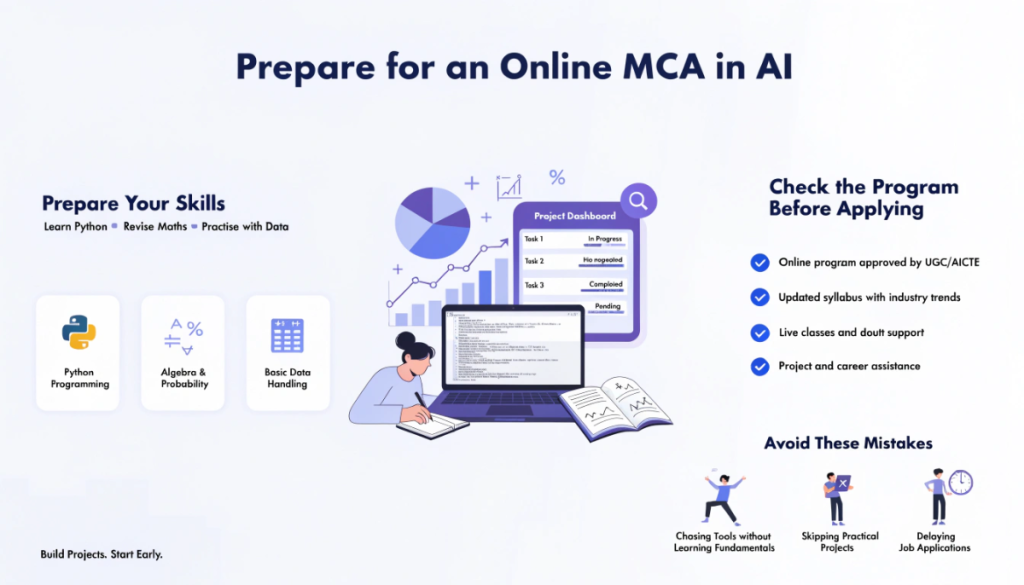
Good preparation before and during the course makes a big difference. A clear plan also helps you pick a program that fits your goals.
Skills to Start Before Day One
- Learn the basics of Python through a free course, which means you will follow the early programming papers with ease.
- Revise school level mathematics such as algebra and probability, since they come back in machine learning papers.
- Get comfortable with spreadsheets and basic data handling, because every project begins with data.
Checklist Before You Apply
- Confirm UGC approval for the online mode and for the exact program, since recognition affects jobs and further study.
- Read the syllabus for current topics like generative AI and Python based machine learning, because outdated papers will not help in interviews.
- Ask about live session timings and doubt support, which tells you how much real interaction you can expect.
- Check the project and career support offered. Ask what they include in practice.
Mistakes to Avoid
- Chasing every new tool without learning the basics, which means you struggle when interviewers ask core questions about how models work.
- Skipping projects and relying only on marks, since employers look for working examples.
- Starting job applications only after the last exam, because the best internships and openings are often filled months earlier.
Conclusion
An MCA in artificial intelligence is a practical choice if you want a technical career in one of the fastest growing areas of computing. The eligibility is open to graduates from most backgrounds and the syllabus builds from basic programming to machine learning and generative AI. What decides your outcome is the work you do alongside the course. Practise coding every week and build projects that solve real problems. Keep your skills current after you graduate. With that habit the degree can open doors to roles that will stay in demand for years.
📖 Sources & References
✓ Verified 2026Explore official resources on online MCA recognition, programming, machine learning, generative AI, cloud computing, responsible AI and salary benchmarks relevant to artificial intelligence careers.
- UGC Online Programme Recognition: Check the official UGC-DEB programme list for the university, MCA programme, online mode and relevant admission session.
- Online MCA Admission Guidance: Official UGC-DEB FAQs on online and distance education, programme recognition and student requirements.
- Python Programming: Official Python tutorial for learning programming fundamentals used in data analysis and machine learning.
- Machine Learning with Scikit-learn: Official guide to machine-learning models, data preprocessing, prediction and model evaluation.
- Deep Learning with TensorFlow: Practical tutorials for building and training machine-learning and deep-learning models.
- Generative AI and Language Models: Hugging Face’s learning course covering transformers, natural language processing and large language models.
- Google Machine Learning Course: Google’s practical machine-learning course covering core concepts, model training and evaluation.
- Responsible AI and Ethics: NIST’s AI Risk Management Framework resources on trustworthiness, risk assessment and responsible AI development.
- Cloud Computing Skills: AWS training resources for cloud fundamentals and skills relevant to deploying and operating AI applications.
- Technology Salary Benchmarks: Adecco India’s salary guide resources for comparing technology role salary benchmarks and experience levels.

Book Your
Free Session
Connect with our experts and get personalised guidance for your career, course selection, and future goals.