
Many students ask the same thing before they join a postgraduate computer course. Will an MCA actually lead to a good job. MCA job opportunities are wide because almost every company now runs on software and data. The degree opens doors to development and data and cloud roles as well as government IT posts. This blog lists the main job options and what each one involves. It also covers expected salary ranges and the eligibility and skills you need to get started.
MCA Job Opportunities Today: Scope and Demand
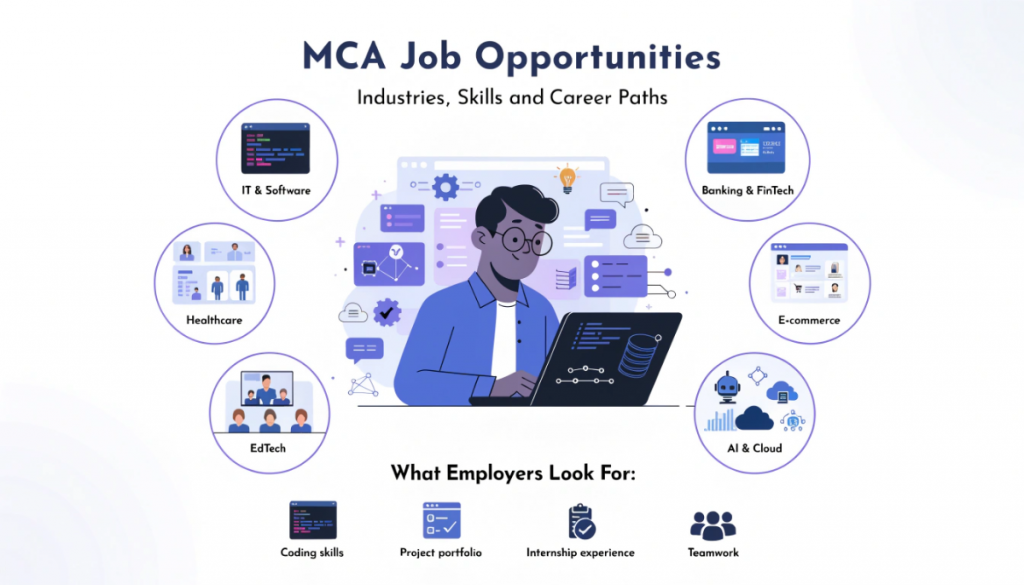
MCA job opportunities exist in any sector that builds or runs software. That includes IT services and banks and hospitals and online shopping and education platforms. The degree is designed to take graduates from any background and train them for technical work in two years.
Why Demand Stays Strong
- Companies in every industry are moving their work online, which means they keep hiring people who can build and maintain applications and databases.
- New areas like artificial intelligence and cloud computing and data analytics need trained people, so graduates with current skills find openings faster.
- Many employers prefer candidates with a postgraduate computing degree for roles that need strong fundamentals, since the course covers programming and databases and system design in depth.
Industries That Hire MCA Graduates
- IT services and product companies hire the largest numbers for development and testing and support teams, which makes them the most common first employer.
- Banks and insurance firms and financial technology companies run complex systems and need developers and data specialists to keep them secure and fast.
- Healthcare and education technology and e-commerce firms also recruit for application and data roles, so options go beyond classic IT.
What Employers Expect From You
A degree gets you shortlisted but employers look for proof of skill. They want to see that you can write clean code and explain your logic and work in a team. Projects and internships and a solid grasp of one or two programming languages count for much more than marks alone. This is why the practical side of your preparation deserves as much time as the exams.
Core Software Roles Open to MCA Graduates
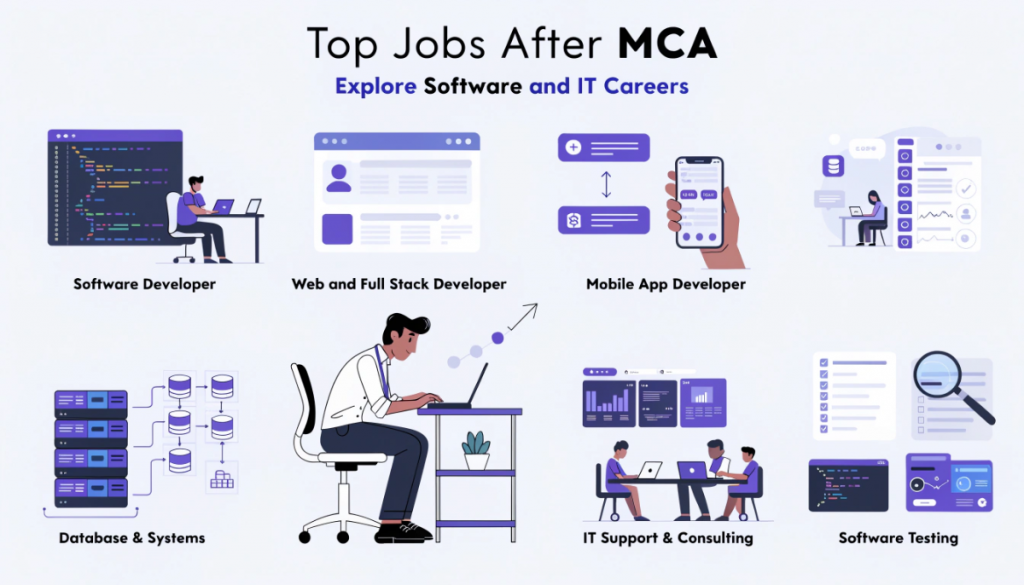
Most MCA graduates start in a software role because the syllabus is built around programming and application development. These jobs offer the clearest path from fresher to senior engineer.
Software Developer
- Developers write and test code for applications and systems, which means the job uses almost everything taught in the programming papers.
- Most freshers begin in a junior developer post and move to a senior developer role in three to five years, depending on performance.
Web and Full Stack Developer
- These roles cover both the visible part of a website and the server side behind it, so the work suits people who like building complete products.
- Knowledge of web technologies and databases and a front end framework helps a lot, since employers test these skills in interviews.
Mobile App Developer
- App developers build software for phones using platforms such as Android and iOS, which means there is steady demand in every industry with a customer app.
- A small portfolio of published or demo apps works better than a long list of subjects on a CV.
Database Administrator and System Analyst
- Database administrators manage and secure company data, so the database and operating system papers prepare you directly for this work.
- System analysts study business needs and design technical solutions, which suits people who enjoy both technology and problem solving.
Technical Support and IT Consulting
- Support engineers solve problems for users and clients, which means you build product knowledge and communication skills that later help in senior roles.
- IT consultants advise companies on which tools and systems to use, so this path suits people who like talking to clients as much as writing code.
Software Tester and Quality Analyst
- Testers find bugs before users do, which makes this a common entry point for graduates who are still building coding confidence.
- Skills in automation tools can move a tester into higher paying quality engineering roles over time.
High Growth MCA Job Opportunities in AI, Data and Cloud
The fastest growing MCA job opportunities are in newer technology areas. These roles often pay more but they also expect extra skills beyond the standard syllabus.
Artificial Intelligence and Machine Learning
- Machine learning engineers build models that predict and classify and recommend, which means strong Python and basic statistics are essential.
- Companies in finance and retail and healthcare use these systems more each year, so the field keeps expanding.
Data Science and Analytics
- Data analysts and junior data scientists turn raw numbers into reports and insights that managers can act on.
- Skills in Python and SQL and a visualisation tool are usually the minimum requirement, so these should be built early in the course.
Cloud Computing and DevOps
- Cloud engineers set up and manage applications on platforms that run over the internet, which means companies can scale without buying their own hardware.
- DevOps engineers automate how code is tested and released, so this role suits people who like systems and automation.
Cybersecurity
- Security analysts protect systems and data from attacks. Demand rises every time a new breach makes headlines.
- Networking and operating system knowledge from the MCA syllabus gives a good base, but extra certifications are usually needed.
Blockchain and Emerging Areas
- Blockchain developers build applications on distributed ledger technology, which is a smaller field but one with strong pay for those who learn it well.
- Internet of things and automation roles are also growing, since more devices now connect to software that must be built and maintained.
Choosing a Specialisation Wisely
Some programs let you pick a track such as artificial intelligence and machine learning or data science or full stack development. Choose the one that matches the job you want in three years. A focused track with real projects shows employers that you have depth and not just a general degree.
Government and Other MCA Job Opportunities
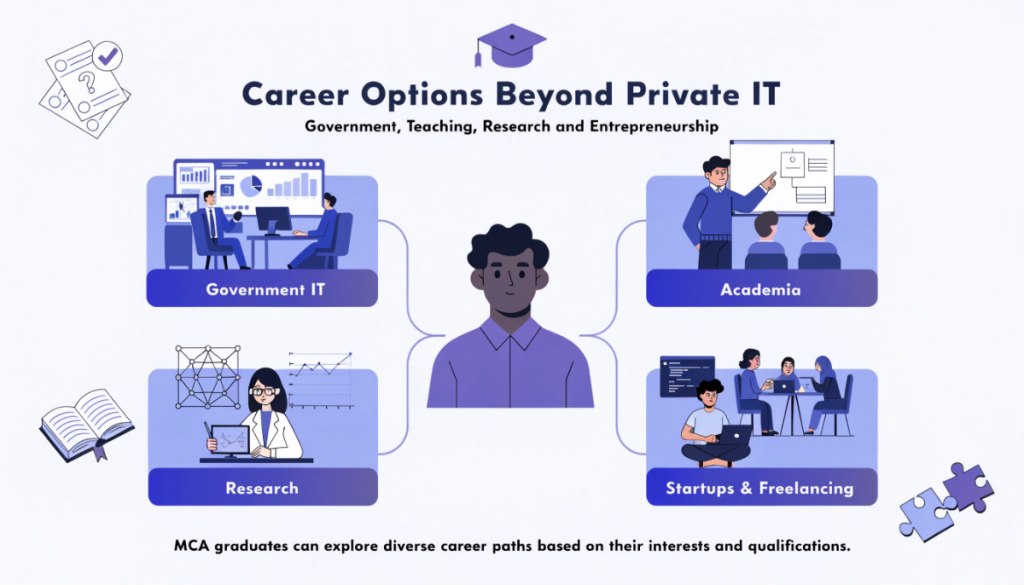
Private companies are not the only employers. MCA graduates also have paths in public service and teaching and research and business.
Government IT Roles
- Banks and public sector undertakings and government agencies hire IT officers and programmers and system engineers, which means there are stable jobs for those who prefer security over fast pay growth.
- Recruitment usually happens through written exams or interviews, so check notification dates and prepare in advance.
Teaching and Academic Careers
- Graduates who clear the national eligibility test can apply for assistant professor posts in computer applications, which suits people who enjoy explaining concepts.
- A doctorate improves your chances of senior academic posts and opens research funding.
Research and Higher Study
- Some graduates move into research labs or doctoral programs in areas like machine learning or software engineering, which means a longer study path with strong specialist outcomes.
- Others add professional certifications in cloud or security to move into niche roles without a full degree.
Startups and Freelancing
The skills from an MCA fit well with building a product or offering services. Freelance developers and small agencies find clients through referrals and online platforms. Startup work carries more risk but it can teach you a lot in a short time. A few years of employment first helps you build contacts and savings.
MCA Job Opportunities and Salary Expectations
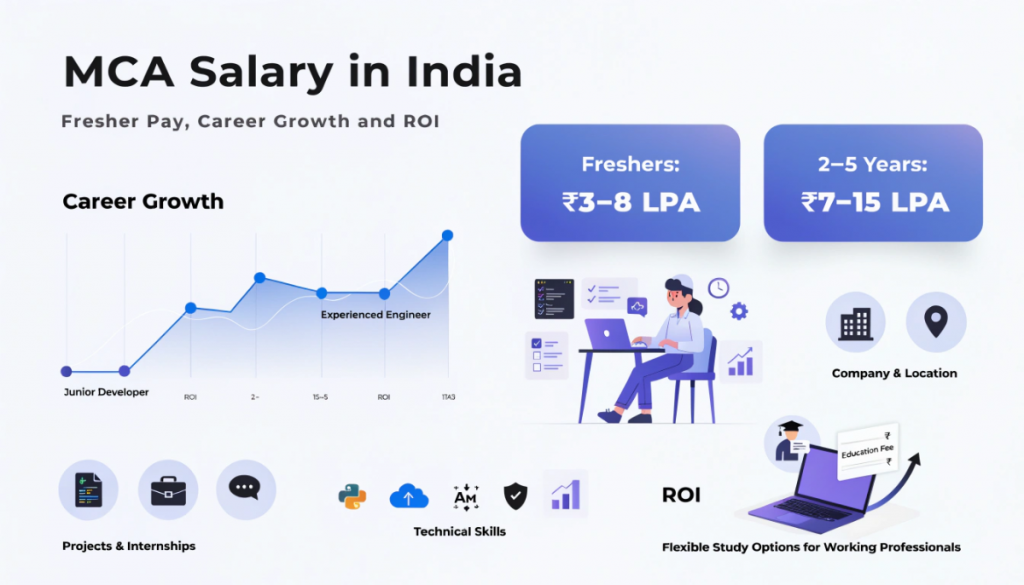
Salary depends on your skills and employer and city more than on the degree name. Figures from career sites vary a lot so treat them as rough guides and check current job listings.
What Freshers Can Expect
- Most reports put fresher pay in the range of about 3 to 8 LPA, with many graduates starting around 4 to 6 LPA in technical roles.
- Product companies and well funded startups often pay at the upper end, while smaller firms and support roles pay at the lower end.
How Pay Grows With Experience
- After two to five years many developers move into the 7 to 15 LPA band, since they take on bigger projects and lead small teams.
- Senior engineers and specialists in AI or cloud or security can earn considerably more, which is why continuous learning matters.
- Switching employers after building solid experience usually brings a bigger jump than waiting for yearly raises.
Is the Salary Worth the Investment
An MCA costs time and money so compare the total fee with the pay you expect in the first three years. Online programs usually cost less than full time campus courses and let you keep earning while you study. That makes the return on investment faster for working professionals. Graduates who already hold a job often get a promotion or a better offer even before the final semester ends.
Factors That Move Your Salary
- Skills in demand such as Python and cloud platforms and data tools, because employers pay more for what is hard to find.
- Quality of projects and internships, since they prove you can do the work.
- City and company type, because metro areas and product firms generally pay more than smaller towns and service providers.
- Communication and teamwork, which decide who gets promoted to lead roles.
How to Prepare for MCA Job Opportunities
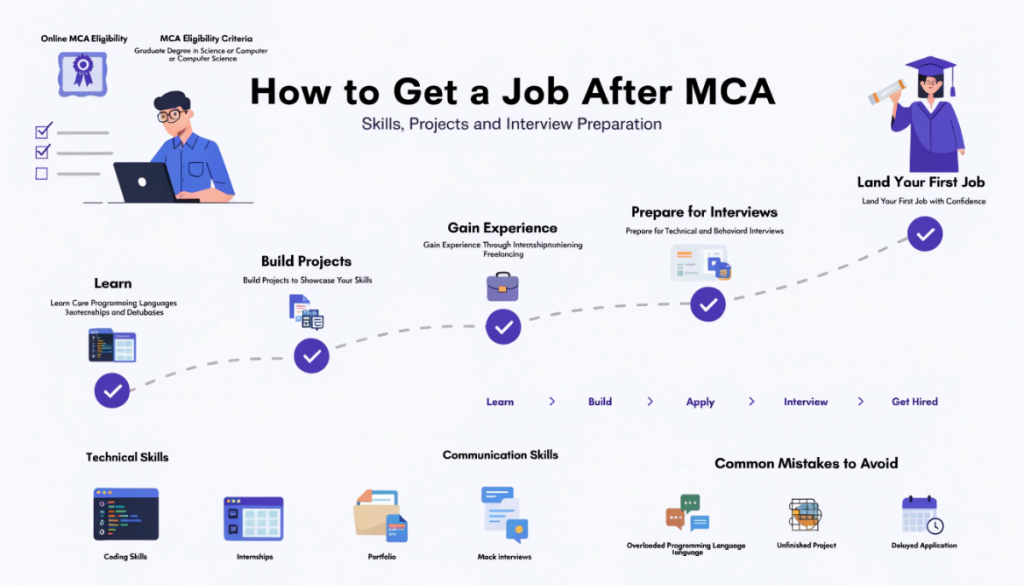
The best results come from starting preparation on day one of the program. Treat every semester as practice for the job you want.
Eligibility for an Online MCA Program
An online MCA is a good fit for working people who want to upgrade their skills without leaving a job. A candidate generally needs a bachelor’s degree in any discipline from a recognised university with at least 50 percent marks. International applicants are usually expected to have around 60 percent marks. Students who did not study mathematics at 10+2 or graduation level are asked to complete a bridge course. The program runs for two years across four semesters. Always confirm that it is approved by UGC for the online mode so that the degree is valid for jobs and further study.
Skills to Build Alongside the Syllabus
- Pick one main language such as Java or Python and practise problems regularly, which means you will handle technical interviews with more confidence.
- Learn databases and version control and basic cloud tools, since almost every developer job uses them.
- Work on soft skills such as clear writing and explaining your code, because teams value people who communicate well.
Mistakes That Slow Down a Job Search
- Learning many languages without depth, which means interviewers find gaps as soon as they ask a detailed question.
- Waiting until the last semester to start applying, since the best internships and campus drives close months earlier.
- Ignoring fundamentals like data structures and databases, because most technical interviews test them first.
Steps to Land Your First Job
- Build two or three projects and host the code on a public profile, so recruiters can see real work.
- Apply for internships early in the program, which often turn into full time offers.
- Prepare a short and clear CV that lists skills and projects first, since recruiters scan quickly.
- Practise mock interviews and coding tests, because most companies filter candidates through these rounds.
- Keep learning after you get the job, since technology changes fast and employers reward people who keep up.
Conclusion
MCA job opportunities cover software development and data and cloud and security as well as government and teaching posts. The degree gives you the base but your skills and projects decide how far you go. Choose a specialisation that matches your goals and build real work while you study. Start applying for internships early and keep your skills current after you join a company. With steady effort an MCA can lead to a stable and well paid technology career.
📖 Sources & References
✓ Verified 2026These official learning resources and regulatory references support the career paths, technical skills, professional development and online MCA recognition guidance discussed in this article.
- Online MCA Recognition: UGC Distance Education Bureau programme list. Check the institution, MCA programme, mode of delivery and applicable academic session.
- Online Education Guidelines: Official UGC-DEB FAQs on online and distance education requirements and recognition.
- Python Programming: Official Python tutorial for learning programming fundamentals and practising code used in software and data roles.
- Java Development: Official Java learning resources for developers building applications and strengthening object-oriented programming skills.
- SQL and Databases: PostgreSQL’s official SQL tutorial covering queries, tables, joins and database fundamentals.
- Machine Learning: IBM’s introduction to machine learning concepts and applications, relevant to AI and machine learning career paths.
- Cloud Computing Skills: AWS training resources for learning cloud concepts and developing skills relevant to cloud engineering and infrastructure roles.
- Cybersecurity Learning: Cybersecurity and Infrastructure Security Agency resources for understanding cyber threats, security practices and protection.
- Government and Academic Careers: Official UGC-NET information explaining its role in determining eligibility for Assistant Professor and Junior Research Fellowship.
- IT Job Search in India: National Career Service portal for exploring job opportunities and career-related services in India.

Book Your
Free Session
Connect with our experts and get personalised guidance for your career, course selection, and future goals.