
Product designer salary sits well above average in most markets and the role has grown significantly in commercial importance over the past five years as companies have recognised that design directly drives product adoption, retention and revenue. If you are starting out in product design, planning a move to a better-paying company or benchmarking a current offer, knowing the real verified numbers is the first step. This guide covers product designer salary data from Glassdoor, Indeed, PayScale, Salary.com and Uxcel’s 2026 compensation analysis across India, the US and the UK. The figures here reflect data from early 2026 and cover entry, mid-level and senior roles so you can find exactly where you sit in the market.
What a Product Designer Does
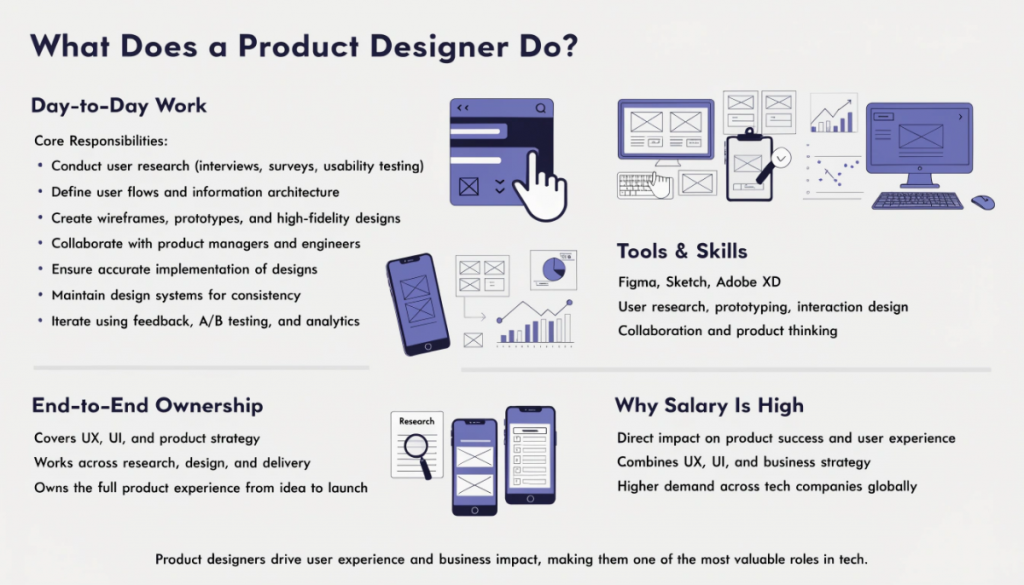
A product designer is responsible for the end-to-end design of a digital product from user research and problem definition through to interaction design, visual design and prototyping. The role sits at the intersection of UX, UI and product strategy and in most organisations product designers work directly with product managers and engineers as part of an integrated product team. Here is what the day-to-day work typically covers:
Conducting user research through interviews, surveys and usability testing to understand how people use a product
Defining user flows, information architecture and interaction patterns based on research findings
Creating wireframes, prototypes and high-fidelity mockups using tools like Figma, Sketch or Adobe XD
Collaborating with product managers to translate business requirements into design solutions
Working with engineers to ensure designs are implemented accurately and to spec
Contributing to and maintaining design system components for consistency across the product
Iterating designs based on user feedback, A/B test results and analytics data
The product designer salary reflects the breadth of this responsibility. Unlike a pure UI designer who focuses on visual execution or a UX researcher who focuses on discovery, a product designer owns the full experience from insight to shipped feature. That end-to-end ownership and the direct business impact it carries is what makes the product designer salary consistently above average across the technology sector globally.
Product Designer Salary in India, US and UK
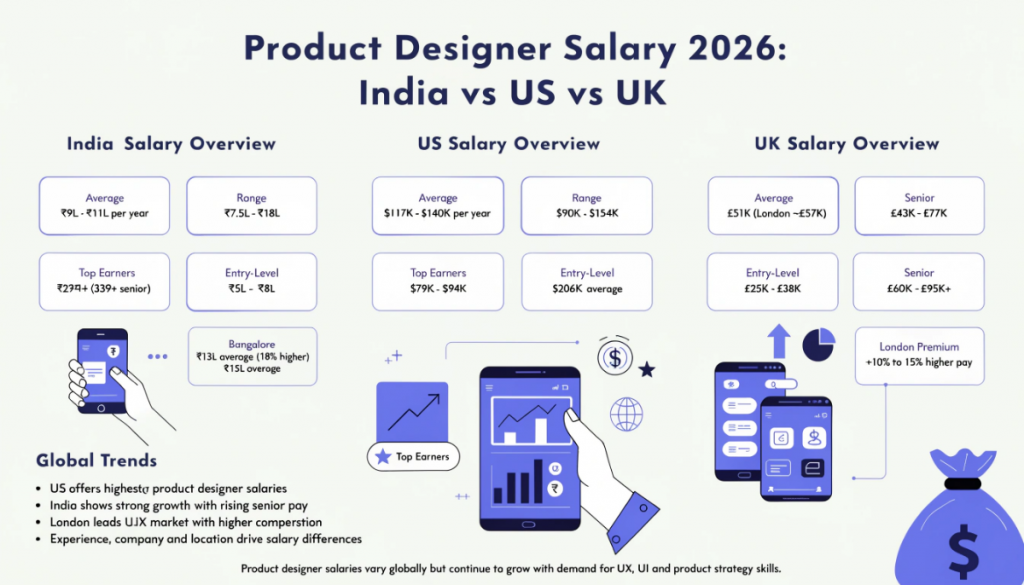
Here are the verified product designer salary figures from Glassdoor, PayScale, Indeed, Salary.com and AmbitionBox from 2025 and early 2026 across all three markets.
| Country | Average Salary | Entry / Mid Range | Senior / Top Range | Key Insights |
|---|---|---|---|---|
| India | ₹9.1L – ₹11L |
₹7.5L – ₹18L 25th to 75th percentile |
₹27.9L+ Top: ₹39.57L (senior) |
Bangalore leads at ₹13L avg (18% higher). Entry: ₹4.5L–₹10L, mid: ₹10L–₹18L. Top firms like Swiggy, Flipkart, PhonePe pay highest. |
| United States | $117K – $140K |
$90K – $154K 25th to 75th percentile |
$196K+ Top: $350K+ (senior) |
Highly competitive globally. Senior avg $206K. Top firms: Snowflake, Google, Airbnb. Real estate & finance industries pay highest. |
| United Kingdom | £51K – £57K |
£25K – £65K Entry to mid-level |
£95K+ Top: £95.6K (90th percentile) |
London leads with ~£57K avg (10–15% higher). Seniors earn £60K–£95K+. PayScale lower due to smaller firms. |
What Drives a Product Designer Salary Higher
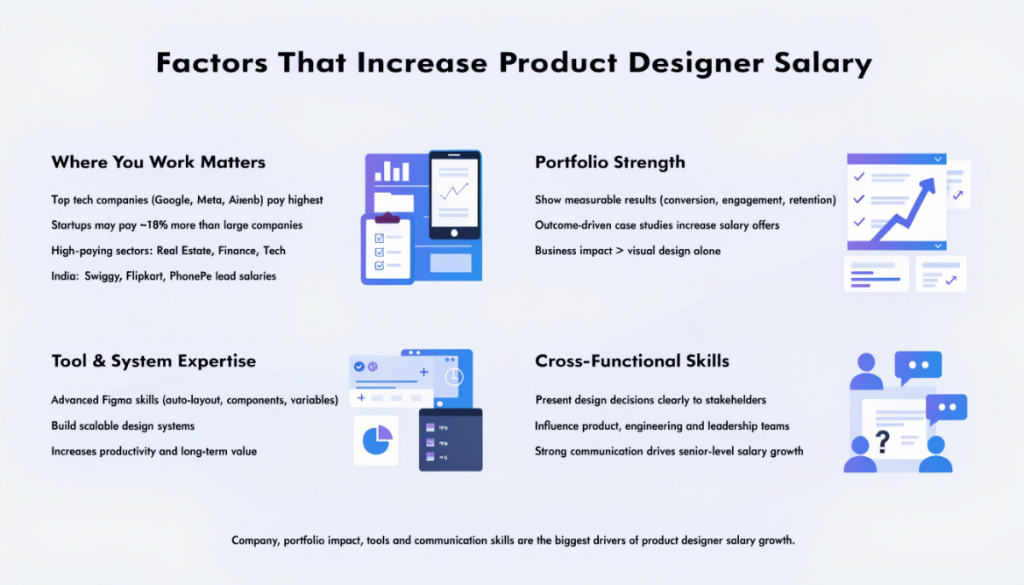
Within the product designer salary range at any level there are specific factors that consistently push pay to the upper end of the band.
Company Type and Industry
The type of company and industry has the most direct impact on product designer salary. Technology product companies at the scale of Google, Meta, Airbnb and Snowflake pay significantly above the national average in every market. In the US the Real Estate sector pays the highest median total pay for product designers at $152,949 followed by Financial Services at $133,348 and Information Technology at $130,236 according to Glassdoor April 2026 data. At the senior level within IT the median total pay reaches $197,037. According to Glassdoor smaller companies in the US pay approximately 18.51 percent more than larger companies for product designers which is the reverse of the pattern seen in most other professions and reflects the competition for design talent at growth-stage startups. In India consumer technology companies including Swiggy, Flipkart and PhonePe offer the strongest product designer salary packages.
Portfolio Strength and Demonstrable Impact
Unlike engineering roles where a technical interview can validate skills directly, product design hiring is heavily portfolio-driven. A product designer with a portfolio that demonstrates measurable impact such as improved conversion rates, reduced drop-offs or increased user engagement after a redesign commands a significantly stronger product designer salary offer than one with a visually appealing but outcome-agnostic portfolio. Building case studies that connect design decisions to business results is one of the most direct ways to negotiate a stronger product designer salary at any level.
Figma and Design System Expertise
Figma has become the dominant tool in product design and designers who are deeply fluent in Figma including auto-layout, component libraries, variables and collaborative workflows are more productive and more valuable. Designers who can build and maintain a comprehensive design system that engineering teams actually use provide compounding value to an organisation that goes beyond individual feature design. This design system capability is specifically cited by senior hiring managers as a differentiator in product designer salary negotiations and it supports stronger compensation at both the mid and senior level.
Cross-Functional Communication and Influence
Product designers who can communicate their design decisions persuasively to product managers, engineers and senior leadership without needing constant validation command stronger product designer salary packages because they reduce the cost of decision-making in the product team. The ability to run a design critique, present a rationale clearly to a non-designer audience and push back on scope reduction when it compromises user experience is a professional maturity that takes time to develop. Designers known for this kind of cross-functional influence are specifically sought out at the senior level where the product designer salary premium is most significant.
Product Designer Salary by Experience Level
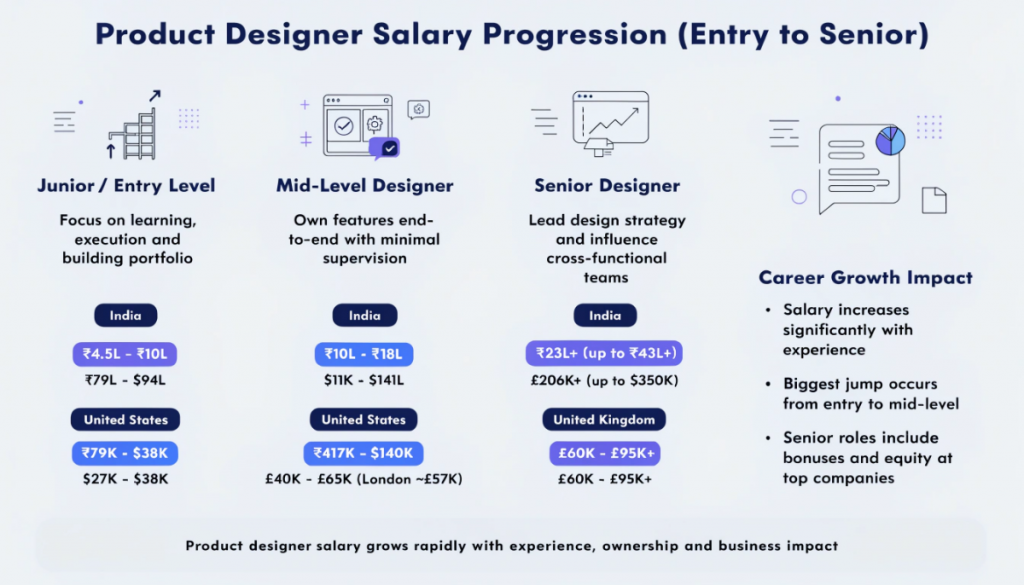
The product designer salary progression from entry to senior level is substantial in every market. Here is how it breaks down.
Junior and Entry Level
Entry-level product designers are typically fresh graduates or designers transitioning from adjacent fields like graphic design or UX research. The focus at this stage is on executing designs under guidance, learning the product team’s tools and processes and building a portfolio of shipped work. In India entry-level product designer salary ranges from Rs 4.5 lakh to Rs 10 lakh per year according to AmbitionBox 2025 data. In the US PayScale puts entry-level compensation with less than one year of experience at $79,528 rising to $94,801 for one to four years. In the UK entry-level designers earn GBP 25,000 to GBP 38,000 per year. The salary jump from entry to mid-level comes from demonstrated ownership of features and the ability to work with less direction.
Mid Level
Mid-level product designers own features or product areas end-to-end with minimal oversight. They conduct independent user research, make interaction design decisions autonomously and present design rationale directly to stakeholders. In India the mid-level product designer salary ranges from Rs 10 lakh to Rs 18 lakh per year according to AmbitionBox. In the US the national average at this level is $117,764 on Glassdoor with Indeed’s broader sample showing $140,407. In the UK mid-level designers earn GBP 40,000 to GBP 65,000 nationally with London averaging GBP 57,158. This is where most of the product design workforce sits and it is also where the largest single career upgrade comes from moving to a better-paying employer or sector.
Senior Level
Senior product designers define design direction for complex product areas, influence decisions across engineering and product management and often contribute to hiring and team culture. In India the senior product designer salary averages Rs 23 lakh nationally and Rs 26 lakh in Bangalore with top earners reaching Rs 43.10 lakh. In the US the average rises to $206,311 on Glassdoor with top earners at the 90th percentile reaching $350,360. In the UK senior designers earn GBP 60,000 to GBP 95,000 or more nationally with Glassdoor’s 90th percentile at GBP 95,648. Total compensation at senior levels at top technology companies in the US and UK includes equity and performance bonuses that can double the base product designer salary in strong years
Core Skills That Every Product Designer Needs
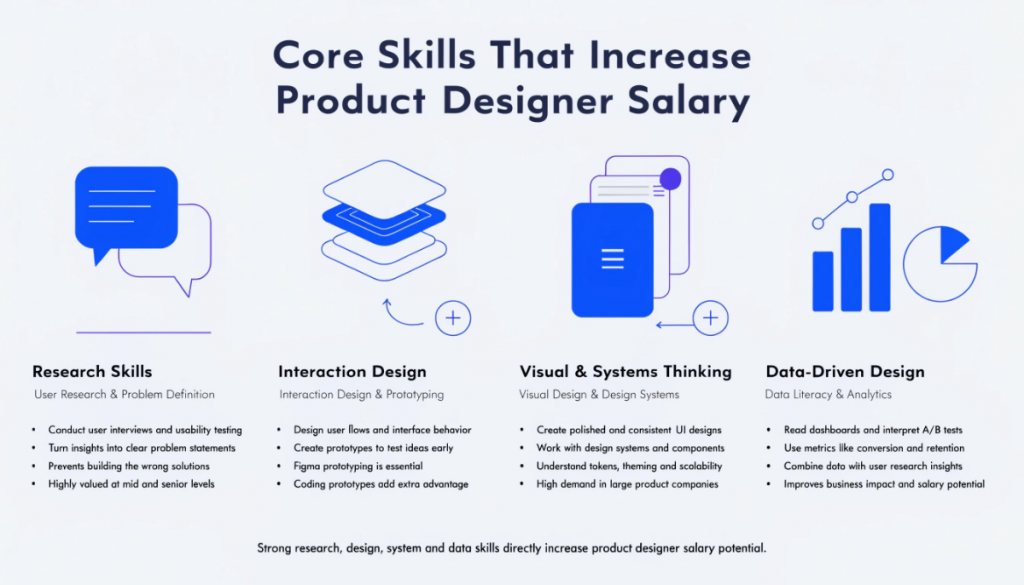
The skills you build determine your effectiveness and your position in the product designer salary range. These are the ones that matter most in practice.
User Research and Problem Definition
The strongest product designers start from a clear understanding of the user problem before touching any design tool. This means being able to plan and conduct user interviews effectively, synthesise findings into actionable insights and frame the design problem in a way that the product team can act on. Product designers who skip this step produce solutions that look good but miss the actual user need. Employers specifically value research capability at the mid and senior level because it reduces the cost of building the wrong thing and it is one of the competencies most directly linked to a stronger product designer salary at companies that take design seriously.
Interaction Design and Prototyping
Interaction design is the core craft skill of product design. It means thinking through how a user will navigate from one state to another, what happens when something goes wrong and how the interface communicates status and feedback clearly. Strong interaction designers prototype their ideas at the appropriate fidelity for the stage of the project and use prototypes to test hypotheses before engineering investment is made. Proficiency in Figma prototyping is now expected at every level of product design and designers who can also build functional prototypes using code have a meaningful advantage in product designer salary negotiations at technology-focused companies.
Visual Design and Design Systems
Visual design quality matters in product design even though it is not the whole job. A product designer who produces work that is visually polished alongside being well-researched and interaction-sound has a competitive advantage in portfolio evaluations. Equally important is the ability to work within and contribute to a design system. Designers who understand component architecture, token-based theming and the governance of a shared design system are particularly valued at larger product organisations and this capability directly supports a stronger product designer salary offer at scale-up and enterprise companies.
Data Literacy and Analytical Thinking
Product designers who can read analytics dashboards, interpret A/B test results and use quantitative data to inform design decisions alongside qualitative research are genuinely more valuable than those who work from intuition or research alone. This data literacy means understanding metrics like conversion rate, task completion rate, time on task and retention well enough to frame design problems in business terms. Designers with this analytical orientation are more credible in product team discussions and their product designer salary reflects that broader commercial usefulness in companies where data-informed decisions are the norm.
Certifications and Qualifications That Strengthen a Product Designer Profile
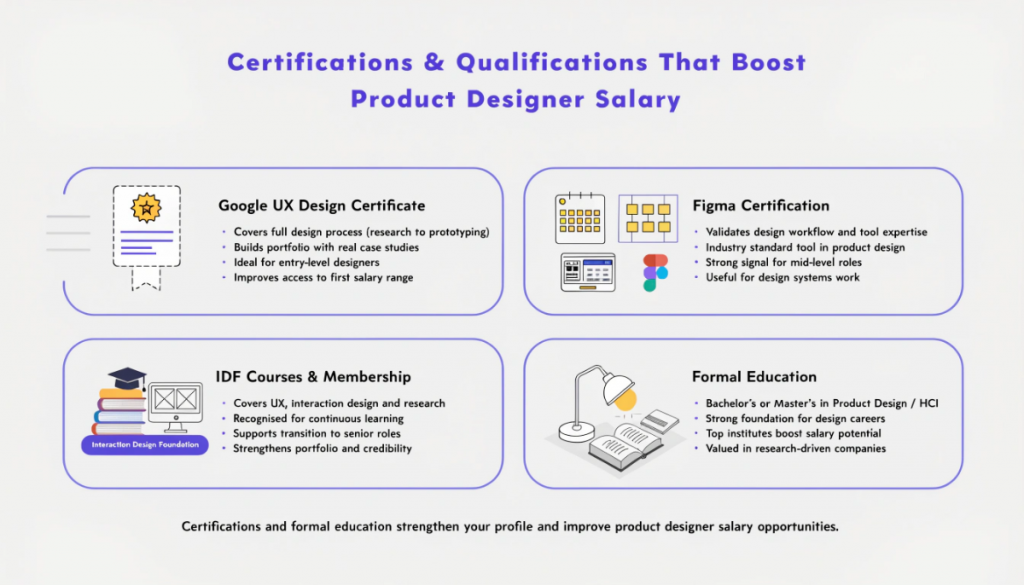
The right qualifications add credibility and in competitive hiring situations directly support a stronger product designer salary offer.
Google UX Design Professional Certificate
The Google UX Design Professional Certificate offered through Coursera is one of the most widely recognised entry-level credentials in UX and product design. It covers the full design process from user research through wireframing, prototyping and usability testing and results in a portfolio of three case study projects. For designers entering the field or transitioning from a related background this credential directly addresses the portfolio gap that most entry-level product designer salary negotiations run into. Completing it and using the portfolio projects effectively in job applications improves access to the Rs 4.5 lakh to Rs 10 lakh entry range in India and the GBP 25,000 to GBP 38,000 range in the UK.
Figma Certification
Figma offers official certifications covering professional design workflow and design system management. Given that Figma is the industry standard tool for product design in 2026 holding an official Figma certification demonstrates both tool fluency and a commitment to professional development. For designers targeting mid-level roles at technology companies where design system ownership is part of the role this certification is directly relevant and it supports a stronger product designer salary case because it validates a capability that hiring managers actively look for in portfolio reviews and interviews.
Interaction Design Foundation Membership and Courses
The Interaction Design Foundation offers a comprehensive library of UX and product design courses covering user research, interaction design, design thinking, information architecture and more. An IDF membership is cost-effective and the certificates from completed courses are widely recognised as evidence of continuous professional development in the design industry. For mid-level designers who want to move into senior roles and access the Rs 18 lakh to Rs 28 lakh range in India or the GBP 60,000 to GBP 95,000 range in the UK building a record of structured professional development through IDF supports both the portfolio and the salary negotiation conversation.
Bachelor’s or Master’s Degree in Product Design or HCI
A formal degree in product design, interaction design, human-computer interaction or a closely related field from a recognised institution provides the strongest foundational credential for a product design career. In the US a bachelor’s degree in product design is held by the majority of designers at top technology companies and it supports access to the strongest entry and mid-level product designer salary packages. In India graduates of design schools like NID, IIT’s design programmes and NIFT with strong portfolios enter the field at the upper end of the entry-level range. A master’s degree in HCI from institutions like Carnegie Mellon, Georgia Tech or the Royal College of Art in the UK is specifically valued at companies where research-led design is central to the product strategy.
Conclusion
Product designer salary is competitive and growing in every market covered in this guide. Based on verified 2026 data from Glassdoor, Indeed, PayScale, Salary.com and AmbitionBox, the average product designer salary in India is Rs 11 lakh nationally with Bangalore averaging Rs 13 lakh and senior designers averaging Rs 23 lakh nationally and Rs 26 lakh in Bangalore. In the US the average is $117,764 on Glassdoor with Indeed showing $140,407 and senior designers averaging $206,311 with top earners reaching $350,360 at companies like Google, Cruise and Airbnb. In the UK the London average is GBP 57,345 with senior designers earning GBP 60,000 to GBP 95,000 nationally. Building a portfolio with demonstrable business impact, developing strong Figma and design system skills and targeting technology product companies or high-paying sectors like financial services are the most reliable ways to push a product designer salary above the market average at any career stage.

Book Your
Free Session
Connect with our experts and get personalised guidance for your career, course selection, and future goals.
.JPG)
📖 Sources & References
✓ Verified 2026Verified salary insights across India, US, and UK based on 2026 data.
- Glassdoor India Avg ₹9.1L–₹11L | Top ₹27.9L+
- Bangalore Glassdoor Avg ₹13L | Senior ₹26L+
- AmbitionBox India Entry ₹4.5L–₹10L | Mid ₹10L–₹18L
- India PayScale Verified India compensation insights
- US Glassdoor Avg $117K–$140K | Senior $206K+
- US Indeed National avg $140,407 | Top industries pay highest
- US Salary.com Salary ranges and senior compensation data
- UK Glassdoor London avg £57K | Senior £95K+
- UK PayScale UK salary benchmarks across experience levels
- Uxcel Compensation Report 2026 UX and product designer salary analysis