

Portfolio manager salary is one of the most attractive compensation packages in the entire finance industry and it is heavily dependent on performance, the type of assets managed and the seniority of the role. This is not a role where the salary is simply set by HR and stays flat. It moves significantly with experience, the assets under management and the investment returns generated. If you are targeting portfolio management as a career or already in the field and want to benchmark your pay, this guide covers verified numbers from Glassdoor, PayScale, Salary.com and the CFA Institute from early 2026 across India, the US and the UK.
What a Portfolio Manager Actually Does
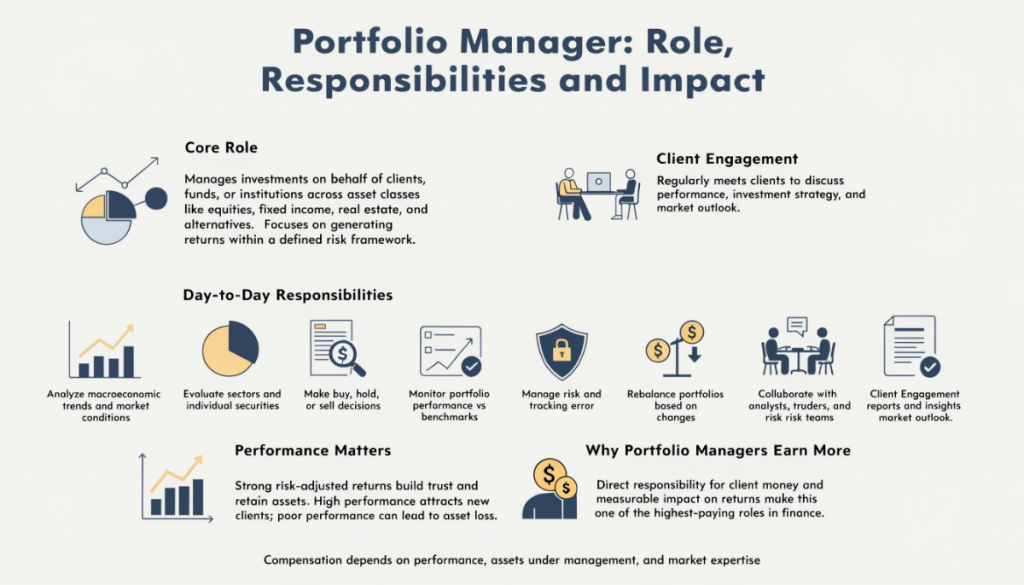
A portfolio manager is responsible for making investment decisions on behalf of clients, funds or institutional investors. The assets managed can include equities, fixed income, alternatives, real estate or a combination across a multi-asset mandate. The core job is generating returns within an agreed risk framework while managing client relationships and communicating performance clearly.
On a day-to-day basis the work involves:
Analysing macroeconomic conditions, sector trends and individual securities
Making buy, hold or sell decisions within the portfolio’s mandate and risk parameters
Monitoring portfolio performance against benchmark targets and managing tracking error
Meeting with clients to discuss performance, strategy and market outlook
Coordinating with research analysts, traders and risk teams on investment ideas and execution
Rebalancing portfolios in response to market movements, client withdrawals or inflows
Producing performance reports and investment commentary for clients and internal stakeholders
The portfolio manager salary reflects the direct accountability for client money that this role carries. A portfolio manager who generates strong risk-adjusted returns builds client trust, retains assets and attracts new mandates. One who underperforms loses clients and assets. That direct commercial consequence is what makes the portfolio manager salary one of the strongest in professional finance.
Portfolio Manager Salary in India, US and UK
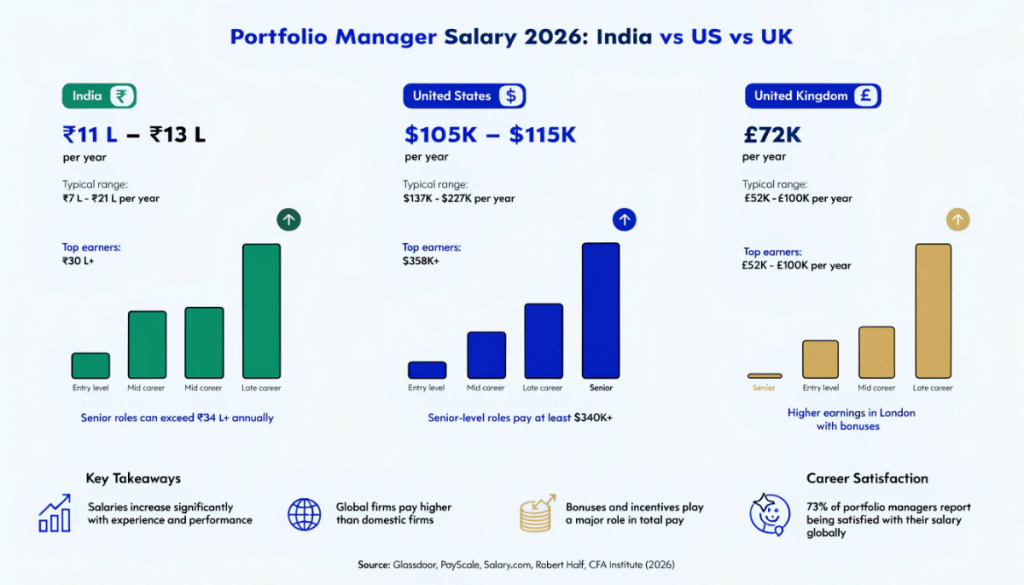
Here are the verified portfolio manager salary figures from Glassdoor, PayScale, Salary.com, Robert Half and the CFA Institute from early 2026 across all three markets.
| Country | Average Salary | Entry / Base Range | Senior / Top Range | Key Insights |
|---|---|---|---|---|
| India | ₹11.24L – ₹12.89L |
₹5.46L – ₹14.04L Analyst level |
₹20L – ₹30.83L+ Top: ₹43.5L | Senior avg up to ₹34.54L+ |
Global firms like BlackRock, Fidelity and HSBC AM pay highest. Mumbai leads due to fund house concentration. |
| United States | $105K – $126K |
$104K – $155K 4+ years (Robert Half range) |
$193K – $308K Top: $380K+ | NYC avg: $220K |
CFA charterholders average ~$300K total comp. Private markets and hedge funds pay significantly more. |
| United Kingdom | £72,818 |
£52K – £100K London typical range |
£100K – £134K+ Higher with bonuses |
London dominates pay. Employers include Aviva, Schroders, BlackRock and M&G Investments. |
What Drives a Portfolio Manager Salary Higher
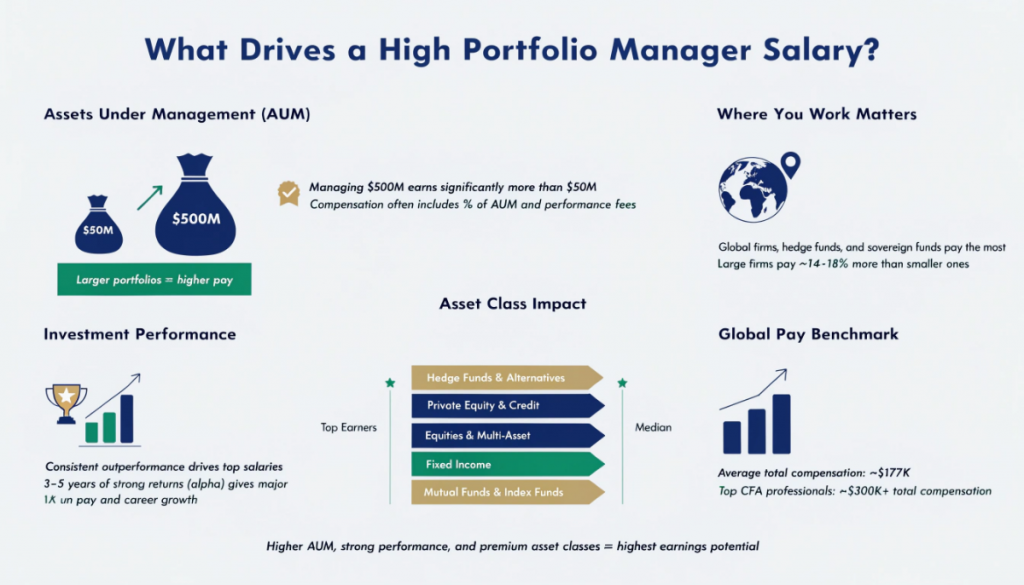
Within the portfolio manager salary range at any experience level there are specific factors that consistently separate the highest earners from the median.
Assets Under Management
The size of the fund or portfolio a manager oversees is the single biggest driver of portfolio manager salary beyond base experience. Asset management firms typically structure compensation as a percentage of AUM or performance fees above a hurdle rate. A portfolio manager overseeing $500 million in assets earns significantly more than one managing $50 million even with comparable skill and experience. Growing your AUM through strong performance and client retention is the most direct way to compound both your investment track record and your portfolio manager salary over a career.
Investment Performance Track Record
Portfolio managers are ultimately paid for results and a verified track record of outperforming the benchmark or peer group over multiple market cycles is what commands the strongest packages. Managers with a three to five year track record of consistent alpha generation have real leverage in salary negotiations because their value is demonstrated and measurable. This is why portfolio manager salary can escalate rapidly for genuinely strong performers and why it is also one of the careers where pay can fall significantly if performance disappoints over a sustained period.
Asset Class Specialisation
Different asset classes carry different portfolio manager salary premiums. Here is a general hierarchy from highest to lowest paying:
Hedge funds and alternative investments: highest base plus performance fee potential
Private equity and private credit: high base plus significant carried interest over time
Equity long-only and multi-asset: strong base at established firms
Fixed income and rates: competitive but typically below equity at equivalent seniority
Retail mutual funds and index-tracking: more stable but lower upside
Professionals who develop expertise in higher-value asset classes and complex strategies command a premium portfolio manager salary because fewer professionals have the depth of knowledge required.
Employer Type and Firm Size
The type and size of employer has a direct impact on portfolio manager salary. Global asset managers with large AUM pools, hedge funds with strong performance fee structures and sovereign wealth funds all pay above the market average for equivalent experience. According to the CFA Institute, the global total compensation for portfolio managers averages $177,000 and CFA charterholders specifically at top firms in the US earn around $300,000 in total compensation. Larger companies also tend to pay more with bigger firms paying 14 to 18 percent above smaller organisations for equivalent roles according to Glassdoor data.
Core Skills That Every Portfolio Manager Needs
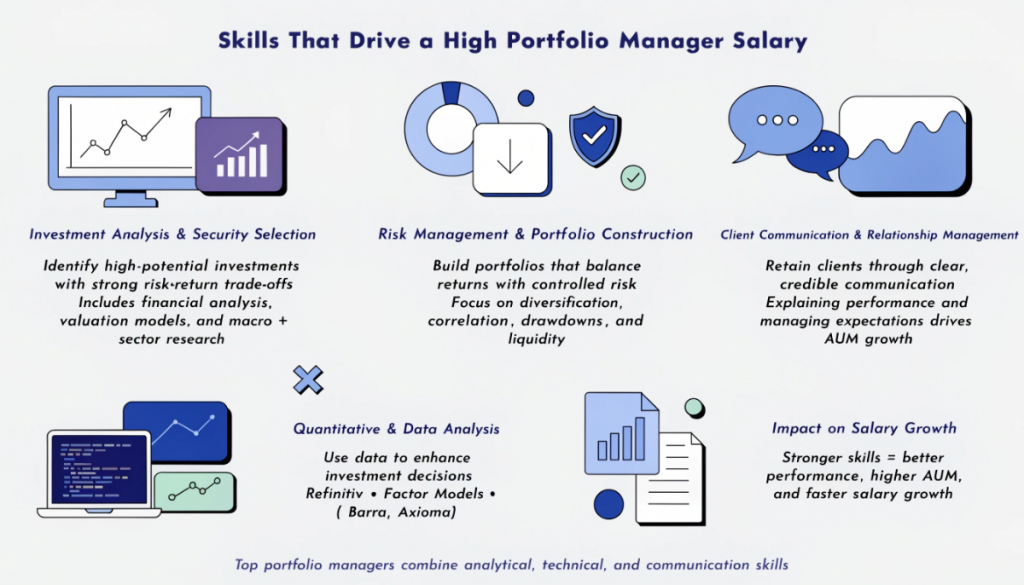
Building the right skill set is what determines how effective you are in this role and how quickly your portfolio manager salary moves toward the upper quartile.
Investment Analysis and Security Selection
The foundation of portfolio management is the ability to analyse securities accurately and identify investment opportunities that offer a favourable risk-return trade-off. This means being comfortable with both fundamental analysis including financial statement review, valuation modelling and competitive positioning and quantitative analysis including statistical risk measures and factor-based frameworks. Portfolio managers who can conduct thorough bottom-up research alongside top-down macro analysis are more versatile and more valued at most investment management firms.
Risk Management and Portfolio Construction
Understanding how to construct a portfolio that achieves its return objectives within defined risk limits is a distinct and critical skill. This involves managing concentration risk, correlation between positions, drawdown controls and liquidity constraints. Portfolio managers who build well-constructed portfolios that deliver consistent risk-adjusted returns rather than volatile outperformance earn more because they retain client assets through difficult markets. This is one of the competencies most directly tested in the CFA curriculum and it is a skill that measurably supports a stronger portfolio manager salary over a career.
Client Communication and Relationship Management
Portfolio managers who manage external client mandates spend a significant portion of their time communicating performance, explaining market conditions and managing client expectations through periods of drawdown. The ability to retain clients through difficult markets is commercially as valuable as generating strong returns during good ones. Portfolio managers who are known for clear and credible communication with clients retain more assets under management which directly supports a higher portfolio manager salary at firms where compensation is linked to AUM or client retention.
Quantitative and Data Analysis Skills
The investment management industry has become increasingly quantitative and portfolio managers who can work with data fluently have a competitive advantage. This includes using Python or R for portfolio analytics, working with risk factor models like Barra or Axioma, understanding attribution analysis and using Bloomberg or Refinitiv for data-driven investment research. Quantitative skills are particularly valued at systematic and multi-factor investment managers where these capabilities are core to the investment process and directly support a stronger portfolio manager salary.
Types of Portfolio Manager Roles and How Pay Differs
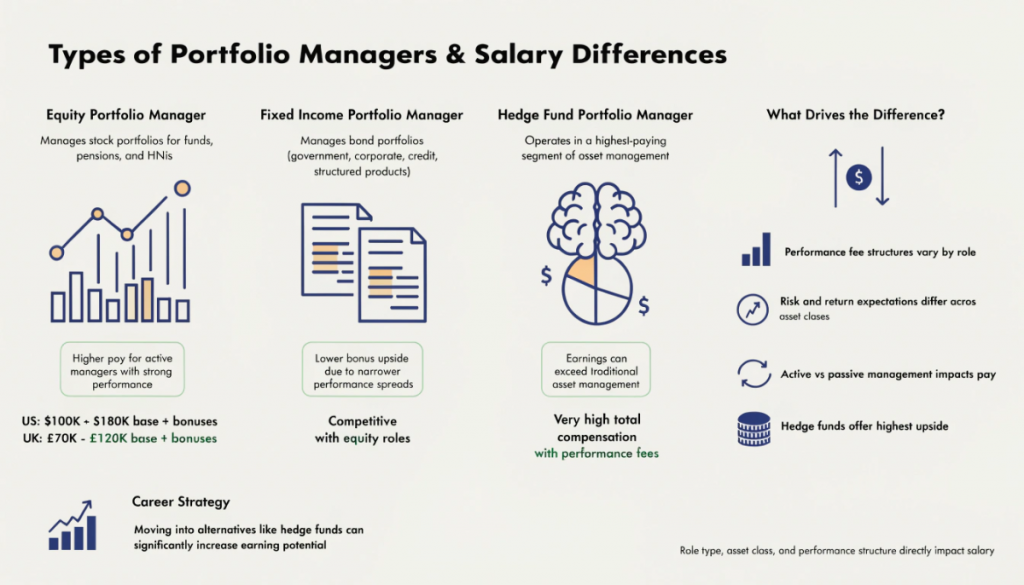
Understanding which type of portfolio management you are doing or targeting matters because portfolio manager salary varies significantly across different mandates and employer types.
Equity Portfolio Manager
Equity portfolio managers run stock portfolios on behalf of mutual funds, pension funds, insurance companies or wealthy individuals. The pay varies widely between an index-tracking manager and an active stock-picker with a strong track record. At major asset management firms in the US active equity portfolio managers earn between $100,000 and $180,000 in base salary according to AnalystPrep’s 2025 guide with significant bonus upside for strong performance. In the UK equity portfolio managers at established firms like Baillie Gifford, Schroders and Liontrust earn GBP 70,000 to GBP 120,000 in base with bonuses adding meaningfully to total compensation.
Fixed Income Portfolio Manager
Fixed income portfolio managers oversee bond portfolios covering government debt, corporate credit, high yield and structured products. The portfolio manager salary in fixed income is generally comparable to equity at the same seniority level but bonus potential is somewhat lower because performance differentials tend to be narrower. At large asset managers and insurance companies fixed income portfolio managers earn competitive packages because the liability-driven investment mandates they manage are very large and technically demanding.
Hedge Fund Portfolio Manager
Hedge fund portfolio managers work in the highest-paying segment of investment management. The fee structure of hedge funds which includes a management fee on AUM and a performance fee on returns above a hurdle rate creates significant upside for managers with strong track records. Senior hedge fund managers at established funds in New York and London can earn total compensation well above the standard asset management benchmark. The portfolio manager salary in hedge funds is the reason many institutional asset managers eventually move to the buy-side alternatives space.
Certifications That Strengthen a Portfolio Manager Profile
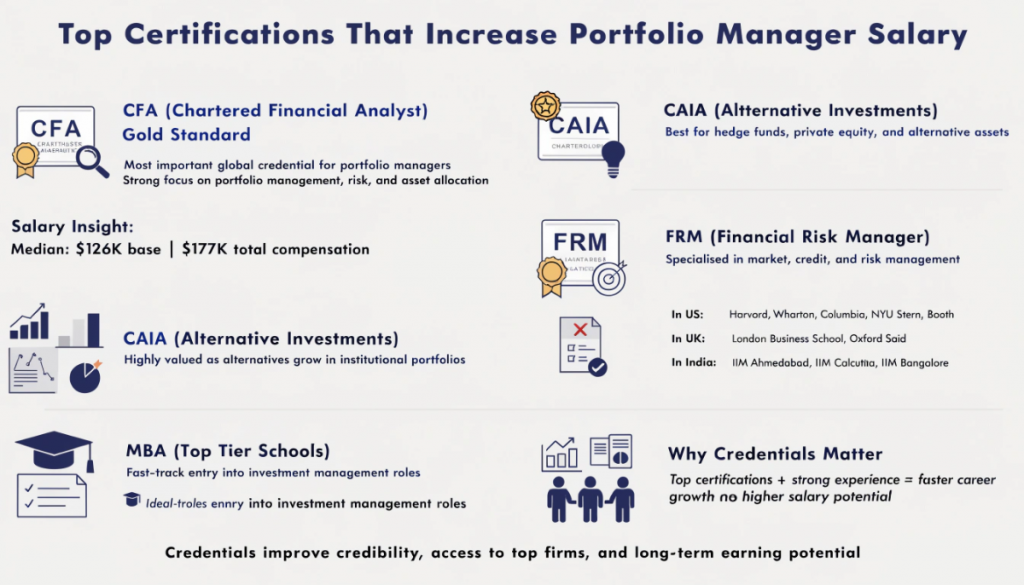
The right credentials add genuine credibility to a portfolio management career and in many cases they are directly linked to access to the most competitive portfolio manager salary packages.
Chartered Financial Analyst (CFA)
The CFA designation from the CFA Institute is the most important professional credential in portfolio management globally. According to the CFA Institute, 22 percent of all CFA charterholders work as portfolio managers making it the most common job title in the CFA community. The CFA curriculum is specifically built around the investment management process covering portfolio construction, asset allocation, risk management, ethics and performance evaluation. Holding the CFA designation directly supports a stronger portfolio manager salary as confirmed by the CFA Institute’s own compensation data which shows charterholders earning a median base of $126,000 and total compensation of $177,000 in the US. CFA charterholders in senior roles at major firms earn considerably more.
Chartered Alternative Investment Analyst (CAIA)
The CAIA designation from the CAIA Association is specifically designed for professionals working in alternative investments including hedge funds, private equity, private credit, real assets and infrastructure. For portfolio managers targeting alternative asset classes the CAIA provides technical depth in areas not covered by the CFA curriculum. As alternatives have grown as a proportion of institutional portfolios the CAIA has become increasingly valued by employers and it supports a stronger portfolio manager salary particularly for professionals managing or targeting hedge fund and private markets mandates.
Financial Risk Manager (FRM)
The FRM from GARP is particularly relevant for portfolio managers who work within defined risk frameworks at institutional investors, banks or multi-asset funds. It provides deep technical grounding in market risk, credit risk, operational risk and risk measurement which directly strengthens a portfolio manager’s ability to construct and defend their risk-taking decisions. For portfolio managers at insurance companies, pension funds and quantitative managers the FRM adds a layer of risk methodology credibility that supports a stronger portfolio manager salary.
MBA from a Target Business School
An MBA from a finance-focused top-tier business school is one of the most direct pathways into institutional portfolio management at the associate level globally. In the US target schools for investment management include Harvard, Wharton, Columbia, NYU Stern and Booth. In the UK London Business School and Oxford Said are the primary routes. In India IIM Ahmedabad, IIM Calcutta and IIM Bangalore are the primary MBA feeders for the investment management industry. An MBA from these institutions combined with internship experience at an asset manager sets the foundation for a portfolio manager salary trajectory that reaches the senior level faster than non-MBA entrants.
Conclusion
Portfolio manager salary is genuinely high and the career offers one of the strongest long-term earnings trajectories in professional finance for those who build a real investment track record. Based on verified 2026 data from Glassdoor, PayScale, Salary.com and the CFA Institute, the average portfolio manager salary in India ranges from Rs 11 lakh to Rs 34 lakh depending on the role and employer. In the US the typical range is $105,000 to $242,000 for mid and senior professionals with total compensation at the senior level including bonuses reaching $300,000 to $380,000 and beyond in top-tier firms. In London the average is GBP 72,818 with top earners exceeding GBP 134,000. Choosing the right firm type, building a verifiable investment track record and earning the CFA designation are the three most direct ways to push a portfolio manager salary above the market average at any career stage.

Book Your
Free Session
Connect with our experts and get personalised guidance for your career, course selection, and future goals.

📖 Sources & References
✓ Verified 2026Verified portfolio manager salary benchmarks, finance compensation reports and investment management career insights across India, US and UK for 2026.
- India Glassdoor Portfolio Manager salary benchmarks across India including Mumbai and Bangalore
- PayScale India Investment management compensation insights by experience and employer type
- US Glassdoor US portfolio manager salaries including hedge funds and asset management firms
- Salary.com Portfolio management salary ranges, bonuses and compensation structures
- UK Glassdoor London and UK investment management salary insights for 2026
- CFA Institute Portfolio management compensation reports and CFA charterholder salary data
- Robert Half Salary Guide Finance and investment management salary benchmarks across major markets
- CAIA Association Alternative investment certification and hedge fund career insights
- GARP FRM Financial Risk Manager certification and portfolio risk management resources
- Bloomberg Markets Global markets data, portfolio analytics and institutional investing insights