

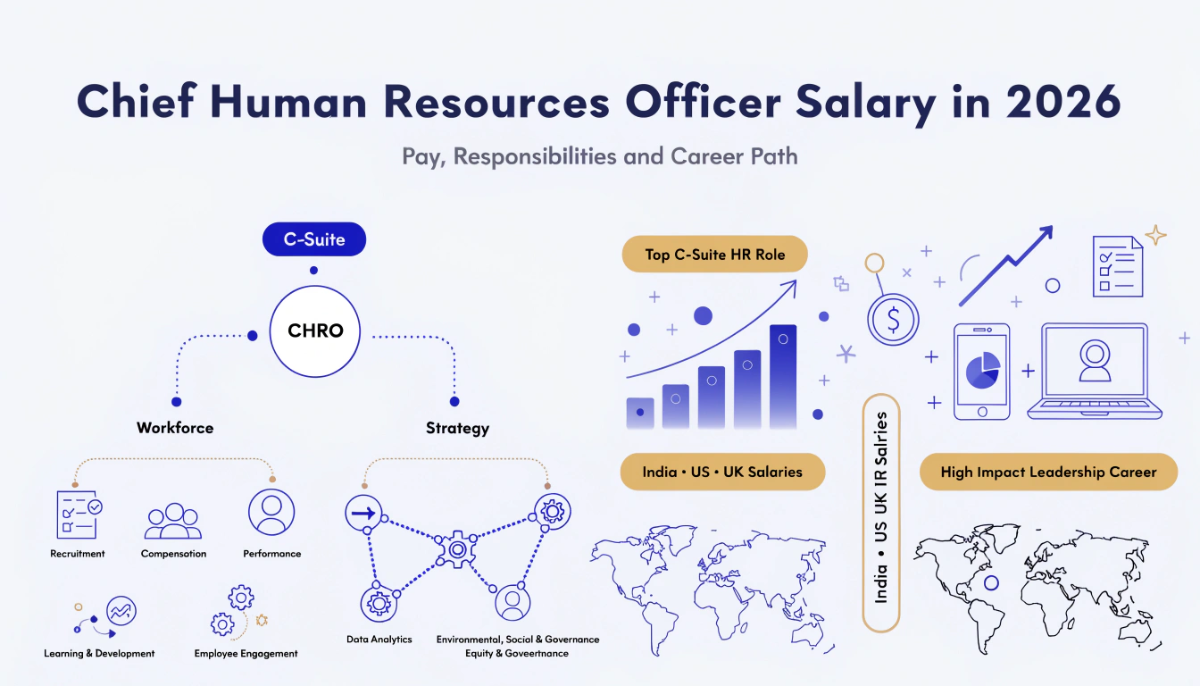
Chief human resources officer salary is among the strongest in the C-suite and the gap between a CHRO and other senior HR professionals is substantial. The role has become genuinely strategic over the past five years as CEOs consistently rank talent, culture and workforce transformation among their top business priorities. If you are an HR leader targeting the CHRO position or a CHRO benchmarking your current package, this guide covers the verified figures from Glassdoor, Salary.com, PayScale and the Frazer Jones HR salary guide updated to early 2026 across India, the US and the UK. Chief human resources officer salary varies significantly by company size, industry and geography and this guide breaks all of that down clearly.
What a Chief Human Resources Officer Does
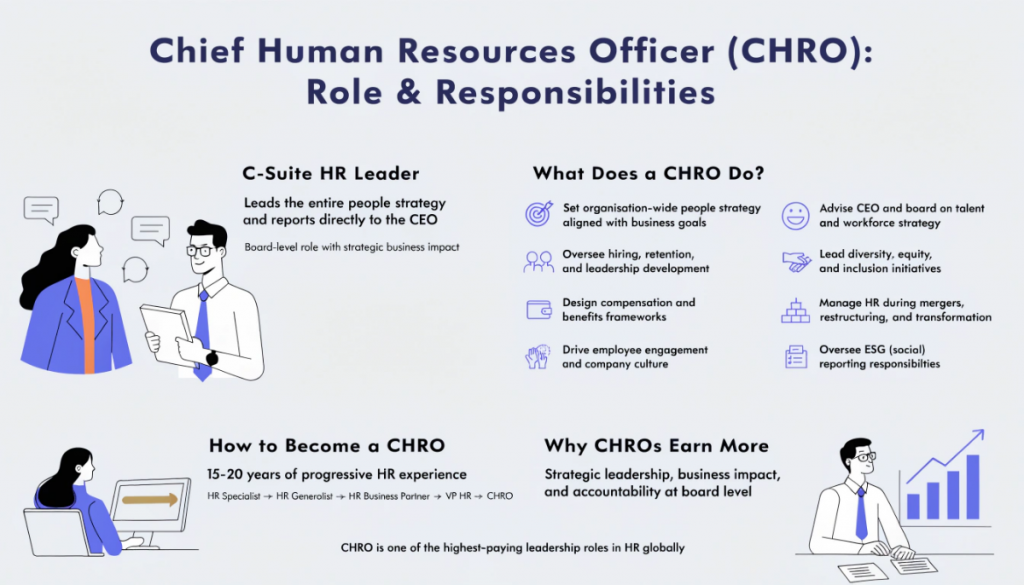
A chief human resources officer is the most senior HR leader in an organisation and reports directly to the CEO. The role has evolved from an administrative function to a full C-suite position with board-level accountability. Here is what the work actually covers:
Setting the people strategy for the entire organisation and aligning it with business objectives
Overseeing talent acquisition, retention, succession planning and leadership development
Designing compensation and benefits frameworks that are competitive and equitable
Driving employee experience, engagement and culture programmes
Advising the CEO and board on talent risks, workforce transformation and organisational design
Leading diversity, equity and inclusion strategy across all levels of the business
Managing the organisation’s response to workforce challenges during mergers, restructuring or major strategic shifts
Owning the social pillar of ESG reporting as this function increasingly sits with the CHRO
The chief human resources officer salary reflects this breadth of strategic accountability. According to the CHRO Role Guide 2026 from Performance Reviews Software, the typical path to this role takes 15 to 20 years of progressive HR experience. Most CHROs have held at least three to four roles of increasing scope moving from specialist to generalist to HRBP to VP of HR before reaching the C-suite. That combination of deep domain expertise and executive leadership is what justifies the chief human resources officer salary at the level it sits in every major market.
Chief Human Resources Officer Salary in India, US and UK
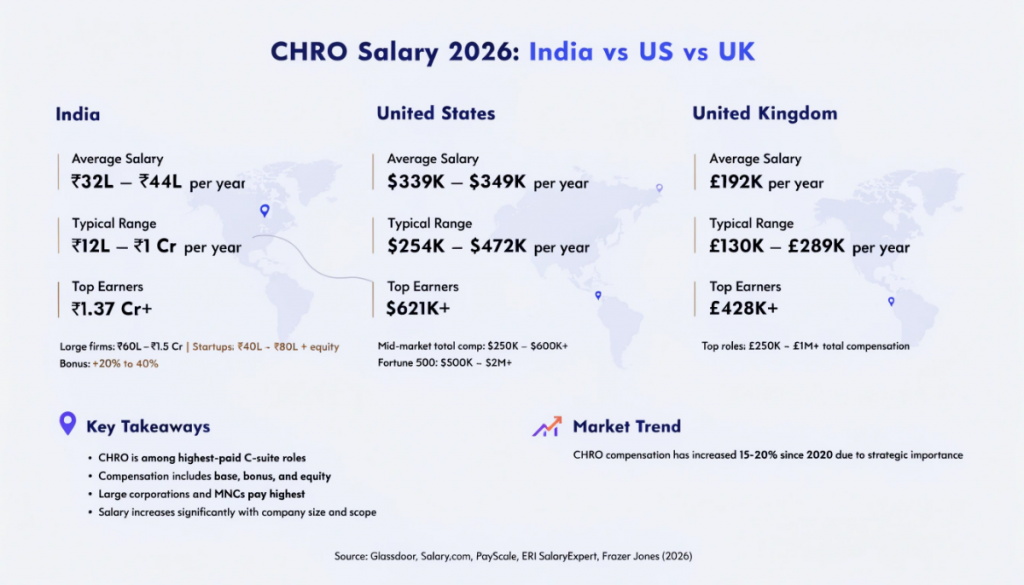
Here are the verified chief human resources officer salary figures from Glassdoor, Salary.com, PayScale, ERI SalaryExpert and Frazer Jones from early 2026 across all three markets.
| Country | Average Salary | Typical Range | Senior / Top Range | Key Insights |
|---|---|---|---|---|
| India | ₹32L – ₹44.32L |
₹12.63L – ₹1Cr Wide variation by company size |
₹60L – ₹1.5Cr+ Top: ₹1.37Cr | Avg up to ₹63L+ |
Large corporates and MNCs dominate pay. Bonuses add 20–40% + equity in startups. |
| United States | $339K – $349K |
$254K – $472K Glassdoor range |
$472K – $621K+ Top: $2M+ total comp (Fortune 500) |
One of the highest-paid C-suite roles. Equity-heavy packages in large firms. |
| United Kingdom | £192K |
£130K – £289K London benchmark |
£250K – £428K+ Top: £1M+ (exec search data) |
London dominates pay. Executive search data shows massive upside at top firms. |
What Drives a Chief Human Resources Officer Salary Higher
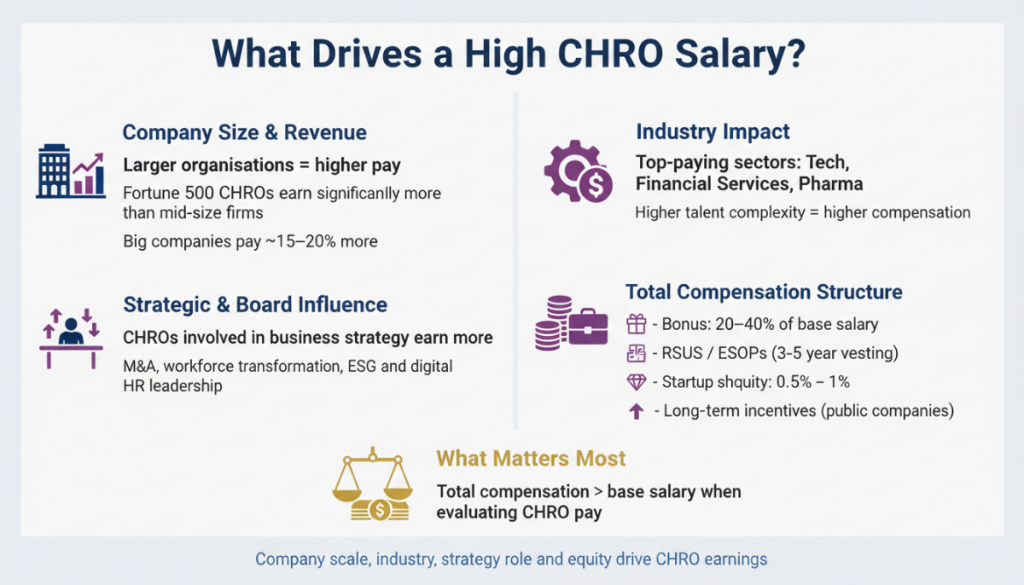
Within the chief human resources officer salary range there are specific factors that consistently separate those at the top end from those closer to the median.
Company Size and Revenue Scale
Company size is the most direct determinant of chief human resources officer salary. A CHRO managing the people function of a 50,000-person Fortune 500 company earns dramatically more than one at a 500-person mid-market firm. The scope of the CHRO role scales directly with workforce size, geographic complexity and the number of HR sub-functions they oversee. Moving from a smaller organisation to a larger one through career advancement is the most reliable way to increase a chief human resources officer salary significantly. Larger companies typically pay 15 to 20 percent more than smaller ones according to Glassdoor data patterns.
Industry Sector
The industry has a measurable impact on chief human resources officer salary. Technology, financial services and pharmaceutical companies consistently pay the most for CHRO-level talent because their talent acquisition challenges are the most complex and the commercial stakes of getting people strategy right are highest. In the US the top companies paying the strongest chief human resources officer salary packages are concentrated in technology and life sciences. In India multinational companies in banking, technology and FMCG pay CHRO compensation significantly above the national average for the role.
Strategic Contribution and Board Engagement
Chief human resources officers who operate as genuine strategic partners to the CEO and board rather than as senior administrators earn more. This means contributing to M&A decisions, workforce transformation strategy, digital HR implementation and ESG reporting. According to the CHRO Role Guide 2026 CHROs are now more involved in shaping business strategy than at any point in the history of the function and this expanded mandate is reflected in the chief human resources officer salary trajectory across all markets over the past five years.
Performance-Linked Variable Pay and Equity
A significant portion of total chief human resources officer salary at large organisations comes from variable components beyond the base. These typically include:
Annual performance bonus of 20 to 40 percent of base salary tied to HR KPIs
Restricted Stock Units or ESOPs that vest over three to five years
Profit-sharing arrangements at private companies
Equity stakes of up to 0.5 to 1 percent at Series B to D stage startups
Long-term incentive plans at publicly listed firms tied to total shareholder return
Understanding the full compensation structure rather than just the base salary is critical when evaluating or negotiating a chief human resources officer salary package.
Core Responsibilities That Define the CHRO Role
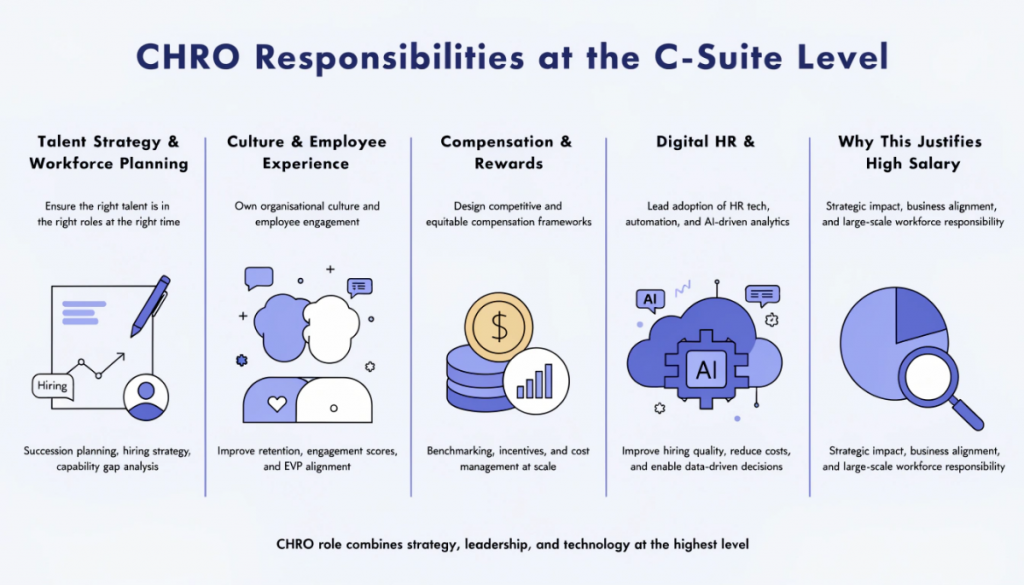
The chief human resources officer salary is justified by a set of responsibilities that go well beyond what any other HR role carries. Here is how the core work breaks down at the C-suite level.
Talent Strategy and Workforce Planning
The CHRO owns the organisation’s talent strategy which means ensuring the business has the right people in the right roles at the right time. This involves long-range workforce planning, identifying capability gaps before they become operational problems, building succession pipelines for critical roles and designing talent acquisition strategies that build employer brand alongside filling immediate vacancies. This strategic planning function is distinct from the operational HR manager role and it is a primary justification for the chief human resources officer salary premium over every other HR title.
Organisational Culture and Employee Experience
Culture and employee experience have become board-level concerns and the CHRO owns both. This includes designing the employee value proposition, measuring engagement at scale, building and executing programmes that improve retention among high performers and ensuring that the organisational culture is genuinely aligned with the stated values rather than just the aspirational ones. CHROs who demonstrate measurable improvement in engagement scores and voluntary turnover rates have a concrete business case for a higher chief human resources officer salary in their negotiations.
Total Rewards and Compensation Strategy
The CHRO is responsible for designing compensation and benefits frameworks that are competitive in the market, equitable across the organisation and aligned with the company’s performance philosophy. This involves benchmarking against market data, designing incentive structures that drive the right behaviours and managing the significant cost implications of compensation decisions at scale. Getting this wrong costs organisations both in talent loss and in regulatory exposure which is why total rewards strategy is a core component of what justifies the chief human resources officer salary at the C-suite level.
Digital HR Transformation and AI Adoption
CHROs who lead the adoption of digital HR platforms, AI-driven analytics and automation across HR processes are particularly valued in 2026. According to PolicyBazaar’s analysis organisations implementing digital HR platforms reward CHROs skilled in automation and AI-driven analytics more generously. The ability to deploy technology to improve hiring quality, reduce HR operational costs and generate workforce insights that support business decisions directly enhances a CHRO’s commercial value and their chief human resources officer salary reflects that technical leadership capability.
Qualifications and Certifications That Strengthen a CHRO Profile
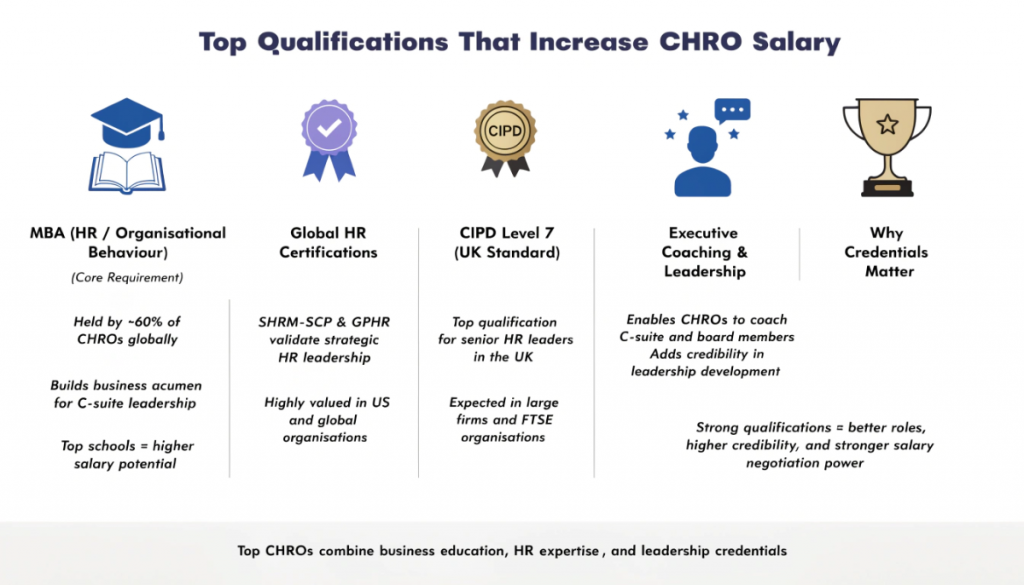
The chief human resources officer salary is supported by a specific combination of qualifications and professional credentials. Here are the ones that carry the most weight.
MBA with HR or Organisational Behaviour Specialisation
An MBA from a recognised business school is held by approximately 60 percent of CHROs globally according to the CHRO Role Guide 2026. The MBA provides strategic business acumen that is genuinely necessary at the C-suite level because a CHRO must speak the language of the CEO, CFO and board as fluently as they speak HR. In India IIM graduates with HR specialisations command a significant premium in chief human resources officer salary negotiations. In the US and UK MBA credentials from target schools materially strengthen CHRO candidacy at large organisations.
SHRM-SCP and GPHR
The SHRM Senior Certified Professional and Global Professional in Human Resources certifications are specifically cited in the CHRO Role Guide 2026 as key credentials for CHRO-level professionals. The SHRM-SCP demonstrates strategic HR leadership capability at the highest level of SHRM’s certification framework and is particularly valued at US organisations. The GPHR is relevant for CHROs with global or multi-country workforce responsibility. Both certifications directly support a stronger chief human resources officer salary case in hiring and board-level compensation conversations.
CIPD Level 7
In the United Kingdom the CIPD Level 7 Advanced Diploma in People Management is the premier professional qualification for senior HR leaders. Holding a Level 7 CIPD is broadly expected at the CHRO level at major UK organisations and it signals the depth of professional knowledge and commitment that justifies a top-tier chief human resources officer salary in the UK market. CHROs at FTSE 100 and large financial services firms in London almost universally hold a Level 7 CIPD or equivalent postgraduate qualification.
Coaching and Leadership Development Credentials
Senior HR leaders who hold accredited executive coaching credentials from institutions like the International Coaching Federation are valued because CHROs frequently coach C-suite peers and board-level executives directly. This capability is particularly relevant for talent development mandates at scale and it adds a dimension of professional credibility that supports a stronger chief human resources officer salary particularly at organisations where leadership development is a board-level priority.
Conclusion
Chief human resources officer salary is genuinely at the top of the HR compensation spectrum and the numbers are substantial in every market. Based on verified 2026 data from Glassdoor, Salary.com, PayScale and Frazer Jones, the average chief human resources officer salary in India is Rs 32 lakh to Rs 63 lakh with large corporation base salaries reaching Rs 60 lakh to Rs 1.5 crore. In the US the average is $339,613 to $349,348 with Fortune 500 CHRO total compensation reaching $500,000 to $2,000,000 or more. In London the average is GBP 192,378 with top earners reaching GBP 428,373 and Frazer Jones citing a permanent base range of GBP 250,000 to GBP 1,000,000 at major organisations.
Building a career to the CHRO level takes 15 to 20 years of progressive HR leadership experience and the combination of strategic business acumen, technology-forward HR practice and demonstrated organisational impact is what justifies the chief human resources officer salary premium at the top of the profession.

Book Your
Free Session
Connect with our experts and get personalised guidance for your career, course selection, and future goals.

📖 Sources & References
✓ Verified 2026Verified Chief Human Resources Officer salary insights across India, US and UK based on 2026 compensation data.
- India Glassdoor Avg ₹32L–₹44L | Senior corporate CHRO salaries exceed ₹1Cr
- India PayScale Large MNCs and enterprise firms pay highest compensation
- US Glassdoor Avg $339K–$349K | Top executive compensation crosses $600K+
- US Salary.com Executive HR leadership compensation benchmarks and bonus structures
- UK Glassdoor London average ~£192K | Top roles exceed £428K+
- Frazer Jones HR Salary Guide Executive HR and CHRO compensation analysis across UK and global markets
- ERI SalaryExpert Global executive HR salary benchmarking and compensation trends
- Performance Reviews Software – CHRO Role Guide 2026 CHRO responsibilities, strategic leadership trends and executive career path insights
- SHRM-SCP Certification Senior HR leadership certification widely recognised for executive HR roles
- CIPD Level 7 Advanced HR leadership qualification commonly held by UK CHROs