


A lot of students finish an MA in Sociology and then get asked the same question by relatives. What kind of job will that get you. The honest answer is that MA sociology jobs exist in government offices and companies and NGOs and classrooms. The roles are less obvious than an engineering or accounting title but they are real and they pay better as your experience grows. This blog lists the main job options and what each role involves. It also covers the skills you need and the eligibility for an online MA.
What MA Sociology Jobs Look Like Today
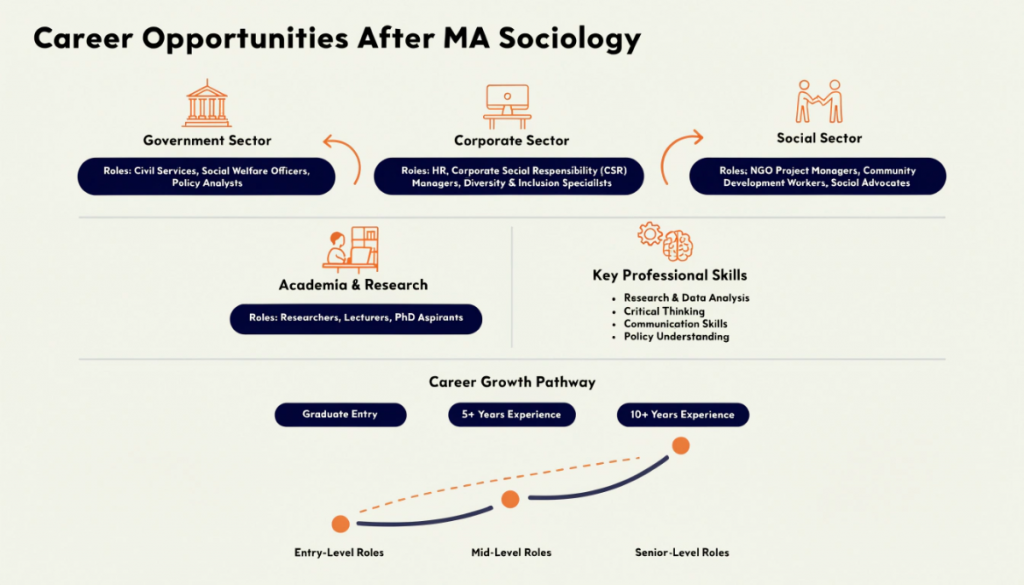
MA sociology jobs are roles where you use your understanding of society and groups and behaviour to solve a practical problem for an employer. That could mean studying why customers behave a certain way or designing a welfare scheme or running a survey for a research body.
Scope of the Degree
- Sociology trains you to read social data and spot patterns in how people live and work and spend, which means you can contribute to any role that depends on understanding people.
- Jobs fall into five broad groups that are government and corporate and social sector and academic and research, so a graduate is never limited to a single path.
- Demand is steady in areas like CSR and HR and market research, since organisations of every size need people who understand communities and employees.
What Employers Actually Value
- Research skills such as designing a survey and running interviews and writing a clear report, because these are used in almost every sociology linked role.
- Strong writing and communication, which means graduates who can explain findings simply get picked over those who only know theory.
- Comfort with data tools like spreadsheets and basic statistics software, since most research and policy jobs now expect it.
Why the Degree Still Matters
- Sociology builds the habit of questioning assumptions, which means you can look at a problem from the side of the people affected and not only from the side of the organisation.
- It trains you to work across groups with different backgrounds, so you can handle diverse teams and communities with more confidence.
A Realistic Expectation on Pay and Growth
Entry level pay in this field is usually modest compared with technical degrees. It rises as you build a track record in a specialised area such as policy research or HR or CSR. Graduates who add practical skills like data analysis or a relevant certification tend to move up faster than those who rely on the degree alone.
Government MA Sociology Jobs
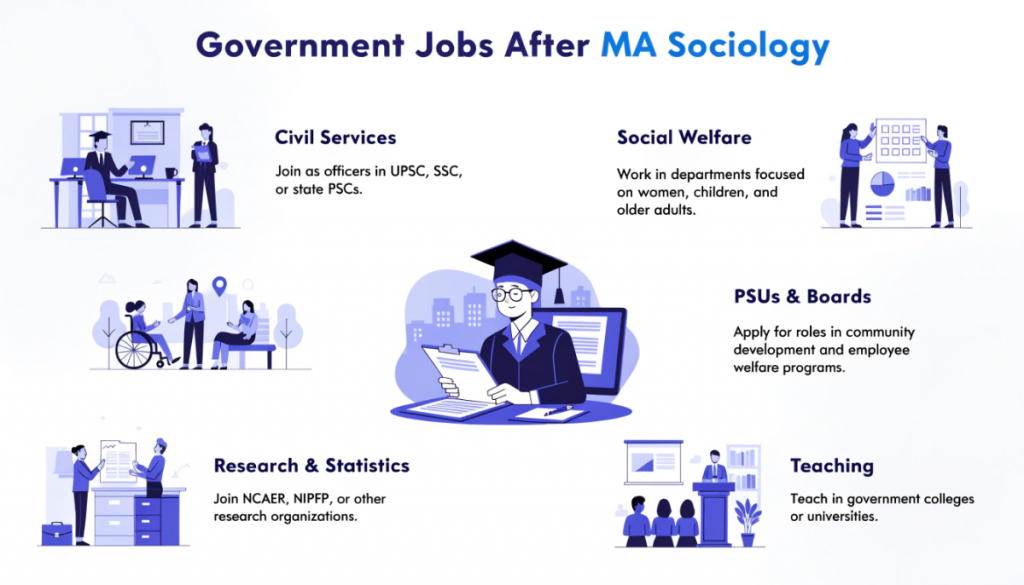
Government service is one of the most popular routes for sociology postgraduates. The subject fits well with public administration since much of governance deals with social groups and welfare and development.
Civil Services
- Sociology is a common optional subject in the civil services exam, which means an MA gives you a head start on a large part of the syllabus.
- State public service commission exams also test social issues and administration, so the same preparation helps for state level posts.
Social Welfare and Development Departments
- Roles such as welfare officer and probation officer and development officer exist in state and central departments, which means graduates can work directly on schemes for women and children and the elderly.
- Rural and urban development bodies hire people who can survey communities and report on how schemes are working on the ground.
Research and Statistics Bodies
- Survey and statistics organisations hire research assistants and investigators for large data collection exercises, so a research focused MA fits naturally.
- Planning and policy units in government need people who can analyse social data and write briefing notes for decision makers.
Public Sector Units and Boards
- Public sector companies and boards run welfare and community programmes of their own, so they hire officers who can plan and monitor these activities.
- Labour and tribal and minority welfare bodies look for graduates who understand the groups they serve, which makes sociology a natural background.
Teaching Posts
Candidates who clear the national eligibility test for assistant professor can apply for college teaching jobs. School teaching roles in social science are also open to those who add a teaching qualification.
Private Sector MA Sociology Jobs
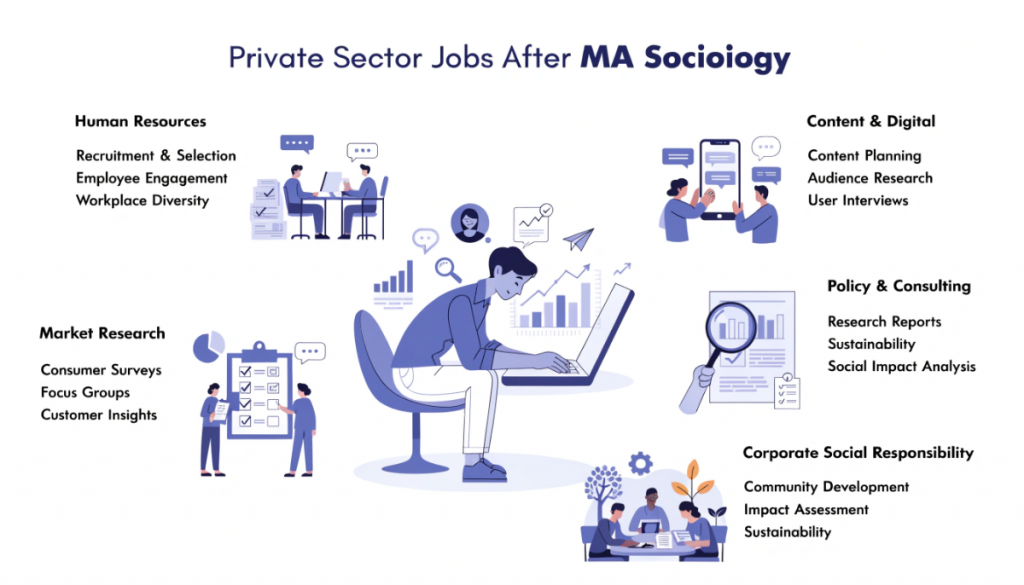
Companies are hiring social science graduates more than before because customer and employee behaviour drives business results. These private roles often pay better than entry level social sector posts.
Human Resources and People Operations
- HR executive and talent acquisition roles use your understanding of group behaviour and workplace culture, so you can contribute to hiring and engagement.
- Employee relations and diversity and inclusion work suit sociology graduates especially well, since these areas deal with social dynamics inside organisations.
Market and Consumer Research
- Research firms hire analysts to run surveys and focus groups and interviews, which means your training in research methods is used every day.
- Insight roles in consumer brands look at how age and income and community shape buying habits, so sociology gives a ready framework.
Corporate Social Responsibility
- CSR officers plan and monitor community projects funded by companies, which means you connect business goals with real social impact.
- Impact assessment work checks whether a funded project actually helped the community. Sociology graduates are well placed to design these studies.
Policy and Consulting Roles
- Consulting firms working on public policy and development projects hire analysts who can combine field research with clear reporting, which suits sociology graduates well.
- Social impact and sustainability teams inside large companies need people who can measure community outcomes, so this area keeps growing.
Content and Digital Roles
Writers and content strategists who understand audiences and social trends are in demand at media houses and digital agencies. User research roles in technology companies also value people who can run interviews and read behaviour. These jobs need a portfolio of writing or research samples so start building one early.
Jobs in NGOs and the Social Sector
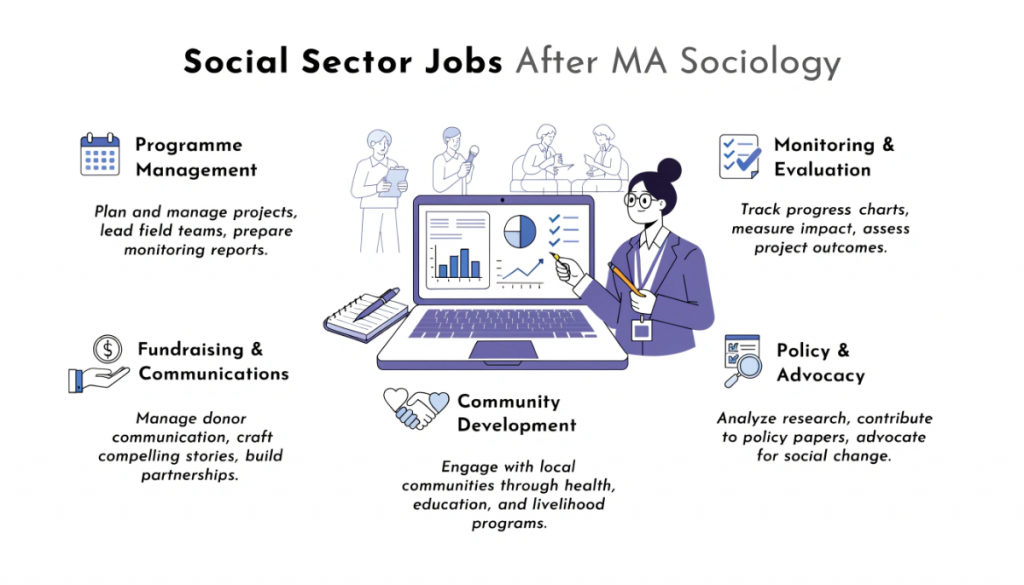
The social sector is where many sociology graduates feel their degree is used most directly. Pay varies a lot between organisations but the work experience is valuable and the growth can be quick in well funded groups.
Programme and Project Roles
- Programme coordinator and project officer roles involve planning activities and managing field teams and reporting to donors, so organisation skills matter as much as subject knowledge.
- Monitoring and evaluation officer roles track whether a project meets its goals, which makes research skills a strong advantage.
Fundraising and Communications
- Communication officers tell the story of an organisation’s work to donors and the public, so writing skill is the main requirement.
- Fundraising and partnership roles need people who understand social issues well enough to explain them clearly to funders.
Community Development and Social Work
- Community development officers work with local groups on health and education and livelihood programmes, which means fieldwork and trust building are central to the job.
- Counselling and case work roles in welfare organisations suit graduates who add a social work or counselling qualification.
Policy and Advocacy Organisations
- Think tanks and advocacy groups hire research associates to study issues like education and gender and urban poverty, so strong writing is essential.
- International development agencies recruit for research and programme roles, though they often ask for prior field experience and fluent English.
Academic and Research Careers After an MA in Sociology

If you enjoy reading and writing and asking deeper questions, the academic route is a solid long term option. It needs patience because the early years pay modestly but the career is stable and respected.
College and University Teaching
- Assistant professor posts normally need a master’s degree with a qualifying score in the national eligibility test, which means preparation for that exam should begin during the MA.
- A doctorate improves your chances of promotion and opens research funding, so many teachers register for a PhD after a few years of service.
Research Assistant and Fellowship Roles
- Research projects at institutes and universities hire assistants for data collection and literature review, which gives you paper credits and contacts for later study.
- Junior research fellowships are open to those who qualify through the eligibility test, so they offer funded time to start a doctorate.
Writing and Publishing
- Sociology graduates often write for magazines and news platforms on social issues, which means regular writing can grow into a full career in journalism or editorial work.
- Research reports and policy briefs also give you a public body of work, so future employers can judge your thinking directly.
Further Study Options
Graduates can move on to an MPhil or PhD in sociology or a related field such as social anthropology or development studies. Others take a professional course in social work or public policy or human resources to move into specific job families. Choose the next step based on the job you want in five years rather than on habit.
How to Prepare for MA Sociology Jobs
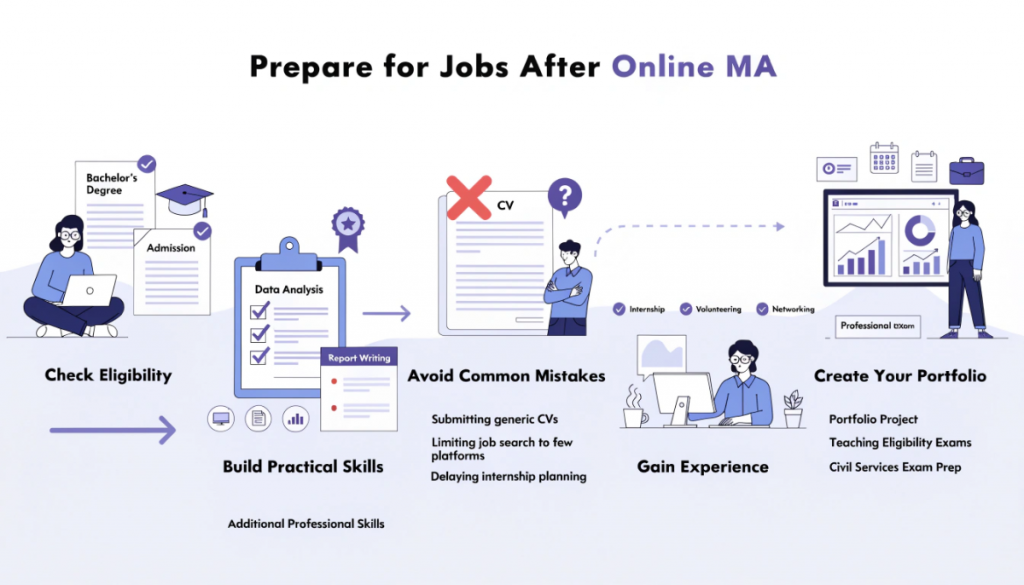
Getting the degree is only the start. What you do during the program decides which of the jobs above you can actually land. Start preparing early and treat each semester as practice for the work you want.
Eligibility for an Online MA Program
Online MA programs in the arts and social sciences usually keep entry simple. A candidate generally needs a bachelor’s degree in any discipline from a recognised university. Many programs expect around 50 percent marks in graduation while some accept a lower score for reserved categories. Applicants upload their semester marksheets and a degree or provisional certificate along with identity proof. Admission is mostly merit based so there is no entrance exam in most cases. Always check that the program is approved by UGC for the online mode because that approval makes the degree valid for jobs and higher study.
Skills to Build While You Study
- Learn basic data analysis in a spreadsheet or statistics tool, which gives you an edge in research and market insight roles.
- Practise report writing by turning every assignment into a short readable brief, since employers read reports far more than essays.
- Pick up a second skill such as HR basics or digital marketing or project management, which widens the jobs you can apply for.
Mistakes That Slow Down a Job Search
- Applying only for jobs with sociology in the title narrows your options a lot, since many suitable roles are listed under research or HR or programme titles.
- Waiting until the final semester to look for work leaves no time for internships, which is where most first jobs actually start.
- Sending the same CV everywhere makes you look generic, so rewrite the top section for each sector you apply to.
Steps to Land Your First Job
- Do a short internship or volunteer project with an NGO or research firm, which means you graduate with real experience on your CV.
- Build a small portfolio with one survey report and one policy note and one article, so recruiters can see your work and not only your marks.
- Prepare for the civil services or eligibility test in parallel if teaching or administration interests you, since exam preparation takes a long time.
- Use professional networks and alumni groups to find openings, because many social sector jobs are filled through referrals.
Conclusion
MA sociology jobs are spread across government and private companies and NGOs and universities. No single role defines the degree. What matters is that you build research and writing and data skills alongside the subject knowledge. Pick the sector that suits your temperament and start building experience before you graduate. Even a few months of real work in your chosen field will tell you more than any career article can. An online MA can fit around work and that makes it easier to earn while you prepare for the job you actually want.
📖 Sources & References
✓ Verified 2026Official career, education and research resources supporting this guide to MA Sociology jobs, including government examinations, teaching eligibility, social research, market research, human resources, development work and online MA recognition.
- UPSC – Civil Services Examination Official previous-year question papers, including Sociology optional papers for Civil Services Main, useful for candidates exploring civil services preparation.
- National Testing Agency – UGC NET Official information about UGC NET, the examination used to determine eligibility for Assistant Professor and Junior Research Fellowship routes, subject to applicable rules.
- UGC Distance Education Bureau – Student FAQs Official guidance on online and distance education recognition, degree equivalence and the checks students should complete before enrolling.
- UGC DEB – Recognised Institutions and Programmes Use the official programme list to verify whether a university is entitled to offer the relevant online or distance MA for the intended admission session.
- Ministry of Statistics and Programme Implementation – National Sample Survey Government survey resources and official statistics relevant to social research, demographic analysis, household studies and evidence-based policy work.
- National Career Service – Government of India Government career and employment portal offering job search, job matching, career information, counselling resources and employment-related services.
- Bureau of Labor Statistics – Market Research Analysts Occupational profile explaining consumer research, surveys, interviews, data analysis and reporting skills relevant to market research careers. Employment and pay data are US-specific.
- Bureau of Labor Statistics – Survey Researchers Explains survey design, questionnaires, interviews, statistical analysis and research roles in government, universities, nonprofits and businesses. Occupational data are US-specific.
- CIPD – Recruitment and Resourcing Professional HR resource covering recruitment, role requirements, attracting applicants and selection processes relevant to human resources and talent acquisition careers.
- Ministry of Social Justice and Empowerment – Government of India Official information on social justice initiatives, welfare programmes and policy areas relevant to social development and community-focused careers.