
Distance MCA is the first thing many working graduates search for when they want a postgraduate degree in computer applications without leaving their job. The idea sounds simple but the options have changed a lot in the last few years. Printed notes and pen and paper exams have given way to learning platforms and live sessions. This blog explains what a distance MCA really involves today and who can apply for it. You will also find the syllabus and the career paths it opens up.
What Distance MCA Means in Practice
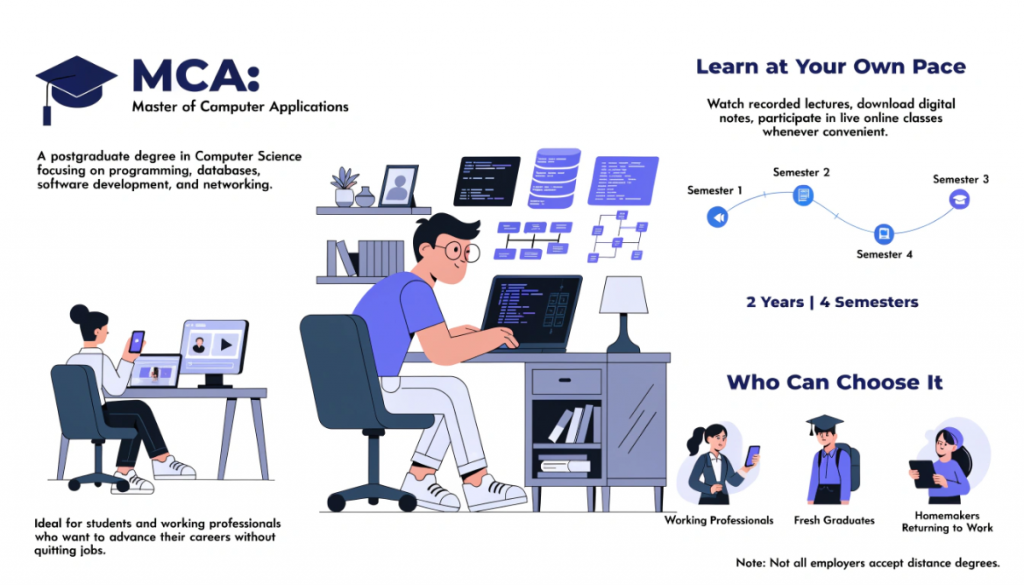
A distance MCA is a two year postgraduate program in computer applications that you complete without attending a regular campus classroom every day. You study on your own schedule and clear the same kind of subjects that a regular MCA covers, such as programming and databases and networking.
The Basic Meaning
- MCA stands for Master of Computer Applications, a postgraduate degree focused on software development and database systems and modern computing tools, which means it is built for people who want technical roles rather than only theory.
- The distance format removes the need for daily attendance, so a candidate can keep a full time job or manage family responsibilities while studying.
- Most programs run for two years across four semesters, which keeps the timeline predictable and similar to a regular degree.
How Learning Happens Now
- Study material is mostly delivered through a learning management system, which means notes and recorded lectures and assignments are available from any phone or laptop.
- Live sessions let students ask questions to faculty in real time, so the learning is less lonely than the old correspondence model.
- Assessments are scheduled through a calendar with clear due dates, which helps candidates plan study hours around work.
Why the Format Is Growing
- Companies now accept flexible degrees for hiring and promotions, which means employees no longer have to choose between a pay cheque and a qualification.
- Better internet access across small towns lets students join live classes from home, so location matters far less than it did a decade ago.
Who Usually Chooses It
Working professionals in IT support or testing or non technical jobs often pick this route to move into development roles. Fresh graduates who want to avoid relocating for a campus course also choose it. Others are homemakers returning to a career after a break and need flexible hours.
Distance MCA vs Online MCA: What Actually Changes
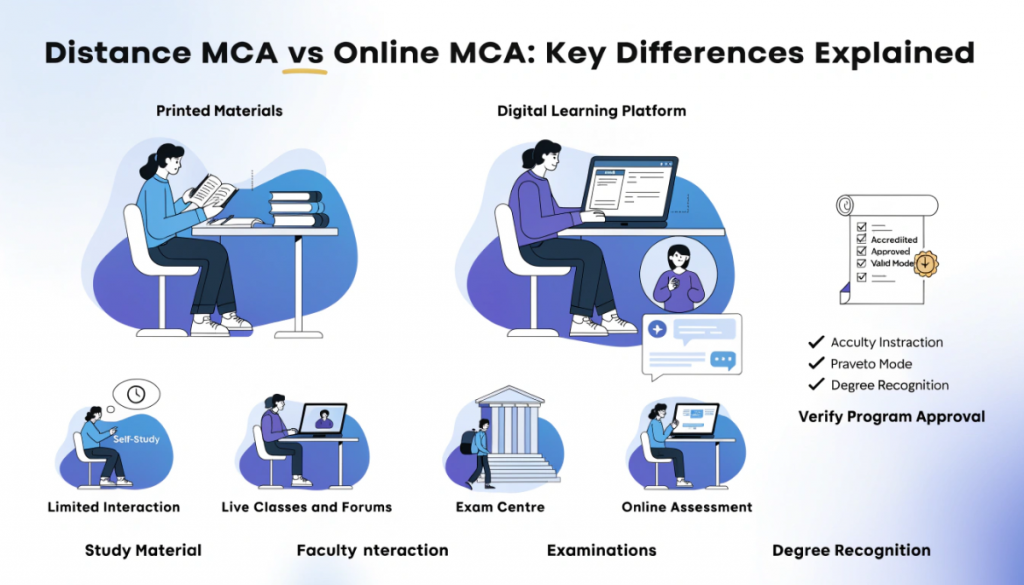
People often use the two terms as if they mean the same thing. They overlap but the experience can be quite different, so it helps to compare them before applying.
Study Material and Delivery
- A traditional distance MCA relies on printed books or discs sent to your address, which means you depend on the postal system and cannot search the material quickly.
- An online MCA gives digital material through a learning platform, so you can revisit a topic at midnight or on a train without carrying anything.
Classes and Interaction
- In a traditional distance program interaction with faculty is limited and often delayed, so doubts can stay unanswered for days.
- Online programs offer live sessions and discussion forums, which means students can clarify concepts and learn from classmates working in different industries.
Exams and Evaluation
- Older distance programs ask students to travel to an exam centre and write a paper by hand, which adds travel cost and planning stress.
- Online programs usually use proctored exams that you can take from home, so a working candidate loses fewer leave days.
Recognition of the Degree
What matters most is whether the program is approved to run in that mode. Under the UGC regulations of 2020 degrees awarded through the online mode by approved institutions are treated as equivalent to the same degree from the conventional mode. Always confirm that the institution holds this approval for the specific program before you pay any fee.
Distance MCA Eligibility and Admission Rules
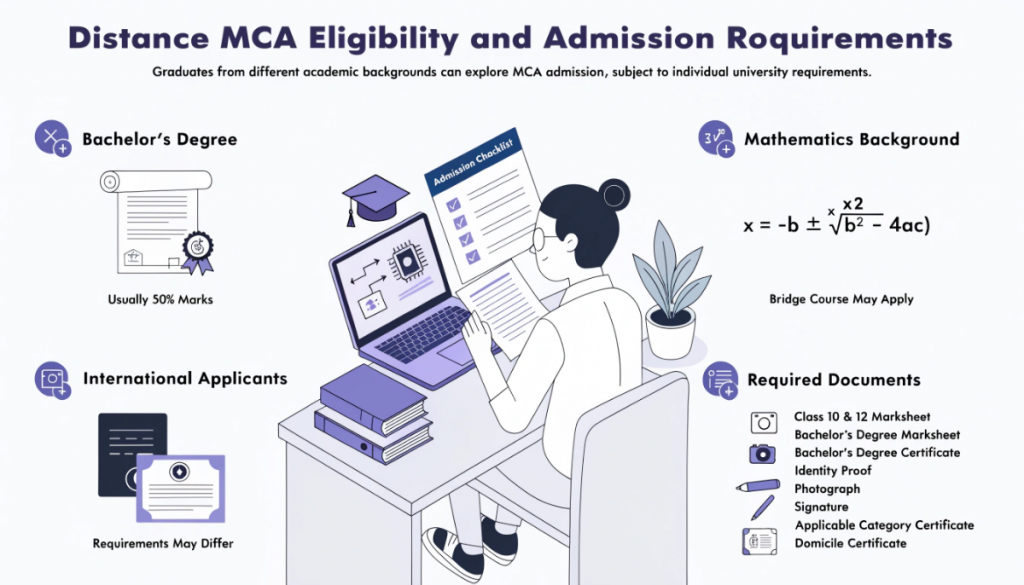
Distance MCA eligibility is easier to meet than many students expect. The rules vary slightly between institutions but the main conditions are fairly consistent.
Academic Requirement
- A bachelor’s degree in any discipline with at least 50 percent marks is the usual requirement, which means graduates from arts and commerce and science backgrounds can all apply.
- The percentage is calculated on the qualifying degree, so students should keep their final marksheets or consolidated marksheet ready.
Mathematics Background
- Computing courses lean on mathematics, so applicants without mathematics at 10+2 or graduation level are generally asked to complete a bridge course.
- The bridge course covers the basics needed for subjects like computational mathematics and data structures, which means a non science graduate does not need to give up on the idea.
International Applicants
Students applying from outside India are generally expected to hold a bachelor’s degree with around 60 percent marks in the qualifying examination. They also need a passport instead of an Indian identity card for the documentation stage.
Documents You Should Keep Ready
- Class 10 and Class 12 marksheets along with all semester grade sheets of the bachelor’s degree, since admission teams verify every stage of your academic record.
- A degree certificate or provisional certificate, which proves that you have completed or are about to complete your graduation.
- A government identity proof and a passport size photograph and a signature copy, so the application can be processed without delays.
- Category or domicile certificates where they apply, which means any available benefit is recorded correctly at the time of admission.
Distance MCA Syllabus and Specialisations
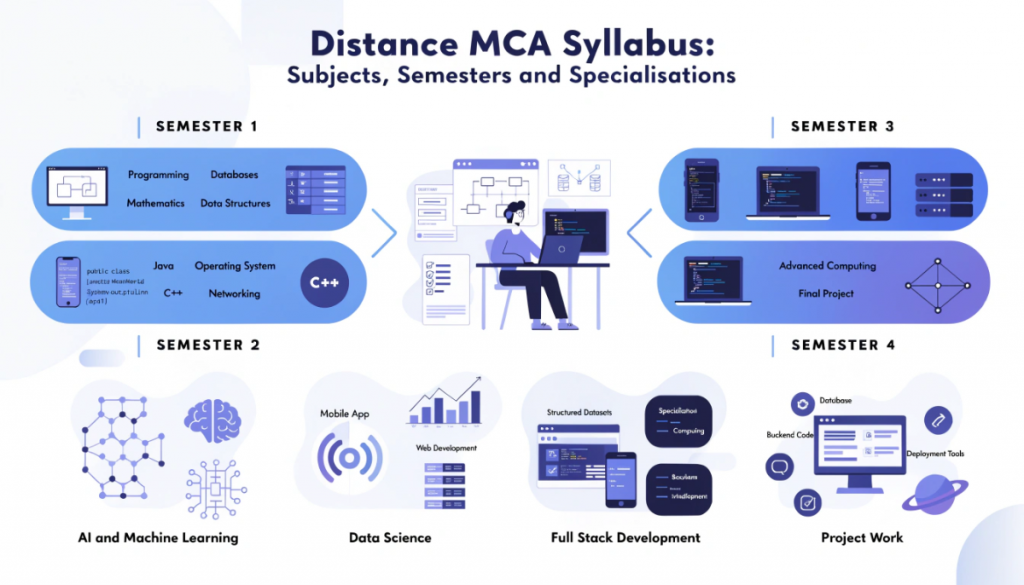
The syllabus of a distance MCA matches what a regular MCA teaches. It starts with fundamentals and moves towards advanced topics and a final project. The exact paper names differ between institutions but the structure is similar.
Semesters One and Two
- Programming in C and computational mathematics and database management form the base, so every student builds the same technical foundation regardless of earlier background.
- Web technology and data structures and Python programming arrive in the second semester, which moves learners from basic coding to building real applications.
- Communication skills and management papers sit alongside the technical subjects, since software roles involve a lot of teamwork and client interaction.
Semesters Three and Four
- Java and object oriented programming with C++ and operating system concepts make up the heavier core papers, which are the subjects most interviewers ask about.
- Computer networking and a project work paper close the program, so students finish with something practical to show employers.
Specialisation Choices
- Artificial intelligence and machine learning covers generative AI and machine learning in Python, which suits students aiming for AI engineer or data roles.
- Data science focuses on analytics in Python and data science methods and IoT, which helps those who prefer working with data and reports.
- Full stack development covers UX and UI design and DevOps and software architecture, which prepares students for web and product development jobs.
Choose the specialisation that matches the job you want in three years rather than the one that sounds most popular today. A clear target makes electives and project work much easier to plan.
Benefits, Limits and How to Choose a Distance MCA
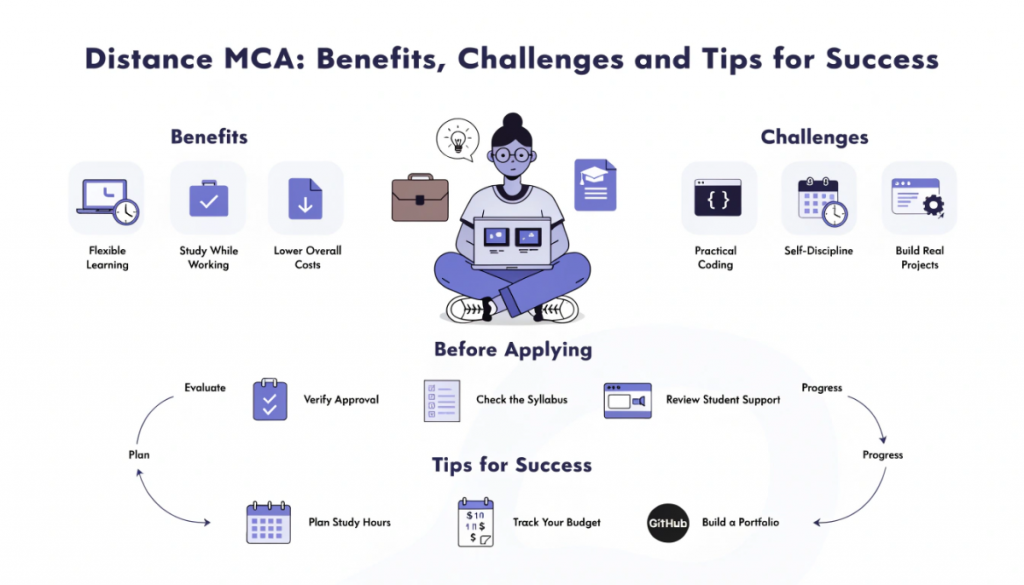
A distance MCA works very well for some students and poorly for others. Knowing both sides helps you decide honestly.
Main Benefits
- You can keep earning while you study, which means the degree does not come at the cost of a two year income gap.
- The total fee is usually much lower than a regular campus MCA, so students avoid hostel and travel expenses on top of tuition.
- Recorded lectures let you revise difficult topics like algorithms again and again, which is hard to do in a live classroom.
Limits to Be Aware Of
- Lab work is lighter than in a full time campus course, so you need to practise coding on your own every week to stay sharp.
- Self discipline matters because nobody checks your attendance daily, and students who postpone study often fall behind before exams.
- A degree alone does not guarantee a job at top product companies, since those employers look closely at projects and problem solving ability.
What to Check Before You Apply
- Confirm that the program is approved by UGC for the online or distance mode, since an unrecognised degree can create problems in jobs and higher studies.
- Look at the syllabus for current topics like Python and cloud and AI, because outdated papers will not help in interviews.
- Ask about live session schedules and doubt support, which tells you how much real interaction you can expect.
- Check whether placement or career support exists and what it actually includes, so you are not relying on vague promises.
Cost and Time Planning
Add up the full program fee and any exam or study material charges before you commit. Then check whether payment in semester instalments is available so that the cost does not strain your monthly budget. Also keep a realistic weekly plan of around ten to twelve study hours, since two years pass quickly when work and family take priority.
Habits That Help You Finish
Set fixed weekly study hours and treat them like office meetings. Build one small project every semester and put it on a public code profile. Join the discussion forum early because asking questions in the first month sets the tone for the rest of the program.
Careers After Distance MCA
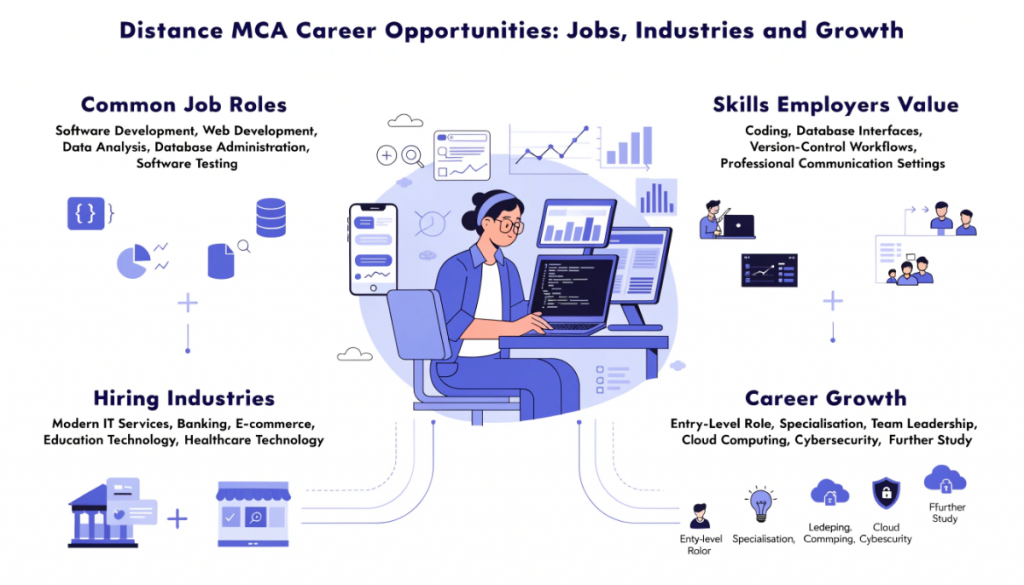
The career value of a distance MCA depends on the skills you build and the projects you can show. A recognised degree opens the door but your portfolio decides how far you walk through it.
Common Job Roles
- Software developer and application developer roles are the most direct path, since the syllabus covers the languages and tools used in daily development work.
- Web developer and full stack developer roles suit students who pick that specialisation and build a few live projects during the course.
- Data analyst and junior data scientist roles fit candidates who take the data science track and are comfortable with Python and reporting.
- Database administrator and system analyst roles use the database and operating system papers, which means they are a natural fit for students who enjoy backend work.
- Software tester and technical support roles offer an entry point for career switchers who want to move into core development later.
Industries That Hire MCA Graduates
- IT services and consulting firms hire in large numbers for development and testing teams, which makes them the most common first employer.
- Banks and insurance companies and e-commerce businesses run large software and data systems, so they need people who can build and maintain them.
- Education technology and healthcare technology companies also recruit for application and data roles, which widens the options beyond classic IT.
Skills Employers Look For
- Strong fundamentals in one programming language such as Java or Python, since interviews usually begin with core coding questions.
- Hands on experience with databases and version control tools, which shows you can work in a team codebase.
- Clear written and spoken communication, because developers regularly explain technical choices to managers and clients.
Growth Beyond the First Job
Many MCA graduates move into team lead and project manager roles after a few years of experience. Others pick up cloud or security certifications to specialise further. Some go on to doctoral studies or teaching roles. In every case the habit of continuous learning that you build during a distance program becomes a real advantage.
Conclusion
A distance MCA can be a smart move if you want a recognised computing degree without pausing your job. The eligibility is open to graduates from most streams and the syllabus covers the same technical ground as a regular course. The real difference lies in how you study and how disciplined you are. Check the recognition and the syllabus and the support on offer before you apply. Then put in steady weekly effort and build projects as you go. That combination turns a flexible degree into a solid career step
📖 Sources & References
✓ Verified 2026Official regulatory guidance and technical learning resources covering distance and online MCA programmes, eligibility verification, computer application subjects, programming, databases, project development and career options.
- UGC Distance Education Bureau – Student FAQs Official guidance on recognised online and distance programmes, degree equivalence, admission precautions and checking institutional recognition.
- UGC DEB – Online Learning Regulations Explains online education requirements, digital learning resources, learner engagement and proctored examinations.
- UGC DEB – Recognised Institutions and Programmes Check the institution, MCA programme, delivery mode and relevant admission session before enrolling in an online or distance course.
- Shoolini Online – MCA Programme Official programme page covering online MCA duration, entry requirements, subject areas, learning experience and admissions information.
- National Institute of Electronics and Information Technology – Syllabus Official academic syllabus resource with computer-related programmes, including MCA, for reference when exploring computing subjects.
- Python – Official Tutorial Technical learning resource for programming fundamentals, data structures, modules and object-oriented programming relevant to MCA practice.
- Oracle – Java Tutorials Official Java learning material covering programming basics, classes, objects, inheritance and application development concepts.
- PostgreSQL – SQL Tutorial Hands-on introduction to relational databases, SQL queries, tables, joins and data manipulation for database management studies.
- GitHub Skills – Practical Development Interactive exercises for learning GitHub, version control and collaborative development while building and documenting coding projects.
- U.S. Bureau of Labor Statistics – Software Developers, QA Analysts and Testers Occupational information on software development and testing, including typical work, education and skills relevant to the career paths discussed in this blog.