

Most business owners and managers use economics every day without calling it that. Every time someone sets a price, hires a team or decides how much stock to order, an economic judgment is being made. The importance of business economics lies in turning those judgments from guesses into reasoned decisions. It gives managers a way to compare options and measure costs against returns before money is spent. This blog explains where business economics matters most and how it helps a business grow with fewer mistakes.
Why the Importance of Business Economics Often Gets Overlooked
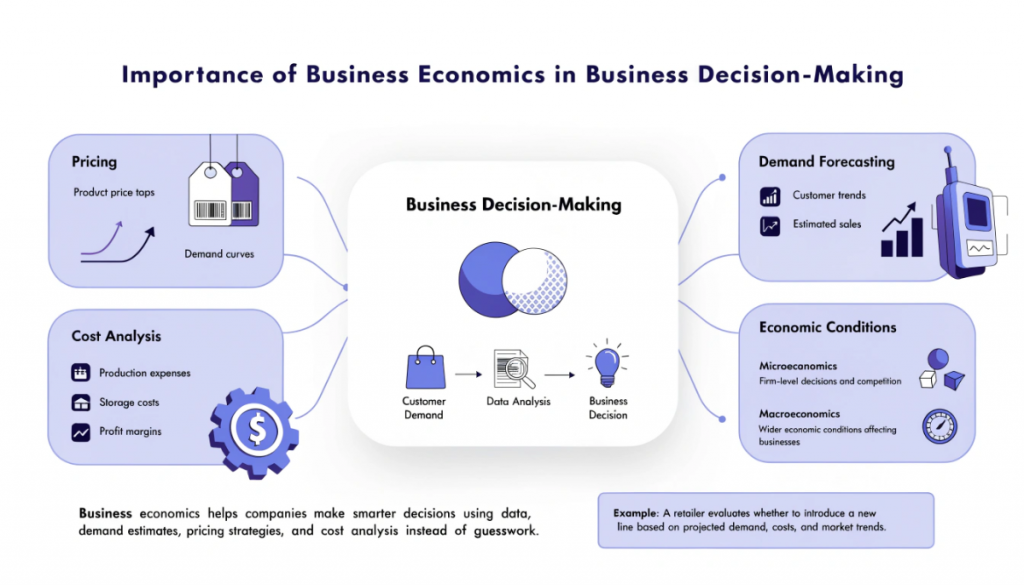
The importance of business economics is easy to miss because its results look like ordinary good management. When a company prices a product well or avoids a bad expansion, nobody credits economic analysis even though it was behind the call.
What Business Economics Covers
- Business economics applies economic theory to the practical problems of a single firm, which means a manager gets tools for pricing, costing and forecasting instead of abstract models.
- It draws on microeconomics for firm level choices and macroeconomics for the wider environment, since a business is affected by both its own decisions and the economy around it.
- It uses data and quantitative methods such as demand estimation and cost analysis, which means conclusions rest on numbers rather than opinion.
Why It Matters Beyond the Classroom
A business that ignores economic thinking usually relies on instinct alone. Instinct works some of the time but fails at the worst moments, such as during a price war or a sudden rise in input costs. Business economics gives a structured way to question assumptions before they turn into losses. It also gives teams a shared language, so a finance head and a marketing head can argue about the same numbers instead of talking past each other.
Think of a retailer deciding whether to stock a new product line. Without economic analysis the choice rests on a hunch about what customers might want. With it the retailer estimates demand at different prices and compares the likely sales against shelf space and storage costs. That small shift from hunch to estimate is what the importance of business economics looks like in practice. The same pattern repeats across every department of a company.
Importance of Business Economics in Everyday Decision Making
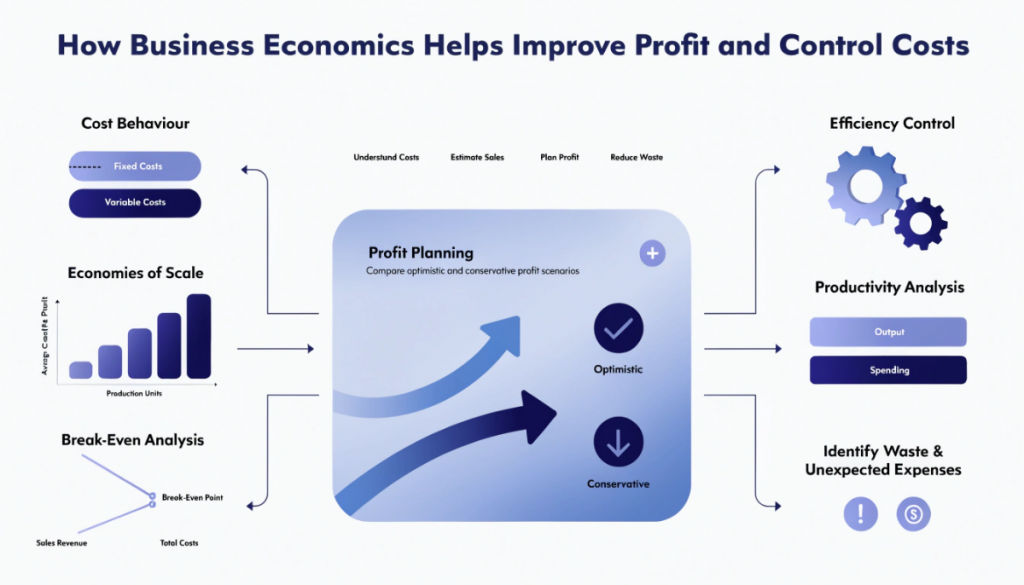
Profit is what is left after costs, so any serious attempt to improve profit has to start with understanding costs. This is one of the most practical reasons the importance of business economics is taught in management programs.
Understanding Cost Behaviour
- Separating fixed costs from variable costs shows which expenses change with output and which stay the same, which means a manager knows where cutting spending is actually possible.
- Studying how average cost falls as output rises explains economies of scale, since larger production runs often lower the cost of each unit.
Finding the Break Even Point
- Break even analysis tells a business how many units it must sell to cover total costs, which gives a clear minimum target for any new product or branch.
- Knowing this number early helps a firm avoid launching products that can never become profitable at realistic sales levels.
Planning Profit Realistically
With cost and demand estimates in hand a firm can build profit scenarios for good and bad conditions. This keeps targets realistic and makes it easier to explain results to owners or investors when actual numbers differ from the plan.
Controlling Waste and Inefficiency
- Comparing actual costs against expected costs highlights where a process is leaking money, so corrective steps can be taken early.
- Looking at productivity per worker or per machine shows whether output is keeping pace with spending, which supports fairer and better informed budget decisions.
Over a few years these small improvements add up. A firm that checks its costs regularly and prices with demand in mind tends to earn steadier margins than one that reviews numbers only when a problem appears.
Importance of Business Economics in Reading Markets and Competition
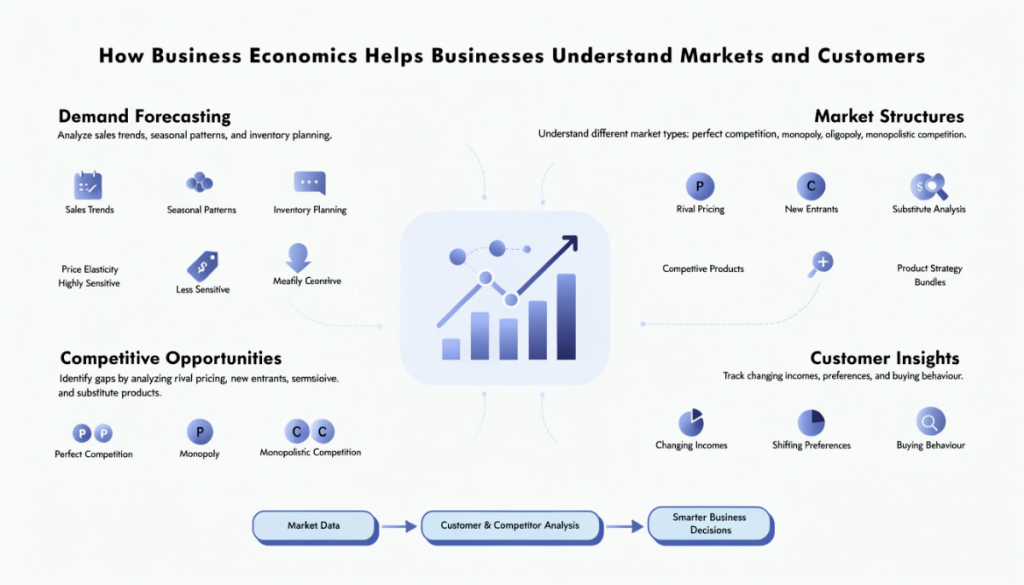
No business operates alone. The importance of business economics becomes clear when you look at how firms respond to customers and rivals. Markets change constantly and economics gives a way to read those changes early.
Forecasting Demand
- Demand forecasting uses past sales and factors such as income and seasonality, which helps a business order the right amount of stock instead of tying up cash in unsold goods.
- Understanding elasticity shows how sensitive customers are to price and income changes, so a firm can predict who will keep buying when conditions tighten.
Understanding Market Structures
- Firms behave differently in perfect competition, monopoly, oligopoly and monopolistic competition, so knowing the structure tells a manager how much control over price is realistic.
- In an oligopoly a price cut by one firm often triggers a response from rivals, which means strategy has to account for competitor reactions and not only customer behaviour.
Spotting Opportunities and Threats
Studying substitutes, new entrants and changing buyer preferences helps a business see openings before competitors do. It also flags threats early enough for the company to adjust its pricing or product range.
Using Customer Insight
- Income and preference trends show which customer groups are growing, which helps a business shift its marketing and product range toward them.
- Understanding complementary and substitute goods explains why sales of one product move with another, so product bundles and ranges can be planned with more care.
Importance of Business Economics During Economic Change
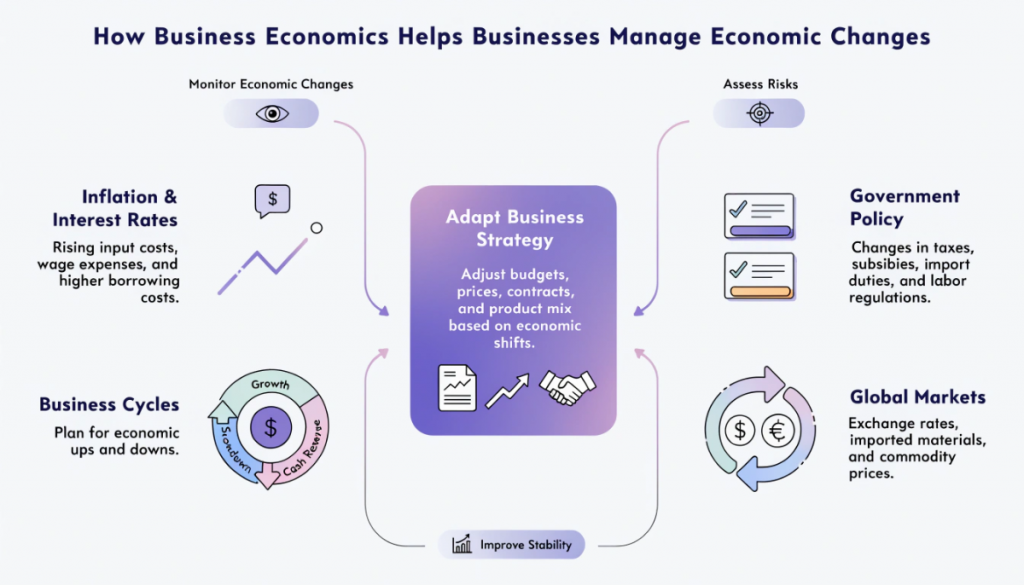
A firm cannot control inflation, interest rates or government policy, but it can prepare for them. This preparation is a major part of the importance of business economics for long term stability.
Inflation and Interest Rates
- Rising inflation increases input and wage costs, so a business that tracks it can revise prices or contracts before margins shrink.
- Changes in interest rates affect the cost of borrowing, which means expansion plans funded by loans need to be checked against likely rate movements.
Business Cycles
- Economies move through periods of growth and slowdown. A firm that understands this pattern can build cash reserves during good years and cut risk before a downturn.
- Different products react differently to a slowdown, since essential goods usually hold up better than luxury items, which affects how a product mix should be planned.
Government Policy and Regulation
Taxes, subsidies, import duties and labour rules all change the cost and demand picture for a business. Economic analysis helps estimate the effect of a new policy so management can respond calmly instead of reacting after the damage is done.
Planning for Global Conditions
- Exchange rate movements change the cost of imported inputs and the price of exports, so businesses dealing across borders can protect margins by planning contracts around likely currency shifts.
- Global commodity prices such as oil or metals feed into transport and manufacturing costs, which makes tracking them a useful habit for any firm that depends on those inputs.
None of this means a business can predict the future. It means the business is less surprised by it. That is a real advantage when competitors are caught off guard by the same events.
Importance of Business Economics for Your Career
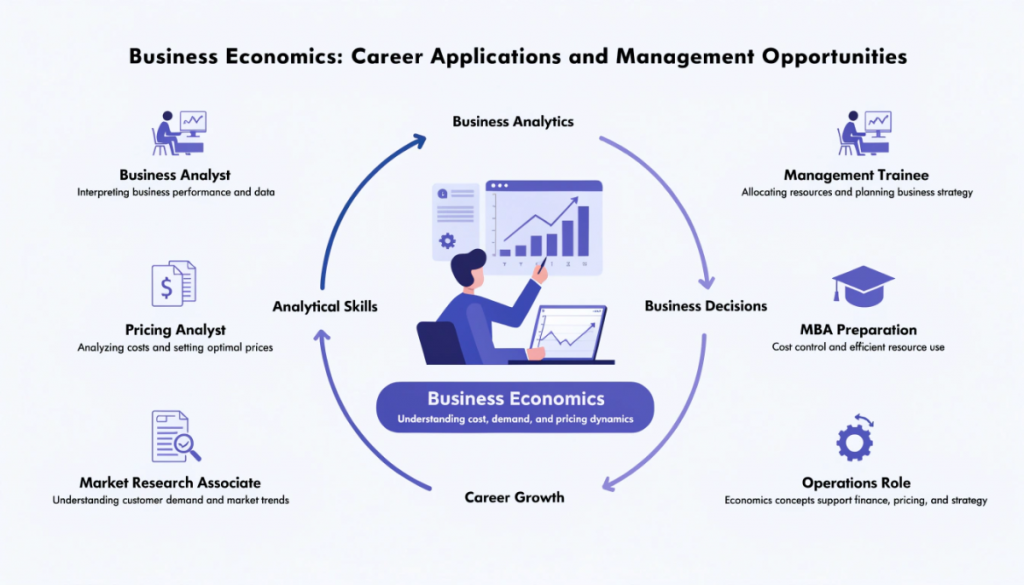
The importance of business economics is not limited to company decision making. It is also one of the most useful subjects for anyone building a management career, since employers value people who can back recommendations with economic reasoning.
Where the Knowledge Gets Used
- Roles such as business analyst, pricing analyst and market research associate use demand and cost analysis daily, so the subject maps directly onto the work.
- Management trainee and operations roles benefit from the ability to judge costs and resource use, which helps new hires contribute to decisions sooner.
- The subject also supports later study such as an MBA, since pricing, finance and strategy courses build on the same concepts.
Eligibility for a Business Degree That Covers It
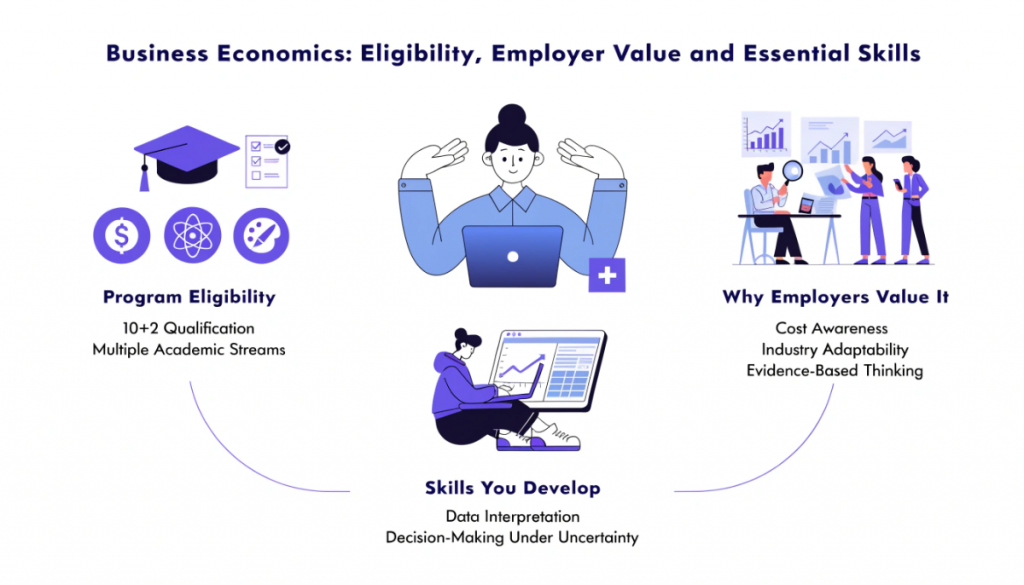
Most online undergraduate business administration programs include business economics as a core subject and keep entry requirements simple. A candidate usually needs to have passed 10+2 from a recognised board in any stream with around 40 percent marks in the qualifying exam. Candidates from reserved categories are often given a relaxation on this percentage. International applicants are generally expected to have around 60 percent marks in their qualifying examination. This keeps the program open to students from commerce, science and arts backgrounds.
Why Employers Value It
- Managers who understand cost and demand can explain why a decision makes sense, which builds trust with senior leaders who approve budgets.
- Candidates with this background adapt quickly across industries, since pricing and cost logic works the same way in retail, manufacturing and services.
- Economic reasoning helps junior employees question assumptions politely and with evidence, which is a habit that gets noticed early in a career.
Skills You Pick Up Along the Way
- Data interpretation improves because coursework involves reading demand curves and cost tables, which are skills employers look for in analyst roles.
- Decision making under uncertainty gets stronger since most economic problems involve incomplete information, much like real management situations.
Conclusion
The importance of business economics comes down to better decisions made with less guesswork. It helps with pricing and cost control and gives a clearer read of markets and economic change. For students it is also a practical subject that opens doors to analyst and management roles. Whether you are running a business or planning to join one, learning business economics gives you a reliable way to judge choices before they cost money. Start with the basics of demand and cost and apply them to one real decision this week. You will quickly see why the importance of business economics keeps showing up in every management syllabus.
📖 Sources & References
✓ Verified 2026Reliable educational and institutional resources covering business economics, demand and pricing, cost analysis, break-even planning, market competition, economic change and business-related careers.
- OpenStax – Principles of Economics Educational textbook introducing economic principles, decision-making, markets and the application of economics to business situations.
- OpenStax – Costs in the Short Run Explains fixed, variable, average and marginal costs and how businesses use cost analysis to evaluate production and profit.
- OpenStax – Elasticity and Pricing Explains price elasticity, customer response to price changes and how elasticity affects business pricing and revenue decisions.
- OpenStax – Market Structure and Competition Defines market structures, perfect competition, price-taking firms and other concepts relevant to competitive business strategy.
- U.S. Small Business Administration – Break-Even Analysis Official business-planning resource covering market research, startup costs and break-even analysis to estimate when a business can cover its costs.
- U.S. Small Business Administration – Market Research Explains how researching customers, market conditions and competitors helps businesses assess demand and identify opportunities.
- Federal Reserve Education – Economics Resources Educational resources on inflation, markets, unemployment, monetary policy and interest rates that help explain the wider economic environment.
- Federal Reserve Education – Price Stability Explains price stability and the effects of inflation, supporting the blog’s discussion of rising costs and changing economic conditions.
- U.S. Bureau of Labor Statistics – Market Research Analysts Official occupational information on analysing consumer preferences, business conditions, sales trends and market data for career planning.
- Shoolini Online – BBA Programme Official programme information covering online BBA study, eligibility, business subjects and management-related learning outcomes.