

If you have just cleared your class 12 and are thinking about a commerce degree, the very first thing you need to get clear on is the B.Com eligibility criteria. A lot of students assume they do not qualify because they studied science or arts instead of commerce, or because their percentage is not as high as they would like.
Neither of those assumptions is as limiting as people think. This blog covers the B.Com eligibility criteria in full, from the basic academic qualification and minimum percentage to stream rules, age limits, subject requirements, entrance exams and documents so that you walk into the admission process knowing exactly where you stand rather than finding out at the last step.
The Basic Qualification That Defines B.Com Eligibility
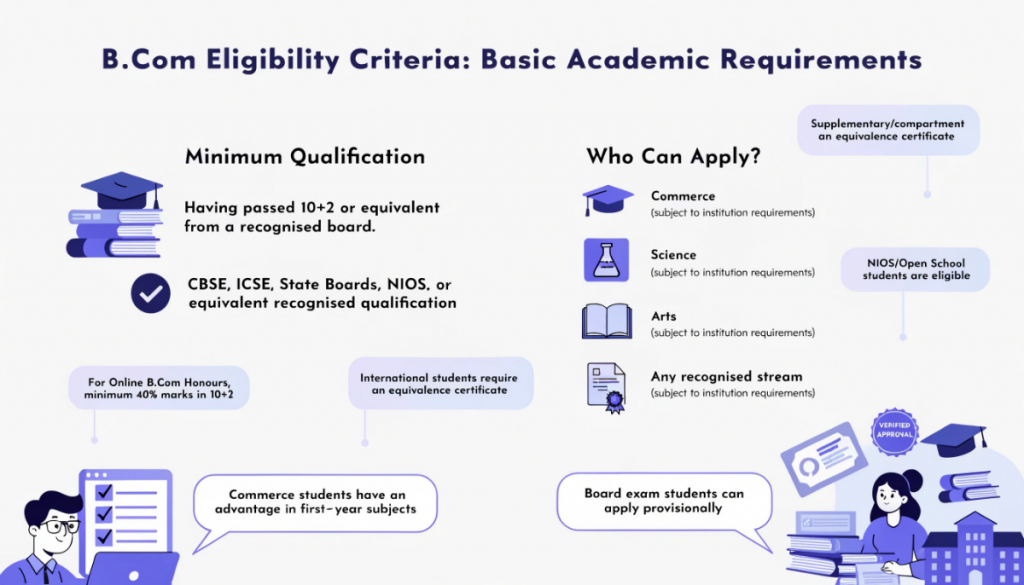
The foundation of B.Com eligibility criteria is your class 12 result. Here is what needs to be in place before anything else:
You must have passed your 10+2 or an equivalent examination from a recognised board such as CBSE, ICSE, state boards or any equivalent approved by the Association of Indian Universities
B.Com eligibility does not require a specific stream at most colleges, which means students from science, commerce and arts are all considered as long as they meet the percentage requirement set by the institution they are applying to
Commerce students who studied accountancy, business studies and economics in class 12 have a built-in advantage in the early semesters since these subjects overlap directly with first year B.Com content
Students currently appearing in their class 12 board exams can apply as provisional candidates at most institutions, with the final marksheet to be submitted before counselling or before the first semester begins
For an online B.Com Honours program, the basic B.Com eligibility requires completing 10+2 in any discipline with a minimum of 40% marks, which is one of the most accessible entry thresholds across all three-year undergraduate programs in India
International students applying to Indian institutions for a B.Com program need an equivalence certificate from a recognised body confirming their foreign board qualification meets the Indian 10+2 standard
Students who completed their 10+2 through open schooling from a recognised board such as NIOS are also eligible for B.Com admission and are not treated differently from students who studied through regular schooling
A compartment or supplementary exam result does not disqualify you from B.Com eligibility provided you hold a complete passing certificate in all subjects before the final admission date
Minimum Percentage Needed to Satisfy B.Com Eligibility Criteria
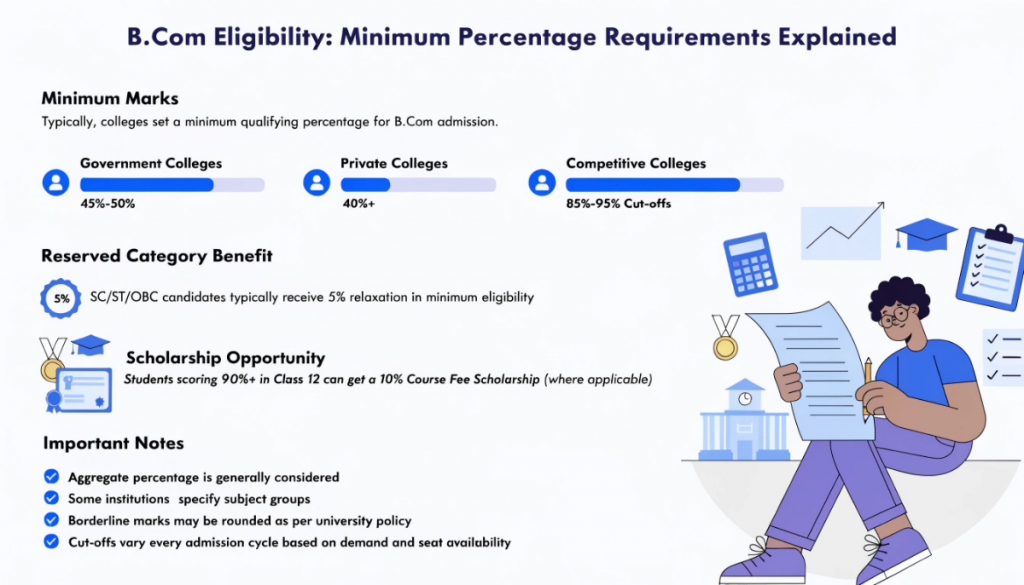
Percentage is the first number every student checks when looking at B.Com eligibility and the answer is not the same everywhere. Here is how it actually breaks down:
Government colleges and well-known central university affiliates typically require a minimum of 45% to 50% aggregate in class 12 for general category students applying for B.Com admission
Private colleges are generally more flexible on percentage and many accept students with 40% and above, especially when the program is delivered in online or distance learning mode
Highly competitive colleges and university departments, particularly in metro cities, set significantly higher cut offs that can go anywhere from 85% to 95% depending on the demand for seats in that particular year
Reserved category candidates including SC, ST and OBC applicants typically receive a 5% relaxation on the minimum percentage requirement, bringing the threshold down from the general category baseline at most institutions
A merit scholarship of 10% on the course fee is available to students who scored more than 90% in their class 12 examination, which is a genuine financial benefit for high scorers choosing an online B.Com Honours program
The percentage used to assess B.Com eligibility is almost always the overall aggregate across all subjects in class 12 and not just the best four or five subjects, though some institutions specify which subject groups they consider
Students with borderline percentages such as 49.6% are often treated as meeting a 50% cut off at institutions that apply standard rounding policies, so it is worth checking the specific rounding method before assuming you fall below the threshold
B.Com cut offs shift from one admission cycle to the next based on applicant volume and seat availability, which means checking the current year’s notification directly from the institution is always more reliable than relying on previous year data
Which Streams Qualify Under B.Com Eligibility Rules
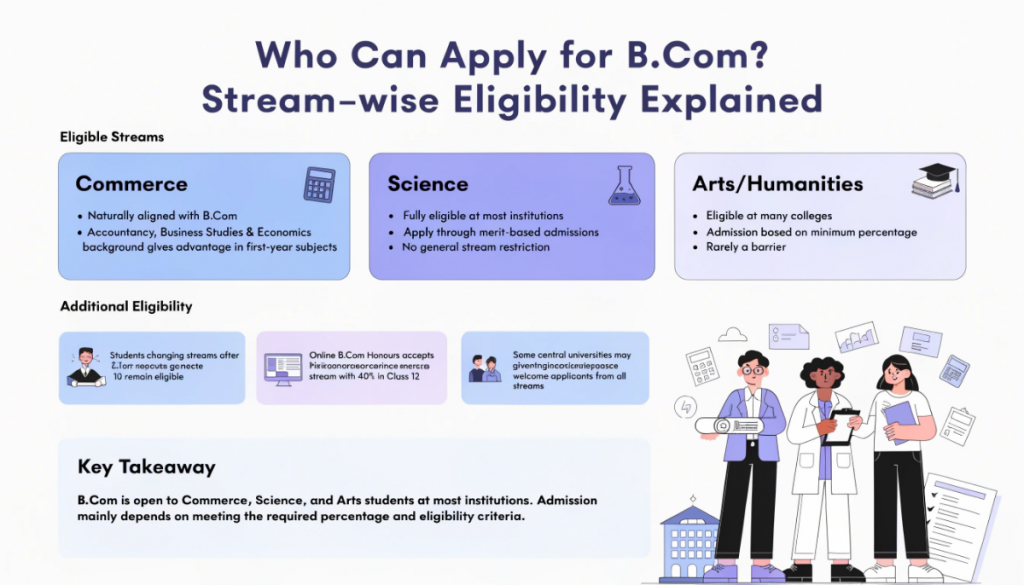
Stream eligibility is one of the most commonly misunderstood aspects of B.Com eligibility criteria. Here is the accurate picture for each stream:
Commerce students are the most naturally eligible group for B.Com since their class 12 subjects in accountancy, business studies and economics align directly with what is taught in the first year of the program
Science students are fully eligible for B.Com at most private and deemed universities and face no stream-based restriction, though they may have to compete with commerce students for the same merit-based seats
Arts and humanities students can also apply for B.Com at a significant number of institutions as long as the minimum percentage requirement is met, and the stream itself is rarely a disqualifying factor outside of a handful of central universities
Students who changed stream between class 10 and class 12, for example moving from science to commerce, face no eligibility issues for B.Com since only the final class 12 stream and result is considered during admission
For a B.Com Honours program, the stream preference may be stronger at traditional campus colleges but online B.Com Honours programs explicitly accept students from any stream with 40% or above in class 12, making them the most accessible route for non-commerce students
Some central universities and their affiliated colleges do have an explicit preference for commerce stream applicants and may reserve a portion of seats exclusively for students who studied commerce subjects in class 12
Even where a commerce background is preferred, arts and science students are rarely rejected outright at private and online institutions as long as the marks threshold is cleared and the application is submitted on time
Is Mathematics a Requirement for B.Com Eligibility
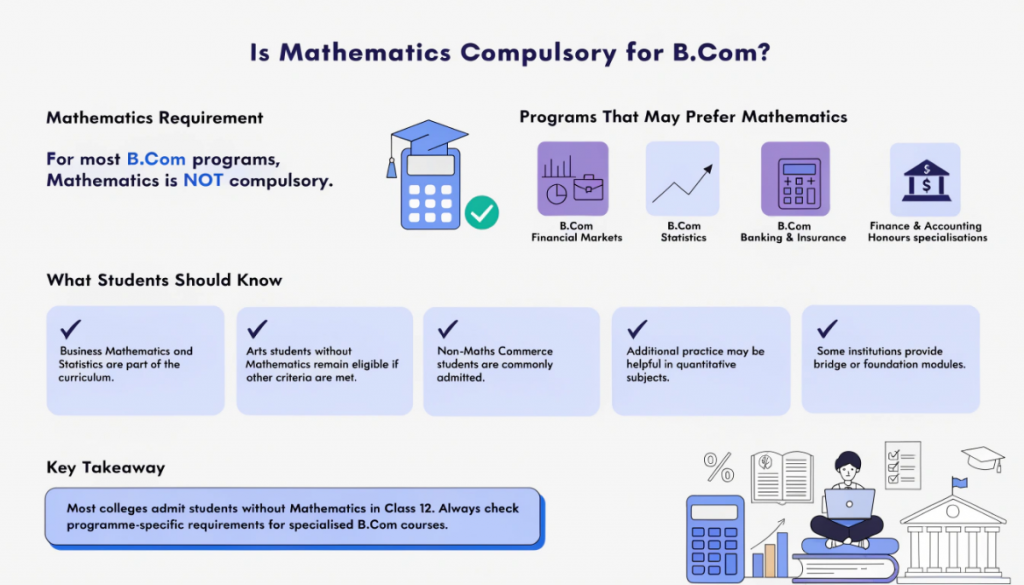
Mathematics is a question that comes up almost every time someone looks at B.Com eligibility criteria. Here is a clear and honest answer:
Mathematics is not a compulsory requirement for B.Com eligibility at most institutions, and students from commerce backgrounds who chose the non-mathematics stream in class 12 are fully eligible at the majority of colleges across India
Some specialised B.Com programs such as B.Com in Financial Markets, B.Com in Statistics or B.Com with Banking and Insurance do require or strongly prefer mathematics as a subject in class 12, so this is worth checking for specific program tracks
The B.Com syllabus does include business mathematics and statistics modules, particularly in the first and second year, so students without a strong maths background should expect to dedicate extra time to those papers
Institutions offering a B.Com Honours program with specialisations in finance or accounting sometimes list mathematics as a preferred subject even when it is not a strict requirement, since the coursework becomes progressively quantitative from the second year onwards
Students from commerce without mathematics at class 12 are in fact in the majority across most B.Com programs in India and colleges factor this into how the syllabus for business mathematics is structured and taught
If you did not study mathematics in class 12 but are interested in a B.Com with a finance or accounts specialisation, it is worth checking whether the program you are applying to offers a foundation or bridge module in the first semester to help students build the numerical skills needed for later coursework
Arts students who also did not study mathematics at class 12 can still pursue B.Com at institutions that accept all streams, and their eligibility is not affected by the absence of mathematics as long as the overall percentage condition is met
Age Limit as Part of B.Com Eligibility Criteria
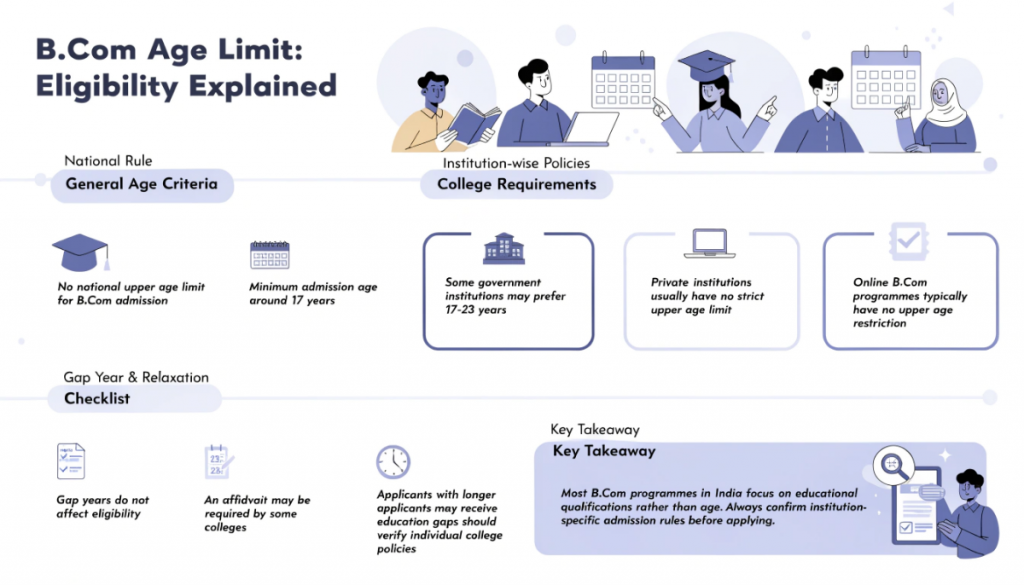
Age limit is a smaller but frequently searched part of B.Com eligibility criteria. Here is what you actually need to know:
There is no nationally mandated upper age limit for B.Com admission in India and the UGC does not prescribe a maximum age for undergraduate commerce programs
The minimum age expected is typically around 17 years at the time of admission, which corresponds to the age of a student who completes class 12 at the standard progression from class 1 onward
Some government institutions and state boards specify a preferred age bracket of 17 to 23 years for direct undergraduate admission, but this is not a universal rule and private institutions rarely enforce a strict upper age cap
Students who took a gap year or more after class 12 are fully eligible for B.Com admission and are not penalised for the gap as long as their qualification is in order and the gap period is explained through an affidavit if the college asks for one
Online B.Com programs are particularly age-friendly since they do not have any upper age restriction and are designed to serve both fresh graduates and working professionals who want to return to education
Reserved category candidates at institutions that do specify an upper age limit often receive age relaxation of three to five years depending on the category, which extends the window for older applicants from these groups
If you are applying after a longer gap such as five or more years since class 12, it is worth confirming the specific age policy with the admission office of each institution since this is one area where individual college rules genuinely vary from the general national standard
Entrance Exams That Are Linked to B.Com Eligibility
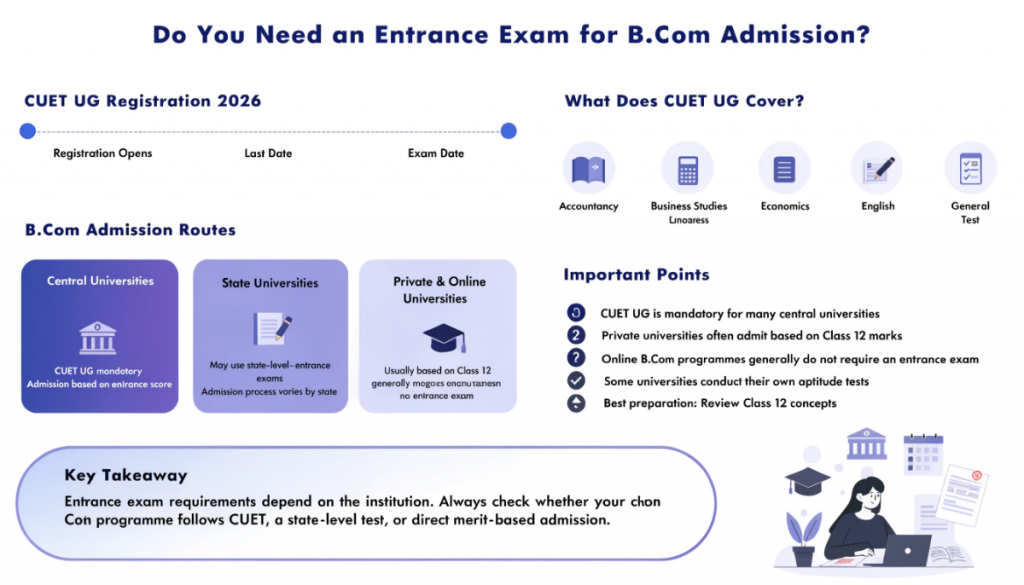
Whether you need to clear an entrance exam as part of your B.Com eligibility depends entirely on the type of institution you are targeting. Here is how this works in 2026:
Central universities including Delhi University, Banaras Hindu University and others under the UGC’s central admission framework require CUET UG scores for B.Com admission and do not admit students on the basis of class 12 marks alone
CUET UG for B.Com typically tests candidates on domain subjects such as accountancy, business studies and economics in addition to a general test and an English section, and the exam is conducted by the National Testing Agency
State universities and affiliated government colleges across different states may use their own state-level common entrance tests for merit ranking rather than CUET, so the exam route varies depending on which state you are applying in
Private universities and deemed universities generally admit students on the basis of class 12 merit without requiring a separate entrance exam, making the class 12 aggregate the primary selection criterion
Online B.Com programs at UGC-approved institutions do not require any entrance exam for admission and admit students entirely on the basis of their class 12 marks and the minimum percentage condition being met
Some well-ranked private colleges conduct their own institution-specific admission tests covering basic aptitude, reasoning and commerce awareness, but these are not standardised across institutions the way CUET is for central universities
If you are applying to a central university for B.Com, appearing in CUET UG is a non-negotiable part of the B.Com eligibility criteria for that institution and no alternative pathway such as direct merit admission is available
CUET UG preparation for B.Com does not require specialised coaching in the way JEE or NEET does, and a focused revision of class 12 commerce subjects alongside practice on the general test section is typically sufficient for most candidates
Conclusion
B.Com eligibility criteria in 2026 are genuinely accessible for a wide range of students. The core requirement is a class 12 pass from a recognised board with a percentage that meets the threshold of your chosen institution, and stream is not the barrier many students assume it to be. Mathematics is not compulsory at most colleges and arts and science students can apply without restriction at private and online programs.
Age is not a concern for the large majority of applicants and entrance exams are only mandatory when you are targeting central university admissions through CUET. The most important step is to check the specific admission notification of each college you plan to apply to since small differences in percentage requirements, subject preferences and document lists do exist and knowing them in advance is what separates a smooth admission process from a last-minute scramble.
📖 Sources & References
✓ Verified 2026Verified B.Com eligibility criteria, admission requirements, stream eligibility, CUET admission process and undergraduate commerce education guidelines based on recognised educational and regulatory sources.
- UGC India Undergraduate commerce programme regulations, admission eligibility norms and higher education guidelines
- Ministry of Education National education policies, undergraduate admission frameworks and academic qualification standards
- National Testing Agency National entrance examinations, application procedures and admission resources
- CUET UG Undergraduate entrance examination eligibility, admission guidelines and examination framework
- AICTE Higher education quality standards, employability initiatives and academic development
- Association of Indian Universities Recognition of international qualifications and equivalence certification for higher education
- National Career Service Commerce career pathways, employability guidance and professional development resources
- NASSCOM Digital business skills, industry hiring trends and future workforce insights
- Shoolini Online Online B.Com admission guidance, eligibility information and commerce programme resources
- National Education Policy 2020 Flexible undergraduate education, multidisciplinary learning and Academic Bank of Credits framework

Book Your
Free Session
Connect with our experts and get personalised guidance for your career, course selection, and future goals.