

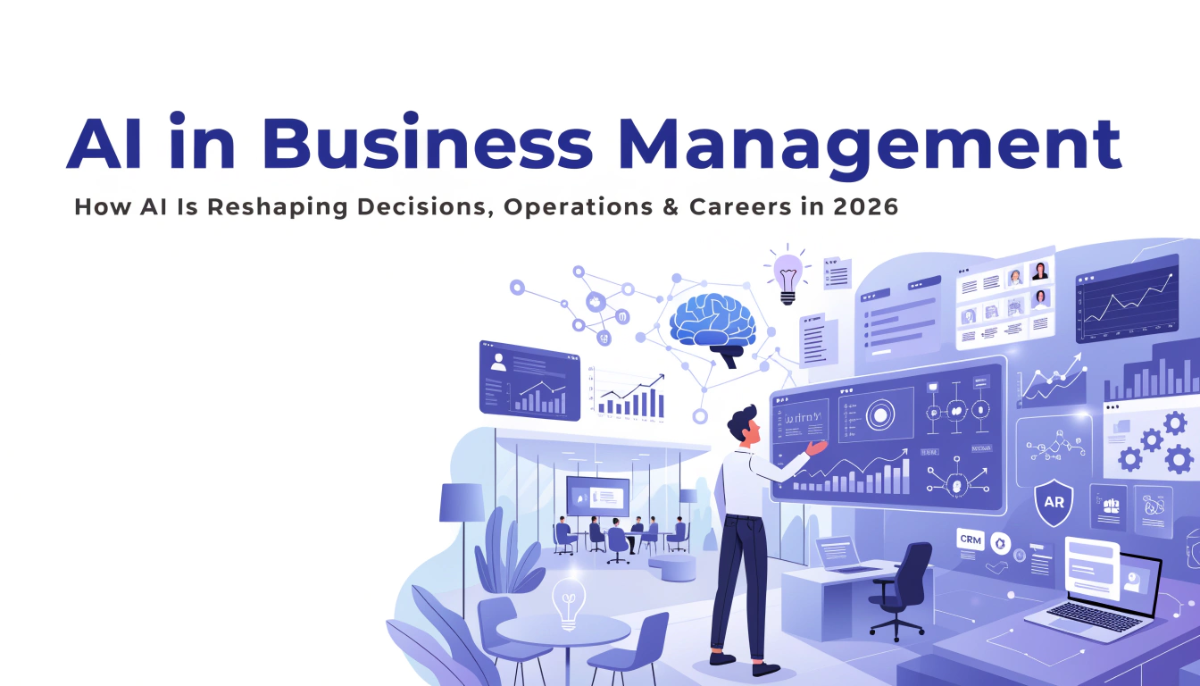
AI in business management is no longer a concept being piloted in select companies. By 2026 it is embedded in how businesses forecast demand, manage people, serve customers, handle finances and make strategic decisions at every level.
The shift has been faster than most predicted and the companies that adapted early are already seeing measurable advantages in cost, speed and decision quality over those that treated AI as optional.
This blog covers exactly how AI in business management is being applied across functions, which industries are leading adoption, what it means for management careers and how you can build the skills to remain relevant in a business environment that now runs partly on machine intelligence.
What AI in Business Management Actually Means in Practice
There is a lot of noise around AI and it helps to be specific about what AI in business management looks like in real organisational settings rather than in theory. Here is the grounded picture:
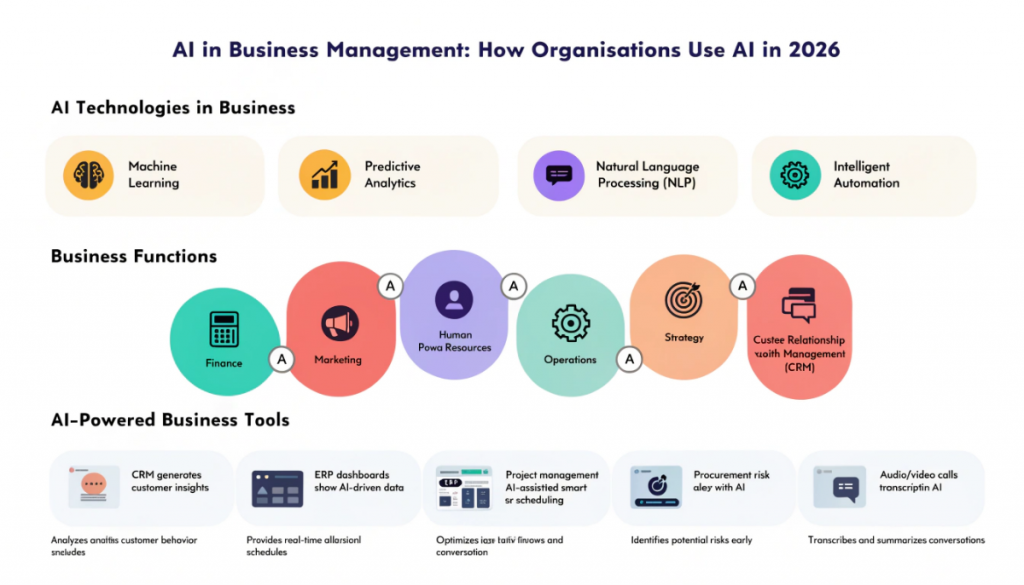
AI in business management refers to the use of machine learning, predictive analytics, natural language processing and automation tools to support or improve managerial decisions across finance, operations, marketing, HR and strategy
In 2026, AI has moved from being a standalone tool to being embedded infrastructure inside CRM systems, ERP platforms, project management software and financial reporting dashboards that managers already use daily
Users in most organisations now interact with AI without explicitly launching it since it surfaces inside their existing tools, generating customer insights in CRM systems, flagging risks in procurement platforms and suggesting schedule adjustments in project management apps
Agentic AI systems, which can complete multi-step tasks across different platforms without constant human input, are being deployed for workflows that previously required a team of junior analysts such as pulling data, generating reports and summarising findings for a leadership review
AI in business management is not about replacing management judgment but about removing the manual and repetitive layer of work so that managers can spend more time on decisions that require contextual understanding, stakeholder relationships and ethical reasoning
According to research from 2025 and 2026, organisations that have deeply integrated AI into their management workflows report 20 to 35 percent improvements in operational efficiency and 15 to 25 percent reductions in decision latency across key business processes
For professionals pursuing an MBA in Business Analytics and AI, the eligibility is a bachelor’s degree in any stream with 50% marks (45% for reserved category), with no entrance exam or prior work experience required, making it accessible to both fresh graduates and working professionals who want to lead in this space
AI in Business Management: How Finance and Accounting Have Changed
Finance was one of the first management functions to be transformed by AI and the depth of change in this area is worth understanding clearly. Here is what has shifted:
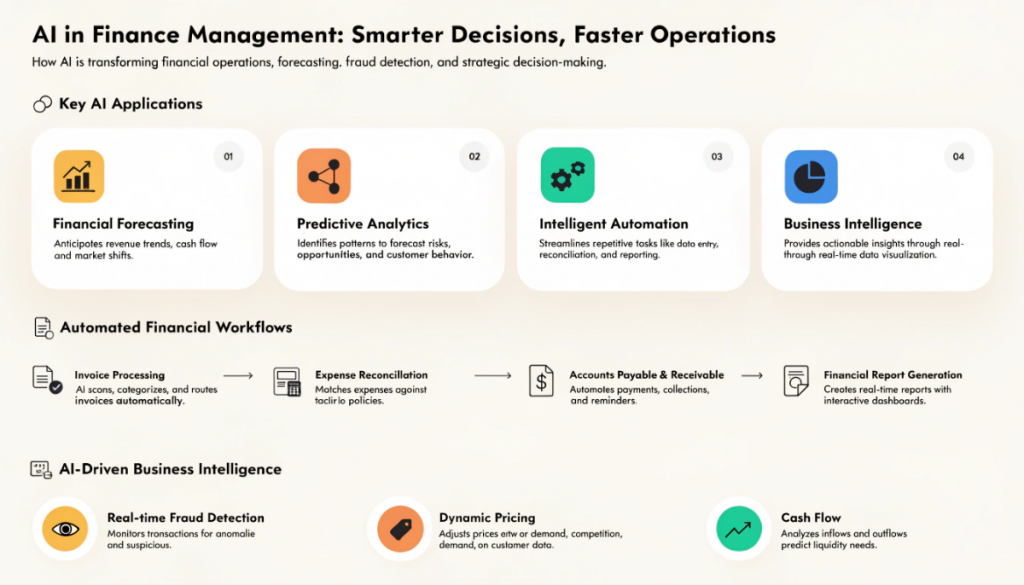
AI-powered financial forecasting tools analyse historical data, market signals, supply chain indicators and macroeconomic variables simultaneously to generate projections that are more accurate than traditional spreadsheet-based models built by analysts working manually
Robotic process automation combined with AI handles invoice processing, expense reconciliation, accounts payable and receivable management at speeds and accuracy levels that eliminate most of the manual accounting workload that junior finance teams previously handled
Fraud detection in financial transactions has become a core AI application in business management, with systems that can flag anomalous patterns in real time across millions of transactions daily, something no human audit team could replicate at that scale or speed
AI-generated financial reports are now a standard feature in business intelligence platforms, automatically pulling data from multiple sources and producing formatted summaries with commentary that would previously have taken a finance team hours to compile
Dynamic pricing models in retail, hospitality and e-commerce use AI to adjust prices in real time based on demand signals, competitor activity and inventory levels, creating revenue outcomes that static pricing strategies cannot match
CFOs and finance managers now need to understand how to interpret, validate and challenge AI-generated financial models rather than build the models themselves, which requires a different but equally rigorous set of analytical skills
Predictive analytics in finance allows companies to anticipate cash flow gaps weeks in advance, optimise working capital more precisely and model the financial impact of strategic decisions before committing to them
How AI in Business Management Is Transforming Marketing and Sales
Marketing and sales have seen some of the most visible applications of AI in business management because the impact shows up directly in revenue numbers. Here is how this function has been reshaped:
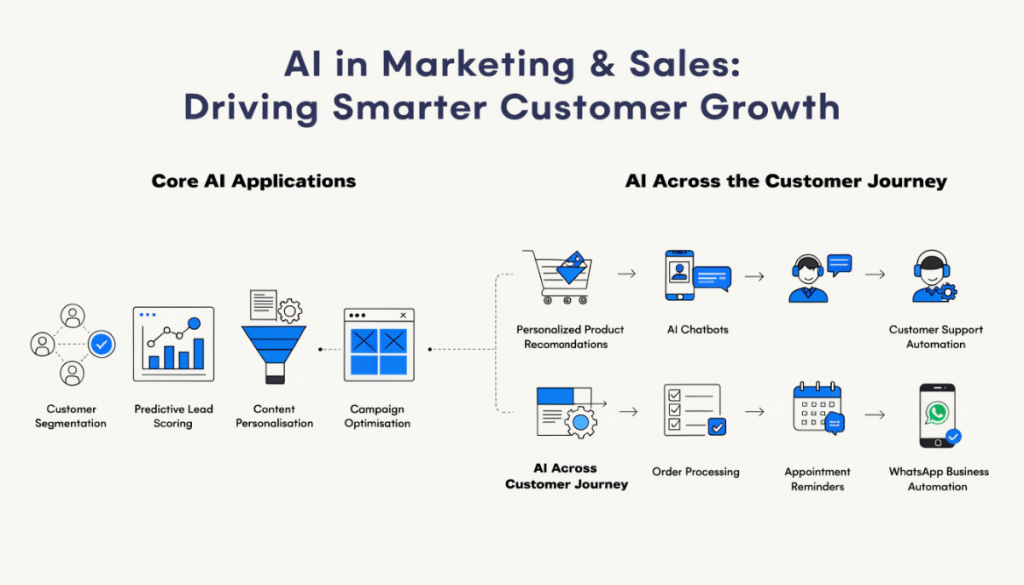
AI-powered customer segmentation analyses purchase history, browsing behaviour, demographic data and engagement patterns to create micro-segments that allow marketers to target specific audiences with specific messages rather than sending the same campaign to everyone
Predictive lead scoring in sales uses AI to rank incoming leads based on the likelihood of conversion, which allows sales teams to focus their time on prospects that are most likely to buy rather than working through a flat list without prioritisation
Content personalisation at scale is now possible through AI in business management, with platforms dynamically adjusting the content, product recommendations and messaging that individual users see based on their behaviour across channels
AI-powered chatbots have moved well beyond basic FAQ handling and in 2026 are managing full customer service conversations, processing orders, resolving complaints and escalating to humans only when genuinely needed, reducing support costs while maintaining customer satisfaction scores
WhatsApp AI integrations are particularly significant in the Indian market where businesses are using AI-powered WhatsApp Business for order updates, appointment reminders, support queries and proactive sales conversations at scale
Campaign optimisation tools powered by AI analyse the performance of ads, emails and content in real time and automatically adjust budget allocation, audience targeting and creative variants to maximise return on spend without waiting for a weekly review meeting
Voice of customer analysis uses natural language processing to process thousands of customer reviews, support tickets and social media mentions and extract structured insights about sentiment, feature requests and complaint patterns that inform product and marketing strategy
Operations and Supply Chain: Where AI in Business Management Has the Deepest Impact
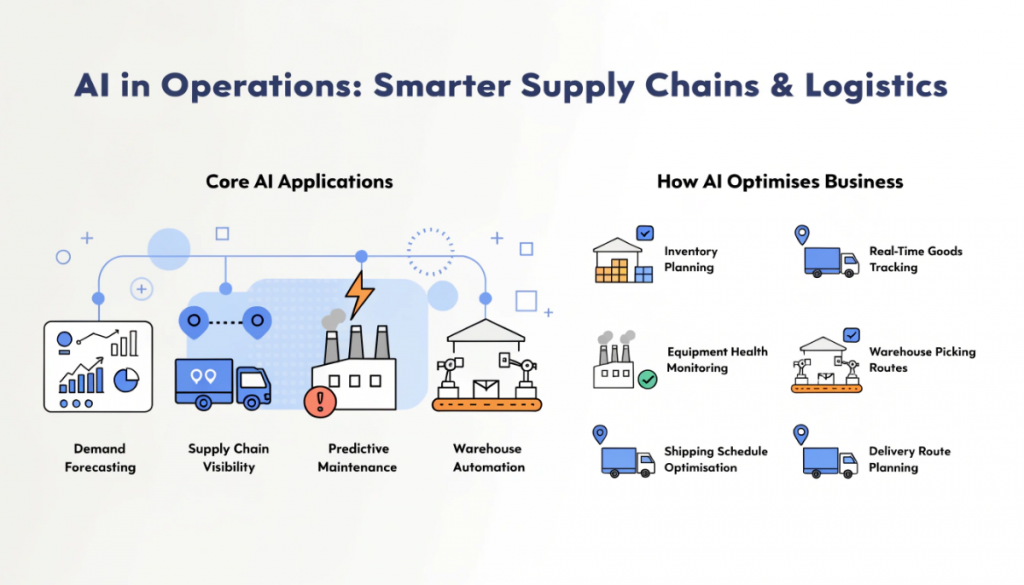
Operations is where AI in business management delivers some of its most financially significant results. Here is what is happening across supply chains, manufacturing and logistics:
Demand forecasting powered by AI reduces the overstock and stockout problems that cost retailers and manufacturers billions annually by analysing not just historical sales data but also weather patterns, social media trends, local events and competitor activity to project demand more accurately
AI-driven supply chain visibility platforms track goods in real time across complex multi-tier supplier networks and flag potential disruptions such as port delays, supplier financial stress or geopolitical risks before they translate into delivery failures
Predictive maintenance in manufacturing uses sensor data from machines to identify the early signs of equipment failure and schedule maintenance before a breakdown occurs, reducing unplanned downtime which is one of the largest operational cost drivers in manufacturing
Warehouse management systems with AI optimise picking routes, inventory placement and shipping schedules in real time, reducing the time and labour cost per order fulfilled and enabling faster delivery without proportional increases in operating cost
Logistics companies including large e-commerce operators are using AI route optimisation to reduce fuel costs, improve delivery time accuracy and handle dynamic rerouting when road conditions or demand patterns change during the day
AI in business management has also enabled what researchers describe as a shift from reactive to anticipatory operations, where instead of responding to disruptions after they happen, companies use AI to identify what is likely to go wrong and take preventive action in advance
For Indian businesses specifically, vernacular AI tools that work in Hindi, Tamil, Telugu and other regional languages are enabling frontline operations teams in manufacturing and logistics to interact with AI management systems in their own language for the first time
AI in Business Management and Its Effect on Human Resources
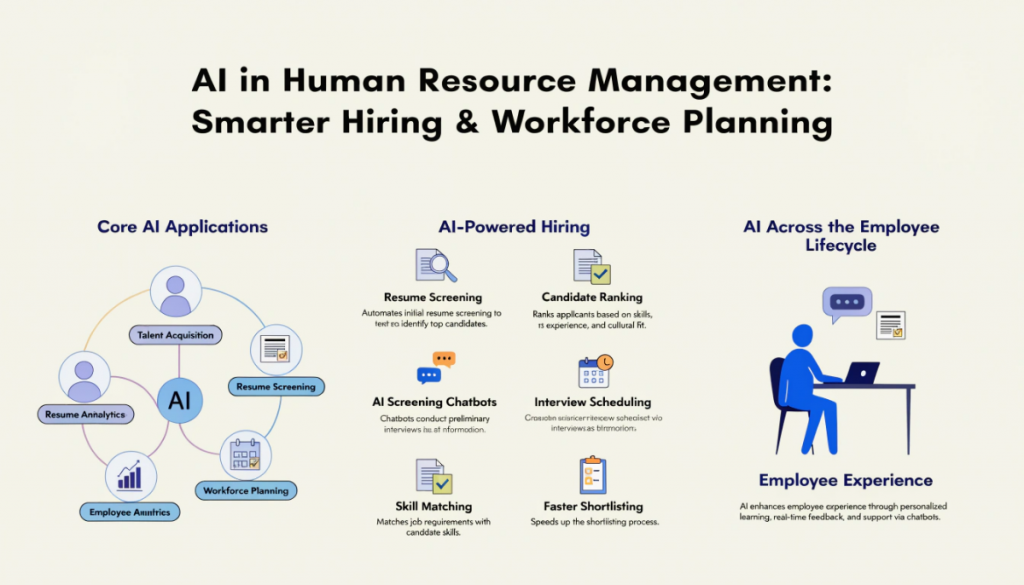
HR is one of the management functions undergoing the most significant structural change because of AI. Here is a clear breakdown of where and how:
AI-powered talent acquisition tools scan thousands of resumes in seconds, score candidates against job requirements and surface the most relevant profiles to hiring managers, reducing the time from job posting to shortlist from weeks to hours
Candidate screening chatbots now conduct initial screening conversations with applicants, asking structured questions and assessing responses before any human recruiter gets involved, which increases consistency and reduces unconscious bias in the early stages of selection
Employee sentiment analysis uses natural language processing to process survey responses, internal communication patterns and exit interview data to identify early signs of disengagement or flight risk before managers would typically notice
AI-generated learning pathways personalise training recommendations for each employee based on their role, performance data, career goals and skill gaps rather than enrolling everyone in the same mandatory training modules
Performance management supported by AI provides managers with data-driven insights about team productivity patterns, collaboration network health and individual output metrics that supplement the subjective observation that traditional appraisal systems rely on entirely
Workforce planning tools use predictive modelling to help HR leaders anticipate which roles will be impacted by business growth or contraction, which skills will be needed 12 to 18 months ahead and where to source talent proactively rather than reactively
An MBA combining business management with AI and analytics prepares HR professionals to lead this transformation by giving them both the business context and the data literacy needed to implement AI tools responsibly and interpret the insights they generate
Strategic Decision Making: Where AI in Business Management Meets Leadership
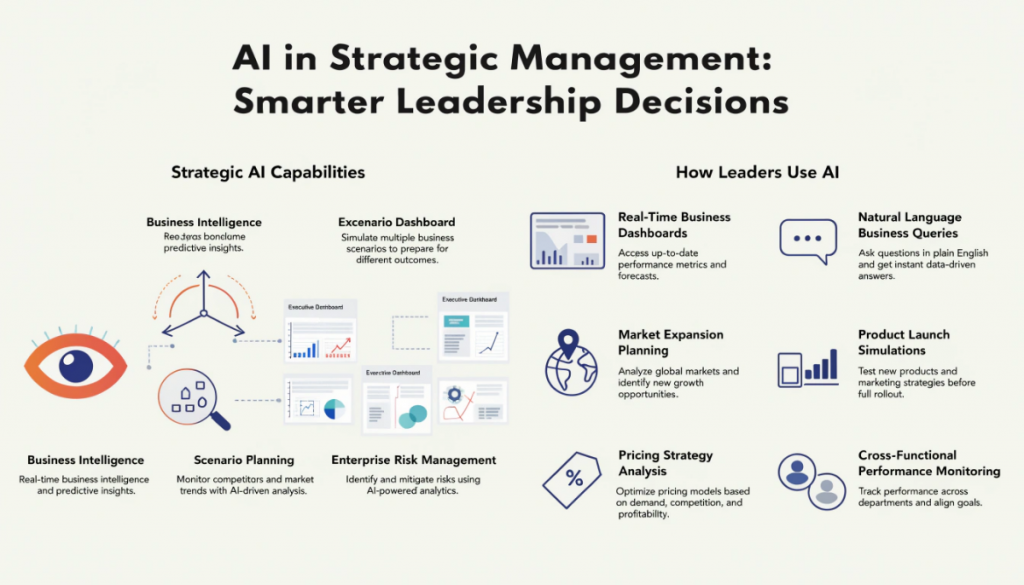
The most consequential application of AI in business management is at the strategic level where it is changing how leadership teams gather intelligence, evaluate options and commit to decisions. Here is what that looks like:
Business intelligence platforms with embedded AI now synthesise data from sales, finance, operations, customer service and external market signals into a single real-time view of business health that executives can interrogate through natural language queries rather than waiting for weekly reports
Scenario planning powered by AI allows leadership teams to model the financial and operational impact of strategic choices such as entering a new market, launching a product or changing a pricing model before committing budget and resources to execution
Competitive intelligence tools use AI to continuously monitor competitor activity including pricing changes, product launches, job postings, patent filings and public communications and surface relevant signals to strategy teams in near real time
Risk management at the enterprise level now incorporates AI models that assess geopolitical, regulatory, financial and operational risks simultaneously, giving boards and executives a more complete picture of exposure than any individual human analyst or committee could produce
AI-assisted board reporting is an emerging practice where tools compile management accounts, operational KPIs and strategic metrics into structured board papers with commentary, reducing the preparation time that senior teams spend on presentation assembly versus actual strategic thinking
The shift AI is creating at the strategic level is that data-informed decisions are becoming table stakes rather than competitive advantage, and the real differentiator is now the speed and quality of judgment that leaders apply to the AI-generated inputs rather than their ability to gather the data themselves
This is exactly why business management programs that combine AI literacy with strategic thinking, ethical governance and cross-functional leadership are in higher demand in 2026 than purely technical data science programs that teach tools without the management context
Conclusion
AI in business management in 2026 is not a future trend to prepare for. It is the current operating reality across finance, marketing, operations, HR and strategy at organisations of every size in India and globally.
The professionals and managers who are thriving are not necessarily the most technically advanced but the ones who understand how to apply AI tools to real business problems, interpret the outputs intelligently and make better decisions faster as a result.
The clearest path to building this capability is through a program that combines business management fundamentals with AI and analytics skills in a format that lets you apply what you learn to the work you are already doing. The demand for this profile is documented, the salary outcomes are strong and the window to position yourself at the intersection of business leadership and data intelligence is open right now.

Book Your
Free Session
Connect with our experts and get personalised guidance for your career, course selection, and future goals.
📖 Sources & References
✓ Verified 2026Verified AI in business management trends, enterprise AI adoption, management transformation, workforce impact and business strategy insights based on recognised educational, regulatory and industry sources.
- World Economic Forum Future of Jobs reports, AI adoption trends, business transformation and leadership insights
- McKinsey & Company Global research on generative AI, enterprise productivity, automation and management transformation
- Deloitte Insights AI strategy, digital transformation, workforce evolution and business leadership research
- IBM Institute for Business Value Enterprise AI adoption, business operations, customer experience and executive decision-making studies
- Microsoft WorkLab AI at work, productivity trends, Copilot research and future workplace insights
- NASSCOM India's AI ecosystem, enterprise technology adoption, digital skills and workforce reports
- Harvard Business Review AI leadership, business strategy, innovation management and organisational transformation insights
- Ministry of Electronics & IT (MeitY) Digital India initiatives, artificial intelligence policies and technology ecosystem development
- Shoolini Online AI-focused business management programmes, admission guidance and career development resources
- UGC India Recognition of higher education programmes, online learning regulations and academic quality standards