
Starting a business looks simple from the outside but most founders learn the hard parts on the job. An online MBA in entrepreneurship is built to teach those parts before you risk your own money. It covers idea testing and funding and marketing and operations in a flexible format that works around a job or an early stage venture. This blog explains what the program includes and who can apply. It also looks at the syllabus and the career paths it opens up.
What an Online MBA in Entrepreneurship Really Is
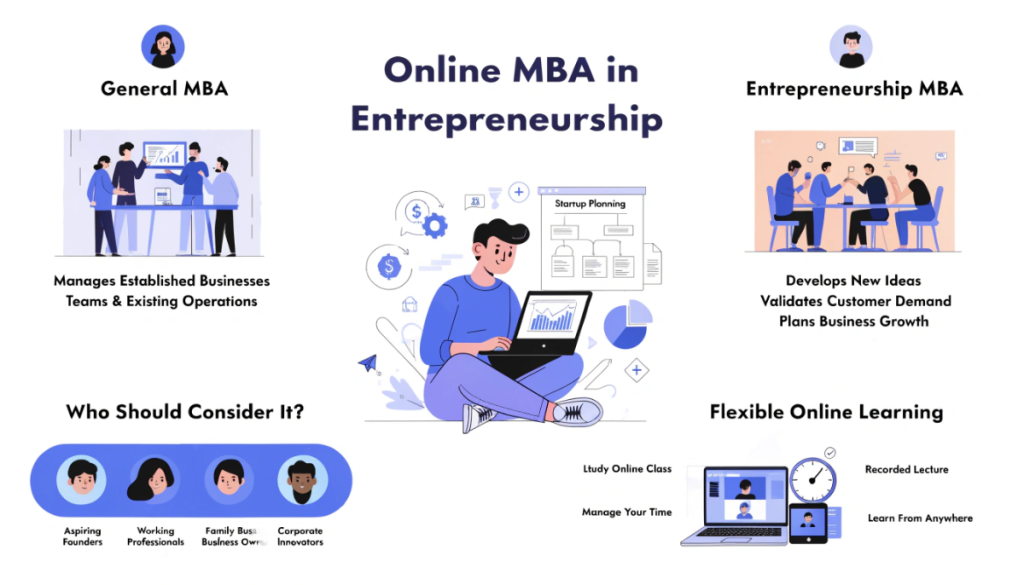
An online MBA in entrepreneurship is a two year postgraduate management program that focuses on starting and running new ventures. You learn the same core business subjects as any MBA student. The difference is that the examples and projects and electives point toward building a business or growing one inside a larger company.
How It Differs From a General MBA
- A general MBA prepares you to work in established companies across many functions, which means the focus is on managing existing systems.
- An online MBA in entrepreneurship focuses on creating something new, so you spend more time on idea validation and funding and early customers.
- Many programs do not offer entrepreneurship as a separate degree and instead include it as a core paper or a major and minor combination, so check how the program is structured before you apply.
Who Should Consider It
- Aspiring founders who want structure and a network before launching, since the program gives frameworks that reduce expensive early mistakes.
- Working professionals with a business idea on the side, because the online format lets them keep their income while they build.
- Family business members who want to modernise operations, which means the degree gives them tools to plan growth in a more organised way.
- Professionals who want to lead new projects inside large companies, since the same skills apply to launching products and new business lines.
Why the Online Format Suits Entrepreneurs
Founders rarely have fixed hours. An online MBA in entrepreneurship lets you attend live sessions in the evening or watch recordings later. You can apply what you learn to your own venture the same week. That quick loop between theory and practice is one of the biggest advantages of the format.
Online MBA in Entrepreneurship Eligibility and Admission
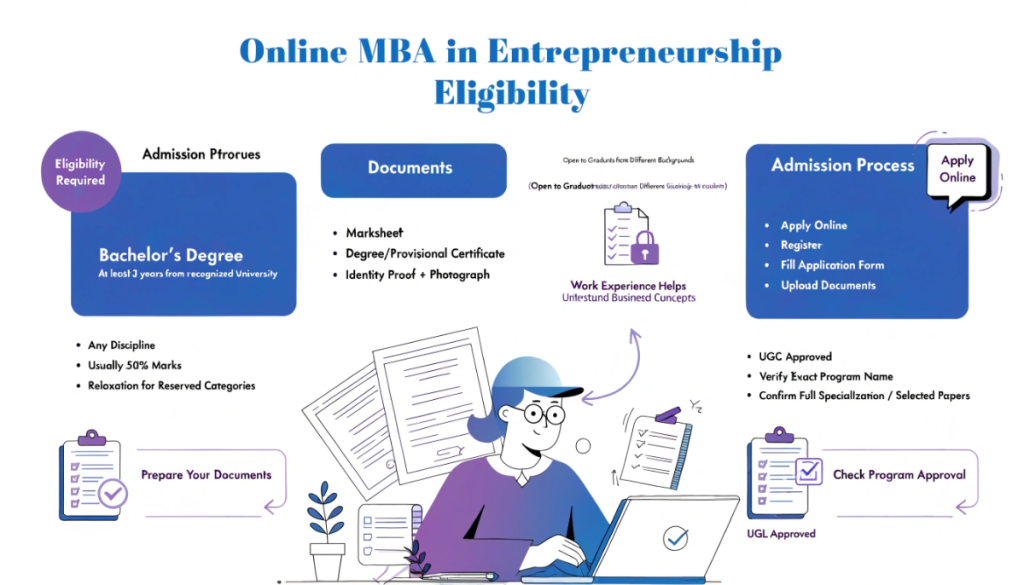
The entry rules for an online MBA in entrepreneurship are open to graduates from most backgrounds. You do not need a business degree or a startup already running to apply.
Academic Requirement
- A bachelor’s degree of at least three years from a recognised university is required, in any discipline, so graduates from arts and science and engineering and commerce can all apply.
- Most programs ask for around 50 percent marks in graduation, with a lower cut off of about 45 percent for reserved categories.
- The percentage is checked on the qualifying degree, so keep your final marksheets and degree or provisional certificate ready.
Admission Process
- Admission is done online through an application where you register and fill in academic details and upload documents.
- There is usually no entrance exam such as CAT or MAT for these programs, so selection depends on eligibility and document checks.
- Documents normally include graduation marksheets and a degree certificate and identity proof and a photograph. Some programs ask for domicile proof where it applies.
Approval to Check Before You Pay
Confirm that the program is approved by UGC for the online mode. That approval makes the degree equal to a regular MBA for jobs and further study. Also ask whether entrepreneurship is a full specialisation or a set of papers inside a broader program so you know exactly what you will learn.
Work Experience and Idea Stage
Work experience is usually not compulsory. It does help because classroom discussions make more sense when you have seen how a business runs. If you already have an idea then write it down in a few lines before you start. You can refine it as the course goes on.
Online MBA in Entrepreneurship Syllabus and Skills
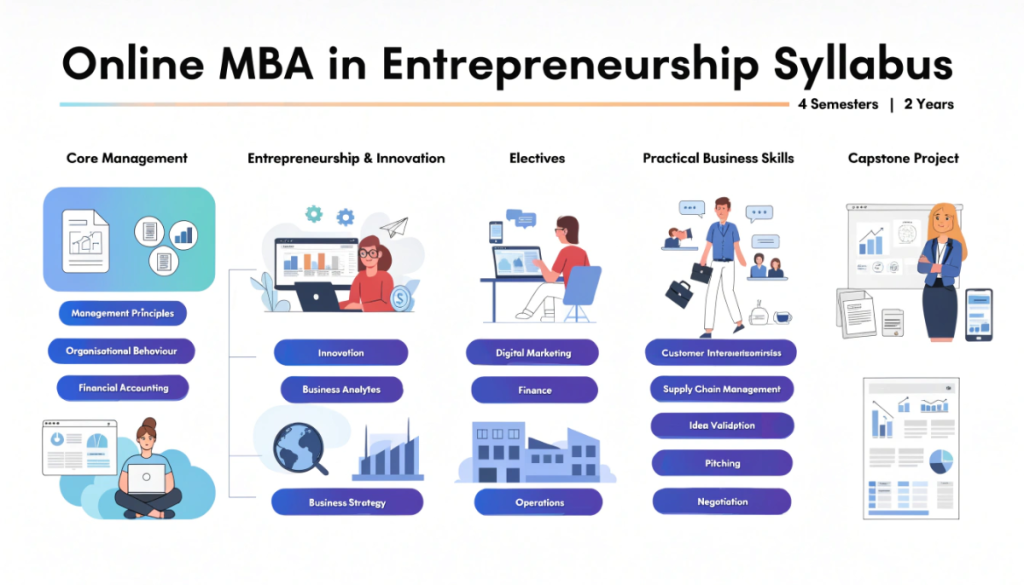
The syllabus of an online MBA in entrepreneurship runs across four semesters. The first year builds general management knowledge. The second year moves into specialised papers and projects that suit new ventures.
Core Management Subjects
- Management principles and organisational behaviour show how teams work, which matters when you start hiring.
- Financial accounting and managerial economics teach you to read numbers and price a product, since every founder has to understand cash flow.
- Marketing management and business statistics give you tools to study customers and measure results.
Entrepreneurship Focused Papers
- Entrepreneurship and innovation papers teach how to spot a gap in the market and turn it into a testable offer.
- Business plan and venture finance papers cover budgeting and funding sources, so you can explain your numbers to investors and banks.
- Strategy and operations papers show how to scale a small business without losing quality, which is where many young ventures struggle.
Electives and Specialisation Pairing
- Marketing and digital marketing electives help you reach customers on a small budget, which is useful for most startups.
- Finance electives help with fundraising and budgeting, so you can plan runway and avoid running out of cash.
- Supply chain and analytics electives help product and data driven ventures, which means you can choose based on the kind of business you plan to build.
Practical Skills You Gain
- Idea validation through customer interviews and small tests, which saves money before a full launch.
- Pitching and negotiation, since founders must convince investors and partners and early employees.
- Basic legal and compliance knowledge such as company registration and contracts and tax, which keeps a new business on safe ground.
Capstone Project
Most programs end with a project where you build a business plan or solve a problem for a real company. Use it to work on your own venture if the rules allow. A strong project becomes a pitch document and a portfolio piece at the same time.
Career Options After an Online MBA in Entrepreneurship
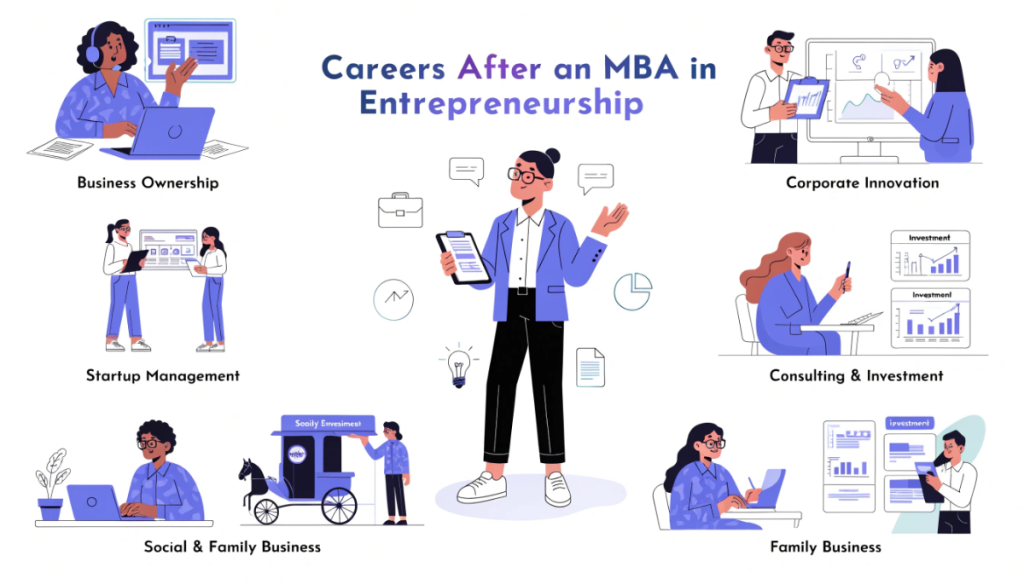
An online MBA in entrepreneurship does not only lead to starting a company. It opens several paths and you can move between them as your goals change.
Starting Your Own Venture
- Many graduates launch a startup in technology or retail or services, which means the course project often becomes the first version of the business.
- Others scale an existing small business with better planning and systems, so the degree adds value even if you already run something.
Working in Startups
- Startups hire people who understand the full picture from sales to operations, so graduates of an online MBA in entrepreneurship fit roles such as business development manager and operations manager.
- Early employees often get wide responsibility and equity or growth opportunities, which makes startup work a strong learning path.
Corporate Innovation and Product Roles
- Large companies create new business units and need leaders who think like founders, so roles in innovation and strategy are open to graduates.
- Product manager and business analyst roles use the same skills in customer research and planning, which means the degree also supports a corporate career.
Consulting, Incubators and Investment Support
- Consultants help small businesses with planning and marketing and finance, so strong communication and problem solving matter.
- Incubators and accelerators hire programme managers who support startups, which suits people who enjoy mentoring.
- Venture funds and angel networks recruit analysts to study deals, though these roles are competitive and often need experience.
Social Enterprise and Family Business
Some graduates build ventures that solve social problems such as education or health access. Others take over a family business and grow it. Both paths need planning and finance and people skills. The program gives you a common framework for either choice.
Benefits and Limits of Studying Entrepreneurship Online
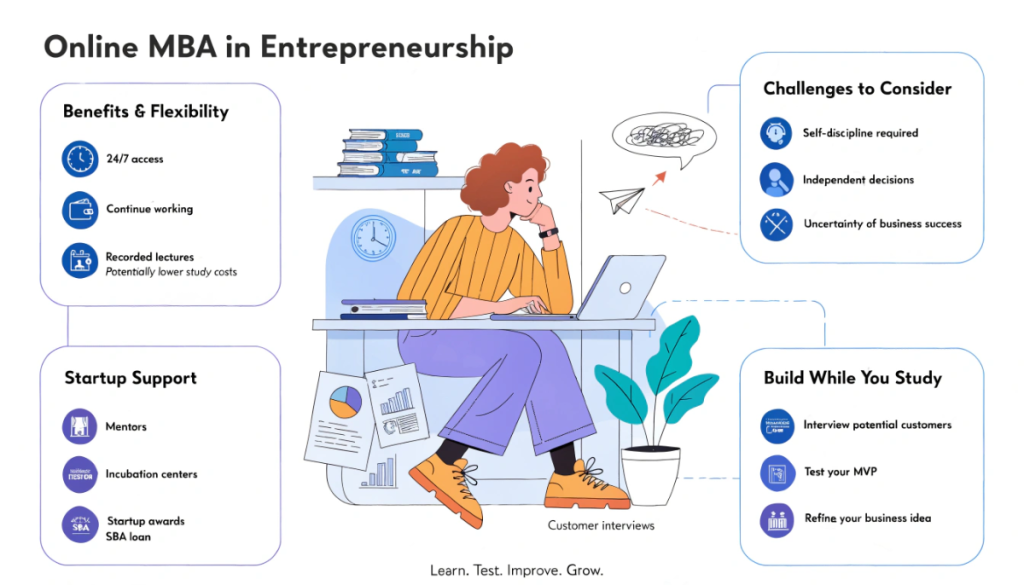
The online format of an online MBA in entrepreneurship brings clear advantages but it also asks more from you. Knowing both sides helps you decide whether it suits your style.
Main Benefits of an Online MBA in Entrepreneurship
- You can keep earning while you study, which lowers the financial risk of starting a venture.
- Recorded lectures let you revise difficult topics like valuation and cash flow as often as you need.
- Classmates from different industries and cities become future partners and customers and advisors, so the network can matter as much as the syllabus.
- The total cost is generally lower than a full time campus MBA, which leaves more money for your venture.
Limits to Be Aware Of
- Nobody can teach you to be a founder, so the degree supports your effort but does not replace it.
- Online learning needs self discipline, since nobody checks your attendance every day.
- Funding and success depend on market conditions and execution, so the degree does not guarantee a profitable business.
Support Available for New Ventures
- Incubation centres and startup cells at institutions offer mentoring and workspace, so ask whether your program connects you to one.
- Government initiatives such as Startup India offer recognition and some benefits for registered startups. Details change so check current rules.
- Banks and microfinance schemes provide small business loans, which can help in the early stage before outside investment.
Building While You Study
The best use of an online MBA in entrepreneurship is to run a small real experiment during the course. Test your idea with ten customers. Track what they say and adjust. By the final semester you will have evidence and not just a plan. That is far more convincing to investors and to your own confidence.
How to Choose and Prepare for an Online MBA in Entrepreneurship
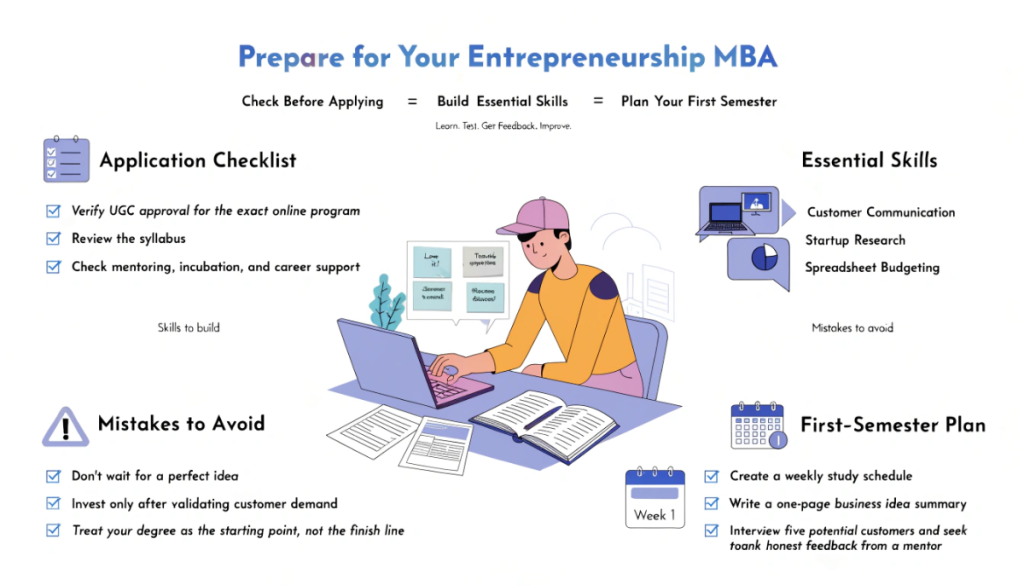
A little preparation before you apply makes the course much more useful. Ask the right questions and set clear goals for what you want to leave with.
Checklist Before You Apply
- Confirm UGC approval for the online mode and for the exact program, since recognition affects jobs and further study.
- Read the syllabus for entrepreneurship papers and project work, because a few generic subjects will not give you much founder knowledge.
- Ask about live sessions and mentoring and incubation support, which tells you how much real guidance you will get.
- Check what career or startup support exists and what it actually includes, so you are not relying on vague promises.
Skills to Start Building Before Your Online MBA in Entrepreneurship
- Practise talking to strangers about your idea, since customer conversations are the heart of early validation.
- Learn spreadsheet basics for budgets and forecasts, because every pitch needs numbers that hold up.
- Read about a few failed and successful startups in your area, which teaches patterns that textbooks miss.
Mistakes to Avoid
- Waiting for a perfect idea before you begin, which means you lose months that could have gone into testing.
- Spending savings on a launch before customers have shown interest, since early evidence reduces risk.
- Treating the degree as the goal instead of the tool, because investors and customers care about results and not certificates.
A Simple Plan for the First Semester
Set a weekly study schedule and keep one evening for your venture. Write a one page summary of your idea in the first month. Talk to at least five potential customers by the end of the semester. Share your progress with a mentor or a classmate for honest feedback. Small steady actions add up faster than occasional bursts of effort.
Conclusion
An online MBA in entrepreneurship works best for people who are ready to learn and act at the same time. The eligibility is open to graduates from any background and the format fits around a job or a young business. What decides your result is how much you apply the lessons to a real venture. Choose a program that gives you practical projects and mentoring and a useful network. Start testing your idea early. With steady effort the degree can save you costly mistakes and give you a stronger start.
Sources & References
✓ Verified 2026Explore these official and professional resources for more information about human resource management, marketing careers, professional skills, salary research and online MBA recognition.
-
UGC Distance Education Bureau
Check recognised institutions and approved online programmes before enrolling in an online MBA.
-
UGC-DEB Frequently Asked Questions
Understand important considerations about recognition and online or distance education.
-
Society for Human Resource Management (SHRM)
Explore HR practices, talent acquisition, employee relations, workforce management and professional development.
-
Chartered Institute of Personnel and Development (CIPD)
Learn about people management, learning and development, organisational culture and HR professional skills.
-
American Marketing Association (AMA)
Explore marketing concepts, customer behaviour, brand management, marketing research and industry knowledge.
-
Google Skillshop
Build practical digital marketing and advertising skills through Google’s training resources.
-
HubSpot Academy
Access learning resources for digital marketing, content marketing, sales and customer relationship management.
-
Adecco India Salary Guide
Consult salary and hiring-market insights when researching compensation and career growth.
-
National Career Service (NCS), Government of India
Explore career information, employment services and job opportunities across different sectors.
-
Human Resources Analytics on Coursera
Explore how data and analytics can support HR decisions and workforce planning.
Note: Salary ranges mentioned in this article are indicative estimates, not guaranteed pay. Actual compensation varies by experience, location, employer, role and individual skills. Check current job listings and salary reports before making career decisions. Online MBA eligibility and recognition can vary by institution and admission session, so confirm the exact programme on the official UGC-DEB website.

Book Your
Free Session
Connect with our experts and get personalised guidance for your career, course selection, and future goals.