
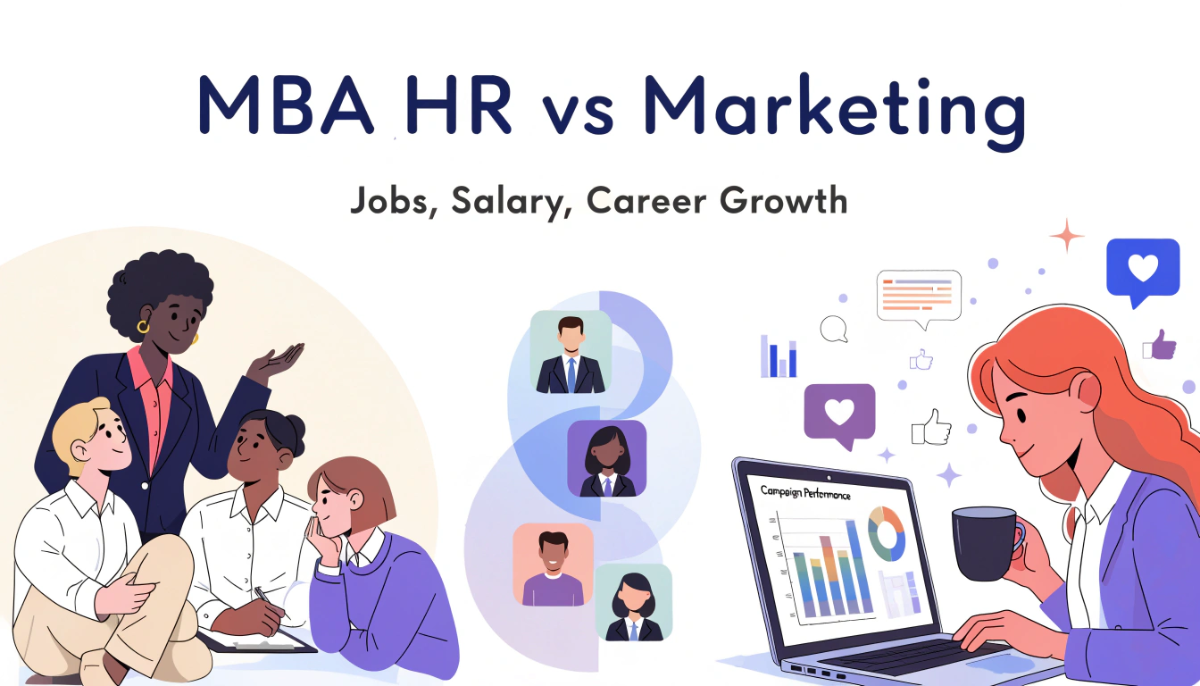
Choosing a specialisation is the hardest part of an MBA for many students. MBA HR vs Marketing is the comparison that comes up most often because both fields hire in large numbers and both lead to management roles. One deals with the people inside a company while the other deals with the customers outside it. This blog compares the two on syllabus and job roles and salary and growth. It also explains the eligibility for an online MBA so you can decide with clear facts.
MBA HR vs Marketing: The Core Difference
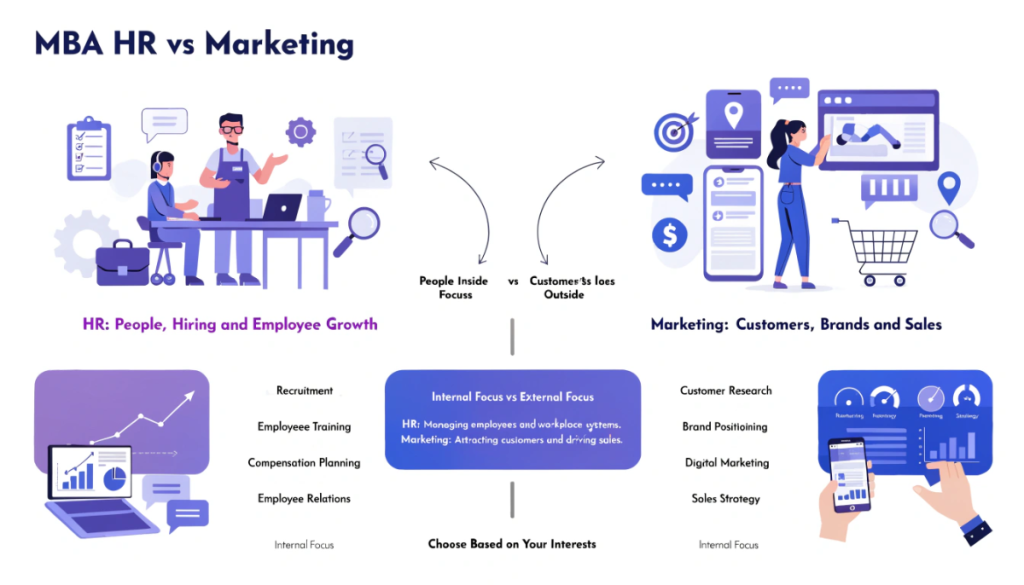
The simplest way to understand MBA HR vs Marketing is to ask who you want to work with every day. HR focuses on employees and the systems that keep them hired and trained and motivated. Marketing focuses on customers and the work of making them aware of a product and keen to buy it.
What an MBA in HR Covers
- HR management trains you to hire and train and retain staff, which means you learn how a company builds the team it needs.
- It also covers pay structures and labour laws and employee relations, so you understand both the human side and the legal side of work.
- The goal is to keep the organisation stable and productive, which makes HR a support function that touches every department.
What an MBA in Marketing Covers
- Marketing management teaches how to study customers and position products and set prices and promote them, so you learn how a business earns revenue.
- Digital marketing and brand management and sales strategy are usually part of the program, which means you can pick up skills that employers use daily.
- The goal is to grow sales and brand value, so marketing is seen as a direct revenue driver.
The Inside vs Outside Way to Look at It
A common way to compare MBA HR vs Marketing is internal versus external. HR professionals work on internal problems such as hiring gaps and employee satisfaction. Marketers work on external problems such as brand awareness and customer demand. Neither is better in general. The right choice depends on which kind of problem you find more interesting.
MBA HR vs Marketing Syllabus and Skills
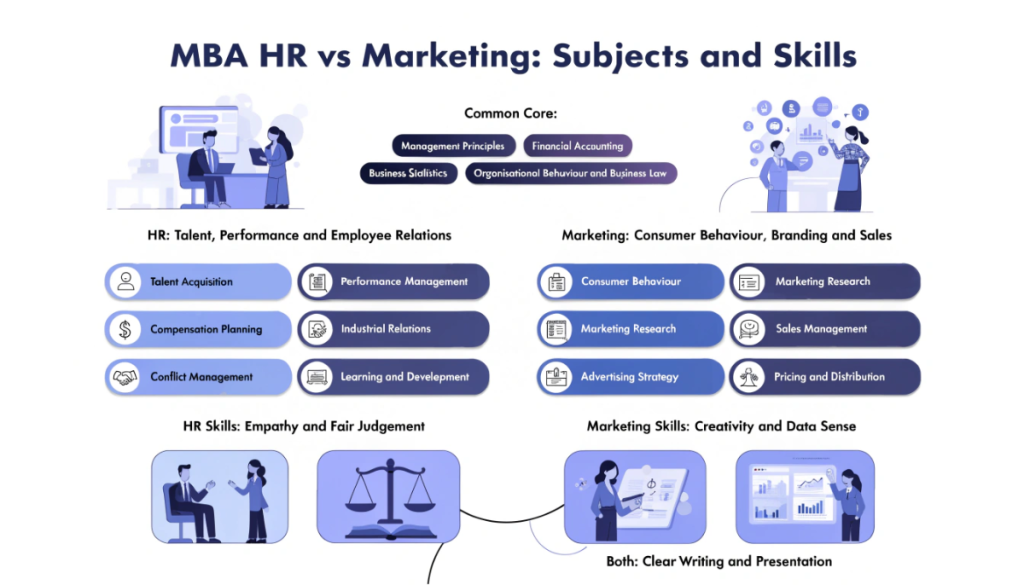
Both specialisations share the same first year of core management subjects. In MBA HR vs Marketing the real difference appears in the elective papers and in the skills each field rewards.
Common Core Subjects
- Management principles and financial accounting and business statistics are taught to everyone, which gives all students the same base in business thinking.
- Organisational behaviour and business law also appear early. They are useful in both HR and marketing roles.
HR Specialisation Subjects
- Talent acquisition and performance management and compensation planning are the main papers, which means you learn how to run the full employee cycle.
- Industrial relations and labour codes and conflict management prepare you to handle disputes and compliance.
- Learning and development and organisational culture papers show how companies build skills and keep people engaged.
Marketing Specialisation Subjects
- Consumer behaviour and brand management and marketing research are central, so you learn why people buy and how to measure it.
- Digital marketing and sales management and advertising strategy give you practical tools used in campaigns.
- Pricing and distribution papers show how products reach customers at the right price, which ties marketing to the wider business.
Skills Each Field Rewards
- HR rewards empathy and fair judgement and good listening, since you often deal with sensitive matters.
- Marketing rewards creativity and data sense and persuasive communication, since results are measured in numbers.
- Both reward clear writing and presentation skills, which is why these papers matter in either track.
MBA HR vs Marketing Job Roles
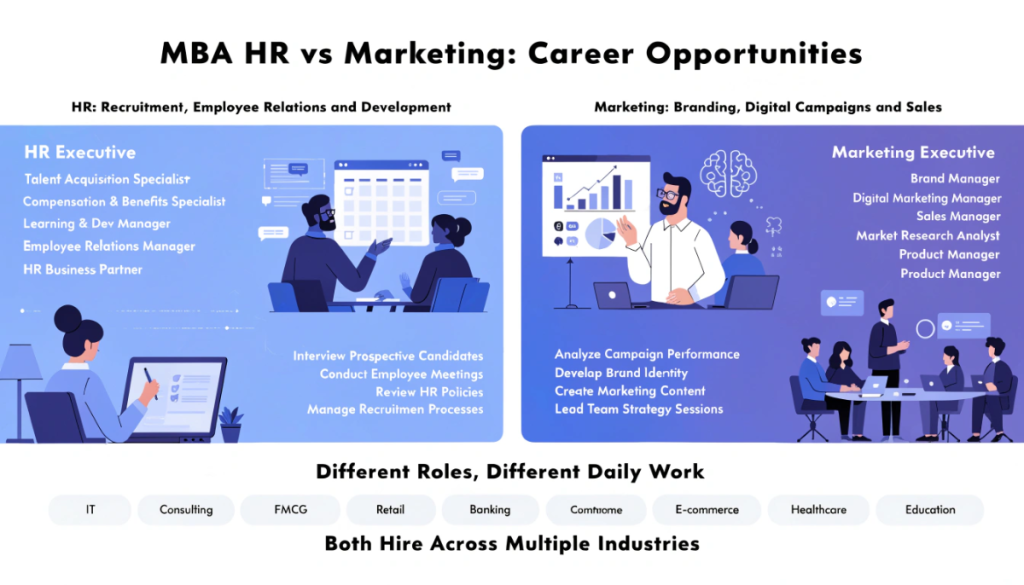
Job roles are where the difference between MBA HR vs Marketing becomes easy to see. The work and the daily rhythm are quite different even though both sit in management.
Common Roles After an MBA in HR
- HR executive and generalist roles handle hiring and records and employee queries, which makes them common first jobs.
- Talent acquisition specialists find and interview candidates, so the role suits people who enjoy meeting new faces.
- Compensation and benefits specialists design pay and reward plans, which means comfort with numbers is a plus.
- Learning and development managers plan training programs while employee relations managers handle disputes and engagement.
- With experience you can grow into HR business partner and head of HR roles that work closely with senior leaders.
Common Roles After an MBA in Marketing
- Marketing executives and managers plan campaigns and track results, which means you learn how a brand speaks to customers.
- Brand managers look after how a product is positioned and perceived, so creativity and market knowledge matter.
- Digital marketing managers run search and social and email campaigns. The work is measurable and fast paced.
- Sales managers and market research analysts and product managers are also common, so the field has many branches.
Day to Day Work in Each Field
- An HR professional spends the day on interviews and policy questions and employee meetings, so people contact fills most of the schedule.
- A marketing professional spends the day on campaign planning and data reports and agency calls, so the day mixes creative work with analysis.
- Knowing this helps you compare MBA HR vs Marketing in terms of lifestyle and not only job titles.
Industries That Hire for Both
- IT and consulting firms hire in large numbers for both HR and marketing teams, which means you can find a first job in either field.
- FMCG and retail and e-commerce companies lean toward marketing but still need strong HR teams, so both tracks have openings.
- Banking and healthcare and education companies need both, so MBA HR vs Marketing is not a choice between jobs and no jobs.
MBA HR vs Marketing Salary and Career Growth
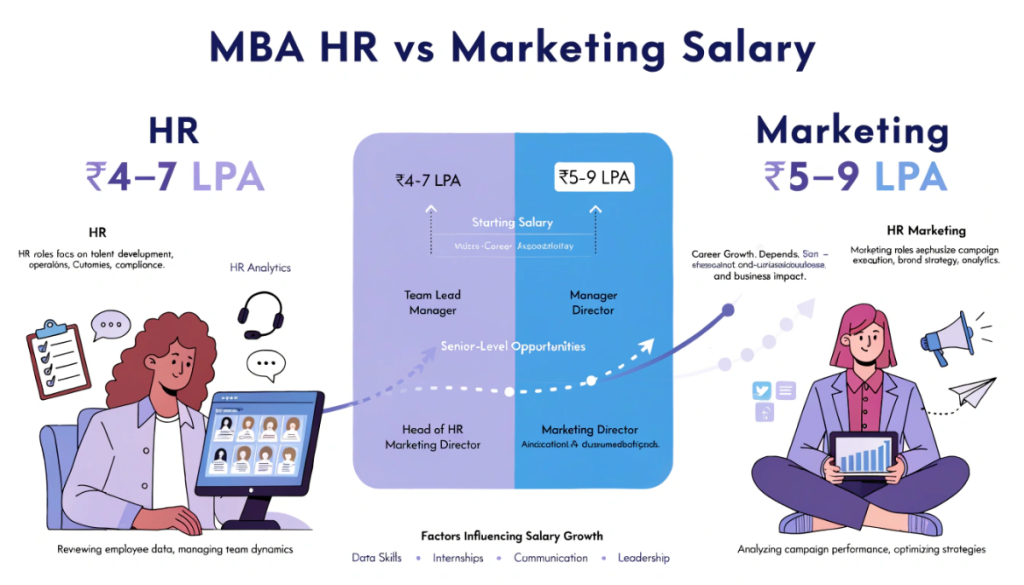
Salary is a big part of any specialisation choice but the two fields overlap more than most people think. Figures from career sites vary a lot so treat everything here as a rough guide.
Starting Pay in MBA HR vs Marketing
- Many sources put MBA HR fresher pay at roughly 4 to 7 LPA, with higher offers at large companies and in specialised roles.
- Marketing fresher pay is often listed slightly higher at roughly 5 to 9 LPA, partly because sales and digital roles include incentives.
- The ranges overlap, so a strong HR graduate from a good program can easily out earn an average marketing graduate.
Mid Career and Senior Levels
- Marketing pay can rise faster in the middle years because it is linked to revenue, which means results can bring bonuses and quick promotions.
- HR pay grows steadily and can reach high levels for senior business partners and heads of HR at large companies.
- At senior levels the gap shrinks, since leadership pay depends on the size of the company and the impact of the person.
Long Term Outlook
Both fields are expected to stay in demand because every company needs to hire people and sell what it makes. Technology is changing the work in each. HR teams now use analytics to study attrition and hiring. Marketing teams use automation and data to target customers. Professionals who learn these tools early stay valuable in the MBA HR vs Marketing debate no matter which side they pick.
What Moves Your Salary More Than the Specialisation
- Skills in demand such as data analysis and digital tools, which raise value in both HR and marketing.
- Internships and project work during the MBA, since they prove you can do the job.
- The size and sector of the employer, because large firms and technology companies usually pay more.
- Communication and leadership, which decide who gets promoted to manager roles.
MBA HR vs Marketing: Pros, Cons and Who Each Suits
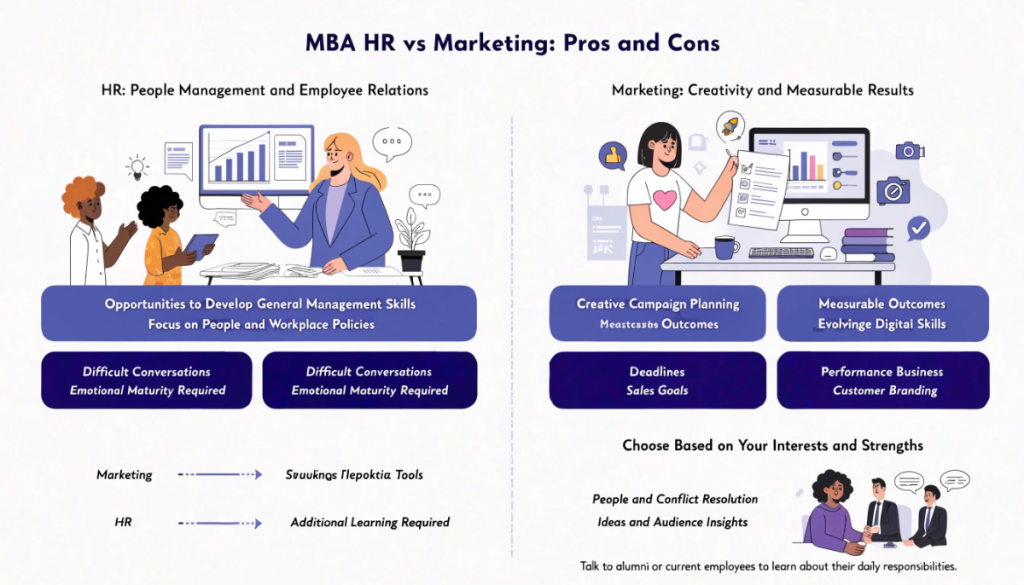
Every specialisation has strengths and trade offs. Looking at both sides of MBA HR vs Marketing honestly helps you avoid a choice you regret later.
Strengths of an MBA in HR
- The work is stable and needed in every organisation, so job security is generally good.
- You build skills in people management and law that help if you later move into general management.
- The pace is often more predictable than sales driven roles, which suits people who value routine.
Strengths of an MBA in Marketing
- Results are visible and measurable, so strong performers can move up quickly.
- The field changes fast with new platforms and tools, which keeps the work fresh for curious people.
- Skills transfer well to entrepreneurship, since marketing is a core part of running any business.
Trade Offs to Keep in Mind
- HR can involve difficult conversations such as layoffs and disputes, so you need emotional maturity.
- Marketing can bring pressure to hit sales or campaign targets, which can be stressful in some companies.
- Both fields are competitive at entry level, so skills and internships matter more than the label on the degree.
Switching Between the Two Later
Choosing one does not lock you in forever. Many professionals start in marketing and move into HR roles that need customer insight such as employer branding. Others begin in HR and shift to people focused marketing roles such as customer experience. The core MBA subjects are common so a switch is possible with some extra learning. This is worth remembering if you feel stuck between MBA HR vs Marketing.
A Simple Way to Decide
Think about what you enjoy when you work on a group project. If you like resolving conflicts and organising people then HR may suit you. If you like coming up with ideas and testing what works with an audience then marketing may be the better fit. Talk to two or three working professionals in each field and ask about a normal day. That conversation often settles the MBA HR vs Marketing question faster than any article.
Eligibility for an Online MBA With HR or Marketing
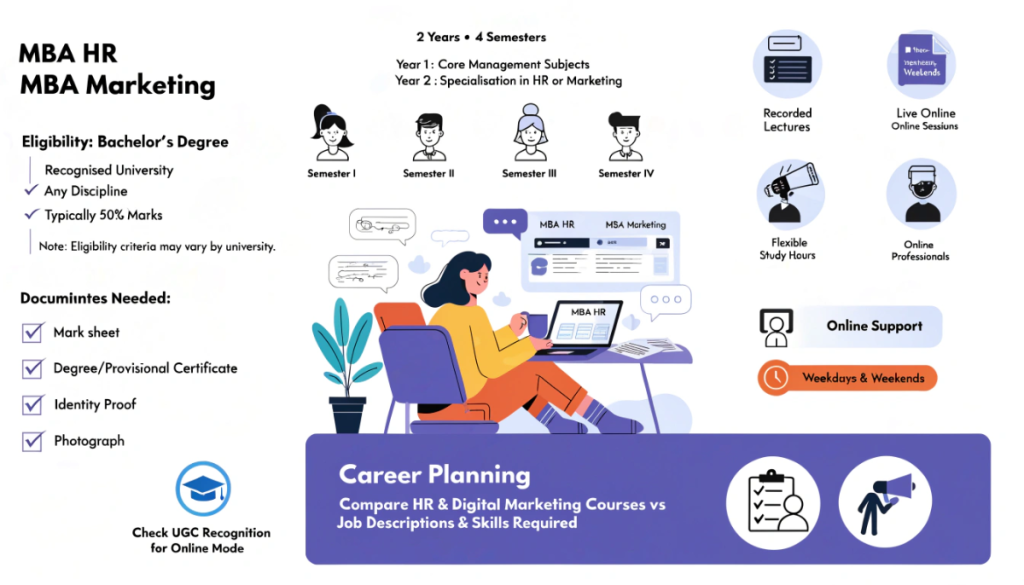
Online MBA programs usually let you choose between HR and marketing and other tracks such as finance and digital marketing. Entry rules are fairly simple.
Academic Requirement
- A bachelor’s degree of at least three years from a recognised university is required, in any discipline, so arts and commerce and science graduates can all apply.
- Most programs ask for around 50 percent marks in graduation, with some relaxation for reserved categories.
- Admission is usually merit based and there is no entrance exam such as CAT in most cases, so selection depends on documents and eligibility checks.
Program Structure
- The MBA runs for two years across four semesters. The first year covers core subjects that are common to every specialisation.
- You normally pick HR or marketing for the second year, which means you get time to explore before committing.
Documents and Approval
Applicants upload marksheets and a degree or provisional certificate and identity proof and a photograph. Always confirm that the program is approved by UGC for the online mode so the degree is valid for jobs and further study. Also ask about live sessions and projects and career support because these shape how much you gain from the course.
Why Many Students Choose the Online Route
- Working professionals can keep their job and study in the evenings, which means no income gap while upgrading skills.
- Recorded lectures and live sessions fit around a busy schedule, so you can revisit a topic as often as needed.
- The lower total cost compared with a full time campus MBA makes it easier to invest in the specialisation you really want.
How to Prepare Before You Choose
- Read the full syllabus for both tracks and mark the subjects that excite you, since interest predicts effort.
- Take a short online course in HR basics and one in digital marketing, which gives you a real feel for each field.
- Look at job postings for roles you want in three years and note the skills they ask for, because this shows what employers actually need.
Conclusion
MBA HR vs Marketing is not a question with one right answer. HR suits people who enjoy working with employees and building stable teams. Marketing suits people who enjoy customers and ideas and measurable results. Salaries overlap and both fields offer growth into senior roles. Whichever side of MBA HR vs Marketing you choose, match it to your interests and strengths and then build real skills through projects and internships. That effort will shape your career far more than the name of the specialisation on your degree.

Book Your
Free Session
Connect with our experts and get personalised guidance for your career, course selection, and future goals.
Sources & References
✓ Verified 2026Explore these resources for further information about human resource management, marketing careers, digital marketing skills, online MBA recognition and salary research.
Note: MBA eligibility, available specialisations, salary ranges and job requirements vary by university, employer, location and experience. Check the relevant official source for current details. Salary figures in this article should be treated as estimates, not guaranteed packages.