
Economics sits behind almost every big decision in business and government. Prices and jobs and interest rates and taxes all come from economic choices. An online MA Economics lets graduates study these ideas in depth without leaving their job or their city. It is a two year postgraduate degree that trains you to read data and understand markets and judge policy. This blog explains what the course covers and who can apply. It also looks at the syllabus and the careers it opens up.
What an Online MA Economics Program Really Covers
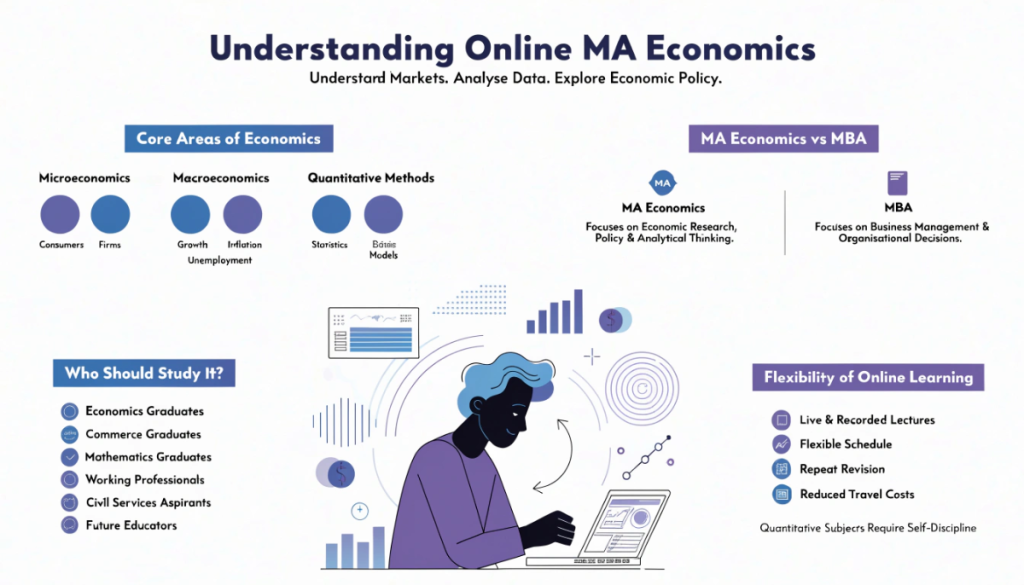
An online MA Economics is a postgraduate degree that teaches how individuals and firms and governments use limited resources. You study theory and also learn to apply it with data. The online format delivers lectures and study material through a learning platform so you can study around your schedule.
The Basic Idea
- Microeconomics looks at how consumers and firms make choices, which means you learn why prices move and how markets behave.
- Macroeconomics looks at the whole economy including growth and inflation and unemployment, so you understand the forces that shape national policy.
- Quantitative methods tie the two together, since modern economics relies on statistics and models to test ideas.
How It Compares With an MBA
- An MBA trains you to run a business function, which means the focus is on management skills and company level decisions.
- An online MA Economics trains you to analyse systems and policies, so the focus is on research and analysis and the wider economy.
- Both can lead to finance and consulting roles, but economics suits people who enjoy theory and data more than team management.
Who Should Consider It
- Graduates in economics or commerce or maths who want to deepen their subject knowledge, since the course builds directly on their earlier study.
- Working professionals in banking or analytics or policy roles who want a postgraduate degree without a career break.
- Civil services and teaching aspirants, because economics is a popular optional subject and a core subject for academic careers.
Why the Online Mode Works
Most students choose an online MA Economics because it fits around work and family. Live sessions and recorded lectures let you revise difficult topics like game theory and econometrics as often as you need. You also save on travel and relocation costs. The trade off is that you need steady self discipline to keep up with a quantitative subject.
Online MA Economics Eligibility and Admission
Eligibility for an online MA Economics varies a little between programs. The common thread is a bachelor’s degree from a recognised university.
Academic Requirement
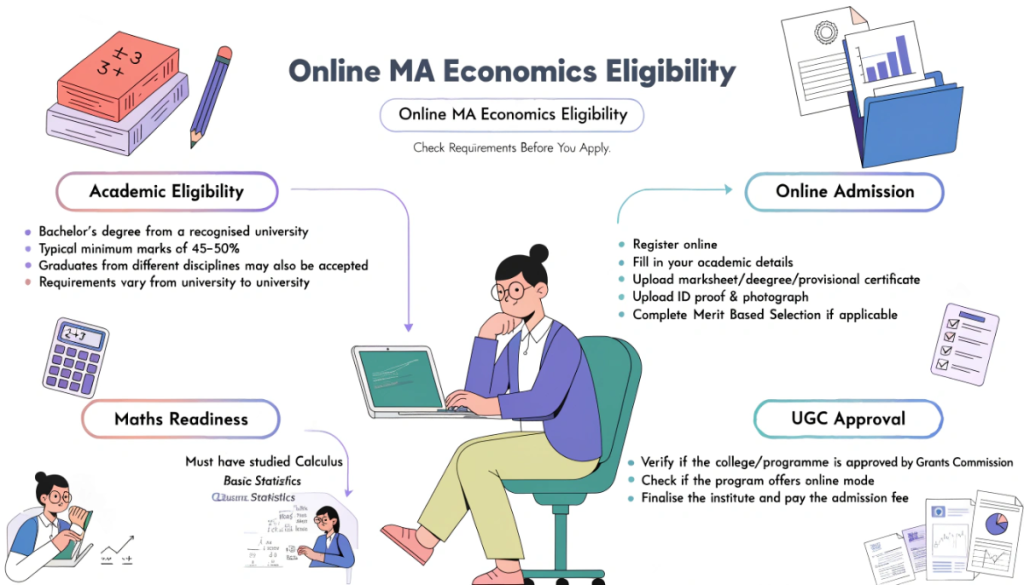
- A bachelor’s degree from a recognised university is the main requirement. Many programs accept graduates from any discipline.
- Some programs ask for economics or mathematics or statistics at the graduation level, so read the notice for your chosen program carefully.
- Minimum marks usually fall between 45 and 50 percent in graduation, with some relaxation for reserved categories.
Maths Readiness
- Economics at the master’s level uses calculus and basic statistics, which means students from non maths backgrounds should revise these topics before the course begins.
- Some programs offer a short bridge or orientation module for new learners, so ask about it if you studied arts or commerce.
Admission Process
- Admission is done online through an application where you register and enter your academic details and upload documents.
- Most online programs select on merit without an entrance exam, so your graduation marks and document checks decide the outcome.
- Documents normally include graduation marksheets and a degree or provisional certificate and identity proof and a photograph.
Approval to Confirm
Before you pay any fee confirm that the program is approved by UGC for the online mode. That approval makes the degree equal to a regular one for jobs and further study. It also matters if you plan to sit for the national eligibility test for teaching or apply for government jobs later.
Online MA Economics Syllabus and Skills
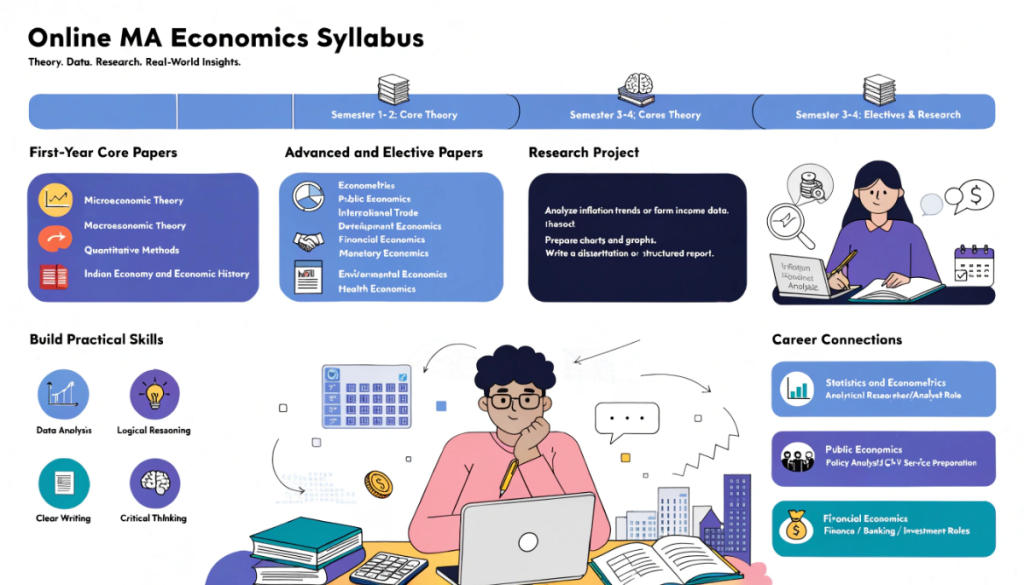
The syllabus runs over four semesters. The first year covers core theory. The second year adds electives and a research project.
Core Papers in the First Year
- Microeconomic theory teaches consumer and producer behaviour and market structures, which forms the base for everything that follows.
- Macroeconomic theory covers income and employment and inflation and growth, so you can explain how an economy moves over time.
- Quantitative methods and statistics give you the tools to analyse data, since almost every economics job uses them.
- Indian economy and economic history papers connect theory to real events, which helps in policy and civil services preparation.
Advanced and Elective Papers
- Econometrics teaches how to test economic ideas with data. It is one of the most valuable skills in the degree.
- Public economics and international trade and development economics let you study taxation and global markets and poverty.
- Financial economics and monetary economics focus on banks and interest rates and markets, which suits students aiming for finance roles.
- Environmental or health economics electives may be available, so check which topics your program offers.
How the Syllabus Connects to Jobs
- Econometrics and statistics papers lead directly to analyst and research roles, which means these subjects deserve the most practice time.
- Public economics and development papers support policy and civil services preparation, so choose electives that match your goal.
Research Project
Most programs end with a dissertation or project. You choose a topic and collect data and write a structured report. Treat it as a portfolio piece. A good project on a real question such as inflation or farm income shows employers and admission committees that you can do independent analysis.
Skills You Build
- Data analysis in a spreadsheet or a statistics tool, which makes you useful in analyst roles.
- Logical argument and clear writing, since economists must explain complex results simply.
- Critical thinking about policy, which helps in research and consulting and civil service roles.
Career Options After an Online MA Economics
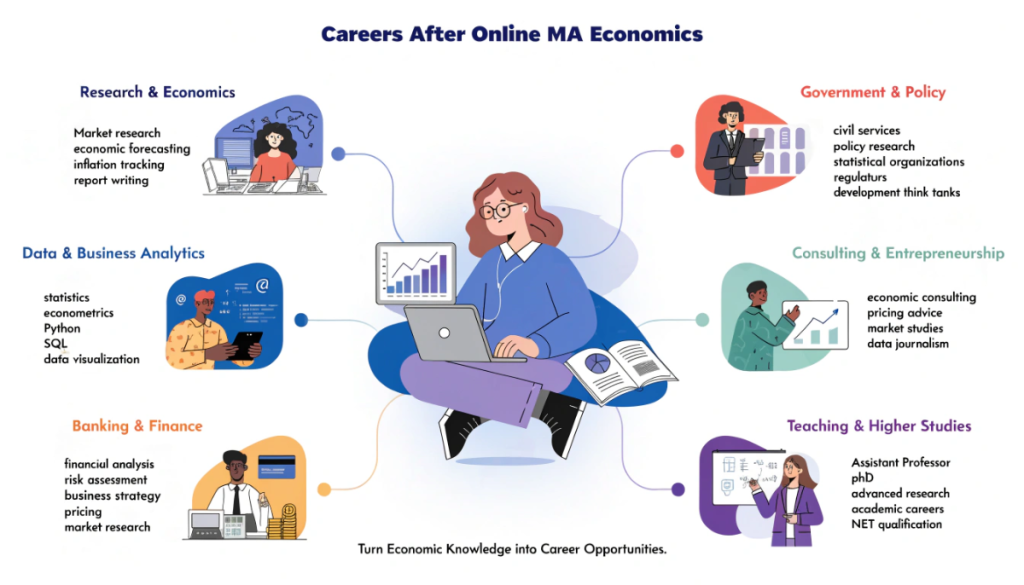
An online MA Economics opens paths in finance and research and government and teaching. The right path depends on your skills and interests.
Economist and Research Analyst
- Research analysts study markets and sectors and write reports for companies and consultancies, which means writing and data skills matter most.
- Economists at banks and rating agencies track inflation and growth and advise on risk, so these roles pay well but are competitive.
Data and Business Analytics
- Data analyst and business analyst roles use the statistics and econometrics you learn, so the degree gives a solid base.
- Adding Python or SQL and a visualisation tool makes you much more employable in this field.
Banking, Finance and Consulting
- Banks and insurance companies and financial firms hire economics graduates for analysis and risk and strategy roles.
- Consulting firms value the structured thinking of economists, especially for pricing and market entry projects.
Government and Policy Work
- Civil services and state exams are open to postgraduates. Economics is a common optional subject, which gives you a head start.
- Planning bodies and statistical organisations and regulators hire economists for policy and data work.
- Think tanks and development organisations recruit research associates to study issues like poverty and education.
Entrepreneurship and Independent Work
- Economists can work as independent consultants who help small businesses with pricing and market studies, which means you build a client base over time.
- Writing and data journalism also welcome economics graduates who can explain numbers clearly to a general audience.
Teaching and Higher Study
- Graduates who clear the national eligibility test can apply for assistant professor posts, which suits those who enjoy explaining ideas.
- A PhD opens research and senior academic roles. An online MA Economics can be a stepping stone if your marks and research project are strong.
Benefits, Limits and Salary of an Online MA Economics
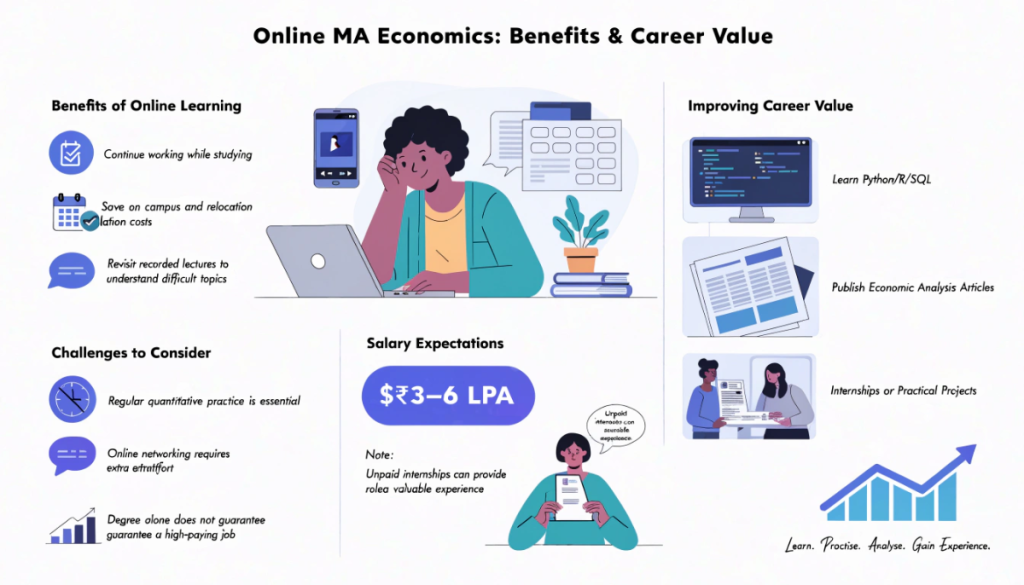
Like any degree an online MA Economics has clear strengths and some limits. Looking at both helps you set realistic expectations.
Main Benefits of an Online MA Economics
- You can keep working while you study, which means you avoid an income gap and can apply new skills at your job.
- The cost is generally lower than a full time campus program, so you save on fees and relocation.
- Recorded sessions help with hard topics such as game theory and econometrics, since you can replay them as many times as needed.
Limits to Keep in Mind
- Economics is quantitative so you need regular practice with problems. Passive watching of lectures is not enough.
- Networking takes more effort online, so join forums and study groups to meet peers and mentors.
- The degree alone does not guarantee a high paying job, since employers look for data skills and projects as well.
Salary Expectations
Pay depends on role and employer and city more than on the degree name. Career sites generally show entry level pay for economics postgraduates in the range of about 3 to 6 LPA. Analyst roles in banks and consulting firms can start higher and experienced economists can earn much more. These are rough figures so check current job listings before you plan around any number.
How to Raise Your Value
- Learn Python or R and SQL alongside the course, because data skills are the biggest salary booster for economists.
- Publish a short analysis or blog on a current economic topic, which gives employers a sample of your thinking.
- Complete an internship or a small project with a research firm or a bank, so you graduate with real experience.
How to Choose and Prepare for an Online MA Economics
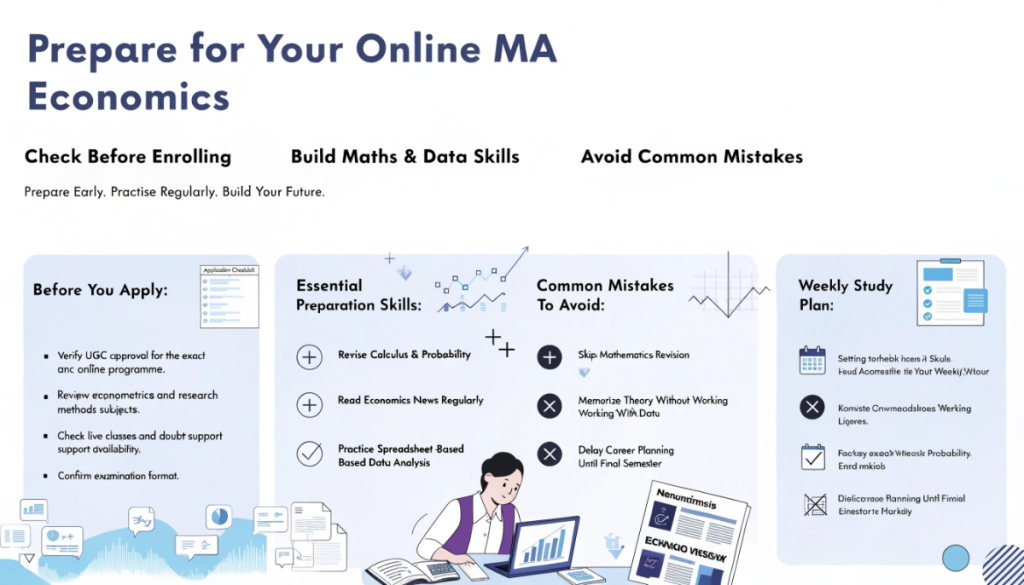
A little planning before you enrol makes the course far more useful. Check the program details and build your maths and data skills early.
Checklist Before You Apply
- Confirm UGC approval for the online mode and for the exact program, since recognition affects jobs and further study.
- Read the syllabus for econometrics and research methods, because these papers give the most career value.
- Ask about live sessions and doubt support, which tells you how much real interaction you can expect.
- Check whether the exams are proctored online or held at a centre, so you can plan your time.
Skills to Start Before Your Online MA Economics Begins
- Revise calculus and basic probability, since you will use them from the first semester.
- Read a good economics newspaper section regularly, which builds your sense of real world applications.
- Practise a spreadsheet tool for data work, because every project begins with cleaning and exploring data.
Mistakes to Avoid
- Skipping the maths revision, which means the first semester will feel much harder than it needs to.
- Memorising theory without applying it to data, since employers want people who can analyse real numbers.
- Waiting until the last semester to think about careers, because internships and exam preparation need months of lead time.
A Simple Study Plan
Set fixed weekly hours for study and treat them like work meetings. Solve problems after every lecture while the idea is fresh. Join one study group and one online community for discussion. Build one data project each semester and keep the code and the report in a public folder. Small steady effort works better than last minute cramming.
Conclusion
An online MA Economics is a strong choice for graduates who enjoy numbers and ideas and want a career in analysis or policy or finance. The eligibility is open to most graduates and the format fits around work. What decides your outcome is how well you build data skills and apply theory to real problems. Check the approval and the syllabus of your online MA Economics before you enrol and ask what support you get for projects. Then study steadily and build projects as you go. That approach turns a flexible degree into a solid career step.

Book Your
Free Session
Connect with our experts and get personalised guidance for your career, course selection, and future goals.
Sources & References
✓ Verified 2026Explore these official resources for information about online MA Economics, higher education recognition, economic theory, Indian economic data, research methods, career exploration and analytical skills.
Note: Eligibility criteria, syllabus, programme duration and admission requirements vary by university. Always check the official programme page and current UGC-DEB recognition before enrolling. Salary figures mentioned in this article are indicative estimates, not guaranteed packages, and may vary by role, employer, location, experience and analytical skills.