

If you are choosing between two commerce degrees after Class 12 then the salary question will come up sooner or later. BBA vs BCom salary is one of the most searched comparisons because both degrees run for three years and cost very different amounts. The short answer is that BBA usually starts slightly higher while BCom can catch up or move ahead with professional courses like CA. This blog breaks down fresher pay and growth by experience and role. It also explains what really decides your income and how to pick the right degree.
BBA vs BCom Salary at a Glance
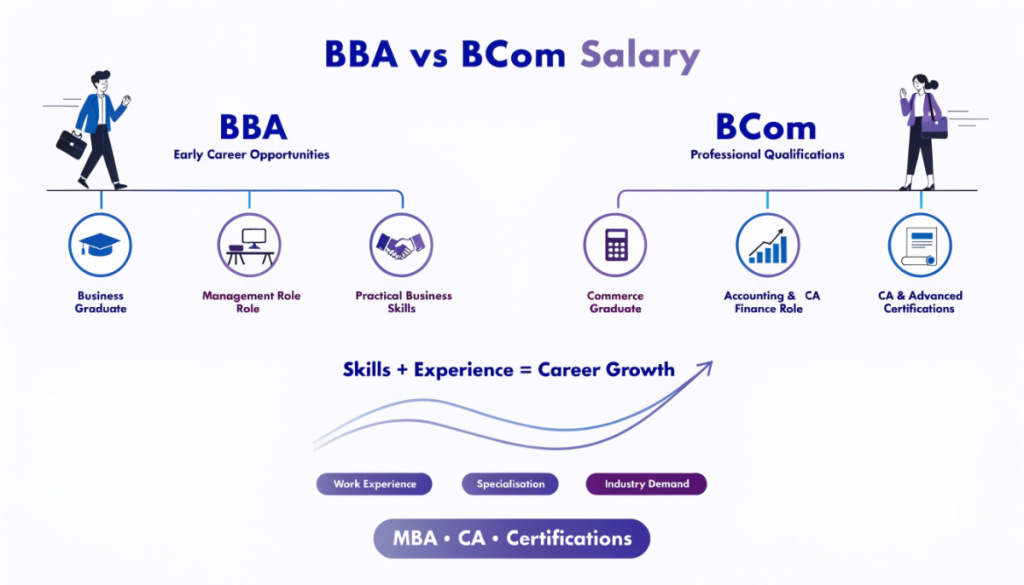
For most freshers the BBA vs BCom salary gap is small. Salary platforms and career sites generally put BBA starting pay a little above BCom, but the ranges overlap a lot. A good BCom graduate can easily out earn an average BBA graduate.
Typical Fresher Packages
- BBA freshers commonly start in the range of 2.5 to 5 LPA, which means monthly take home of roughly 20,000 to 40,000 rupees in most entry level corporate jobs.
- BCom freshers commonly start in the range of 2 to 4 LPA, with higher figures in finance and audit roles at larger firms.
- Graduates from well known colleges in big cities can cross these ranges, so the college and city change the numbers as much as the degree does.
Why Different Websites Show Different Numbers
You will see figures from 2.5 LPA to over 6 LPA on different sites. The reason is simple. Some report the average for all graduates while others quote only top college placements. Some include variable pay and bonuses and others show fixed pay. Treat every number as a rough guide and check recent job listings for the roles you want. Salary ranges also move every year with hiring demand so a figure from two years ago may already be out of date.
What the Gap Really Tells You
- BBA gets a small head start because many recruiters see it as a management oriented degree, which helps in sales and operations and business development roles.
- BCom gets steady demand in accounts and taxation and audit roles, so the starting pay is modest but the career path is clear.
- The gap shrinks quickly once experience and skills start to matter, which means the first job should not be the only thing you compare.
BBA vs BCom Salary by Experience
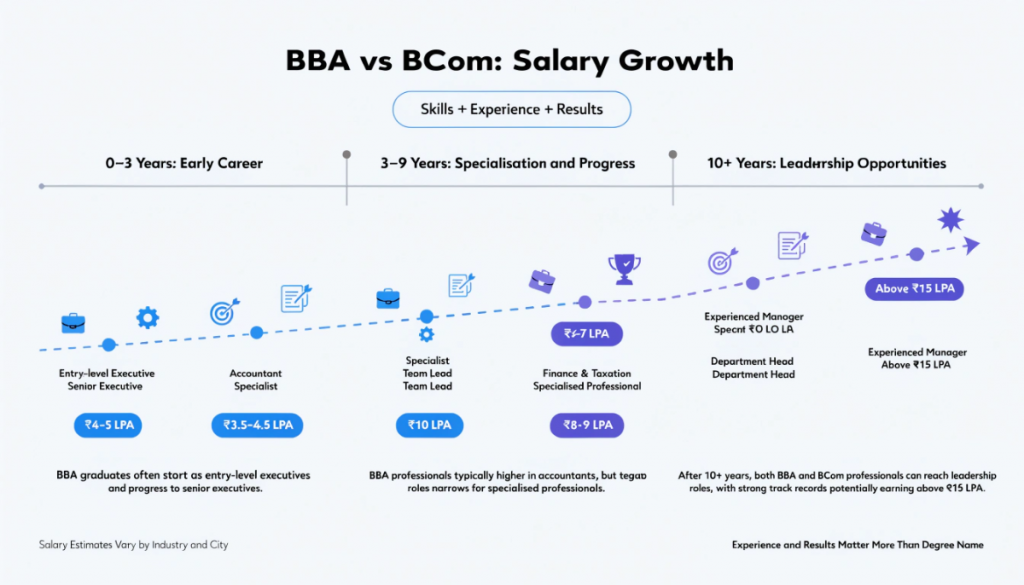
Starting pay is only the first chapter. Growth over the years matters more. Here the two degrees follow similar paths with different triggers for big jumps.
The First Three Years
- BBA graduates often move from entry roles to executive or senior executive posts within two or three years. Pay commonly rises to around 4 to 5 LPA.
- BCom graduates in accounts or finance support roles usually see steady but slightly lower increments in this phase, often around 3.5 to 4.5 LPA.
- Switching jobs after two years is common in both groups. It often brings a bigger jump than staying put.
Three to Nine Years of Experience
- Salary platform estimates for BBA professionals often reach roughly 6 to 7 LPA by the three to six year mark and about 10 LPA by year nine, since team lead and manager roles open up.
- BCom professionals tend to show somewhat lower averages in the same period but the gap narrows, particularly for those in finance and taxation.
- Specialisation matters here because a marketing or finance specialist is paid for results and not for the degree name.
Beyond Ten Years
At senior levels the degree name matters very little. Managers and heads of departments are paid for the business impact they create. Professionals from both backgrounds can reach well above 15 LPA with the right track record. These are estimates from salary survey sites and they change with city and industry so use them only as a direction.
BBA vs BCom Salary by Job Role
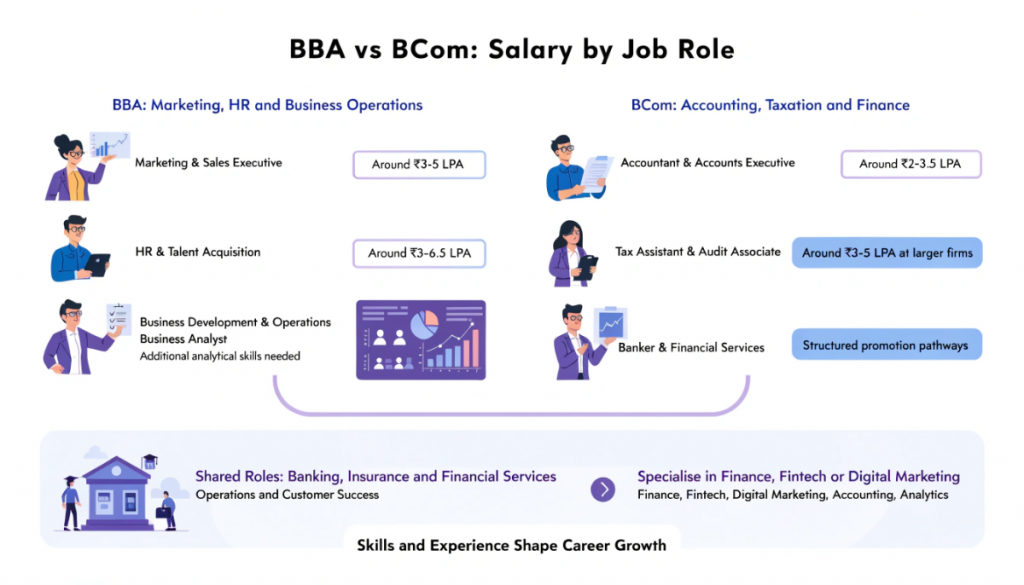
The kind of work you do shapes your salary more than the three letters on your degree. Looking at roles shows where each degree has a natural edge.
Common BBA Roles and Their Pay Direction
- Marketing executive and sales executive roles usually start around 3 to 5 LPA, with incentives that can raise total pay when targets are met.
- HR executive and talent acquisition roles often begin near 3 to 4.5 LPA. Pay rises with experience in recruitment or employee relations.
- Business development and operations roles commonly pay 3 to 6 LPA, which makes them popular first jobs for BBA graduates.
- Business analyst roles can pay much more, but they usually need data skills in addition to the degree.
Common BCom Roles and Their Pay Direction
- Accountant and accounts executive roles typically start around 2 to 3.5 LPA, with steady growth as you handle more of the books.
- Tax assistant and audit associate roles at larger firms can start higher, often around 3 to 5 LPA, since the work is detailed and compliance driven.
- Banking and financial services roles pay in a similar range and offer clear promotion steps, which suits people who like structured careers.
Roles Where Both Degrees Compete
- Banking and insurance and financial services jobs recruit both BBA and BCom graduates, so the pay is similar and the deciding factor is usually the interview.
- Operations and customer success roles in large companies also accept both degrees, which means skills and communication decide who gets the better offer.
Specialisation Effect
Finance and fintech and digital marketing specialisations tend to pay more than general tracks in both degrees. A BBA with a finance focus and a BCom with strong accounting and analytics skills can end up in very similar jobs with very similar pay. This is why choosing electives and building skills matters so much.
What Decides Your Salary More Than the Degree
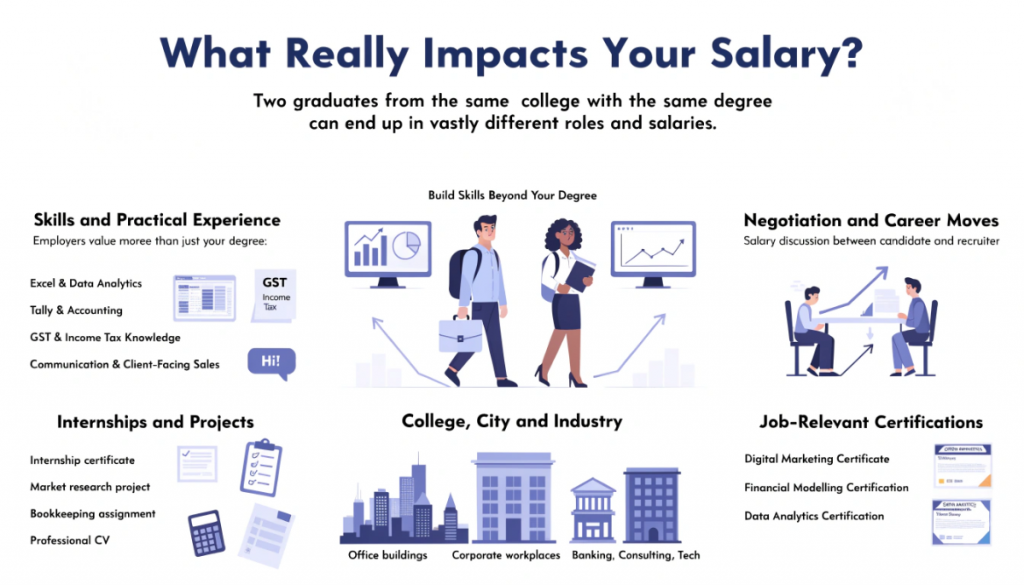
Two people with the same degree can earn very different amounts. Employers look at what you can do, so the following factors often explain the difference better than BBA vs BCom salary comparisons do.
Skills Employers Pay For
- Excel and data analysis skills make you useful in almost every office role, which means they can lift both BBA and BCom starting offers.
- Accounting software such as Tally and a working knowledge of GST and income tax are strong plus points for BCom graduates.
- Communication and sales skills help BBA graduates in client facing jobs, where pay often depends on performance.
Internships and Practical Experience
- A few months of real internship experience gives you something concrete to talk about in interviews, which often matters more than marks.
- Projects such as a market survey or a small bookkeeping assignment show initiative, so they help you stand out among similar CVs.
College, City and Industry
- Metro cities and large companies usually pay more than smaller towns and small firms, though living costs are also higher.
- Industries like banking and consulting and technology services often pay above the average for commerce graduates.
- A recognised program and a good placement record help at the first job, but skills decide how fast you move after that.
Negotiation and Job Switching
- Knowing the market range for your role lets you negotiate calmly, which can add a meaningful amount to your first offer.
- Changing employers after building solid experience is often the fastest route to a pay jump, since internal raises are usually smaller.
Certifications That Add Value
Short courses in digital marketing or financial modelling or data analytics can raise your market value. They are cheaper and faster than a full degree and employers can see the skill directly. Pick certifications linked to the job you want and not to whatever is trending.
Salary After Further Study: MBA, CA and Other Routes
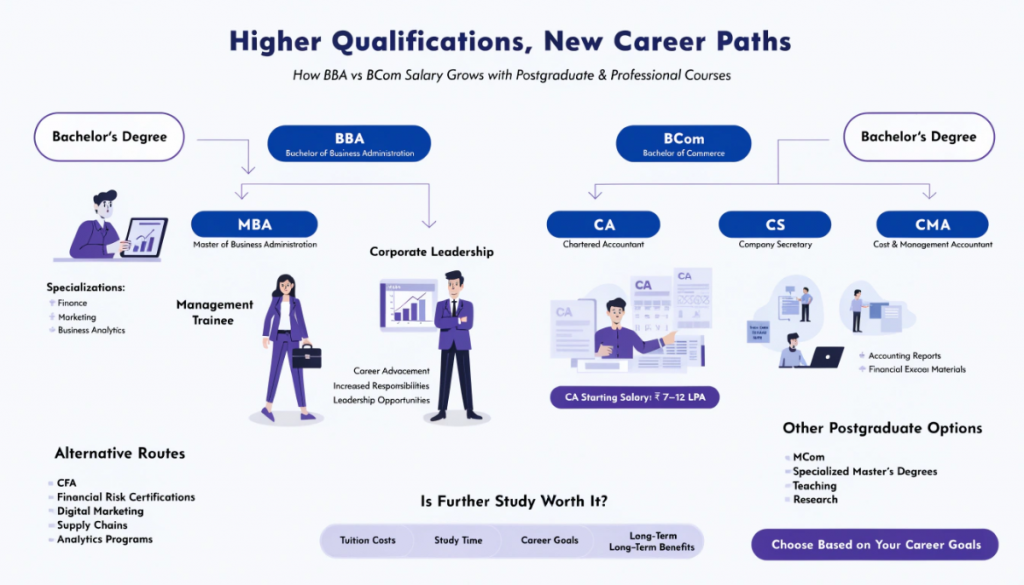
Many people treat the bachelor’s degree as a stepping stone. The biggest salary jumps in both streams usually come after a professional or postgraduate qualification.
BBA Followed by an MBA
- BBA is the most natural path into an MBA, since the subjects overlap and you already understand business basics, which helps in entrance exams and interviews.
- An MBA can move salaries into a much higher band, especially with a strong specialisation in finance or marketing or analytics.
- Many companies also hire MBA graduates directly into management trainee programmes, which speeds up the climb.
BCom Followed by CA, CS or CMA
- BCom pairs well with professional courses because the syllabus overlaps a lot, so you can prepare for exams while completing the degree.
- Newly qualified chartered accountants are often reported to start at around 7 to 12 LPA, which is well above most plain graduate offers.
- These courses are tough and take years, so the higher pay reflects the effort and the pass rate.
Is the Extra Study Worth It
Further study costs money and time so treat it as an investment. If you already have a clear target role then a focused course usually pays back faster than a general one. If you are still unsure then work for a year or two first. Real experience helps you pick the right specialisation and makes MBA interviews easier.
Other Useful Routes
BCom graduates can also take up CFA or financial risk certifications while BBA graduates can try digital marketing or supply chain or analytics programs. Some move into an MCom or a specialised master’s degree to teach or work in research. The right route depends on whether you prefer numbers or people and strategy.
Choosing Between BBA and BCom and Eligibility for Online Programs
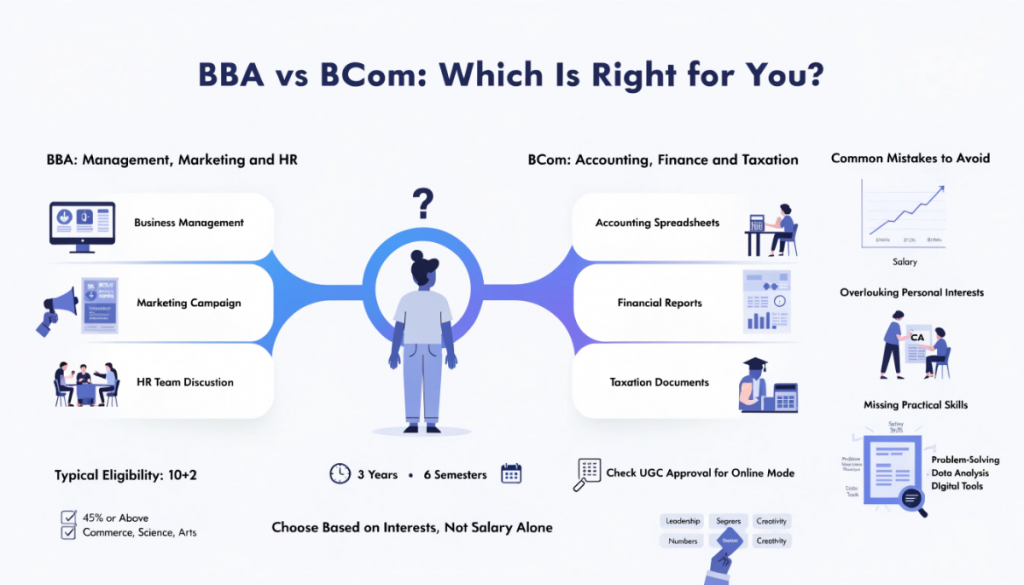
Because the BBA vs BCom salary difference is small at the start, the smarter question is which degree fits the work you want to do. Choose based on your interests and your long term plan.
Pick the Degree That Fits Your Goal
- Choose BBA if you want to move into management and marketing and HR and general business roles, or if an MBA is part of your plan.
- Choose BCom if you enjoy accounting and finance and taxation, or if you plan to attempt CA or similar professional exams.
- If you are unsure then look at the subjects in the first two semesters of each program, since they show which one holds your interest.
Eligibility for Online BBA and BCom Programs
Online undergraduate programs in business and commerce keep entry requirements simple. A candidate usually needs to have passed 10+2 from a recognised board in any stream with around 40 percent marks in the qualifying exam. Candidates from reserved categories often get a relaxation on this percentage. International applicants are generally expected to have around 60 percent marks. Admission is mostly merit based so there is no entrance exam in most cases. Both programs run for three years across six semesters. Always check that the program is approved by UGC for the online mode so that the degree is valid for jobs and higher studies.
Mistakes to Avoid While Deciding
- Choosing only on the basis of a salary figure from a website, since those numbers mix top college data with averages and can mislead you.
- Ignoring your own strengths, because people who enjoy their subject usually learn faster and earn more over time.
- Skipping skill building, which means waiting for the degree to do all the work when employers want proof of ability.
Conclusion
BBA vs BCom salary comes down to a small early gap in favour of BBA and a path in BCom that can overtake it with professional qualifications. After the first few years your skills and experience matter far more than the degree name. Pick the program that matches the work you want to do and start building practical skills from the first semester. Add an MBA or CA or a strong certification when the time is right. That combination does more for your pay than the choice between the two degrees ever will.
📖 Sources & References
✓ Verified 2026Explore salary estimates, career paths, professional qualification outcomes and official guidance on online BBA and B.Com programmes. Salary figures vary by role, location, experience and employer.
- BBA Careers and Salaries: Indeed India’s guide to career options after BBA, including roles, responsibilities and salary estimates.
- B.Com Career Options: Indeed India’s overview of careers in accounting, taxation, finance and other fields after B.Com.
- BBA Salary Estimates: Careers360’s BBA salary overview, with estimates and factors that influence earnings.
- Accountant Salary in India: Indeed’s salary data for accountant roles, useful for understanding pay in accounting-related careers.
- Marketing Executive Salary: Indeed’s salary estimates for marketing executive roles in India.
- CA Campus Placement Data: The Institute of Chartered Accountants of India’s campus placement information for newly qualified chartered accountants.
- UGC Online Programme List: Check the university, programme, mode and academic session listed by the UGC Distance Education Bureau.
- UGC-DEB Student Guidance: Official guidance on online and distance education recognition and the checks students should make before enrolling.
- Online BBA Programme: Shoolini Online’s BBA programme page for programme details and the university’s published eligibility requirements.
- Online B.Com Programme: Shoolini Online’s B.Com Honours page for programme details and the university’s published eligibility requirements.

Book Your
Free Session
Connect with our experts and get personalised guidance for your career, course selection, and future goals.