

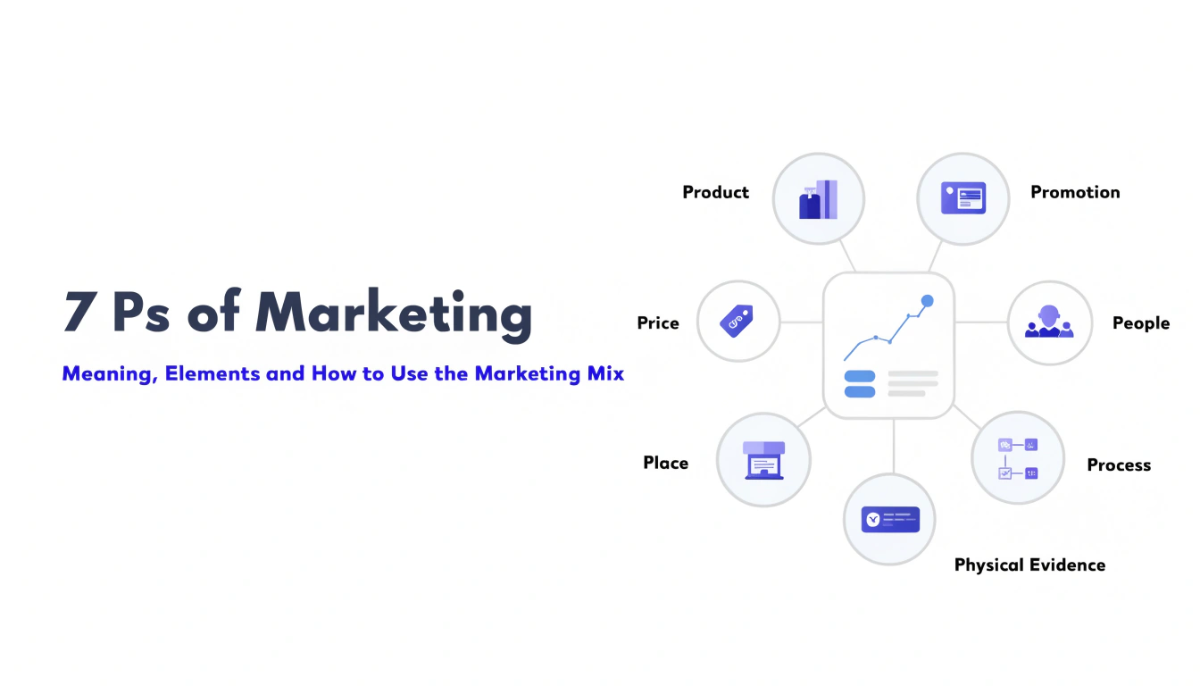
Every marketing plan answers the same basic questions. What are we selling and at what price and where and how do we tell people about it. The 7 Ps of marketing take those questions and add three more that matter a lot for service businesses. Together they give marketers a simple checklist to plan a product launch or fix a weak campaign. This blog explains each of the seven elements and how they fit together. It also covers how to use them in a real plan and how to learn them as a career skill.
What the 7 Ps of Marketing Actually Mean
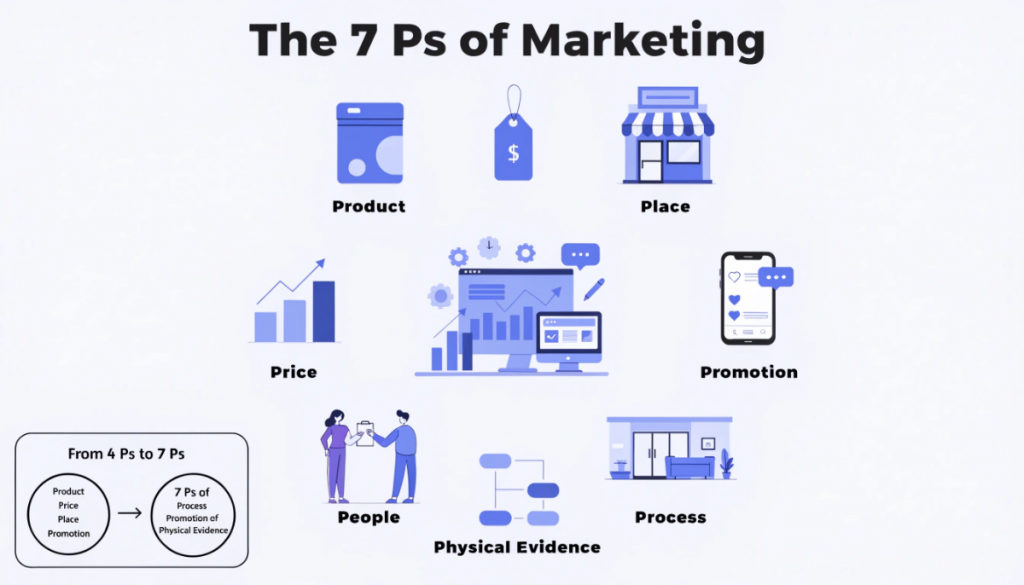
The 7 Ps of marketing are Product and Price and Place and Promotion and People and Process and Physical Evidence. Together they form the extended marketing mix, a set of seven levers that a business controls to attract customers and keep them.
Where the Model Comes From
- The original four Ps of Product and Price and Place and Promotion were popularised by Jerome McCarthy in 1960, which gave marketers a simple way to organise their decisions.
- Bernard Booms and Mary Bitner added People and Process and Physical Evidence in 1981, since services need more than the four basic levers to be marketed well.
- The extended model is now used for goods and services alike, which means a software company and a restaurant can both plan with the same framework.
Why Seven and Not Four
The first four Ps work well for physical goods that sit on a shelf. A service is different because the customer experiences it live and cannot touch it before buying. The added three Ps cover the staff and the delivery steps and the visible cues that shape that experience.
When the Model Is Most Useful
- Launching a new product or service, because the seven elements force you to plan the full customer journey before spending money.
- Repositioning an existing brand, since a gap in one element often explains why sales have stalled.
- Reviewing a weak campaign, which means you can check each P in turn to find where the plan is breaking down.
The Core Four Ps: Product, Price, Place and Promotion
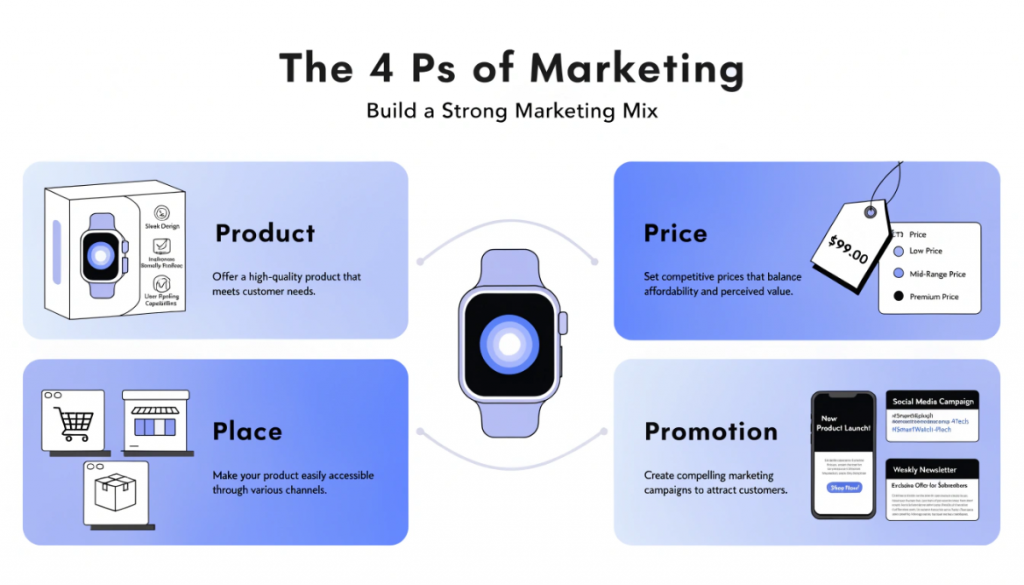
These four elements come from the original marketing mix and they still form the base of every plan. Get these wrong and no amount of extra effort on the other three will rescue the offer.
Product
- Product covers what you sell including its design and features and quality and packaging, which means it answers whether the offer solves a real problem for a real customer.
- Branding and warranty and after sales support also sit here, since customers judge the whole package and not only the item.
- A good product decision starts with customer needs, so research should come before design.
Price
- Price is the amount customers pay and it includes discounts and payment terms and credit options, which means it shapes both demand and the way people see your brand.
- Common approaches include cost plus pricing and competitor based pricing and value based pricing, so the right choice depends on how much customers value your offer.
- A price that is too low can signal poor quality while a price that is too high can push buyers to rivals, which is why testing matters.
Place
- Place refers to where and how customers can buy, including stores and websites and marketplaces and distributors, which means it decides how easy it is to say yes.
- Inventory and delivery speed belong here too, since a product that is out of stock cannot make a sale however good the advertising is.
- Many brands now mix online and offline channels, so the goal is to be available wherever the target customer already looks.
Promotion
- Promotion covers advertising and public relations and social media and email and sales offers, which means it is how you tell people your offer exists and why it matters.
- The message should match the audience and the channel, so a video ad for young buyers and a detailed brochure for business buyers can both be right.
- Measure results by channel, because promotion budgets are easy to waste when nobody checks what is working.
The Service Three Ps: People, Process and Physical Evidence
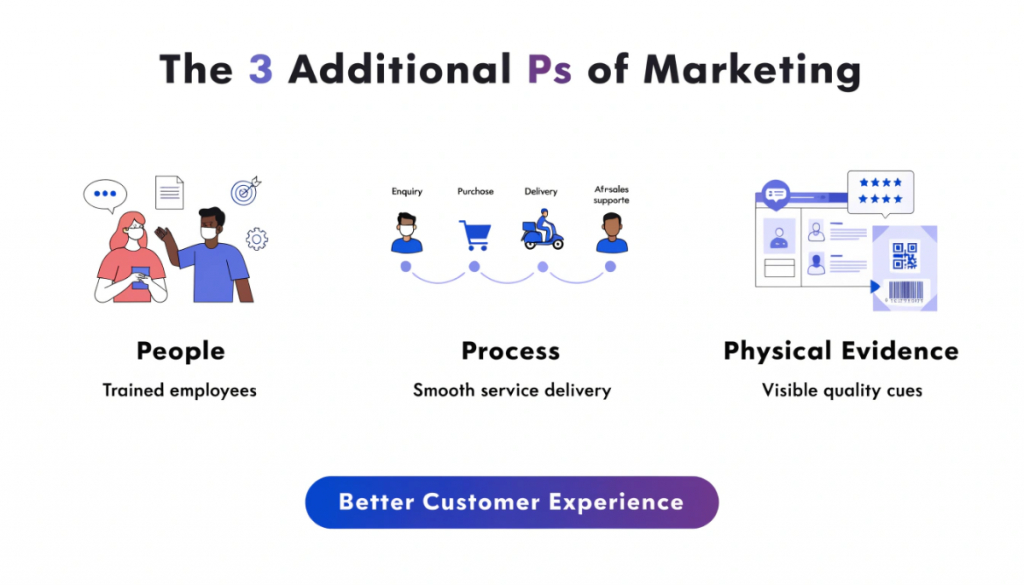
These three elements were added because services depend on how they are delivered. They are just as useful for product businesses that care about customer experience.
People
- People means everyone who deals with the customer including sales staff and support teams and delivery partners, so their behaviour becomes part of the product.
- Hiring and training decide service quality, which means a friendly and well informed team can win customers even when prices are higher.
- Internal culture matters too since unhappy staff rarely deliver a good customer experience for long.
Process
- Process is the set of steps a customer goes through from enquiry to purchase to support, so smooth steps mean fewer complaints and faster sales.
- Booking and billing and delivery and returns should be simple and consistent, since every extra step is a chance for the customer to give up.
- Mapping the journey step by step helps find delays, which means small fixes can lift satisfaction without extra spending.
Physical Evidence
- Physical evidence is everything the customer can see or touch that proves the quality of the offer, such as the store layout and website design and packaging and uniforms.
- For online businesses it includes reviews and ratings and clear policies, which means these act as proof when the customer cannot inspect the item.
- Consistent visual identity builds trust, so logos and colours and tone should look the same on every channel.
How the 7 Ps of Marketing Work Together
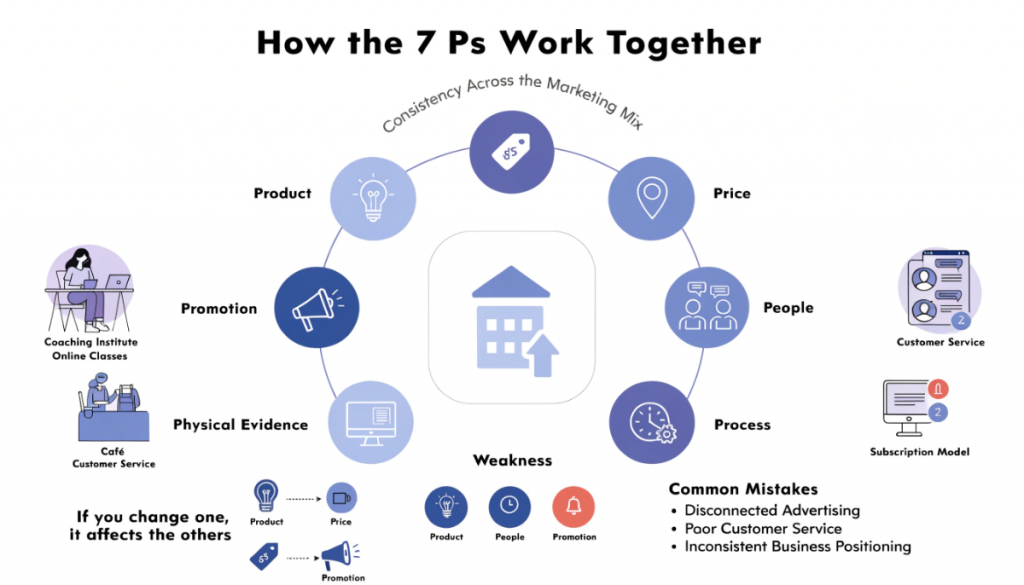
The seven elements are not a list to tick off one by one. They influence each other all the time. A change in one P usually forces a change in another, so the mix has to be planned as a whole.
Keeping the Mix Consistent
- A premium product needs a premium price and a premium place and a matching message, which means a luxury item sold on a discount stall confuses buyers.
- A low cost offer needs a lean process and simple promotion, since expensive service steps would break the pricing logic.
Examples Across Industries
- A coaching institute uses a clear course as the product and fixed fees as the price and online classes as the place and social media as promotion. Its teachers are the people and its enrolment steps are the process and its results page is the physical evidence.
- A cafe sells coffee and food as the product and sets prices that match its neighbourhood. Its location is the place and offers are the promotion. Baristas are the people and the order flow is the process and the interior is the physical evidence.
- A mobile app business treats the app as the product and a subscription as the price and the app store as the place. It promotes through ads and referrals and relies on support staff and onboarding steps and in app design to complete the mix.
Which P Matters Most
There is no single winner. Price gets the most attention because customers notice it first but a fair price cannot fix a weak product or a poor service experience. The element that matters most is usually the one where your business is weakest compared with competitors, so the audit should decide where you spend time.
Common Mistakes to Avoid
- Spending most of the budget on promotion while ignoring the product, which means ads bring people in and a weak offer sends them away.
- Ignoring people and process in a service business, since slow replies and unclear steps lose customers who liked the offer.
- Copying a competitor’s mix without checking the audience, because what works for one brand can fail for another.
Using the 7 Ps of Marketing to Build a Plan
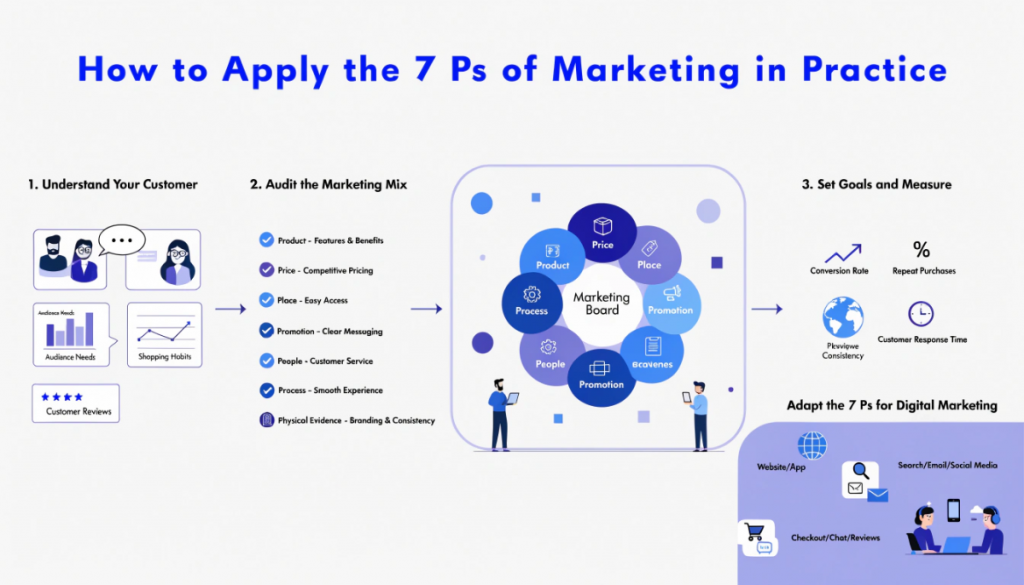
The 7 Ps of marketing are most useful when they are turned into a working plan. A simple sequence keeps the process practical and stops it from becoming a classroom exercise.
Start With the Customer
- Define the target audience by age and income and needs and habits, since every P should be shaped around this person.
- Talk to a few real customers or read reviews, which gives you the words and concerns that should appear in your message.
Audit Each P in Turn
- Ask whether the product solves the problem better than alternatives, which means you find weaknesses before customers do.
- Check whether the price matches the value and whether the channels reach the right people, since these two often explain weak sales.
- Review the promotion message and the staff behaviour and the customer steps and the visible proof, so no element is left to chance.
Set Goals and Measure
- Attach a number to each P such as conversion rate for promotion and repeat purchase for product and response time for people, which means you can see progress clearly.
- Review the mix every quarter because customers and competitors change, so a plan that worked last year may now be out of date.
Adapt for Digital Marketing
The same seven elements apply online. Product becomes the app or digital service. Place becomes the website and marketplaces and social platforms. Promotion includes search and email and content and ads. People includes support chat and community managers while process covers checkout and onboarding. Physical evidence shows up as reviews and site design and secure payment badges.
Learning the 7 Ps of Marketing as a Career Skill
Marketing roles in almost every industry expect you to understand the marketing mix. It appears in interviews and case studies and in daily planning work, so learning it well gives you a clear advantage.
Eligibility for a Management Program That Teaches It
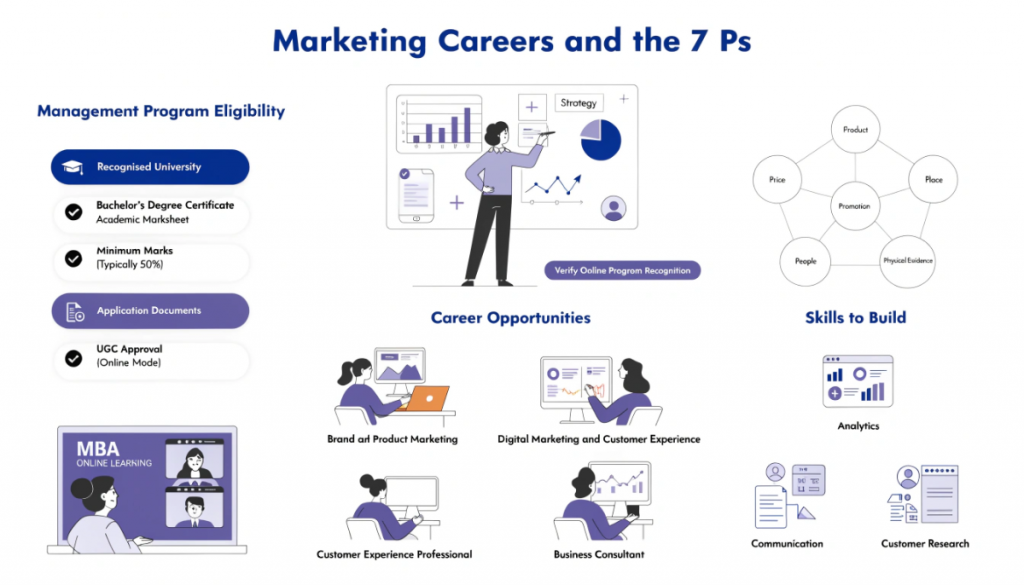
The 7 Ps of marketing are a core topic in online MBA programs with a marketing focus and in many undergraduate business programs. For an online MBA a candidate usually needs a bachelor’s degree of at least three years from a recognised university with around 50 percent marks. Reserved category candidates often get a relaxation on the percentage. Admission is mostly merit based so there is no entrance exam in most cases. Applicants submit marksheets and a degree certificate and identity proof. Always confirm that the program is UGC approved for the online mode before applying.
Roles Where the Framework Is Used Daily
- Brand manager and product marketing manager roles use all seven elements to plan launches, which means the model is part of the daily job.
- Digital marketing executive and content strategist roles apply promotion and place decisions across channels, so a clear grasp of the mix helps them choose priorities.
- Customer experience and service operations roles focus on people and process and physical evidence, which makes the service Ps especially relevant.
- Business owners and consultants use the mix as a quick diagnostic tool, since it helps them spot weak areas in a few minutes.
Skills to Build Alongside the Framework
- Basic analytics to read campaign and sales data, because every P should be judged with numbers and not opinion.
- Clear writing and presentation skills, which help you explain a marketing plan to managers who control the budget.
- Customer research methods such as surveys and interviews, since good decisions on all seven Ps start with real insight.
Conclusion
The 7 Ps of marketing give you a simple way to look at a business from every angle that affects a customer. Product and price and place and promotion set the offer. People and process and physical evidence shape the experience. When all seven point in the same direction the plan feels clear to the buyer. When one is weak it shows quickly in the results. Use the seven elements as a regular checklist and review them often. That habit is worth building whether you run a business or plan a marketing career.
📖 Sources & References
✓ Verified 2026Relevant marketing and academic resources covering the 7 Ps of marketing, the traditional marketing mix, service marketing, customer experience, pricing, distribution, promotion, marketing analytics and management education.
- American Marketing Association – The Four Ps of Marketing Explains product, price, place and promotion, including how these elements guide marketing strategy, customer targeting and business decisions.
- HubSpot – The 7 Ps of Marketing Practical explanation of the original four Ps and the additional elements of people, process and physical evidence in the extended marketing mix.
- ScienceDirect – Research on the 7 Ps of Service Marketing Peer-reviewed study examining the seven service marketing mix elements and their relationship with customer responses in the Indian banking context.
- HubSpot – Marketing Mix Strategy Practical guidance on organising product, pricing, distribution and promotion decisions into a coordinated marketing plan.
- HubSpot – Marketing Frameworks Introduces the 7 Ps marketing mix and explains how marketing frameworks support planning, reviewing business strategy and identifying gaps.
- Think with Google – Data Analysis Strategy Explains how marketers can interpret customer data and combine insights across channels to improve decisions and measure marketing performance.
- Think with Google – Marketing Research and Consumer Insights Research, consumer insights and marketing examples that help businesses understand audiences, assess customer behaviour and plan relevant campaigns.
- HubSpot – Customer Experience and Marketing Discusses how customer experience, brand promises, customer journeys and interactions across touchpoints connect with marketing strategy.
- UGC Distance Education Bureau – Student FAQs Official guidance for checking online programme recognition and understanding the precautions students should take before enrolling in an online degree.
- Shoolini Online – MBA in Marketing Management Official programme information relevant to marketing management education, digital marketing, brand management, consumer behaviour and marketing analytics.