

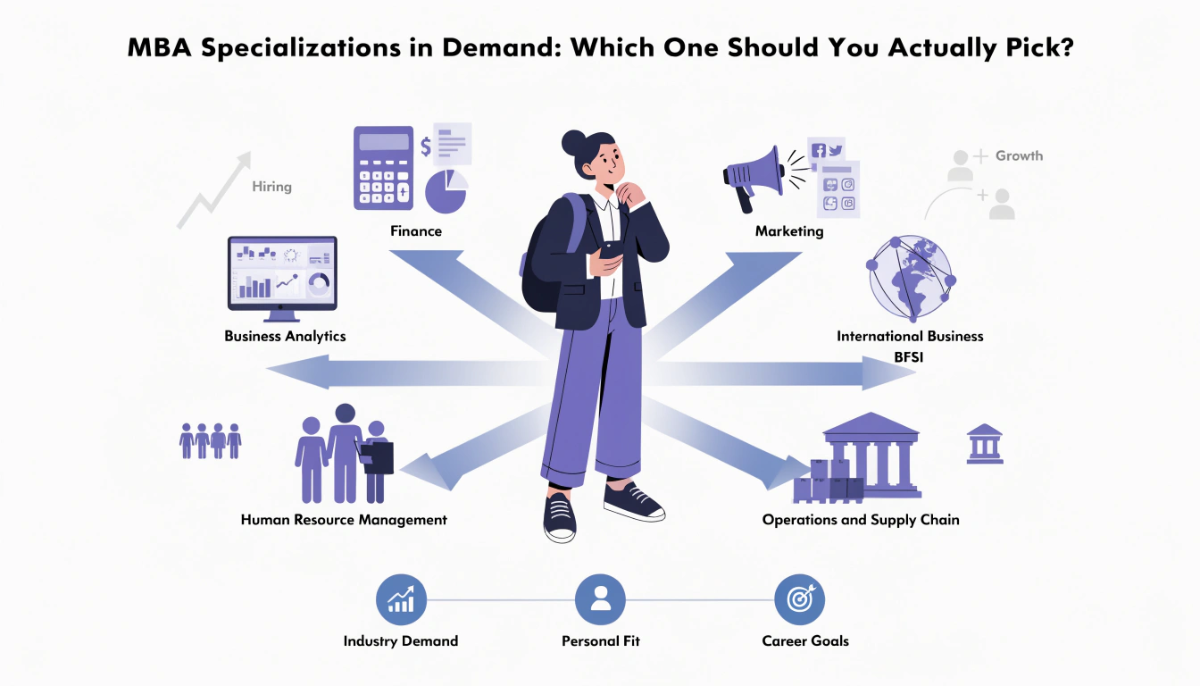
Picking an MBA is only half the decision, the real question is which specialization you choose because that is what shapes your career from here. Every year thousands of students enroll without giving much thought to this part and end up confused once placements start. Some specializations open doors across every industry while others stay useful only in specific sectors. If you are trying to figure out which MBA specializations are in demand right now, this blog breaks it down in a simple practical way. We will look at what recruiters are hiring for, what each specialization pays and how you can choose one that suits you instead of just following the crowd.
Why MBA Specializations in Demand Change Every Few Years
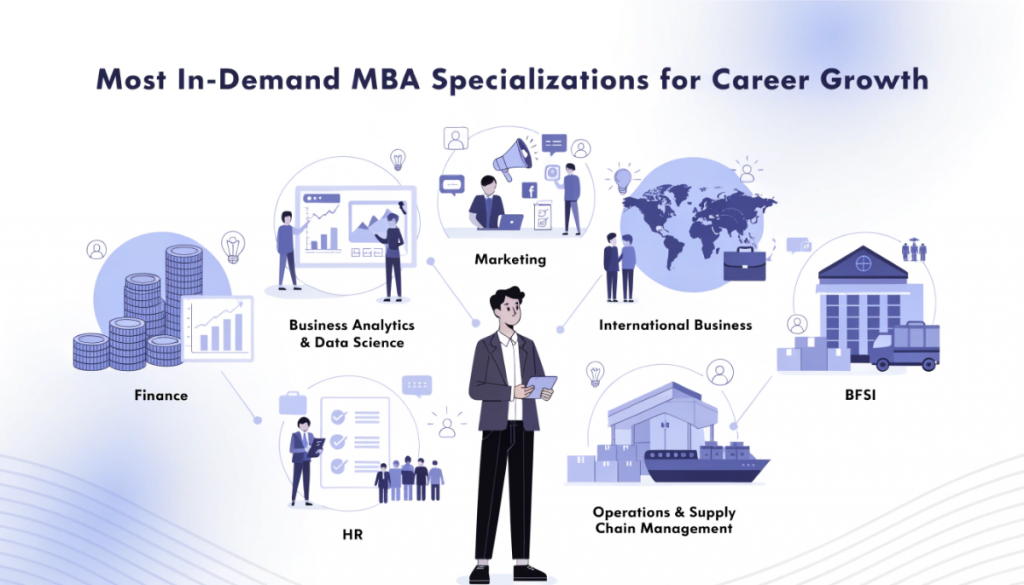
Demand for a specialization is not fixed, it moves with what industries need at that point in time. A decade ago finance and marketing were the only specializations most students considered. Today business analytics, BFSI and international business have joined that list because companies now hire for skills that did not even exist as job titles a few years back.
This is exactly why checking current demand before locking in a specialization matters so much. An MBA takes up two years of your life and a fair amount of money, so picking one purely because a friend picked it or because it sounds prestigious is not a smart move. The specialization decides your first job title, your starting salary and often the industry you stay in for the next several years.
Recruiters today are also more specific about what they are hiring for compared to a few years back. A generic MBA without a clear specialization sometimes struggles to stand out in interviews because it does not signal any particular strength. This is part of why picking a specialization with genuine demand behind it gives you a real edge over someone who just holds a general management degree.
MBA in Finance
Finance remains one of the most in demand MBA specializations and for good reason. It fits naturally with a commerce or economics background and gives you access to roles in corporate finance, investment banking and financial planning. Companies across every sector need people who can read balance sheets, manage budgets and take calls on where money should go next.
Students who specialize in finance usually start as financial analysts or credit analysts and move into corporate finance manager or investment banking associate roles within a few years. The specialization stays relevant regardless of which industry you eventually work in because every business needs someone managing its money. It also pairs naturally with a commerce background, which is why so many BCom and BBA graduates gravitate toward it during their MBA.
MBA in Business Analytics and Data Science
This is the specialization that has seen the fastest rise in demand over the last few years. Businesses today sit on huge amounts of data and need people who can turn that data into decisions instead of just reports. An MBA in business analytics teaches you statistics, data visualization and business strategy together so you are not just a number cruncher but someone who can also explain what the numbers mean to leadership.
Roles like business analyst, analytics manager and business intelligence analyst pay well right from the start and the demand for this specialization only keeps growing as more companies build their operations around data.
MBA in Marketing
Marketing continues to be a strong pick, especially now that digital channels have become the main way brands reach customers. This specialization suits students who understand consumer behaviour and enjoy building strategy around how a product or service gets positioned in the market.
Graduates move into roles such as brand manager, marketing manager and digital marketing manager. Since almost every company needs someone handling its brand and customer outreach, this specialization keeps you employable across industries ranging from FMCG to technology to healthcare.
MBA in Human Resource Management
HR as a specialization has become a lot more strategic than it used to be. It is no longer just about hiring and payroll, companies now expect HR managers to work on culture, retention and organizational planning as well. This makes it a stable specialization with consistent demand no matter which sector you look at.
Common roles after this specialization include HR manager, talent acquisition manager and learning and development manager. If you enjoy working with people more than spreadsheets, this is one of the more people focused specializations you can pick.
MBA in International Business
This specialization suits students who want to work with global trade, exports and multinational companies. It covers subjects like international trade law, global supply chains and cross border finance, preparing you for roles that involve managing operations across countries rather than just one market.
International business pairs well if you already have some background in economics or commerce since a lot of the concepts build on trade and taxation basics you may already know.
MBA in Banking, Financial Services and Insurance (BFSI)
Often shortened to BFSI, this specialization is built specifically for students who want to work in banks, insurance companies and financial institutions. It goes deeper into risk assessment, compliance and financial regulation compared to a general finance specialization.
Given how much the banking and insurance sector has grown in India, BFSI graduates are picked up quickly for roles in risk management, compliance and relationship banking. Salaries in this space also tend to be on the higher side once you cross a couple of years of experience.
MBA in Operations and Supply Chain Management
Every company that manufactures, stores or ships a product needs people managing its operations end to end and this is exactly what this specialization prepares you for. It covers logistics, procurement, inventory planning and vendor management.
Supply chain manager and operations manager roles have grown steadily in demand as e-commerce and manufacturing sectors have expanded. This specialization also tends to offer strong pay once you have a few years of hands on experience.
How to Pick the Specialization That Actually Fits You
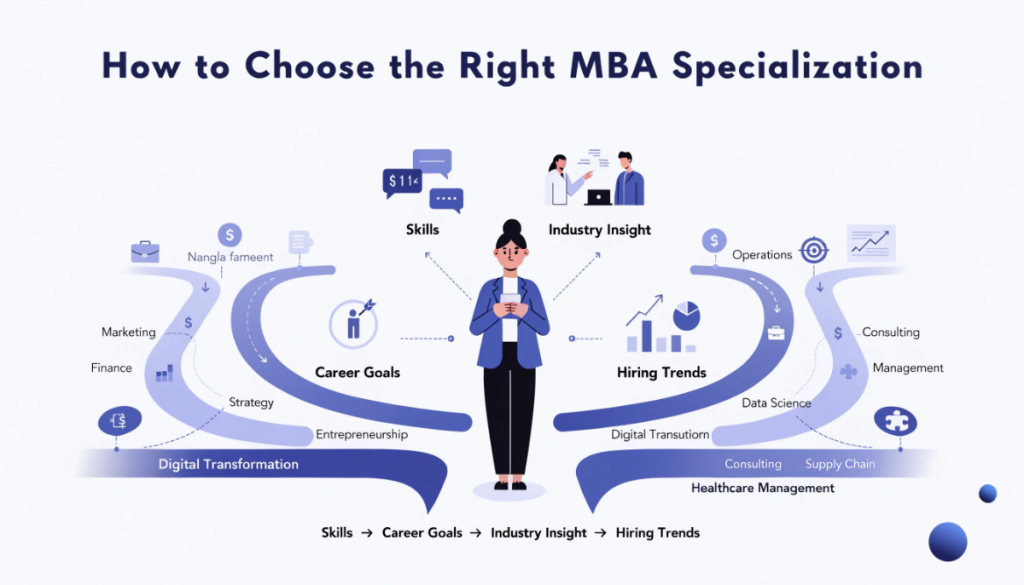
Demand alone should not decide your specialization, fit matters just as much. A specialization that pays well but does not match how you think or work will slow you down instead of helping you grow. Here is what actually helps when making this decision.
- Look at what you were naturally good at during your undergraduate years, whether it was numbers, communication or working with people.
- Check where you see yourself in the next five years and pick a specialization that leads there instead of one that just sounds good right now.
- Talk to people already working in that field to understand what the job actually looks like day to day, not just what the brochure says.
- Compare the specializations shortlisted against current hiring trends so you are not walking into a saturated space.
Full Time vs Online MBA When Choosing a Specialization

Once you have shortlisted a specialization, the next decision is usually the format. A full time MBA works well if you can dedicate two years completely to studies and want the campus network and placement support that comes with it.
An online MBA works better if you are already working and cannot afford a break from income. Most recognized programs let you pick the same specializations available in full time courses and study at your own pace through recorded and live sessions. The degree carries equal academic value as long as the university offering it is UGC approved. The flexibility also means you can apply what you learn at work right away instead of waiting for graduation.
Eligibility Criteria You Should Know Before Applying

Eligibility rules vary slightly between universities but most MBA programs in India, whether full time or online, follow a fairly similar pattern. Here is what you can typically expect.
- A bachelor’s degree of at least three years duration from a recognized university in any discipline.
- A minimum of 50% aggregate marks in your qualifying degree, usually relaxed to 45% for candidates from reserved categories.
- International students are generally asked for a slightly higher aggregate, often around 60% in their qualifying examination.
- Reservation of seats as per applicable government policy, which most recognized universities follow for both online and on campus programs.
Some universities accept a valid CAT, MAT, XAT, GMAT or CMAT score in place of their own internal admission test, so it helps to check the specific admission page of the program you are applying to before assuming you need to sit for a fresh exam.
Documents You Will Need
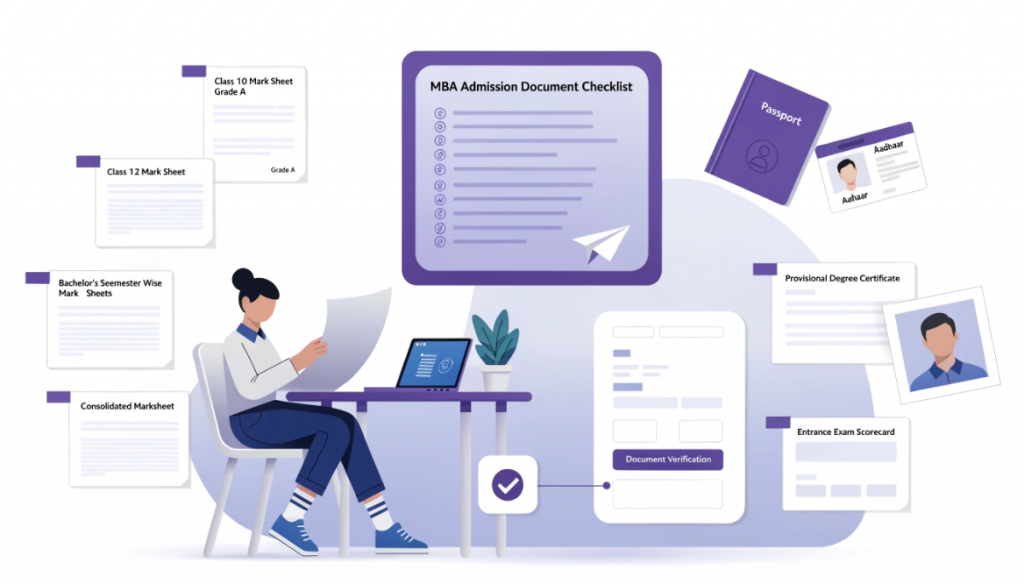
Once you clear the eligibility check, the application itself is mostly a documentation exercise. Keep these ready in advance so the process does not get delayed.
- Mark sheets of class 10 and class 12.
- Semester wise mark sheets of your bachelor’s degree along with the consolidated mark sheet or provisional degree certificate.
- Aadhaar card for Indian applicants or a valid passport for international applicants.
- Passport size photographs in the format specified by the university.
- Entrance exam scorecard if the program you picked requires one.
Common Mistakes Students Make While Choosing a Specialization
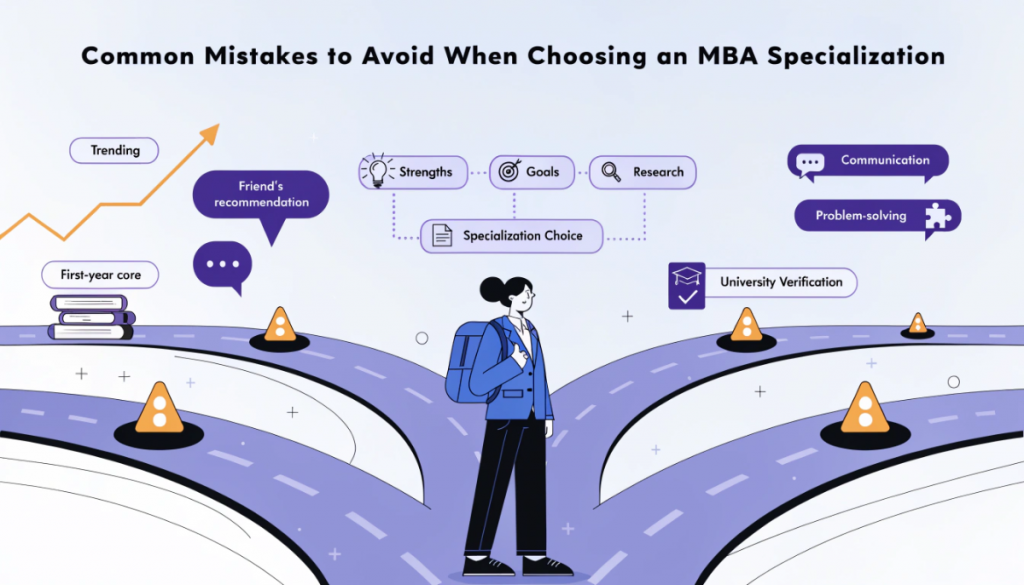
A lot of students end up picking the wrong specialization not because they lack information but because they rush this decision or let the wrong factors guide it. Knowing these mistakes in advance can save you from a choice you regret two years down the line.
- Picking a specialization purely because it is trending without checking if it matches your own strengths or interests.
- Ignoring the core subjects of the first year and assuming the specialization alone will decide the job you get.
- Choosing based on what a friend or senior picked instead of researching what fits your own career goals.
- Not checking whether the specialization is recognized and taught properly by the specific university you plan to join, since course quality varies a lot even within the same specialization name.
- Overlooking soft skills that matter regardless of specialization such as communication and problem solving, and assuming the degree alone is enough.
Avoiding these mistakes is often more important than picking the single best specialization on paper, since the wrong fit tends to hurt you more than a slightly less trendy but well matched choice.
Conclusion
Choosing an MBA specialization is not about picking whatever sounds impressive, it is about matching what the market wants with what you are actually good at. Finance and business analytics currently lead the demand chart but marketing, HR, BFSI, international business and operations all continue to offer solid career paths depending on what suits you.
Take the time to research current hiring trends, talk to people already working in the field and be honest about your own strengths before you lock in a choice. Get this decision right and your MBA will do exactly what it is meant to do, open doors that a regular degree simply cannot.
📖 Sources & References
✓ Verified 2026Verified sources covering MBA specializations, current skill demand, finance and BFSI, marketing, international business, operations and supply chain, online MBA regulations, eligibility and degree recognition.
- World Economic Forum – Future of Jobs Report 2025 Current employer expectations on analytical thinking, AI and big data, leadership, talent management, technological literacy and other skills shaping future workforce demand
- UGC – Regulations Official University Grants Commission regulations and current higher education regulatory information
- UGC – University Regulations Official UGC regulations covering Open and Distance Learning and Online Programmes, including amendments and degree-related provisions
- UGC – Equivalence of Online and Conventional Degrees UGC provisions explaining equivalence of recognised undergraduate and postgraduate qualifications awarded through Online and ODL modes with corresponding conventional awards
- Shoolini Online – MBA Specializations Official Shoolini Online MBA information covering Finance, Business Analytics, Operations, Logistics and Supply Chain, HR, Marketing, Banking and Insurance and other specializations
- Shoolini Online – MBA Program Official MBA programme information including eligibility, admission documents, online mode and recognition details
- IBEF – Financial Services in India Industry information on India’s financial services and BFSI ecosystem, including digital finance, banking, insurance, fintech and financial-sector developments
- IBEF – Insurance Sector in India Current information on India’s insurance industry, market growth and developments relevant to Banking, Financial Services and Insurance careers
- Ministry of Commerce and Industry – International Trade Government information on India’s international trade, trade relationships, investment issues and foreign-trade activities
- Ministry of Commerce and Industry – Logistics Government information on India’s logistics sector, supply-chain coordination, infrastructure, warehousing and the National Logistics Policy
- IBEF – Logistics Sector in India Current industry information on India’s logistics and supply-chain sector, including e-commerce, digitalisation, infrastructure and technology-led logistics
- IBEF – India’s Advertising Market Industry information on India’s advertising market and the growing role of digital channels relevant to marketing careers

Book Your
Free Session
Connect with our experts and get personalised guidance for your career, course selection, and future goals.