

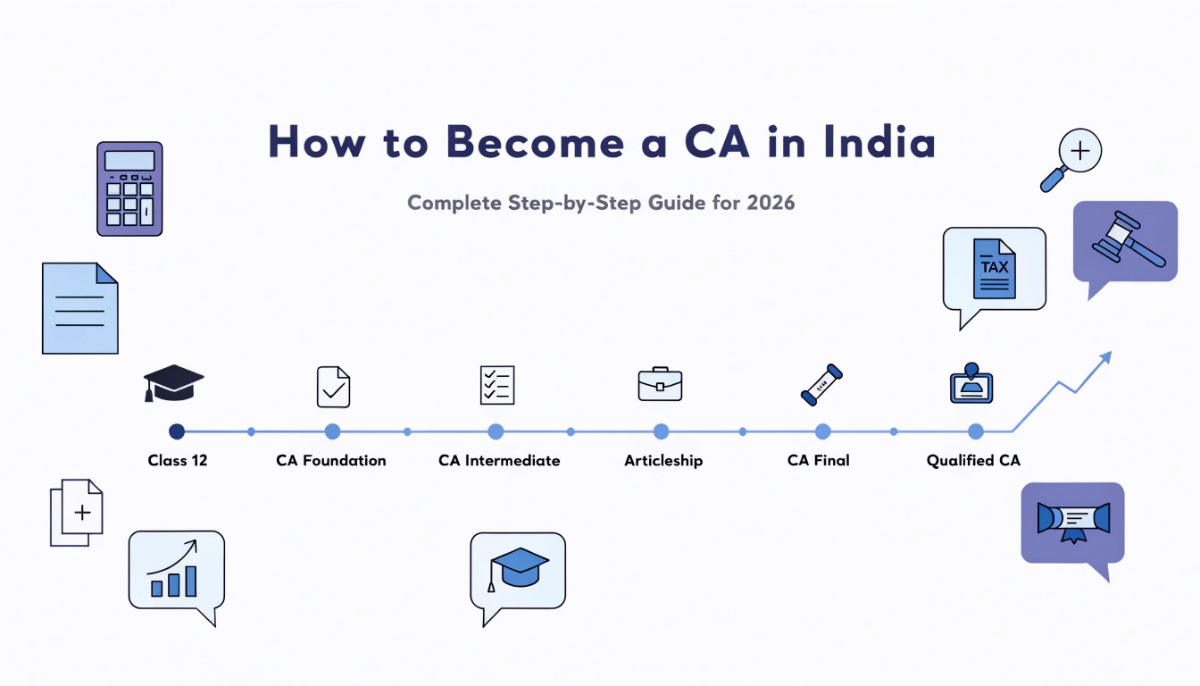
If you are seriously asking how to become a CA, you are looking at one of the most respected and financially rewarding professional qualifications available in India.
Chartered Accountancy is not a degree you collect in three years and move on from but a multi-level professional examination administered by the Institute of Chartered Accountants of India that tests your knowledge of accounting, taxation, auditing and financial law at progressively deeper levels.
The pass rates are low, the time commitment is real and the path takes anywhere from three and a half to six years depending on how many attempts you need at each level. But the career that comes out the other side, with starting salaries ranging from 6 to 12 LPA as a fresh CA and senior roles at Big 4 firms crossing 30 to 50 LPA, makes it the most financially rewarding qualification available to commerce students who complete it.
This blog covers how to become a CA from scratch, including every level of the exam process, eligibility requirements, articleship, the time it takes and what career options open up once you qualify.
Who Is a Chartered Accountant and What Does a CA Actually Do
Before getting into how to become a CA, it is worth being clear about what the qualification actually authorises you to do and why it is treated so differently from other finance qualifications. Here is the practical picture:
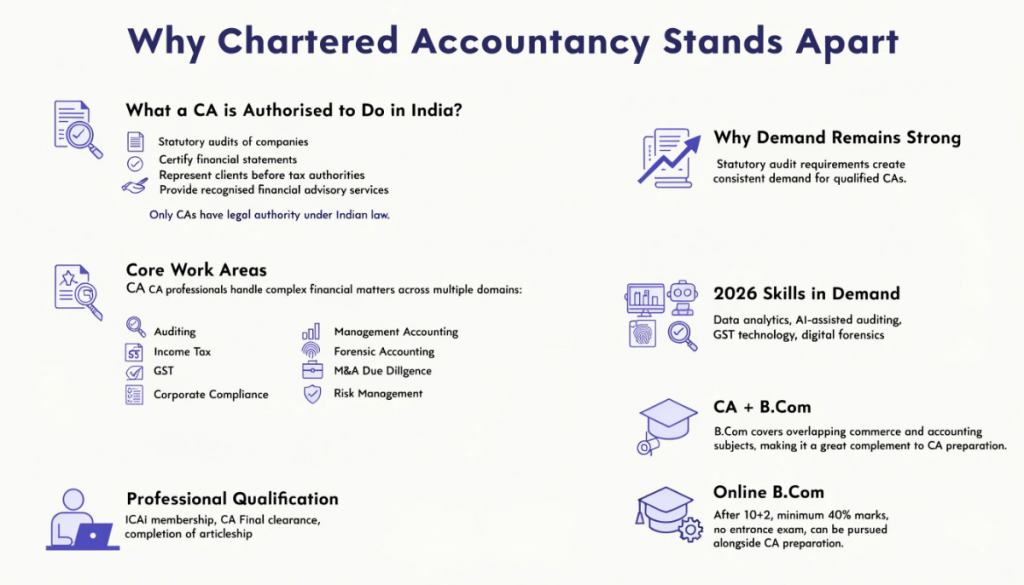
A chartered accountant is a licensed financial professional who is authorised by ICAI to sign statutory audit reports, certify financial statements, represent clients before tax authorities and provide legally recognised financial advisory services, all of which non-CA finance professionals cannot do regardless of their qualifications
The scope of a CA’s work in India covers financial statement auditing, income tax and GST advisory and compliance, corporate law compliance, management accounting, forensic accounting, financial due diligence for mergers and acquisitions and financial risk management
Only ICAI members who have cleared the CA Final examination and completed their articleship are legally permitted to practice as chartered accountants in India, which means the designation carries a statutory authority that makes it distinctly different from an MBA in Finance or any other finance-related qualification
The demand for chartered accountants in India is structurally consistent because every company above a certain threshold is legally required to have its accounts audited by a qualified CA, which means the qualification is tied to statutory requirements rather than to discretionary employer preference
In 2026, CAs with expertise in technology including data analytics, AI-assisted auditing, GST system compliance and digital forensics are specifically in higher demand than those with only traditional accounting skills, reflecting how the profession has evolved alongside the digitalisation of financial systems
A B.Com from a recognised institution is one of the most commonly held qualifications among CA aspirants because the direct entry route into CA Intermediate requires a commerce degree, and the subject overlap between B.Com and CA Foundation makes the two qualifications strongly complementary when pursued together
For students pursuing an online B.Com alongside their CA preparation, the eligibility is 10+2 in any discipline with a minimum of 40% marks and no entrance exam required, which means students can begin their degree simultaneously with CA Foundation registration and use both qualifications to strengthen their academic and professional profile
Who Can Become a CA: Eligibility Criteria You Need to Know First
Understanding how to become a CA starts with understanding who can enter the process and at which stage. Here is the eligibility breakdown for each route:
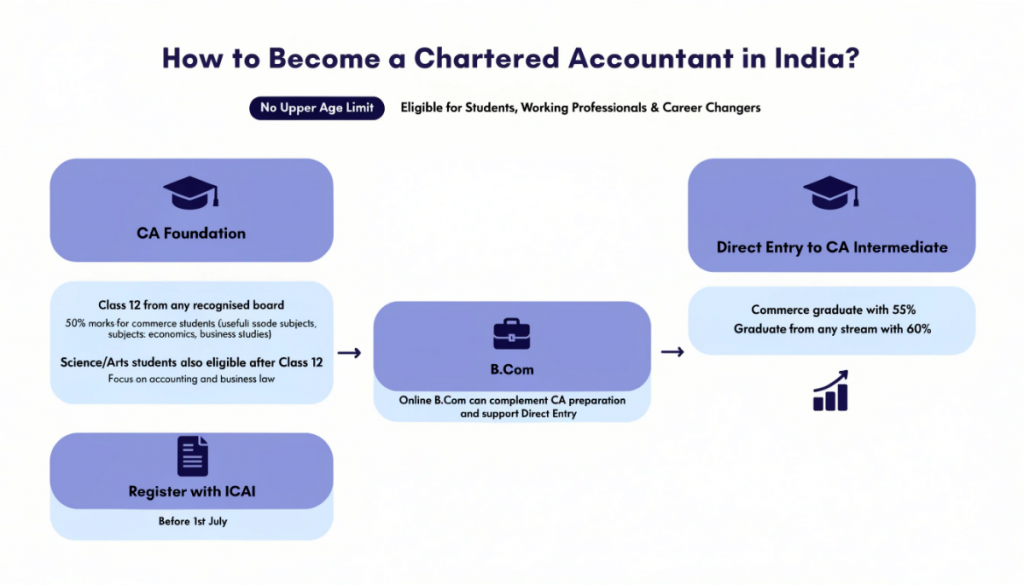
The most common entry point is the CA Foundation route, which requires passing class 12 from any recognised board with any stream, and registering with ICAI for the CA Foundation course at least four months before the exam date
Commerce students who have passed their 10+2 with at least 50% marks can register for CA Foundation and benefit from the subject overlap with accountancy, economics and business studies that gives them an early understanding of several Foundation topics
Science and arts students who have passed class 12 can also enter via the Foundation route, though the absence of commerce background means they need more time on accounting and business law subjects than a commerce student would require
The Direct Entry route into CA Intermediate bypasses the Foundation entirely and is available to commerce graduates with at least 55% marks or graduates from any other stream with at least 60% marks in their bachelor’s degree, making it a faster path for students who completed a commerce undergraduate degree before deciding to pursue CA
Students who complete an online B.Com alongside CA Foundation preparation are in a particularly strong position because the degree provides the academic credential for the direct entry route into Intermediate while the Foundation simultaneously builds their CA knowledge, which means the two tracks reinforce rather than compete with each other
There is no upper age limit for registering for any level of the CA examination, which means the question of how to become a CA is open to working professionals and career changers at any stage of their professional life and not just to students who started the process immediately after class 12
ICAI registration is mandatory before beginning CA preparation at any level, and students should register directly through the ICAI portal since no coaching institute or third party can complete ICAI registration on a student’s behalf
How to Become a CA: Starting with the CA Foundation
The CA Foundation is the first official stage of the how to become a CA process for students entering directly from class 12. Here is everything you need to know about this level:
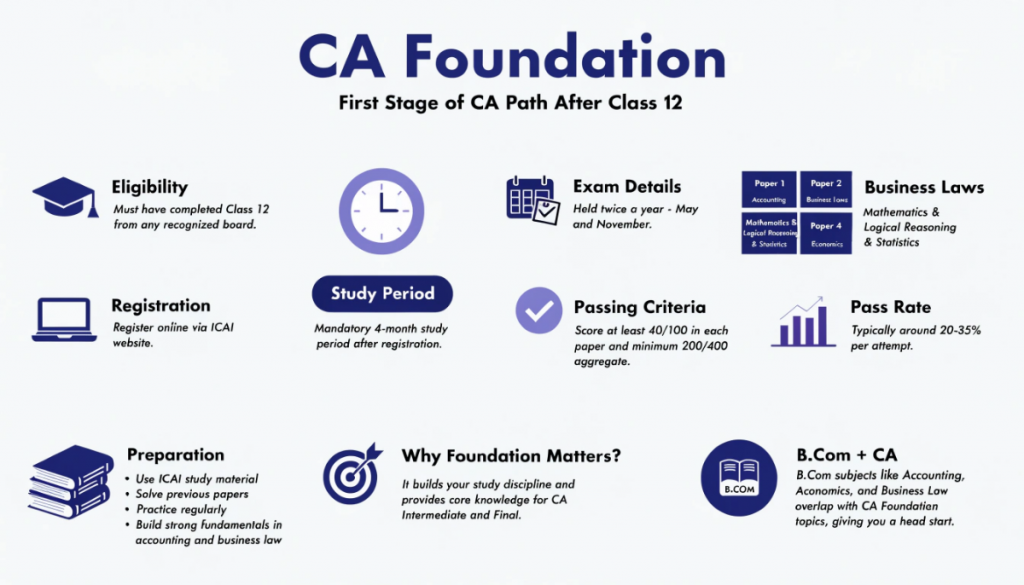
CA Foundation registration can be done online at the ICAI portal after passing class 12, and the mandatory study period of four months must be completed before a student is eligible to appear in the Foundation examination
The Foundation examination is held twice a year in May and November, with students required to complete four papers covering Principles and Practice of Accounting, Business Laws, Business Mathematics with Logical Reasoning and Statistics and Business Economics
The passing criteria for CA Foundation requires a minimum of 40 out of 100 marks in each individual paper and an aggregate of 200 out of 400 marks across all four papers, which means a strong performance in one paper can compensate for a slightly weaker performance in another
CA Foundation pass rates typically hover between 20 and 35 percent per attempt, which reflects the genuine difficulty of the papers rather than a desire by ICAI to limit entries into the profession
Effective preparation for how to become a CA at the Foundation level involves completing ICAI study material, practising past exam papers systematically and building strong foundational understanding in accounting and business law since these subjects recur and deepen at Intermediate and Final levels
Students who are simultaneously pursuing a B.Com degree while preparing for CA Foundation will find that the accountancy, economics and law content in B.Com directly overlaps with Foundation subjects, which means time spent on degree coursework is not wasted but actually compounds the CA preparation
The Foundation level of how to become a CA is the most accessible stage in terms of difficulty compared to Intermediate and Final, but it should not be underestimated since the habit of rigorous preparation established at Foundation level is the primary predictor of success at the more challenging levels that follow
CA Intermediate: The Most Demanding Stage of How to Become a CA
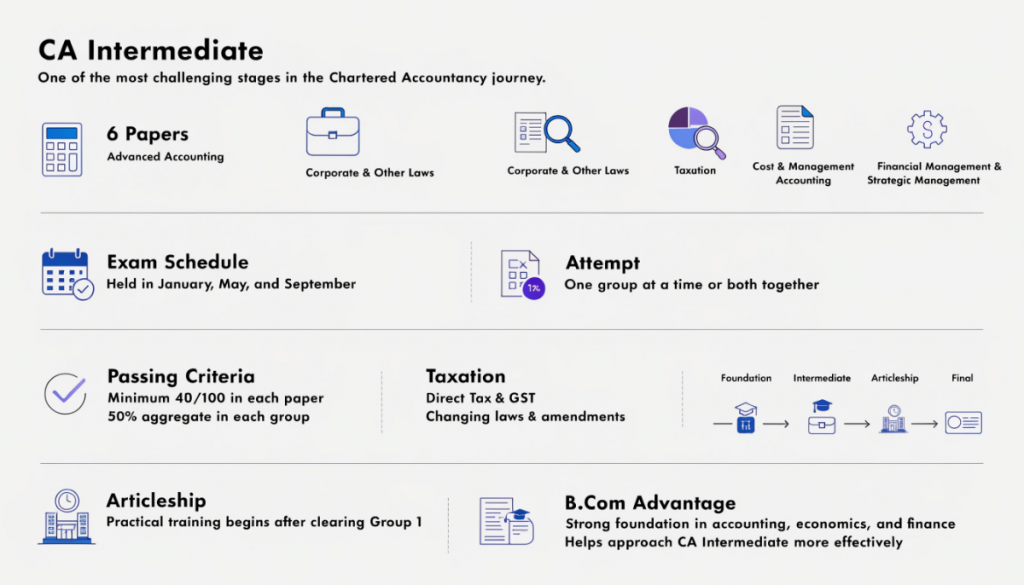
CA Intermediate is where most students find the process most challenging, both in terms of volume of content and the depth of knowledge required. Here is the full picture:
CA Intermediate consists of six papers divided into two groups of three papers each, covering Advanced Accounting, Corporate and Other Laws, Taxation covering both direct and indirect taxes, Cost and Management Accounting, Auditing and Ethics and Financial Management with Strategic Management
Examinations for CA Intermediate are held three times a year in January, May and September, which gives students more opportunities per year to clear the level compared to the Foundation
The passing criteria requires a minimum of 40 marks out of 100 in each individual paper and an aggregate of 50 percent, which is 150 out of 300 marks in each group and 300 out of 600 marks if attempting both groups simultaneously
Students can attempt both groups together or one group at a time, and many candidates opt to attempt one group first to build confidence and reduce the volume of content they are managing in a single exam window
The Taxation paper at Intermediate level is consistently identified as one of the most challenging papers because it covers both direct taxes under the Income Tax Act and indirect taxes under GST, both of which change regularly with budget amendments and notifications that must be tracked and incorporated into exam preparation
Articleship can begin after clearing Group 1 of CA Intermediate, which means practical training and continued study for the remaining group and the Final examinations happen simultaneously for most CA aspirants
CA Intermediate is the level where the gap between students who have a strong academic foundation in commerce subjects and those who do not becomes most visible, which is one of the reasons that pursuing an online B.Com alongside CA preparation is strategically smart rather than unnecessary effort
Articleship: The Practical Training Stage That Makes a CA Complete
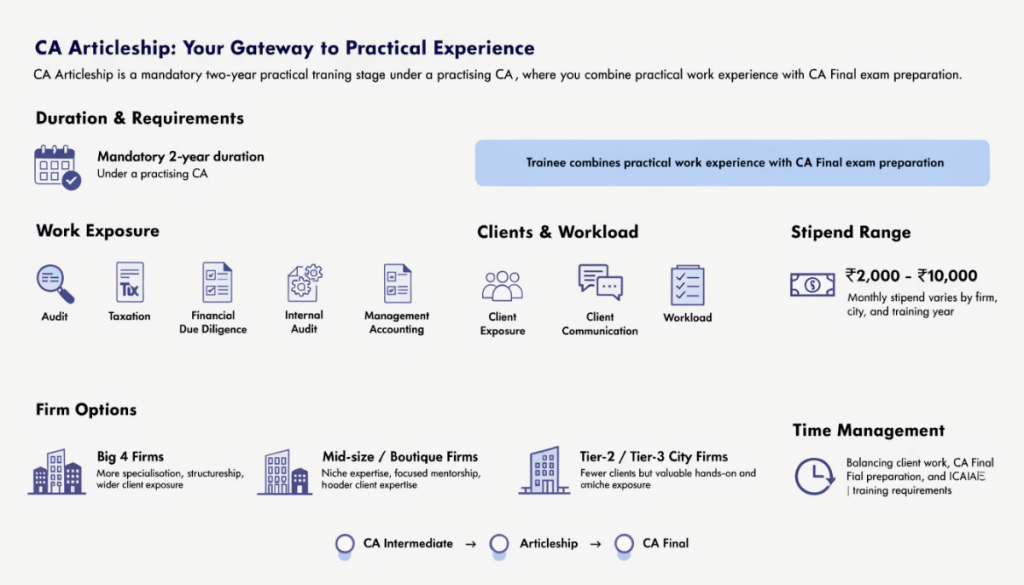
Articleship is not just a formality in how to become a CA but a genuinely demanding two-year period of practical training that shapes the kind of professional a CA becomes. Here is what it actually involves:
Articleship is a mandatory two-year period of practical training that every CA aspirant must complete under the supervision of a practising chartered accountant, and it cannot be shortened or skipped regardless of prior work experience or academic qualifications
During articleship, a CA student is exposed to real client work across audit, taxation, GST compliance, company law filings, financial due diligence, internal audit and management accounting depending on the nature and size of the firm they are placed with
Big 4 articleships at Deloitte, PwC, Ernst and Young and KPMG are the most competitive to secure because they provide structured training across multiple service lines and carry strong brand recognition for future employment, but they also involve the highest workload and the steepest learning curve
Mid-size and boutique CA firm articleships offer closer mentorship from the principal CA and broader exposure to client-facing work since students handle a wider range of tasks than they would in a large firm where work is more specialised
Articleship stipends in India typically range from 2,000 to 10,000 rupees per month depending on the city, firm size and year of articleship, which is deliberately below a market wage because the training and experience are treated as the primary compensation
Students who complete their articleship with a regional firm in a Tier-2 or Tier-3 city should not assume this is a disadvantage for future career prospects, since many regional clients represent complex and interesting financial situations and the practical exposure is often richer than what large-firm students who are assigned a single narrow task experience
Time management during articleship is the most practically challenging aspect of how to become a CA because students are simultaneously working full-time client hours, preparing for the CA Final examination and meeting ICAI’s mandatory training requirements including the Orientation Programme, soft skills courses and the Self-Paced Online Modules that must be completed before the Final exam
CA Final: The Last Exam in How to Become a CA
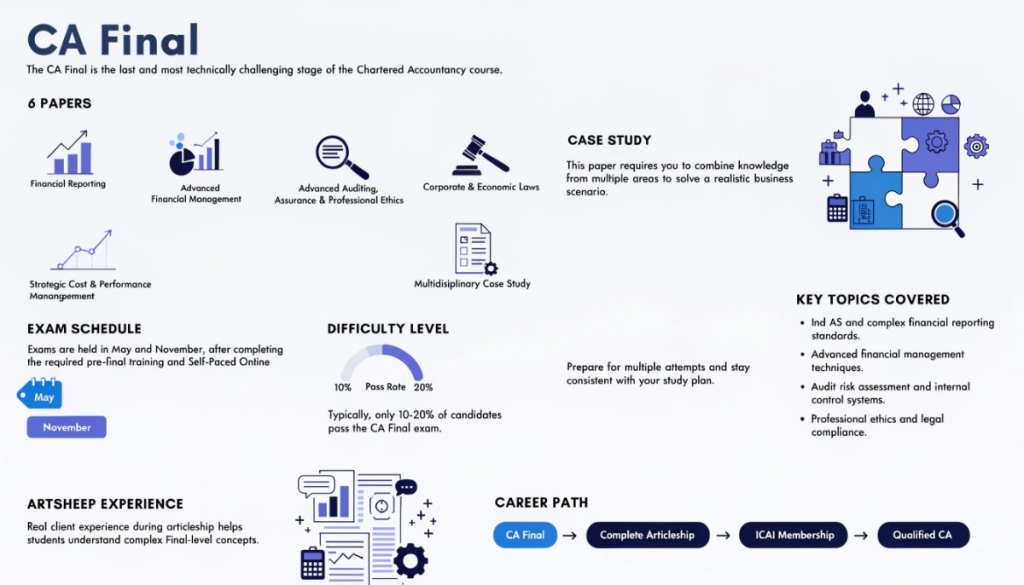
CA Final is the culmination of the how to become a CA journey and the most technically demanding examination in the entire process. Here is a clear breakdown of what it involves:
CA Final consists of six papers across two groups covering Financial Reporting, Advanced Financial Management, Advanced Auditing Assurance and Professional Ethics, Corporate and Economic Laws, Strategic Cost and Performance Management and a Multidisciplinary Case Study paper
The Multidisciplinary Case Study paper is unique to the CA Final under ICAI’s revised scheme and requires students to apply knowledge from multiple subjects simultaneously to solve a comprehensive business scenario, which is closer to real professional work than any previous examination in the CA process
CA Final examinations are held twice a year in May and November, and students are eligible to appear after completing the mandatory pre-final requirements including the Orientation Programme, communication and soft skills training and the Self-Paced Online Modules on ICAI’s portal
Pass rates for CA Final typically range between 10 and 20 percent per attempt, making it one of the most challenging professional examinations in India and globally, and students should realistically plan for multiple attempts rather than expecting to clear in the first sitting
The depth of knowledge required for CA Final papers, particularly Financial Reporting which covers complex Ind AS accounting standards, and Advanced Auditing which covers risk-based audit methodology and professional ethics, requires a fundamentally different approach from the preparation used at Foundation and Intermediate levels
Many CA Final students find that the practical experience gained during articleship significantly helps their understanding of exam topics because concepts like audit risk assessment, deferred tax accounting and consolidation of financial statements become concrete rather than theoretical after they have done the work in a real client engagement
After clearing both groups of CA Final and completing two years of articleship, a student can apply for ICAI membership, which is the official step that converts a CA aspirant into a qualified chartered accountant with the legal right to practice
Conclusion
How to become a CA in India follows a clear sequence: register with ICAI, clear the Foundation examination, clear CA Intermediate, complete two years of articleship, clear the CA Final and apply for ICAI membership.
The full journey takes a minimum of three and a half years and realistically five to six years for most candidates who need additional attempts at one or more levels. The difficulty is real, the pass rates are low and the time commitment is substantial. But so are the rewards, in terms of professional recognition, salary potential, practice freedom and career longevity.
A CA qualification does not expire, it does not lose its legal standing and it does not go out of demand as long as India has a private sector and a tax system. For students serious about finance, accounting and professional practice, the question of how to become a CA deserves a serious and structured answer, and this guide gives you exactly that.

Book Your
Free Session
Connect with our experts and get personalised guidance for your career, course selection, and future goals.
📖 Sources & References
✓ Verified 2026Verified management, leadership and organisational development resources used to support the key concepts discussed in this guide.
- Shoolini Online Online MBA and management education, career-focused learning and professional development
- CIPD – Management Development Management competencies, manager development, organisational strategy and effective management practices
- CIPD – Effective People Managers Evidence on effective people management, leadership, employee support and organisational performance
- CIPD – Leadership in the Workplace Leadership development, management and leadership differences, leadership approaches and workplace effectiveness
- CIPD – Leadership Resources Leadership styles, effective leadership, leading teams and leadership skills
- OpenStax – Principles of Management Foundational management concepts, organisational functions, leadership and business management principles
- Shoolini Online MBA Online MBA programme information and career-focused management education
- Shoolini Online Career Support Career sessions, resume building, interview preparation and industry-oriented career support