
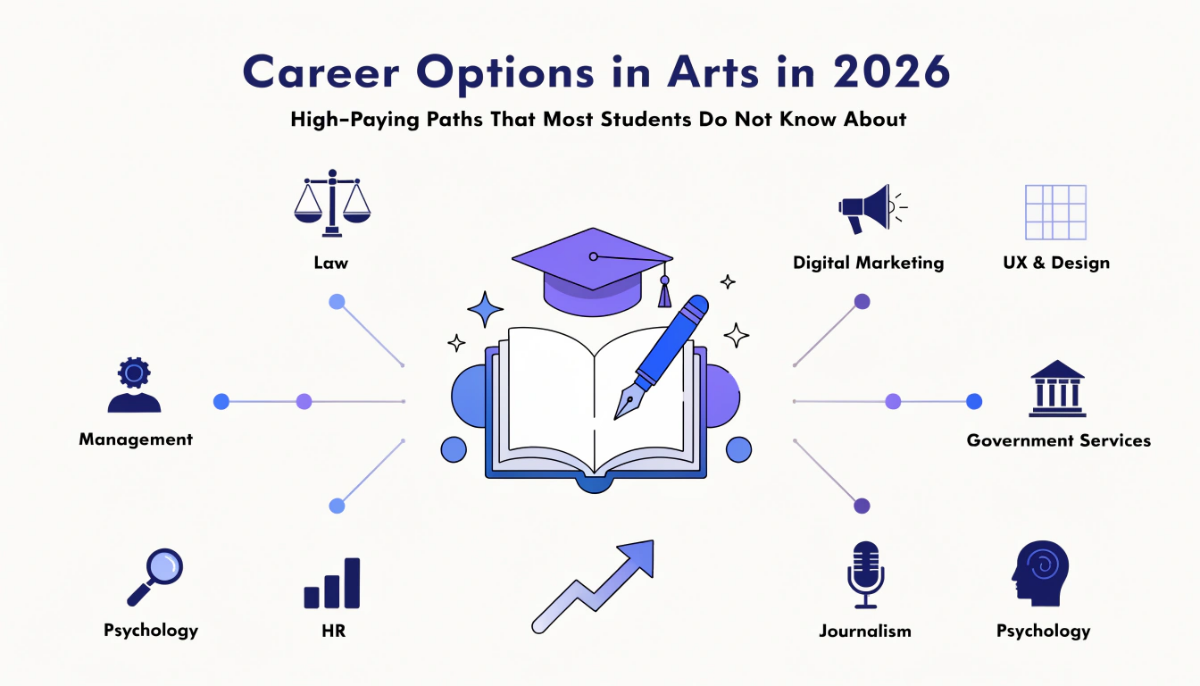
The narrative around career options in arts has not caught up with what the actual job market in India looks like in 2026.Corporate lawyers from NLUs are getting placements above 15 LPA, UX designers with three years of experience are earning more than many engineers, and digital marketing managers from humanities backgrounds are running campaigns worth crores for some of the country’s largest brands. Career options in arts are not limited to teaching and civil services, and that outdated perception is costing arts students the chance to make informed decisions about high-growth, well-paying professions that their stream directly prepares them for.
This blog covers career options in arts across every stage, after 12th, after graduation and after postgraduation, with salary benchmarks, what each role actually involves and how to position yourself for the best outcomes from an arts background.
Why Career Options in Arts Are Stronger Than Their Reputation Suggests
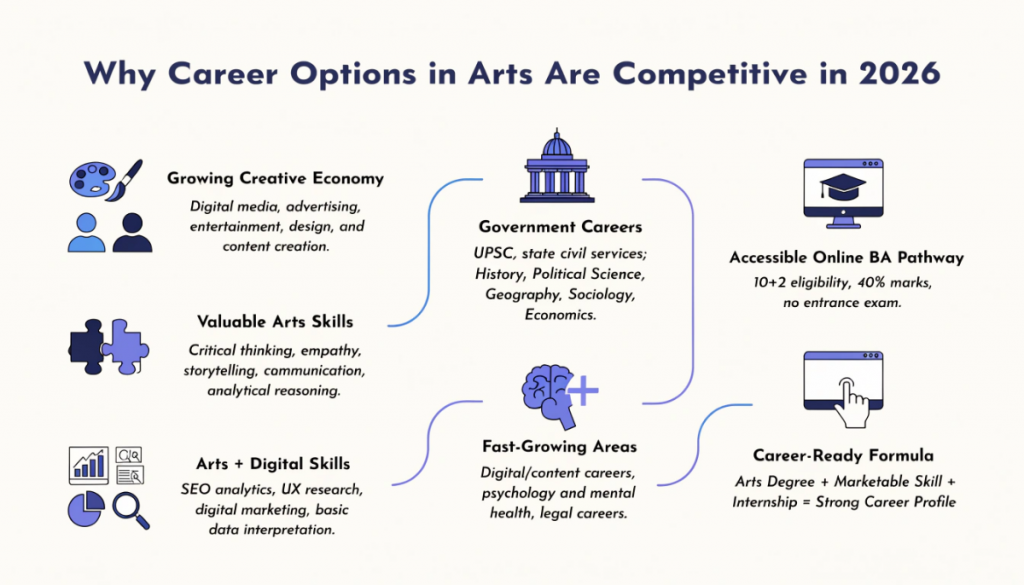
Before getting into specific roles, it is worth understanding why career options in arts are genuinely competitive in 2026 rather than treating this section as reassurance for a decision already made. Here is the data-backed picture:
The creative and cultural economy in India contributes a measurable and growing share of GDP, with sectors like digital media, advertising, entertainment, design and content creation collectively employing millions and expanding at rates that exceed several traditional industries
Skills that arts graduates develop through their degree, including critical thinking, empathy, narrative construction, cross-cultural communication and analytical reasoning, are consistently cited by employers in 2026 as among the hardest to find and most valuable to retain
Deloitte India research confirms that the job market in 2026 wants technical fluency and human ability in the same person, and arts graduates who add one digital or data skill such as SEO analytics, UX research, digital marketing tools or basic data interpretation are outcompeting purely technical candidates for roles that require client communication, content judgment and strategic thinking
The arts stream is also the most natural entry point into UPSC and state civil service careers, with subjects like History, Political Science, Geography, Sociology and Economics appearing directly in both the Prelims and Mains syllabi, making an arts degree a direct academic preparation for the most competitive government examination in India
A BA with an online UGC-DEB approved program is one of the most accessible qualifications in India, with the eligibility being 10+2 in any discipline with just 40% marks and no entrance exam required, which means the path into formal arts education and the career options in arts it supports is open to a genuinely wide range of students
Career options in arts are expanding fastest in three directions in 2026: digital and content-driven roles where communication skills are the core value, psychology and mental health roles where demand is outstripping supply significantly and legal roles where the volume of corporate work has made qualified lawyers consistently scarce relative to demand
The honest framing is this: arts as a stream does not guarantee any outcome on its own, but arts combined with one specific marketable skill, one solid degree from an accredited institution and one internship in your target field is a profile that a wide range of employers are actively looking for
Career Options in Arts After 12th: What You Can Start Building Immediately
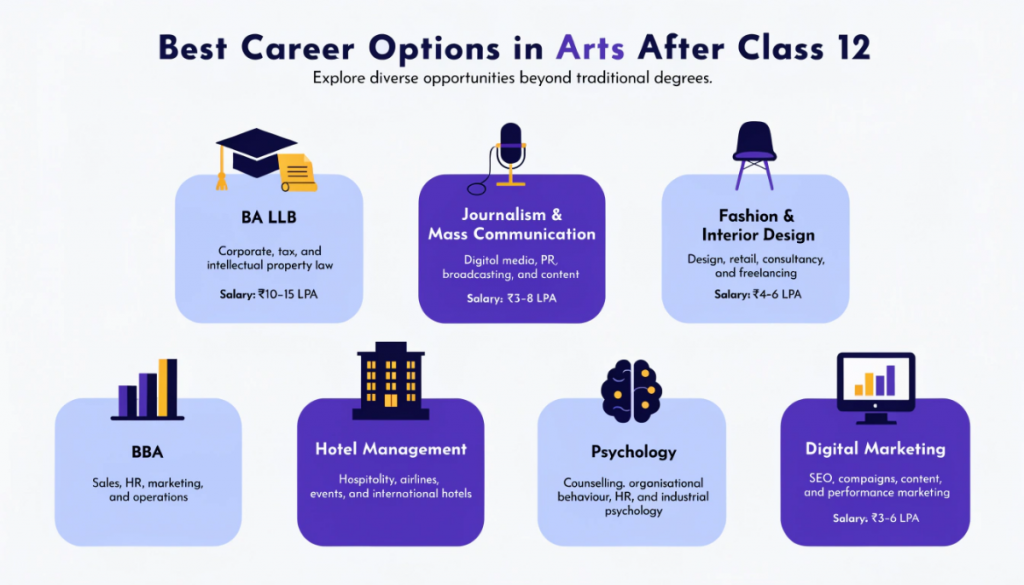
Career options in arts after 12th are broader than the standard advice of just choose a BA subject suggests. Here is what the most viable paths actually look like right after class 12:
BA LLB, the integrated five-year law program, is the most financially rewarding career option in arts that begins immediately after 12th, leading to corporate legal roles with average salaries of 10 to 15 LPA for fresh law graduates from good programs and significantly higher for those who specialise in corporate, tax or intellectual property law
Journalism and Mass Communication programs starting after 12th lead to careers in digital media, print, broadcast, PR and content strategy, with entry salaries around 3 to 8 LPA and strong upward trajectory for those who build strong portfolios and specialize in video, investigative or data journalism
Fashion and interior design programs starting after 12th lead to creative careers in retail, manufacturing and consultancy, with entry-level salaries of 4 to 6 LPA and substantial freelance earning potential for those who build a strong client portfolio within three to five years of graduating
BBA is one of the most strategic career options in arts after 12th for students who want to enter management or corporate careers quickly, since most BBA programs accept arts students with 45% marks and no entrance exam, and the degree leads directly to sales, HR, marketing and operations roles within three years
Hotel management programs after 12th arts lead to careers in luxury hospitality, airline services, event management and international hotel chains, with strong placement pipelines especially for those targeting the Middle East, Europe and Southeast Asia where Indian hospitality professionals are in high consistent demand
Psychology programs starting after 12th lead to careers in clinical psychology, counselling, organisational behaviour, HR and industrial psychology, with mental health professional demand growing faster than supply in India’s metro and Tier-1 cities as mental health awareness reaches corporate and educational institutions
Digital marketing certifications, which can be completed alongside a BA degree in 12 to 16 weeks, are one of the most immediately employable additions an arts student can make to their profile, with digital marketing roles for freshers starting between 3 and 6 LPA and growing rapidly with demonstrated campaign results
Career Options in Arts After Graduation: Where the Real Earning Potential Starts
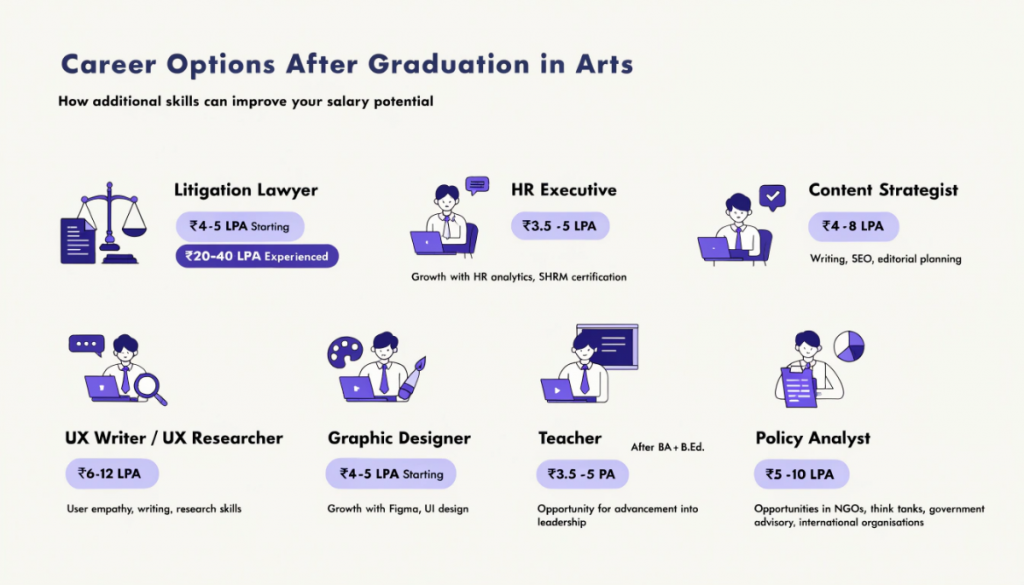
After completing a BA or equivalent arts undergraduate degree, the career options in arts expand significantly and the salary potential rises sharply for students who have built some additional skill alongside the degree. Here is the clear picture:
Litigation lawyer is one of the most prestigious career options in arts after completing an LLB, authorising practitioners to represent clients in civil and criminal cases, with salaries starting around 4 to 5 LPA and growing to 20 to 40 LPA for experienced senior advocates in metro cities and commercial courts
HR executive roles are directly accessible after a BA in any subject, with companies across IT, manufacturing, BFSI and healthcare hiring arts graduates for HR operations, talent acquisition and employee relations roles at starting salaries of 3.5 to 5 LPA, with strong growth for those who add HR analytics or SHRM certification
Content strategist and content marketing roles are among the fastest-growing career options in arts after graduation, with companies across SaaS, e-commerce, edtech, fintech and healthcare building dedicated content teams and offering salaries of 4 to 8 LPA for graduates who can write well, understand SEO and manage editorial calendars
UX writer and UX researcher roles are emerging career options in arts after graduation that pay 6 to 12 LPA even at early career stage because the combination of writing ability, user empathy and research skill that a humanities graduate naturally develops is exactly what product teams at technology companies cannot find enough of
Graphic designer positions are accessible after a BA in Fine Arts or Visual Communication, with salaries starting at 4 to 5 LPA and scaling significantly for those who master UI design tools like Figma and can work on digital product design rather than just print and advertising material
Teaching at the school level after completing a BA plus B.Ed qualification is a stable career option in arts with salaries starting at 3.5 to 5 LPA in private schools and higher in international schools, with the added benefit of structured working hours, consistent demand and clear advancement pathways through school leadership roles
Policy analyst roles at NGOs, think tanks, government advisory bodies and international organisations are career options in arts after graduation for students who studied Political Science, Economics or Sociology, with salaries ranging from 5 to 10 LPA depending on the organisation type and research specialisation
Career Options in Arts After Postgraduation: Senior Roles and Specialist Paths
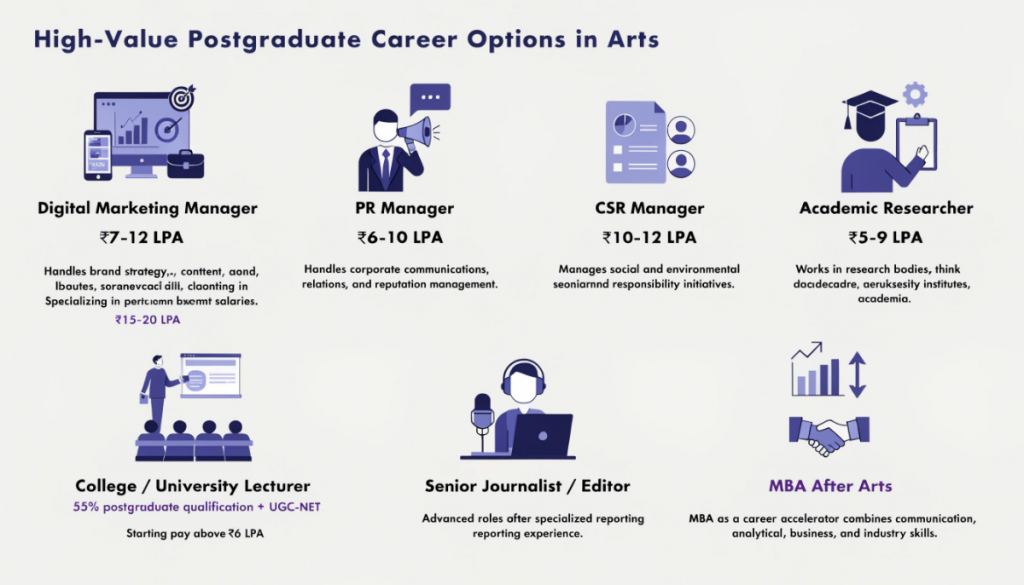
Postgraduate qualifications in arts subjects or related professional programs unlock a different tier of career options in arts with substantially higher salary ceilings. Here is what the most valuable paths look like:
Digital marketing manager is the most in-demand postgraduate career option in arts in 2026, with salaries averaging 7 to 12 LPA and reaching 15 to 20 LPA for performance marketing specialists who can demonstrate measurable ROI from campaigns across Google, Meta and programmatic channels
Public relations manager is a postgraduate career option in arts where experienced professionals earn 6 to 10 LPA managing the reputation, media relationships and communications strategy of corporate clients, startups and public figures, with the rise of social media crises and influencer management creating additional demand for skilled PR professionals
Corporate Social Responsibility manager is a growing career option in arts at the postgraduate level, with CSR managers earning 10 to 12 LPA at large organisations as companies face increasing regulatory, investor and consumer pressure to demonstrate meaningful social and environmental accountability
Academic researcher positions after completing an MA or M.Phil in a humanities subject lead to roles in government research bodies, think tanks, policy institutes and academic departments, with salaries typically between 5 and 9 LPA plus benefits, and the path often leading to PhD programs that open higher-level research and teaching positions
College and university lecturer positions become accessible after completing a postgraduate degree with 55% marks, and qualified arts postgraduates who clear the UGC-NET examination are eligible for assistant professor positions in government colleges with pay bands starting above 6 LPA plus allowances and strong job security
Senior journalist and editor roles at digital media platforms, newspapers and broadcast channels are postgraduate career options in arts for those who entered journalism after graduation and built five or more years of specialised reporting experience in domains like business, policy, technology or international affairs
MBA after an arts undergraduate degree is one of the most effective career accelerators available, combining the communication, critical thinking and analytical strengths developed through the arts degree with business management, data skills and industry exposure, producing a profile that management consulting firms, BFSI organisations and FMCG companies specifically value in 2026
Government Career Options in Arts: Stable Paths With Strong Long-Term Benefits
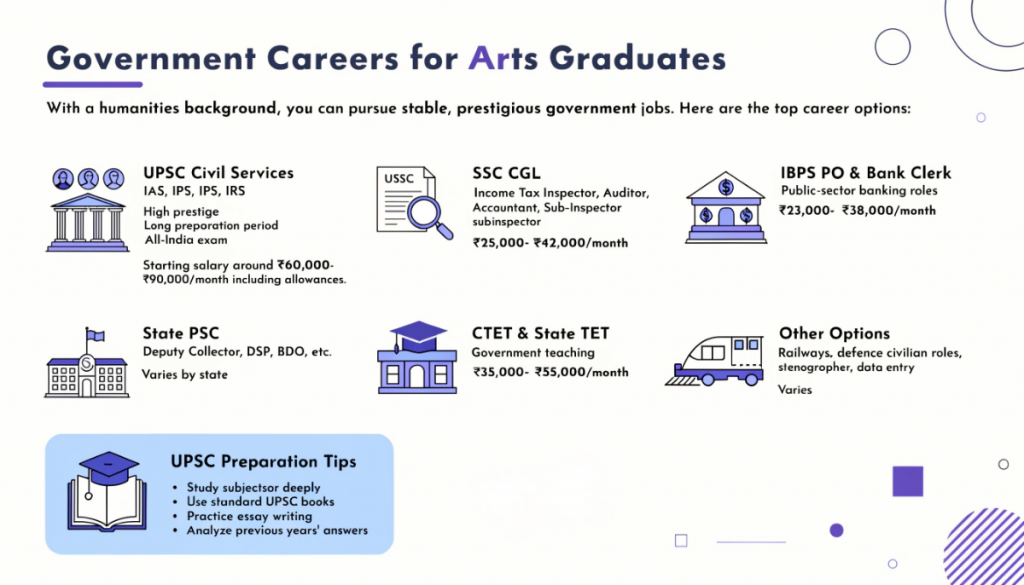
Government career options in arts remain among the most stable and long-term rewarding choices for arts graduates, and the range of examinations available to arts students is wider than most realise. Here is the clear picture:
UPSC Civil Services is the most prestigious government career option in arts, with successful IAS, IPS, IFS and IRS officers starting at pay scale levels that translate to 60,000 to 90,000 rupees per month including allowances, with the examination specifically rewarding the analytical and communication depth that arts graduates develop through their subjects
SSC CGL, or the Combined Graduate Level examination, is a more accessible government career option in arts after graduation, with roles including Inspector of Income Tax, Auditor, Accountant and Sub-Inspector in various central government departments, and starting salaries between 25,000 and 42,000 rupees per month
IBPS PO and bank clerk examinations are government sector career options in arts that lead to probationary officer and clerical roles in public sector banks, with starting salaries between 23,000 and 38,000 rupees per month and structured promotion pathways that lead to branch manager and senior management positions over time
State Public Service Commission examinations, which differ by state but broadly follow the UPSC pattern at a state level, are career options in arts that lead to Deputy Collector, Deputy Superintendent of Police, Block Development Officer and other Class I and Class II administrative service positions
CTET and state-level teacher eligibility tests are government career options in arts for BA and MA graduates who want to teach at government primary and upper primary schools, with permanent government teacher positions offering job security, pension benefits and salaries of 35,000 to 55,000 rupees per month in most states
Railways, Defence civilian positions, Stenographer in central government offices and Data Entry Operator roles are government career options in arts that require class 12 or graduation-level qualification and offer steady income, pension and job security for candidates who prefer stability over salary maximisation
Arts students who plan to appear for UPSC should use their undergraduate years to build optional subject depth, read standard reference books for General Studies and practise essay and answer writing systematically, since the civil services examination rewards writing quality and analytical precision more than rote subject knowledge
The Skills That Separate High-Earning Arts Graduates From Average Outcomes
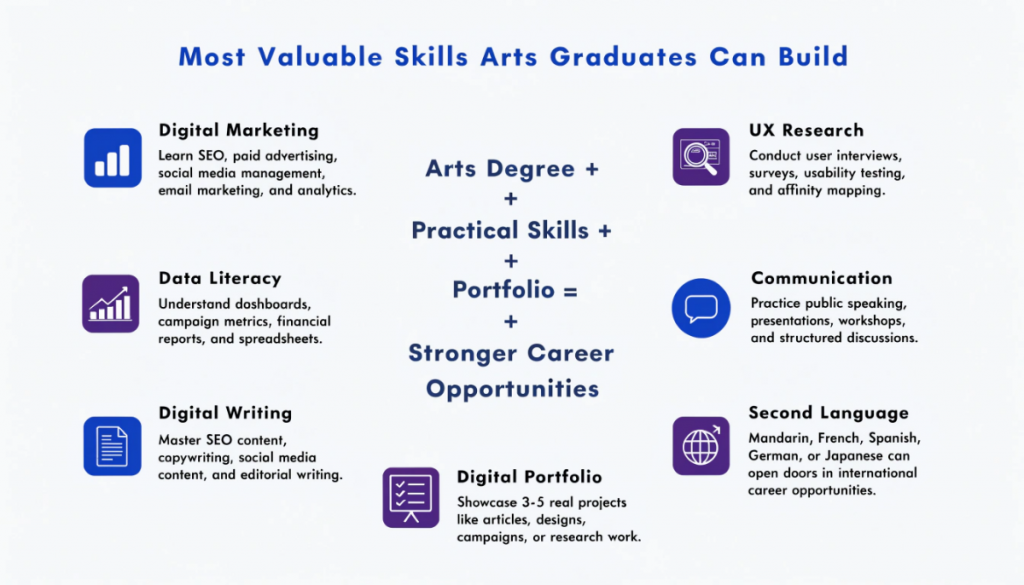
Career options in arts are wide but the income outcomes vary enormously depending on which additional skills an arts graduate builds alongside their degree. Here is what the research on high-earning arts graduates consistently shows:
Digital marketing proficiency is the single most transferable skill an arts graduate can add, covering SEO, paid search and social media advertising, email marketing and analytics, with the entire skill set learnable through free platforms and affordable certifications within six months of sustained practice
Data literacy at a basic level, meaning the ability to read a dashboard, interpret campaign metrics, understand a basic financial report and work with spreadsheet data, is a skill gap that arts graduates who fill it consistently earn 30 to 50 percent more than peers with identical educational qualifications who cannot work with data
Writing for digital platforms, including SEO-optimised content, persuasive copywriting, social media copy and long-form editorial content, is a skill that arts students develop through their degree but that most do not formally package and demonstrate through a portfolio, which is the difference between being hired and being overlooked for content-related career options in arts
UX research skills including user interview design, survey methodology, usability testing and affinity mapping are skills that psychology, sociology and anthropology graduates are naturally positioned to develop and that technology product companies are actively paying 6 to 12 LPA for even at early career level
Public speaking and structured communication, including the ability to present clearly to a mixed audience, facilitate a workshop or chair a discussion panel, is a skill that dramatically improves placement outcomes for arts graduates because most employers test it directly in assessment centres and interviews
A second language at a professional working level is a career accelerator for arts graduates targeting roles at MNCs, diplomatic missions, international NGOs and the BPO sector, with proficiency in Mandarin, French, Spanish, German or Japanese specifically commanding salary premiums of 15 to 30 percent in roles where the language skill is functionally required
Building a digital portfolio during the arts degree rather than waiting until graduation is the single most impactful preparation step for career options in arts, since a portfolio of three to five real projects, published articles, design samples or research summaries gives a hiring manager something concrete to evaluate rather than only a mark sheet and a list of subjects studied
Conclusion
Career options in arts in 2026 span a range that most school counsellors, parents and even arts students themselves have not fully mapped. Law, digital marketing, UX research, journalism, civil services, psychology, content strategy, CSR management, academic research and corporate HR are all career options in arts with documented salary trajectories that match or exceed what many science and commerce graduates earn.
The combination of a recognised degree, one well-chosen marketable skill and practical experience through internships or freelance work is what separates high-earning arts graduates from those who struggle to find roles matching their qualification.
Start building that combination from the first semester rather than the last one and the career options in arts become significantly more concrete and accessible than they look from the outside looking in.

Book Your
Free Session
Connect with our experts and get personalised guidance for your career, course selection, and future goals.
📖 Sources & References
✓ Verified 2026Verified career, skills, higher-education and workforce insights based on authoritative government, institutional and research sources.
- World Economic Forum – Future of Jobs Report 2025 Employer demand for analytical thinking, creative thinking, technological literacy, leadership, multilingualism and other skills relevant to arts graduates
- Deloitte India – 2025 Gen Z and Millennial Survey Career development, practical experience, creativity, soft skills, technical skills and changing workforce expectations in India
- Deloitte India – Human Capital Trends 2025 Workforce transformation, human capabilities, leadership and the changing relationship between technology and people at work
- UGC – Equivalence of Online and Conventional Degrees UGC provisions stating that recognised undergraduate and postgraduate online and ODL degrees are treated as equivalent to corresponding conventional degrees
- UGC – Online and Open & Distance Learning Regulations Regulatory framework and academic standards applicable to recognised online and open-distance-learning degree programmes
- UPSC – Civil Services Examination Official information on Civil Services Examination structure and examination pathways relevant to aspirants from arts and humanities backgrounds
- UGC-NET – National Testing Agency Official information on UGC-NET, the national eligibility test used for eligibility related to Assistant Professor and research pathways
- Deloitte India – Talent Readiness Study 2025–26 Current workforce priorities around talent development, leadership pipelines and future-ready capabilities
- World Economic Forum – Skills Outlook Employer-reported importance of analytical thinking, creative thinking, resilience, leadership, technological literacy and design-related skills