

Management is one of those words that every business program teaches and every organisation depends on, yet most people have a surface-level understanding of what it actually involves in practice.At its core, management is the process of getting things done through people, resources and structured decision-making so that a group or organisation moves consistently toward a defined goal.
Bad management is one of the most documented reasons for startup failure, employee attrition and organisational stagnation, while strong management is the one constant across companies that grow, adapt and sustain performance over time.
Whether you are running a five-person startup, leading a department in a large corporation or studying business for the first time, understanding management in its full depth, including its functions, objectives, principles and career implications, is non-negotiable for anyone who wants to lead effectively in 2026.
What Management Actually Means Beyond the Textbook Definition
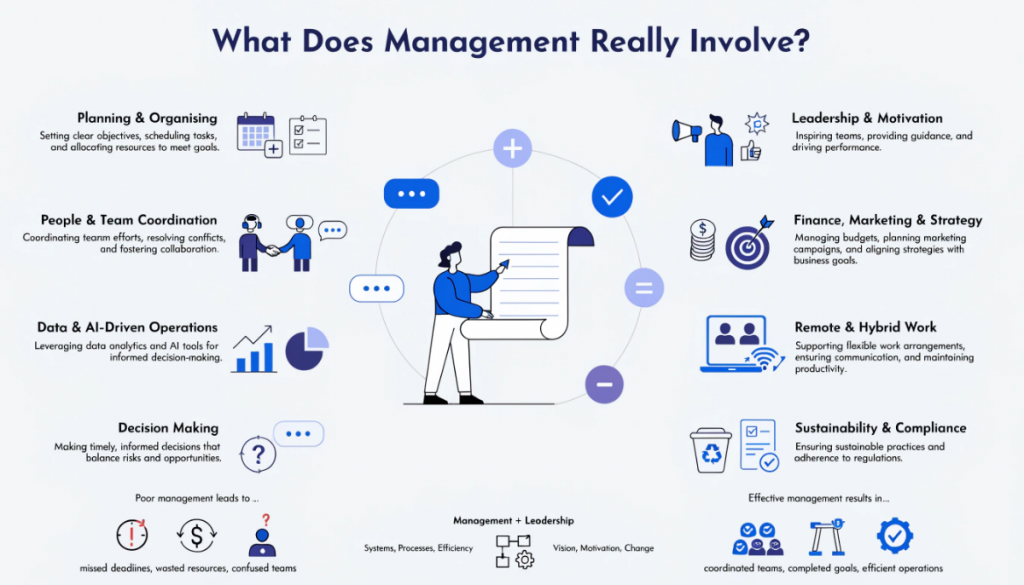
Management is defined in business curricula as the process of planning, organising, leading and controlling resources to achieve organisational goals, but that definition on its own does not capture what management looks like in a real working environment. Here is a grounded picture of what management actually involves:
Management is the invisible infrastructure of every functioning organisation, coordinating what people do, when they do it, with which resources and toward which outcome, and its absence is immediately visible in the form of missed deadlines, wasted budgets, confused teams and unmet targets
Effective management requires a specific combination of technical knowledge, interpersonal skills and the ability to make decisions under uncertainty, which is why experienced managers are consistently among the most valued and well-compensated professionals across every industry in India and globally
Management applies across every type and size of organisation, from a two-person freelance agency to a publicly listed multinational, because the fundamental problem it solves, coordinating people and resources toward a shared outcome, exists at every scale
Modern management in 2026 has expanded significantly beyond its traditional scope to include data-driven decision making, AI-assisted operations, remote and hybrid team leadership, sustainability governance and cross-cultural organisational coordination, all of which require managers to continuously update their skills and frameworks
The relationship between management and leadership is often debated but they are not the same thing: management is about systems, processes and consistency while leadership is about vision, motivation and change, and the most effective managers in 2026 need to be competent at both rather than treating them as separate disciplines
Poor management is not just an internal problem for an organisation but has direct external consequences including customer dissatisfaction, regulatory non-compliance, supplier relationship breakdown and reputational damage, all of which affect revenue and long-term viability
An online MBA is the most direct formal pathway to building advanced management capability, with the eligibility being a bachelor’s degree in any stream with a minimum of 50% marks and 45% for reserved category candidates, no entrance exam required, and the program covering financial management, operations, marketing, strategy and organisational behaviour in a format designed for working professionals
Why Management Is Non-Negotiable for Organisational Success
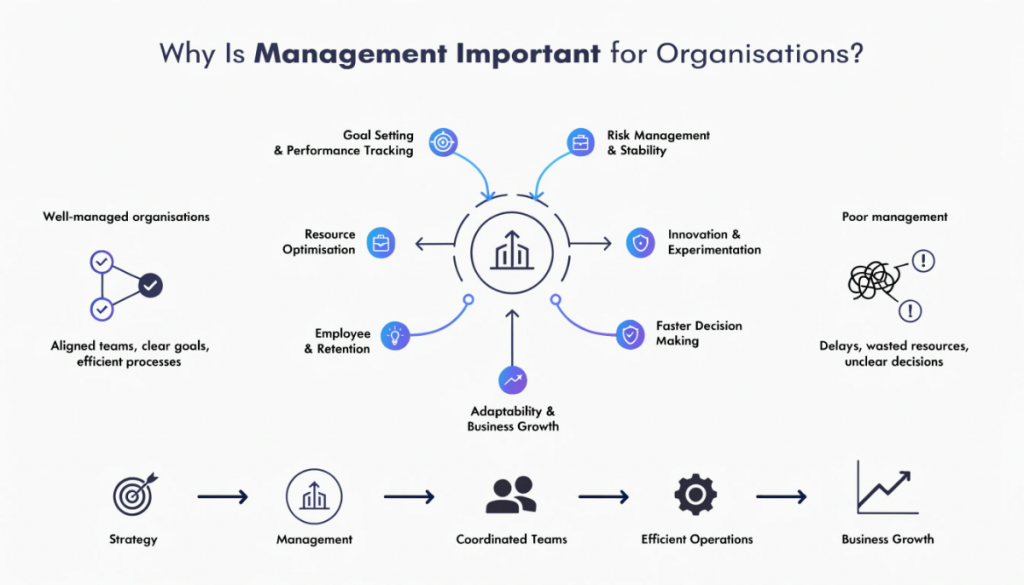
Every organisation that performs consistently over time has strong management at its centre. Here is why management is so foundational to how organisations actually function and grow:
Management provides the structure within which every other organisational function operates, and without it, even talented teams with excellent ideas produce inconsistent outputs because there is no system for coordinating effort, allocating resources or monitoring progress against a defined plan
Goal achievement in any organisation begins with management translating a broad strategic vision into specific, measurable targets that departments and individuals can work toward, and then tracking performance against those targets systematically enough to identify gaps and make corrections before they become failures
Optimum utilisation of resources is one of the clearest financial benefits of effective management, since a well-managed team consistently produces more output per rupee of cost than a poorly managed one, which makes management quality directly visible in margin, efficiency and profitability metrics
Employee retention and engagement are directly linked to management quality, with Gallup research consistently showing that the majority of employees who leave a job are leaving their manager rather than the organisation, which means poor management is one of the largest and most avoidable sources of talent-related cost in any business
Organisational stability during periods of disruption, whether that is a market downturn, a leadership change, a supply chain shock or a technology shift, depends entirely on whether management has built robust planning and risk management processes that allow the organisation to absorb the shock without losing operational continuity
Innovation at scale requires management because individual creative ideas without a management system to evaluate, resource, test and implement them consistently produce nothing commercially useful, and the organisations that have the strongest innovation track records in 2026 are those that have built management processes specifically designed to support structured experimentation
Management also determines how quickly an organisation can change direction when market conditions require it, since an organisation with strong management processes can identify the signal, make the decision and execute the change significantly faster than one where decision-making authority is unclea
The Five Core Functions and What Each One Involves
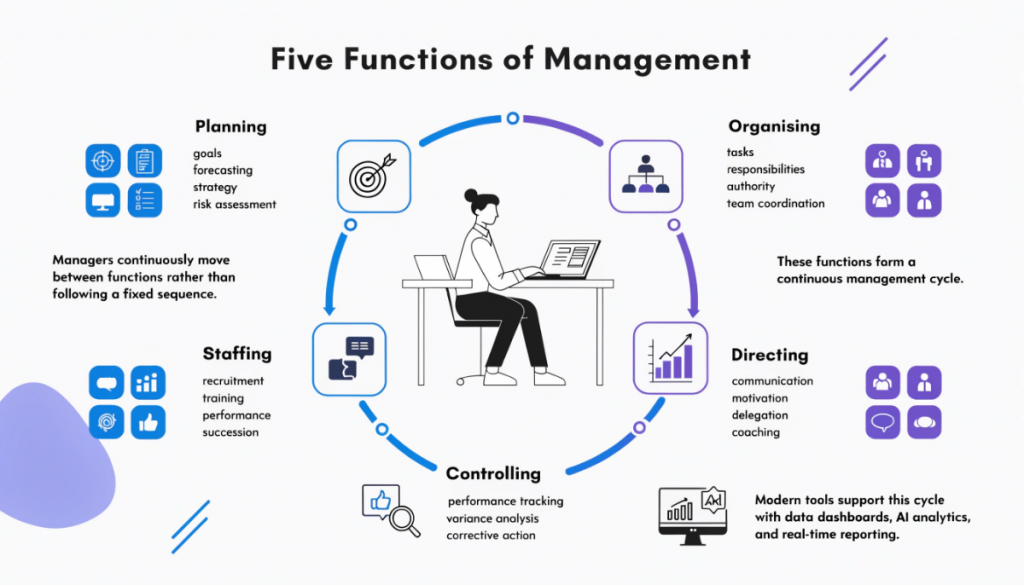
Management theory organises its core activities into five functions that together describe the full scope of what a manager does. Here is what each one actually means in practice:
Planning is the first and most foundational function of management and involves setting goals, analysing the current situation, forecasting what is likely to happen in the environment and deciding on a course of action, including which resources will be needed, which risks need to be managed and what success looks like at each stage
Planning in 2026 has moved significantly beyond annual business plans to include scenario modelling, real-time data-driven forecast revision and AI-assisted competitive intelligence, which means managers who plan effectively are those who can work with both structured long-term strategy and rapid short-term adaptation simultaneously
Organising is the function that translates a plan into an actionable structure, determining which tasks need to be done, who will do them, what authority they have over the work and how different teams or functions will coordinate with each other to avoid duplication and gaps
Staffing is the management function that deals with the human side of execution, covering recruitment, selection, onboarding, training, performance management and succession planning, and it is the function that most directly determines the quality of the team a manager is working with and the speed at which that team can develop
Directing is where a manager brings the plan to life through daily communication, motivation, delegation, coaching and conflict resolution, and it is the function most visible to employees since it is the one they experience directly through their interactions with their manager rather than through documents and systems
Controlling is the function that closes the loop by measuring actual performance against planned targets, identifying variances and taking corrective action when results are not on track, and in 2026 this function has been significantly enhanced by real-time dashboards, AI-powered anomaly detection and automated performance reporting that make issues visible much earlier than traditional monthly review cycles allowed
The five functions of management are not sequential phases but continuous, overlapping responsibilities that a manager handles simultaneously, which is why management is genuinely difficult to do well and why structured education in management through an MBA or similar program produces meaningfully better outcomes than learning management entirely through trial and error
Core Principles of Management That Drive Real Organisational Performance
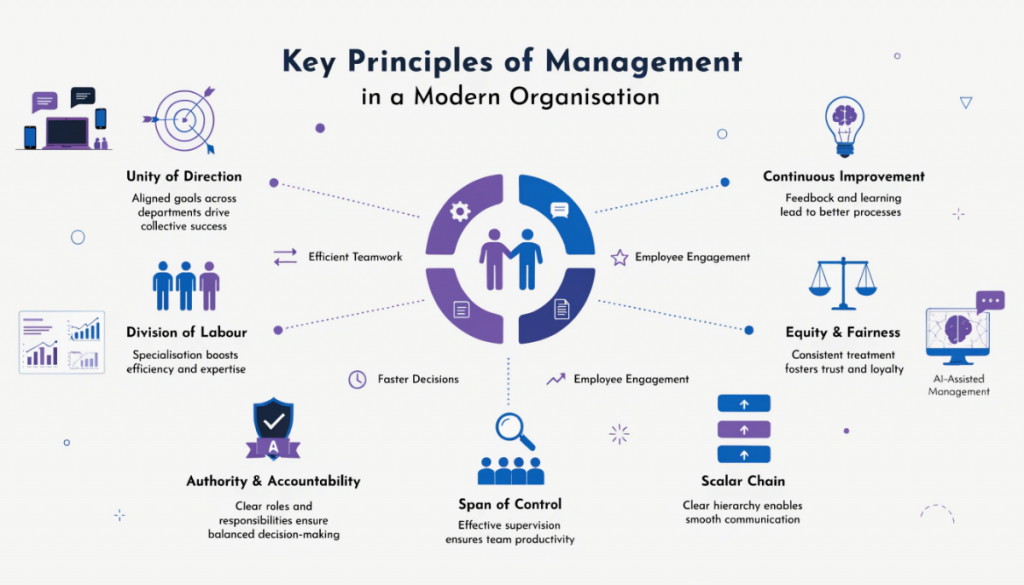
Management principles are the guidelines that experienced managers apply consistently across different situations. Here is what the most important ones look like in a modern organisational context:
Unity of direction means that every team, department and individual in an organisation should be working toward the same set of goals through a coordinated plan, and one of the most common management failures is allowing teams to pursue conflicting priorities that waste resources and create friction without producing results
Division of labour and specialisation allows organisations to be significantly more efficient because people who focus on a specific function develop deeper expertise and produce higher quality output faster than generalists doing the same work, and the management challenge is to coordinate specialists so that their individual outputs combine into a coherent organisational result
Authority and accountability must be balanced in effective management, since giving someone responsibility for an outcome without the authority to make the decisions that determine that outcome is one of the most reliable ways to demoralise a capable employee and produce poor results
Span of control, the number of direct reports a manager can effectively oversee, is a management principle that directly affects organisational structure, and in 2026 digital collaboration tools and AI-assisted management platforms have expanded the effective span of control significantly compared to what was manageable in purely in-person environments
Scalar chain, the principle that there should be a clear line of authority from the most senior to the most junior person in an organisation, matters because it determines how quickly decisions get made and how clearly employees understand where to escalate issues, and organisations with too many layers often find that management overhead slows execution more than it improves coordination
Equity and fairness in how management treats employees across different levels, functions and backgrounds is not just an ethical principle but a practical management requirement in 2026, since organisations that apply management principles inconsistently across different employee groups consistently experience higher attrition, lower engagement and greater difficulty attracting top talent
Continuous improvement as a management principle means treating every operational outcome as a source of learning rather than just a performance number, and the organisations where management actively builds feedback loops and encourages reflection on both successes and failures are consistently the ones that improve fastest over time
Types of Management Every Business Professional Should Understand
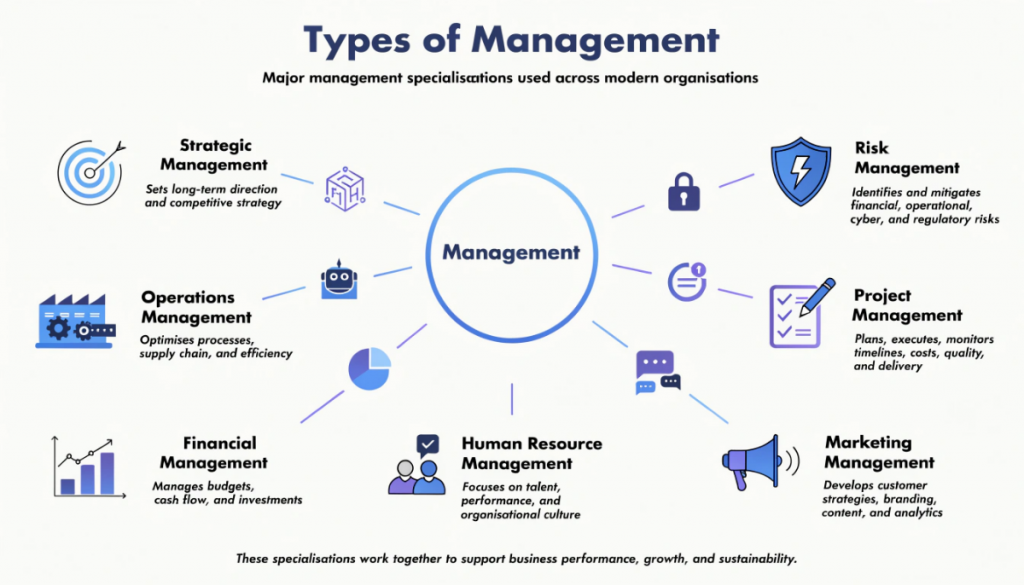
Management is not a single uniform practice but a set of specialised disciplines that apply to different functions, levels and contexts within an organisation. Here is what the most important types of management cover:
Strategic management operates at the senior leadership level and involves setting the long-term direction of the organisation, analysing the competitive environment, allocating resources across business units and making decisions about which markets to enter, which capabilities to build and how to position the organisation for sustainable competitive advantage
Operations management focuses on the day-to-day processes that produce a product or service, including supply chain coordination, quality control, process design, capacity planning and efficiency optimisation, and in 2026 AI and automation have made operations management one of the fastest-evolving management disciplines
Financial management covers the planning, monitoring and control of an organisation’s financial resources including budgeting, cash flow management, financial reporting, investment decisions and risk management, and it is the management function with the most direct and measurable connection to the financial health of the business
Human resource management covers all aspects of managing the workforce including talent acquisition, learning and development, performance management, compensation strategy, organisational culture and employee relations, and its strategic importance has grown significantly as organisations recognise that people quality is consistently the most differentiating competitive factor
Marketing management involves planning, executing and measuring activities that attract, retain and grow a customer base, and in 2026 it has expanded to include performance marketing, content strategy, data analytics, brand management and customer experience design as core management responsibilities rather than peripheral creative activities
Project management is a specialised management discipline that focuses on delivering a defined outcome within a specified time, cost and quality framework, and the PMP, PRINCE2 and Agile certifications reflect the growing formalisation of project management as a distinct professional competence valued across industries
Risk management has become an independent management function in most large organisations in 2026, covering the identification, assessment and mitigation of financial, operational, cyber, regulatory and reputational risks, and the increasing complexity of these risk environments has made formal risk management training one of the most sought-after components of MBA programs
Skills That Separate Average Managers from Effective Ones
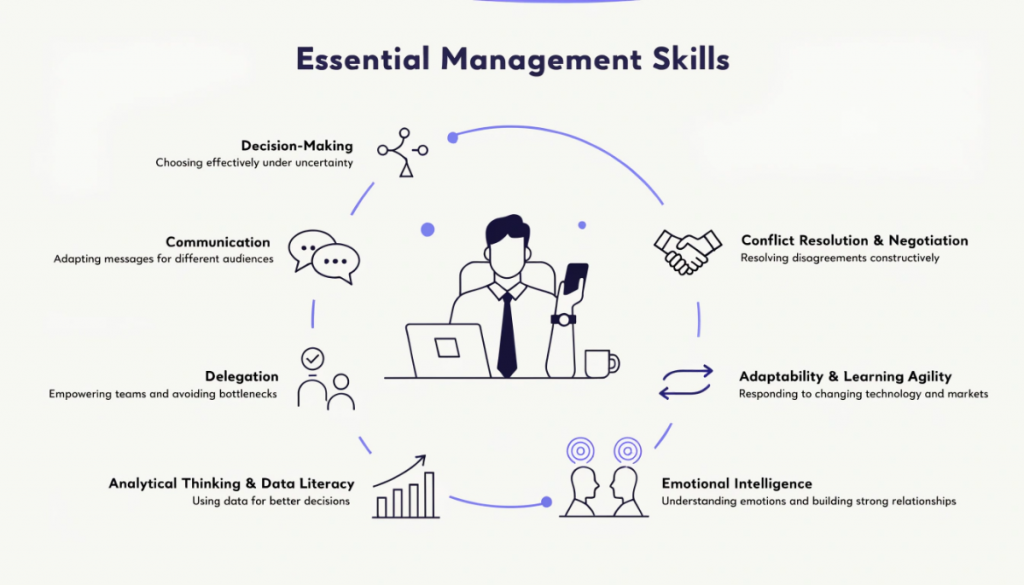
Management as a discipline requires a specific skill set that goes beyond technical domain knowledge. Here is what the skills that actually determine management effectiveness look like:
Decision-making under uncertainty is arguably the most important management skill because managers regularly need to choose between imperfect options with incomplete information and real consequences, and the ability to structure a decision, gather the most relevant information efficiently and commit to a course of action while remaining open to revision as new information emerges is what separates decisive management from either recklessness or paralysis
Communication across different audiences including frontline teams, senior leadership, external clients and regulatory bodies is a management skill that requires the ability to adapt tone, format and level of detail to the specific listener rather than delivering the same message the same way to everyone
Delegation is a management skill that many technically strong professionals struggle with because it requires trusting others to do work to an acceptable standard rather than doing it yourself, and managers who cannot delegate effectively become bottlenecks that constrain the output of their entire team
Analytical thinking and data literacy have become foundational management skills in 2026 because the volume of data available to inform management decisions has grown substantially, and managers who cannot read, interpret and critically evaluate quantitative analysis are making decisions with less information than their peers who can
Emotional intelligence, specifically the ability to recognise and manage your own emotional state while reading and responding appropriately to the emotional states of the people around you, is a management skill that consistently predicts team performance, employee engagement and the quality of stakeholder relationships better than technical expertise alone
Adaptability and learning agility are management skills that have grown in importance as the pace of change in technology, regulation and market conditions has accelerated, and the managers who perform most consistently in 2026 are those who can absorb new frameworks, tools and contexts quickly rather than relying on a fixed playbook built from past experience
Conflict resolution and negotiation skills are management competencies that most managers encounter daily, from resolving disagreements between team members to negotiating resource allocation with peer managers to managing expectations with clients, and the ability to navigate these situations constructively without creating lasting damage to working relationships is a direct determinant of how smoothly a management role actually operates
Conclusion
Management is not a soft subject or a collection of common-sense principles. It is a rigorous discipline that determines whether organisations achieve their goals or fall short of them, whether employees perform at their potential or disengage, and whether resources are used efficiently or wasted.
The functions of planning, organising, staffing, directing and controlling together form the operational backbone of every functioning organisation, and the principles of good management, from clear authority and accountability to continuous improvement and equity, are what separate organisations that compound their performance over time from those that stagnate or fail.
In 2026, effective management also requires digital literacy, data-driven decision making, adaptability and the ability to lead diverse and geographically distributed teams. For anyone who wants to lead at the management level, whether in a startup, a corporate function or an independent venture, building formal management capability through structured education is the most reliable way to develop these skills in a way that employers recognise and reward.

Book Your
Free Session
Connect with our experts and get personalised guidance for your career, course selection, and future goals.
📖 Sources & References
✓ Verified 2026Verified management, leadership, workplace and organisational performance insights based on authoritative 2025–2026 research and professional standards.
- Gallup – Employee Engagement Manager and team-leader impact on employee engagement, coaching and workplace performance
- CIPD – Effective People Managers Evidence on people management, leadership behaviours, performance and organisational outcomes
- World Economic Forum – Future of Jobs Report 2025 Analytical thinking, leadership, resilience, technological literacy and resource management among core workforce skills
- McKinsey – State of AI 2025 AI adoption, workflow redesign, governance, organisational change and leadership responsibilities
- McKinsey – AI and Management How AI is changing management roles, operating models and the responsibilities of managers
- Deloitte – Global Human Capital Trends 2025 Modern management, manager effectiveness and the changing role of managers in AI-enabled organisations
- Project Management Institute – PMBOK Guide Current project management principles, performance domains, adaptability, accountability and value delivery
- Project Management Institute – Project Management Skills Communication, problem-solving, collaborative leadership and strategic thinking as key management capabilities
- International Labour Organization – Performance Management Management practices linking individual performance, organisational objectives, expectations, feedback and development
- Project Management Institute – Leadership Skills Leadership, communication, negotiation, listening, influencing and team-building capabilities