


MBA fees in India can range anywhere from 8 lakh to 27 lakh for a two-year program at a reputable institution and that number stops a lot of deserving students before they even apply. The good news is that MBA scholarships in India exist across multiple categories and there are more options available today than most students realise. Whether you are a fresh graduate, a working professional, a woman returning to studies or someone from an economically weaker background, there is very likely a scholarship that fits your situation.
This blog covers every major type of MBA scholarship in India, who qualifies, what the amounts look like, which exams and criteria matter and exactly how to apply so you are not left scrambling at the last minute.
What MBA Scholarships in India Actually Cover
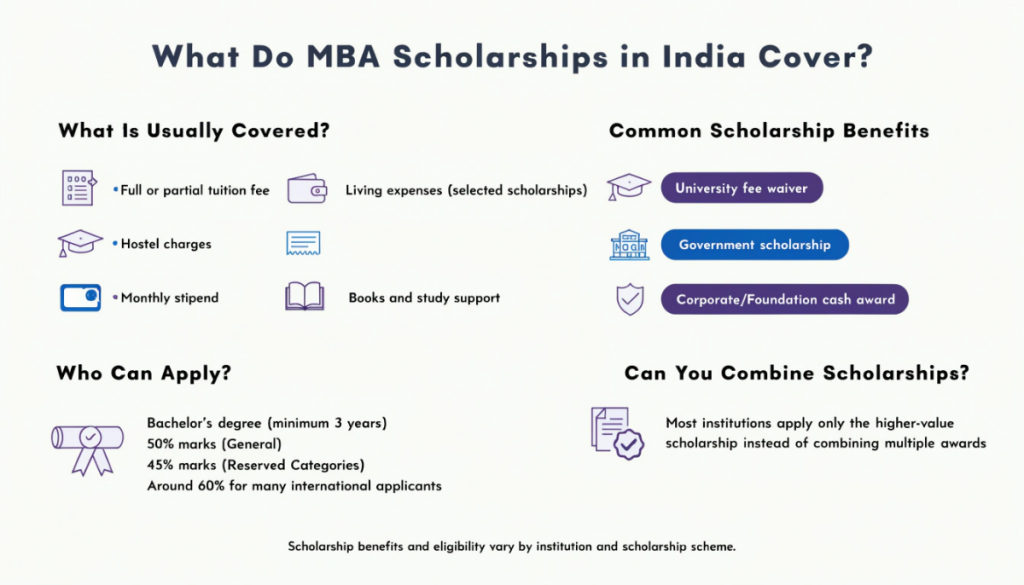
Before getting into the types, it helps to understand what MBA scholarships in India typically cover and what they do not. Here is the straightforward picture:
Most MBA scholarships in India cover part or all of the tuition fee, which is the largest single cost of the program
A smaller number of scholarships also cover living expenses, hostel charges or a monthly stipend on top of the fee waiver
Corporate and foundation scholarships sometimes come with a cash award rather than a tuition waiver, which gives you more flexibility in how you use the funds
Government scholarships under central and state schemes often cover full or partial tuition and may include a small monthly allowance for books and living costs
University-specific scholarships are usually applied directly to the fee structure and reduce what you pay per semester rather than providing a separate cash disbursement
MBA scholarships in India are almost never fully combinable, meaning if you qualify for two scholarships most institutions will apply the higher of the two and not stack both
The basic eligibility to be considered for any MBA scholarship in India is having a recognised bachelor’s degree of at least three years duration with a minimum of 50% marks, with 45% for reserved category candidates
International students typically need 60% in their bachelor’s degree to be considered for most scholarship categories at institutions offering online or distance MBA programs in India
Government MBA Scholarships in India Worth Knowing About
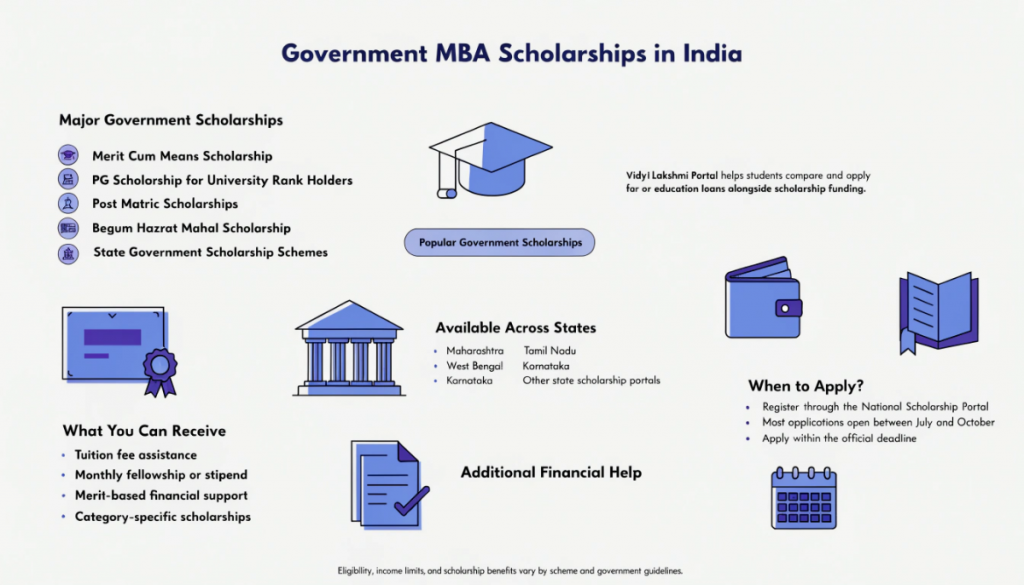
Government scholarships for MBA students are among the most reliable options because they are backed by central and state funding and tend to have transparent eligibility criteria. Here is what is available:
The Merit Cum Means Scholarship for Professional and Technical Courses run by the Ministry of Minority Affairs supports students from minority communities with a family income below 2.5 lakh per year and covers a significant portion of tuition
The Post Graduate Scholarship for University Rank Holders awards a fellowship of around 3100 rupees per month for the full two-year duration of the MBA program and is open to first and second rank holders from recognised universities in their undergraduate examination
Post Matric Scholarships under the National Scholarship Portal cover SC and ST students pursuing postgraduate programs including MBA, with income thresholds of 2.5 lakh per year for SC candidates and 1 lakh per year for OBC candidates under central list norms
The Begum Hazrat Mahal National Scholarship supports meritorious girls from minority communities at the secondary level and has a pathway continuation into postgraduate programs at several institutions
Several state governments including Maharashtra, Tamil Nadu, West Bengal and Karnataka operate their own scholarship portals for MBA students from reserved and economically weaker categories
The Vidya Lakshmi portal at vidyalakshmi.co.in is not a scholarship but allows students to compare and apply for education loans up to 7.5 lakh without collateral from multiple banks simultaneously, which many students use alongside scholarship funding
Government MBA scholarships in India require timely registration on the National Scholarship Portal at scholarships.gov.in and most open their application windows between July and October for programs starting in that academic year
Corporate and Foundation MBA Scholarships in India That Pay Well
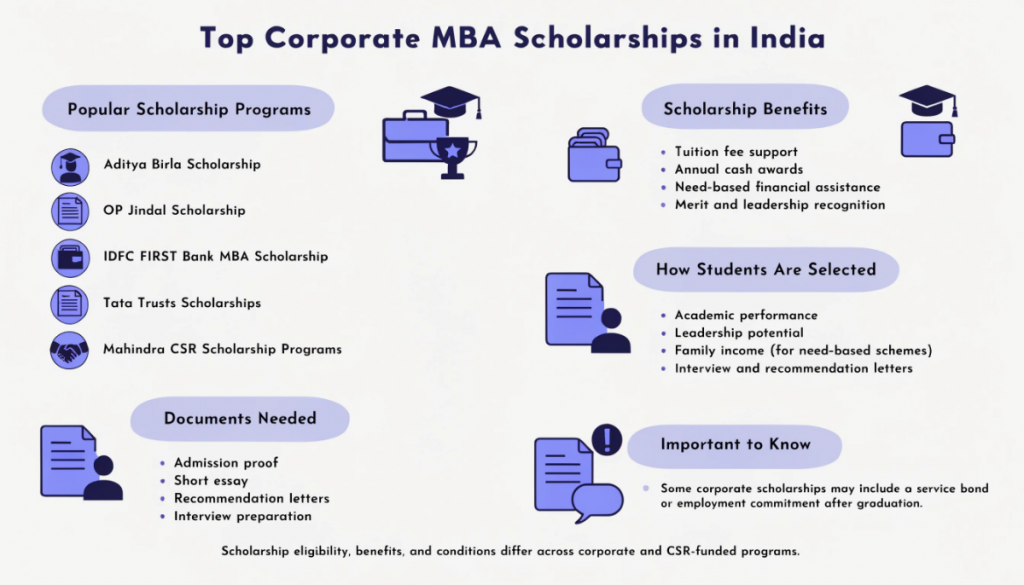
Some of the highest-value MBA scholarships in India come from the corporate and foundation sector. These are competitive but the rewards are significantly larger than most institutional scholarships. Here is what to know:
The Aditya Birla Scholarship is one of the most prestigious corporate MBA scholarships in India and is awarded to students admitted to top IIMs and a select list of other premier institutions, covering a large portion of tuition with an annual cash award
To retain the Aditya Birla Scholarship, students are required to remain in the top 25% of their batch, maintain a quality rating on at least 60% of their assignments and participate actively in campus forums
The OP Jindal Scholarship supports students from government-funded institutions and engineering and management programs and is one of the few corporate scholarships that considers social leadership potential alongside academic merit
The IDFC First Bank MBA Scholarship is need-based and targets students whose family income is below 6 lakh per year, offering 1 lakh per year for up to two years, with candidates required to appear before a panel interview before final selection
Tata Trusts, Mahindra Educational Institutions and several other large Indian conglomerates run CSR-funded scholarship programs that support postgraduate management students from economically weaker sections
Corporate scholarships for MBA students in India typically require a short essay, letters of recommendation, proof of admission to a recognised institution and an interview, so applying early and preparing these materials in advance is essential
Some corporate scholarships are tied to a bond period or return of service condition, meaning you may be required to work with the sponsoring company for a defined period after graduation, which is worth understanding before accepting
Merit Based MBA Scholarships in India and the Role of Entrance Exams
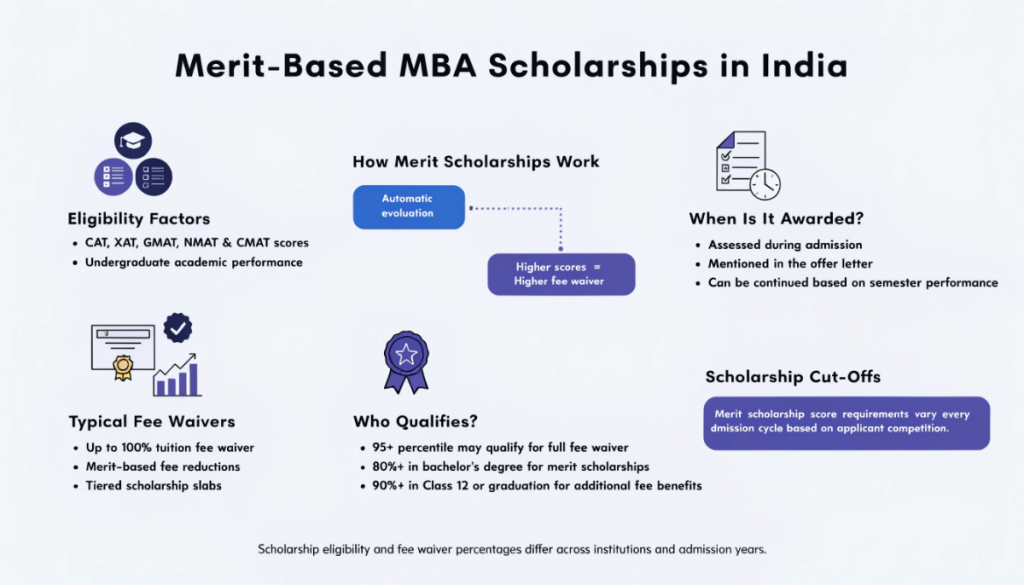
A large portion of MBA scholarships in India are directly linked to your entrance exam score or your undergraduate academic record. Here is how this category works:
Institutions that admit students through CAT, XAT, GMAT, NMAT or CMAT often have internal scholarship slabs tied to percentile or score brackets, where a higher score translates to a higher fee waiver
A 100% tuition fee waiver is available at select private institutions for students scoring at or above the 95th percentile in CAT or XAT, which is one of the few ways to cover the full MBA fee through merit alone
Merit scholarships at most private and deemed universities are assessed automatically as part of the admission process and do not require a separate application, so the entrance exam score you submit becomes the deciding factor
Students with a strong undergraduate percentage, typically 80% and above, also qualify for additional merit-based fee waivers at institutions that operate tiered academic scholarship programs
A 10% scholarship is a common baseline offering at several institutions for students who scored above 90% in class 12 or above 90% in their bachelor’s degree, and this applies on top of base fee reductions in some programs
Merit scholarships for MBA programs are usually announced at the time of the admission offer letter and are valid for the full program duration as long as the student maintains the required academic performance each semester
The cut off percentile or score required for each scholarship slab changes from one admission cycle to the next depending on applicant quality, so checking the current year’s scholarship table from the institution directly is more reliable than using previous year numbers
MBA Scholarships in India Based on Category and Special Circumstances
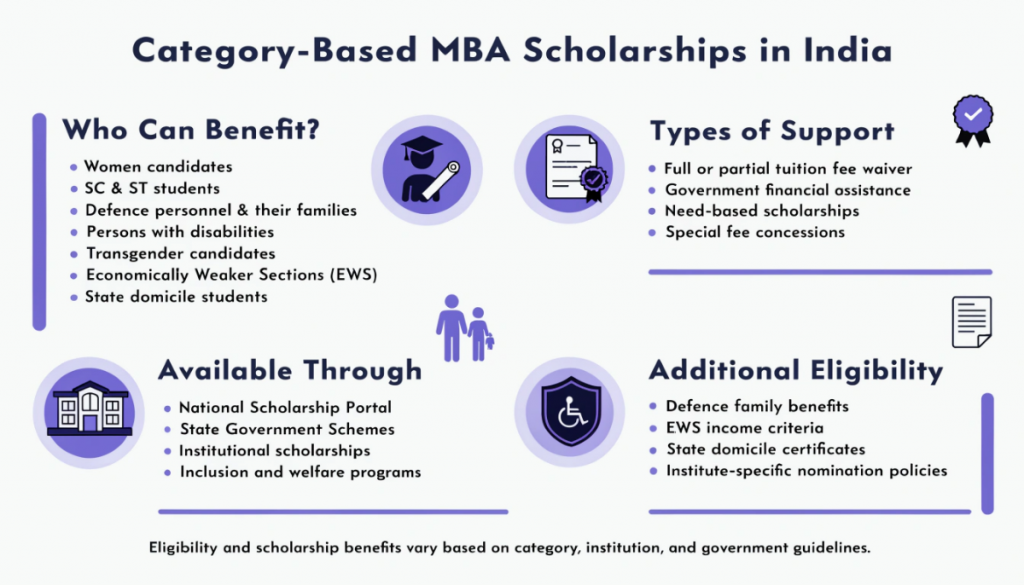
Beyond merit and financial need, a significant number of MBA scholarships in India target specific student groups. Here is what each category looks like:
Women candidates pursuing MBA are specifically targeted by several scholarship programs including the Women’s MBA Scholarship at select IIMs which covers the full second year tuition fee for eligible female PGP students nominated by the institute
SC and ST candidates have access to Post Matric Scholarships through state and central government channels in addition to the need-based fee waivers offered by most IIMs and several private institutions
Defence personnel and children of defence veterans qualify for fee concessions and scholarships at several institutions, and children of martyred defence personnel are eligible for full tuition waivers at select private B-schools regardless of entrance exam score
Persons with disabilities are covered under separate government schemes through the National Scholarship Portal and several institutions also offer internal fee waivers for differently-abled students as part of their inclusion policy
Transgender candidates are supported through specific scholarship programs like the Ujjivan Small Finance Bank Transgender Scholarship which provides financial assistance for postgraduate education including MBA
Students from Economically Weaker Sections as defined by government guidelines with family income below 8 lakh per year qualify for additional reservation and financial assistance at central and state government institutions
Domicile-based scholarships are available in several states including Haryana, Himachal Pradesh and Rajasthan where students with local domicile certification can access full or partial fee concessions at state government institutions
How to Apply for MBA Scholarships in India Without Missing Out
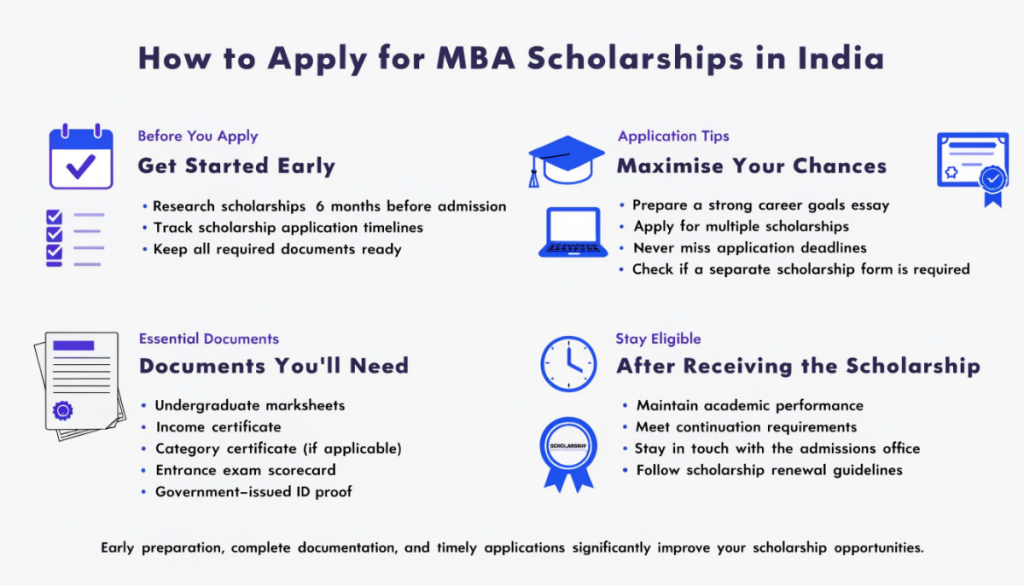
Having the right profile is only half the job. Knowing how to apply correctly and on time is what actually gets you the scholarship. Here is a practical guide:
Start researching MBA scholarships in India at least six months before your intended admission date since government scholarship windows on the National Scholarship Portal typically open in July and close by October
Keep a master document ready with your undergraduate marksheets, income certificate, category certificate if applicable, entrance exam scorecards and a government-issued identity proof since these are required across almost every scholarship application
For corporate scholarships, prepare a 250 to 500 word essay on your career goals and social impact intent well in advance since essay quality is a major differentiator in competitive corporate scholarship selection rounds
Never miss the deadline by even a day since most scholarship portals close applications automatically and there is generally no provision for late submissions regardless of how strong your profile is
Apply to multiple MBA scholarships in India simultaneously rather than betting on one since eligibility criteria differ and you may qualify for more than one category even if only the highest applicable one gets applied to your fee
Check whether the institution you are applying to assesses scholarships automatically at the time of admission or requires a separate application because missing a separate scholarship application form can mean losing out even if you meet all the eligibility criteria
Ask the admissions office of your chosen program specifically about all scholarship categories available at that institution since not all fee waivers and merit discounts are prominently listed on the website and some are only communicated during the counselling process
Maintain your academic performance throughout the program since most scholarships come with a continuation condition and students who drop below the required grade threshold can lose the scholarship from the following semester
Conclusion
MBA scholarships in India in 2026 cover a wider range of students than most people assume. Merit, financial need, gender, category, domicile, entrance exam performance and even payment mode can all work in your favour depending on which scholarship you target. The key steps are straightforward: check eligibility early, prepare your documents in advance, apply through the right portals before the windows close and ask your shortlisted institution directly about every scholarship option they offer. The cost of an MBA does not have to be the reason you hold back from a degree that can meaningfully change your career trajectory. The money is there for students who look for it and plan well enough to claim it.

Book Your
Free Session
Connect with our experts and get personalised guidance for your career, course selection, and future goals.
📖 Sources & References
✓ Verified 2026Verified MBA scholarship schemes, eligibility criteria, financial assistance, fee waivers and application guidelines based on recognised government, educational and industry sources.
- National Scholarship Portal Central government scholarships, eligibility criteria, application process and scholarship timelines
- UGC India Postgraduate scholarship schemes, higher education funding and university regulations
- Ministry of Education National scholarship policies, financial assistance initiatives and higher education reforms
- AICTE Technical and management education scholarship schemes and student support initiatives
- Vidya Lakshmi Portal Education loan information, financial assistance and bank application portal for higher studies
- Aditya Birla Scholarship Merit-based MBA scholarship programme, eligibility criteria and selection process
- IDFC FIRST Bank Foundation Need-based MBA scholarship programme, financial support and application guidelines
- National Career Service Management career guidance, postgraduate education resources and employability information
- Shoolini Online MBA scholarship guidance, admission support and programme information
- National Education Policy 2020 Higher education reforms, equitable access initiatives and student financial support framework