
A few years ago, people were still skeptical about whether an online degree held the same value as a campus one. That conversation has largely moved on. In 2026, UGC-approved online degrees are recognised by employers, accepted for government jobs and treated on par with regular degrees for higher studies and competitive exams.
The online degree benefits that were once considered secondary advantages such as flexibility and lower cost have now become primary reasons for choosing this mode of education over traditional classrooms. This blog breaks down every real advantage of pursuing an online degree so you can make an informed decision rather than relying on assumptions that may no longer be accurate.
The Core Online Degree Benefits That Actually Change How You Study
Before getting into specific advantages, it helps to understand what online degree benefits look like at a structural level compared to traditional learning. Here is the overall picture:
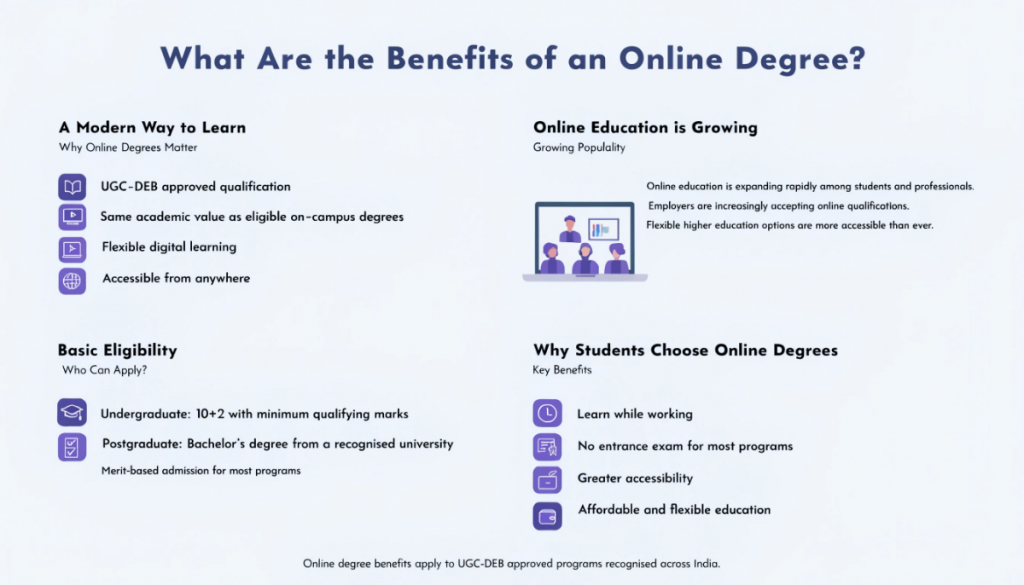
An online degree is a full undergraduate or postgraduate qualification delivered through a digital learning platform, carrying the same academic value as a degree earned on campus when the program is UGC-DEB approved
The Indian online education market was valued at around USD 3.6 billion in 2025 and is projected to grow at approximately 23% CAGR through 2030, which reflects how seriously this mode of education is now being taken by both students and employers
Online degree benefits are not just about convenience, they are about removing the structural barriers that have historically prevented working professionals, people in smaller cities and students from low-income households from accessing quality higher education
For undergraduate programs, the basic eligibility is completing 10+2 in any discipline with at least 40% marks from a recognised board, which means a wide range of students qualify without needing exceptional academic scores
For postgraduate programs, the requirement is a bachelor’s degree from a recognised university with at least 50% marks, while international students need 60% in their qualifying examination
Admission to most online programs is merit-based and does not require entrance exams, which removes another barrier for students who want to continue their education without preparing for a separate competitive test
The online degree benefits discussed in this blog apply specifically to UGC-DEB approved programs since those are the ones legally equivalent to regular degrees and recognised by public and private sector employers across India
Flexibility Is the Most Talked-About Online Degree Benefit for a Reason
When people list online degree benefits, flexibility always comes first and it deserves more than a single bullet point because it shows up in multiple concrete ways. Here is exactly how it works:
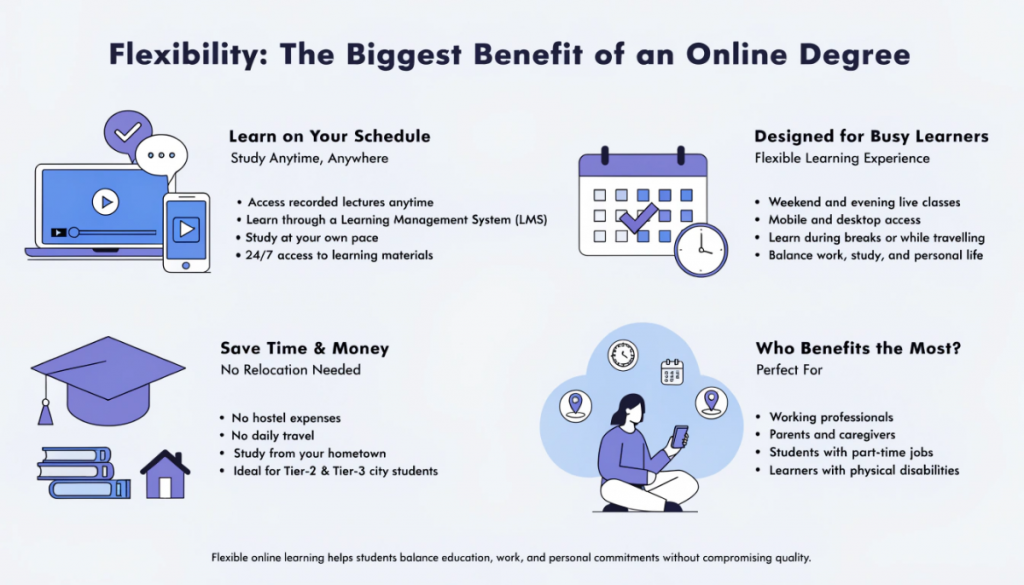
You can access recorded lectures, assignments and study materials at any time through a Learning Management System, which means your study schedule is built around your life and not the other way around
Live classes are typically scheduled on weekends or evenings so that working professionals and students with part-time jobs can attend without having to take time off during regular work hours
Self-paced modules within most online programs let you speed through topics you already understand while spending more time on areas that need work, which is something a fixed campus schedule cannot offer
There is no requirement to relocate for an online degree, which is a significant financial and personal benefit for students from Tier-2 and Tier-3 cities who would otherwise have to bear the cost of hostel accommodation, travel and the disruption of moving away from family
A 2024 survey found that more than 70% of Indian professionals prefer flexible learning formats over traditional classroom schedules, which confirms that this benefit is not just theoretical but a real deciding factor for most people choosing online education
The flexibility of an online degree also extends to the device you use since most programs are accessible through both desktop and mobile, which means you can study during a commute, on a lunch break or at any point in your day when you have 30 to 60 minutes available
For parents, caregivers and individuals with physical disabilities, this level of flexibility removes barriers that would otherwise make pursuing a degree practically impossible even if they meet all the academic eligibility criteria
Online Degree Benefits in Terms of Cost: How Much You Actually Save
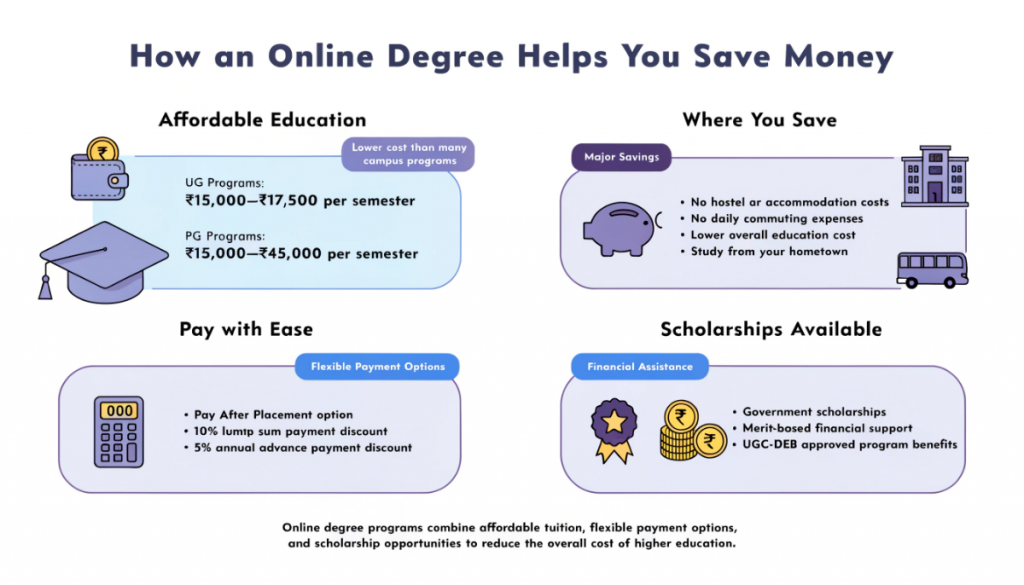
One of the most practical online degree benefits is the cost difference compared to a campus program. Here is a clear breakdown of where the savings actually come from:
Tuition fees for online UG programs typically range from 15,000 to 17,500 rupees per semester and for PG programs from 15,000 to 45,000 per semester, which is significantly lower than the fees at most private campus institutions for equivalent programs
You save on hostel and accommodation costs entirely since there is no requirement to stay on campus, which for many students represents a saving of 60,000 to 1.5 lakh rupees per year depending on the city they would otherwise have had to move to
Commuting costs and daily transportation expenses are eliminated, which adds up to a meaningful saving over a two to three year program especially for students in metro cities where public transport costs alone can run into thousands of rupees per month
Many online programs offer a pay after placement option where students pay a portion of the fee upfront and settle the remaining amount only after securing employment, which makes the degree financially accessible to students who cannot pay the full fee at the time of enrollment
Lump sum payment discounts of around 10% are available at several online programs for students who pay the full course fee upfront, which brings the net fee down further for those who have the funds available
Annual advance payment options offer an additional 5% discount at some programs for students who clear the full year’s fee at the start of the academic year rather than paying semester by semester
Government scholarships including the Merit Cum Means Scholarship and Post Matric Scholarships are applicable to UGC-DEB approved online programs, which means students from economically weaker backgrounds can access financial assistance for online degrees just as they would for a campus program
Career Growth Is a Real Online Degree Benefit, Not Just a Promise
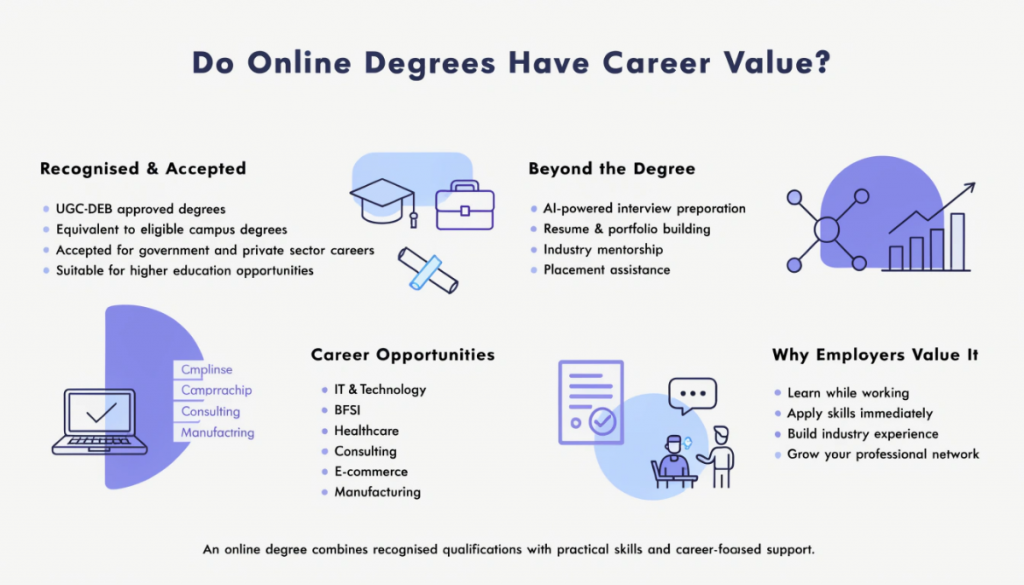
Some students worry that an online degree will not carry the same weight with employers as a campus degree. Here is what the actual picture looks like in 2026:
UGC-DEB approved online degrees are legally equivalent to regular degrees and are accepted for government job applications, civil service examinations and public sector roles in India just as a campus degree would be
Private sector employers across IT, BFSI, healthcare, consulting, e-commerce and manufacturing have increasingly moved to skills-based hiring where what you know and what you can do matters more than where or how you studied
An online MBA, MCA or BBA from an accredited institution carries real placement value, with top companies including Nestle, IBM, Tata, Accenture, HCL and Cognizant among those actively recruiting graduates from online programs at well-ranked institutions
For working professionals, an online degree earned while staying employed demonstrates to employers that you can manage multiple responsibilities simultaneously, which is a skill that hiring managers genuinely value
Career support offered by online programs now includes AI-based interview preparation, resume and portfolio building, industry mentorship sessions and dedicated placement cells that work with both online and campus students equally
The ability to apply learning immediately at your workplace is one of the most underappreciated online degree benefits for professionals since you can take a concept taught on Monday and apply it in a meeting on Tuesday, reinforcing both the theory and your professional performance at the same time
Students who complete an online degree while working also graduate with a stronger professional network than many campus students since they have maintained and grown their industry connections throughout the program rather than pausing their career for two to three years
Online Degree Benefits for Working Professionals Specifically
Working professionals are the fastest-growing group enrolling in online degree programs and the reasons are easy to understand when you look at what the format actually offers them. Here is what makes it the right fit:
An online degree allows you to continue drawing your salary while upgrading your academic qualification, which means you are not choosing between financial stability and education but rather combining both
Professionals who upgrade to a postgraduate degree like an online MBA or MCA while working report stronger negotiating positions when asking for promotions or salary revisions since they are bringing both experience and a higher qualification to the table simultaneously
The online degree syllabus for management and technology programs is built around real industry contexts, which means the case studies, projects and assignments are directly relevant to the work you are already doing rather than purely theoretical exercises
Programs designed for working professionals often include specialisations in areas like digital marketing, business analytics, HR management, IT management and supply chain, which allow you to align your degree with your existing career track or pivot into a new one
For professionals in Tier-2 and Tier-3 cities, an online degree from a nationally or internationally ranked institution would otherwise require either relocating or commuting to a campus, both of which are impractical without disrupting work, and the online format removes that constraint entirely
The Executive MBA route available through some online programs specifically requires work experience as an eligibility condition, with a bachelor’s degree carrying at least 50% marks alongside demonstrated professional experience, which means the program is deliberately built around a learner profile that already has industry context
Even a 5 to 15 hour weekly study commitment is enough to stay on track in most online programs, which means a full-time professional can complete a degree without burning out or falling behind if they plan their time consistently across weekdays and weekends
Access to Better Programs Is One of the Underrated Online Degree Benefits
One benefit that does not get discussed enough is the ability to enroll in programs from top-ranked institutions without geography being a limiting factor. Here is what this actually means in practice:
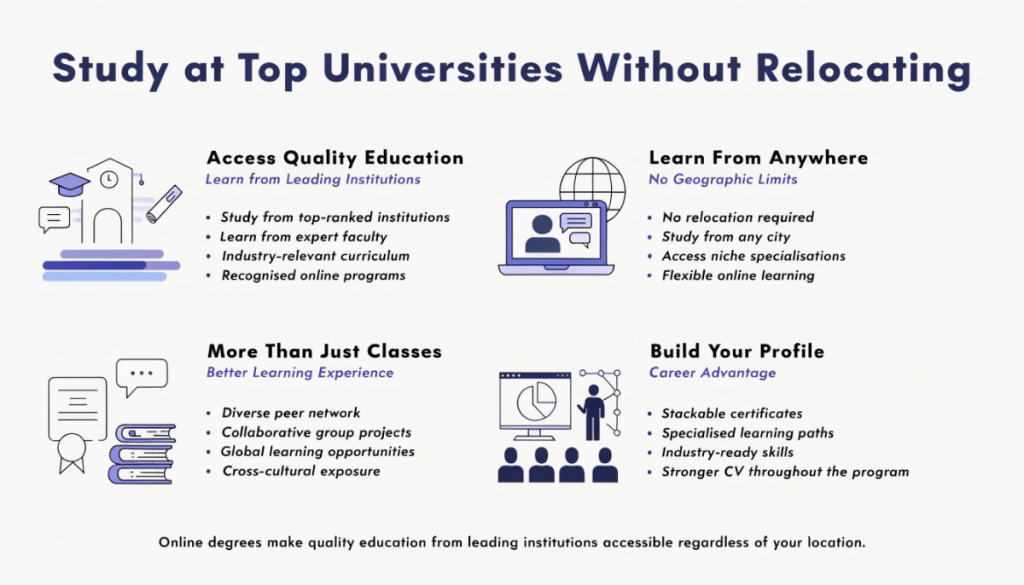
Students from any part of India can enroll in online degree programs from institutions ranked in the NIRF top 100 or recognised by QS World University Rankings without needing to qualify for a specific city or campus seat
Online programs from well-ranked institutions use the same faculty, the same curriculum and often the same assessments as their campus counterparts, which means the academic quality is not a watered-down version of the campus experience
The diversity of peers in an online program is often greater than in a campus setting since classmates come from different states, industries and professional backgrounds, which enriches discussions, group projects and the overall learning experience
Specialisations that are not available in your city can be accessed through online programs, which is a practical benefit for students in smaller cities who may have access to local colleges but not to programs in niche fields like business analytics, fintech or healthcare management
Global collaborations built into some online programs allow Indian students to interact with international peers and faculty, adding a cross-cultural perspective that is difficult to access through a purely local campus experience
Stackable credentials offered alongside the degree allow you to earn course-level certificates as you progress through the program, which adds to your CV incrementally rather than requiring you to wait two to three years before you have anything additional to show
Conclusion
Online degree benefits in 2026 go well beyond convenience. The financial savings are real, the career outcomes are documented, the academic equivalence is legally established and the flexibility genuinely removes barriers that have historically kept quality education out of reach for a large section of students and working professionals in India.
Whether you are a fresh graduate looking for a program that fits your current situation, a professional who wants to upgrade without quitting your job or someone in a smaller city who deserves access to a top-ranked degree without relocating, the online route offers something concrete for each of these situations.The right question to ask is not whether online education is as good as campus education but whether this specific accredited online program in this specific institution will get you to where you want to go.

Book Your
Free Session
Connect with our experts and get personalised guidance for your career, course selection, and future goals.
📖 Sources & References
✓ Verified 2026Verified online degree recognition, UGC regulations, career outcomes, flexibility, affordability and digital learning insights based on recognised educational, regulatory and industry sources.
- UGC India Recognition of online degrees, higher education regulations and academic equivalence guidelines
- Distance Education Bureau Approval framework for online and distance learning programmes in India
- Ministry of Education National Education Policy, digital learning initiatives and higher education reforms
- AICTE Technology-enabled learning, employability initiatives and quality standards in higher education
- World Economic Forum Future of Jobs reports, lifelong learning trends and digital workforce insights
- NASSCOM Digital skills demand, technology workforce trends and industry hiring reports
- LinkedIn Workforce Insights Employment trends, in-demand skills and professional learning insights
- National Career Service Career guidance, employability resources and opportunities for graduates across industries
- Shoolini Online Online degree programmes, admission guidance, learner support and career-focused education
- National Education Policy 2020 Flexible learning pathways, multidisciplinary education and digital higher education reforms