


Platform engineer salary is among the highest in the entire cloud-native and DevOps ecosystem and it sits above comparable roles like software engineer, DevOps engineer and site reliability engineer in every major market. According to Kube Careers Q1 2025 data, platform engineering pays 2 to 20 percent more than all other popular cloud-native job titles on average. If you are a DevOps or infrastructure engineer looking to transition into platform engineering or already in the role and benchmarking your pay, this guide covers verified figures from Glassdoor, Indeed, ZipRecruiter, PayScale and Salary.com updated to 2026 across India, the US and the UK. Platform engineer salary varies by seniority, company type and location and this guide covers all of it clearly.
What a Platform Engineer Does and Why It Commands Premium Pay
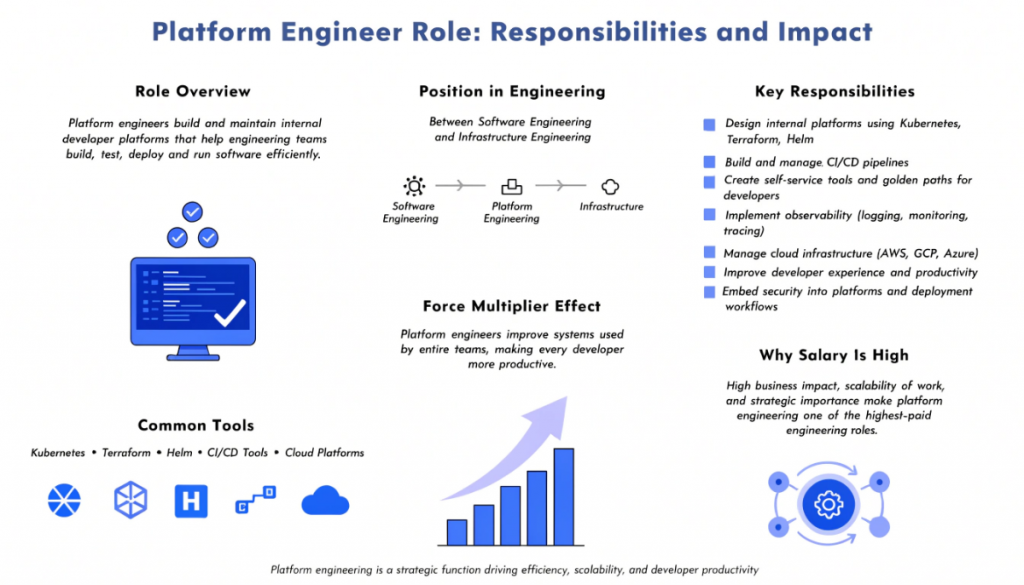
A platform engineer builds and maintains the internal developer platform that engineering teams use to build, test, deploy and operate software. The role sits between infrastructure engineering and software engineering. Platform engineers create the tools, pipelines, abstractions and self-service capabilities that allow product and application developers to ship code reliably without needing to manage low-level infrastructure directly. Here is what the day-to-day work typically involves:
Designing and building internal developer platforms using Kubernetes, Terraform, Helm and cloud-native tooling
Setting up and maintaining CI/CD pipelines that automate build, test and deployment workflows
Creating and maintaining golden paths and self-service templates that developer teams use to create new services
Implementing observability infrastructure including logging, monitoring, alerting and distributed tracing
Managing cloud infrastructure across AWS, Google Cloud or Azure at scale
Improving developer experience by reducing the cognitive overhead of infrastructure management for application teams
Collaborating with security teams to embed security controls into the platform and deployment pipeline
The platform engineer salary reflects the significant leverage this role has across an entire engineering organisation. A platform engineer’s work is a force multiplier because every improvement to the developer platform makes every product engineer more productive. That multiplier effect is why platform engineering is increasingly treated as a strategic function at technology companies and why the platform engineer salary sits consistently above most other engineering specialisations.
Platform Engineer Salary in India, US and UK
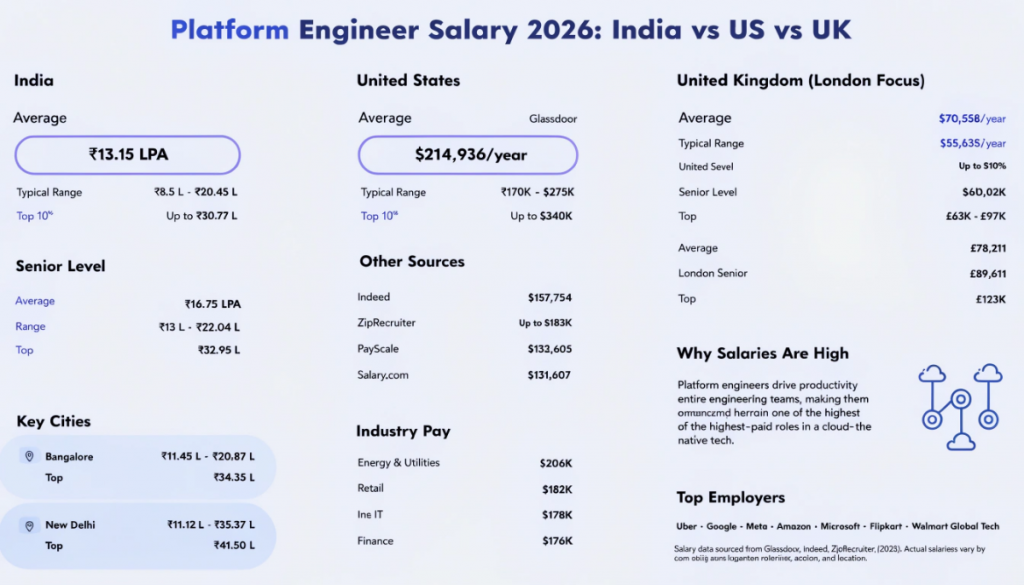
Here are the verified platform engineer salary figures from Glassdoor, Indeed, ZipRecruiter, PayScale and Salary.com from early 2026 across all three markets.
| Country | Average Salary | Entry / Mid Range | Senior / Top Range | Key Insights |
|---|---|---|---|---|
| India | ₹13.15L |
₹8.5L – ₹20.45L 25th to 75th percentile |
₹30.77L+ Top: ₹32.95L (senior) |
New Delhi leads at ₹23.43L avg. Senior roles ~₹16.75L. Product companies (Google, Amazon, Microsoft) pay significantly higher than IT services firms. |
| United States | $157K – $214K |
$170K – $275K Glassdoor 25th–75th percentile |
$340K+ Top: $183K+ (ZipRecruiter baseline) |
One of the highest-paid cloud roles. Pays 2–20% more than SRE/DevOps. Top firms: Uber, Google, Meta. IT & energy sectors lead. |
| United Kingdom | £70.5K |
£55.6K – £90.7K 25th to 75th percentile (London) |
£115.9K+ Top: £139.6K (senior London) |
London dominates market. Senior avg ~£78K–£89K. Strong demand across finance, tech and cloud-native startups. |
What Drives a Platform Engineer Salary Higher
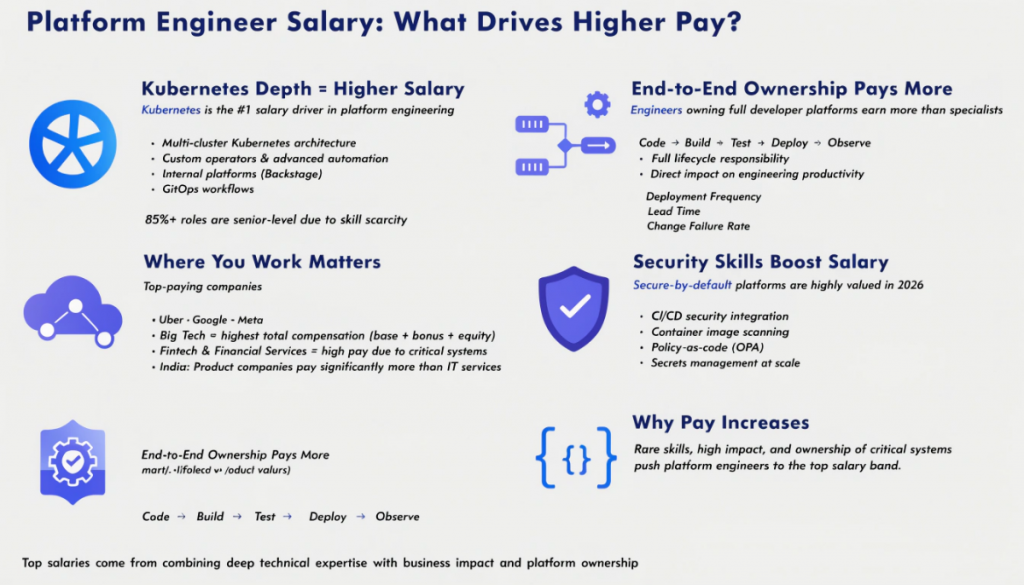
Within the platform engineer salary range there are specific factors that consistently push pay to the upper end of the band.
Kubernetes and Cloud-Native Depth
Kubernetes expertise is the single most important technical factor in determining where a platform engineer sits in the salary range. According to Kube Careers Q1 2025 analysis, 85.1 percent of platform engineer roles are senior-level which is 10 percent higher than equivalent DevOps roles. This senior-heavy distribution exists precisely because deep Kubernetes and cloud-native knowledge is hard to develop and harder to replace. Platform engineers who can design multi-cluster Kubernetes architectures, implement custom operators, build internal developer platforms on top of Backstage and manage complex GitOps workflows are genuinely scarce and their platform engineer salary reflects that scarcity across every market.
Employer Type and Company Size
The employer has a direct and significant impact on platform engineer salary. At large technology companies like Uber, Google and Meta which are specifically identified by Glassdoor as the top paying US employers for this role, platform engineers earn total compensation well above the national average driven by base, bonus and equity. Financial technology firms and major financial services companies also pay strongly because their engineering infrastructure requirements are complex and their cost of downtime is high. In India the gap between IT services firm pay and product company pay for platform engineers is particularly wide. Moving from an IT services employer to a technology product company is one of the most impactful single moves for platform engineer salary improvement at the mid level.
Breadth of Platform Ownership
Platform engineers who own a broader piece of the developer platform earn more than those with narrower scope. Owning the full developer experience from code commit through build, test, deploy and observe is a significantly higher-value role than maintaining one component of the pipeline. Platform engineers who can articulate the end-to-end impact of their work on developer productivity metrics like deployment frequency, lead time and change failure rate have a concrete business case for a stronger platform engineer salary because those metrics directly link platform quality to engineering velocity and business outcomes.
Security Engineering Integration
Platform engineers who can embed security controls natively into the CI/CD pipeline and deployment platform rather than leaving security as a separate concern are increasingly valued in 2026. This includes implementing supply chain security practices, container image scanning, policy-as-code with tools like Open Policy Agent and secrets management at scale. The ability to build a secure-by-default platform reduces an organisation’s vulnerability surface without slowing down development teams and it is a capability that measurably supports a stronger platform engineer salary particularly at financial services, healthcare and enterprise technology companies where compliance requirements are highest.
Platform Engineer Salary vs Related Roles
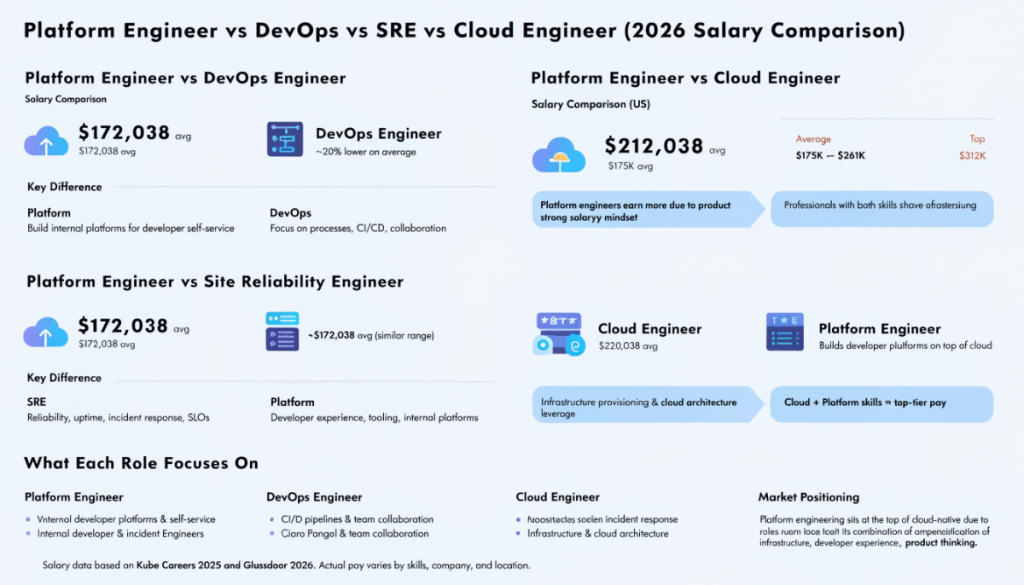
Understanding how platform engineer salary compares to closely related roles gives a clearer picture of where this specialisation sits in the broader engineering market.
Platform Engineer vs DevOps Engineer
Platform engineering grew out of DevOps and the two roles are closely related but meaningfully different in focus and pay. According to Kube Careers Q1 2025 analysis, the average platform engineer salary at $172,038 is approximately 20 percent higher than the average DevOps engineer salary. DevOps engineers focus on processes, collaboration and deployment pipelines between development and operations teams. Platform engineers focus specifically on building the internal platform that enables developer self-service at scale. The additional product engineering mindset required in platform engineering compared to DevOps is a key reason for the salary premium.
Platform Engineer vs Site Reliability Engineer
Site reliability engineers focus on the reliability, availability and performance of production systems including incident response, on-call operations and service level objective management. Platform engineers focus on the developer experience and internal tooling that allows teams to build and deploy reliably. According to Kube Careers Q1 2025 data, the average platform engineer salary at $172,038 slightly exceeds the average SRE salary at $172,038 as well with both sitting near the top of the cloud-native engineering pay range. The two roles are complementary and professionals who can bridge both functions have strong platform engineer salary leverage in negotiations.
Platform Engineer vs Cloud Engineer
Cloud engineers focus on cloud infrastructure provisioning, architecture and management. Platform engineers work with cloud infrastructure but layer developer platform tooling and internal product thinking on top of it. The cloud platform engineer specifically combines both domains and according to Glassdoor March 2026 data based on 112 salary submissions the average cloud platform engineer salary in the US is $212,007 per year with the range from $175,799 to $261,053 and top earners reaching $312,806. This is comparable to the general platform engineer salary on Glassdoor reflecting that the market treats these as equivalent-value specialisations when cloud and platform skills are combined.
Core Skills That Every Platform Engineer Needs
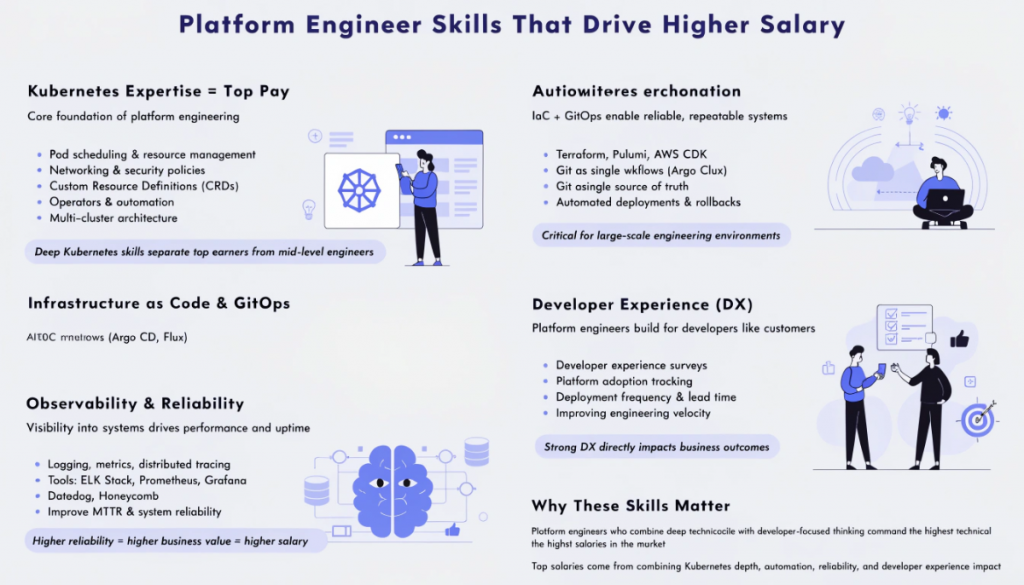
The skills you build directly determine your effectiveness and your position in the platform engineer salary range.
Kubernetes and Container Orchestration
Kubernetes is the foundational technology of modern platform engineering and deep fluency in it is the minimum requirement for any serious platform engineer role. This means understanding pod scheduling, resource management, network policies, custom resource definitions, operators and cluster federation. Platform engineers at the senior level who can design and operate multi-cluster Kubernetes environments at scale are the most sought-after professionals in the cloud-native market. This depth of Kubernetes knowledge is the primary technical factor that separates platform engineer salary at the top of the range from the middle.
Infrastructure as Code and GitOps
Infrastructure as Code using tools like Terraform, Pulumi or AWS CDK is a core platform engineering skill because it enables consistent, reproducible and auditable infrastructure provisioning. GitOps workflows using tools like Argo CD or Flux extend this principle to continuous deployment by using Git as the single source of truth for both application and infrastructure state. Platform engineers who can design and operate a complete GitOps delivery model bring significant operational discipline and reliability to an engineering organisation and this capability directly supports a stronger platform engineer salary at companies that operate at scale.
Observability and Platform Reliability
Platform engineers are responsible for the observability stack that the entire engineering organisation relies on to understand system behaviour. This means designing and operating logging, metrics and tracing infrastructure using tools like the ELK Stack, Prometheus, Grafana, Datadog or Honeycomb. Platform engineers who build observability systems that give development teams genuine visibility into production without requiring them to manage the underlying instrumentation create measurable improvements in mean time to recovery and system reliability. This reliability focus is a capability that is valued above the average platform engineer salary at organisations where uptime directly translates to revenue.
Developer Experience and Internal Product Thinking
The best platform engineers think like product managers for their internal developer users. This means conducting developer experience surveys, measuring platform adoption rates, tracking developer productivity metrics like deployment frequency and lead time and prioritising platform improvements that have the highest impact on engineering velocity. According to Platform Engineering dot com’s analysis, platform engineering is on a double-digit growth trajectory for at least the next decade precisely because organisations are recognising the commercial value of improving developer experience at scale. Platform engineers who can quantify and communicate their team’s impact on these metrics have a concrete and compelling case for a stronger platform engineer salary in both hiring and performance review conversations.
Certifications That Strengthen a Platform Engineer Profile
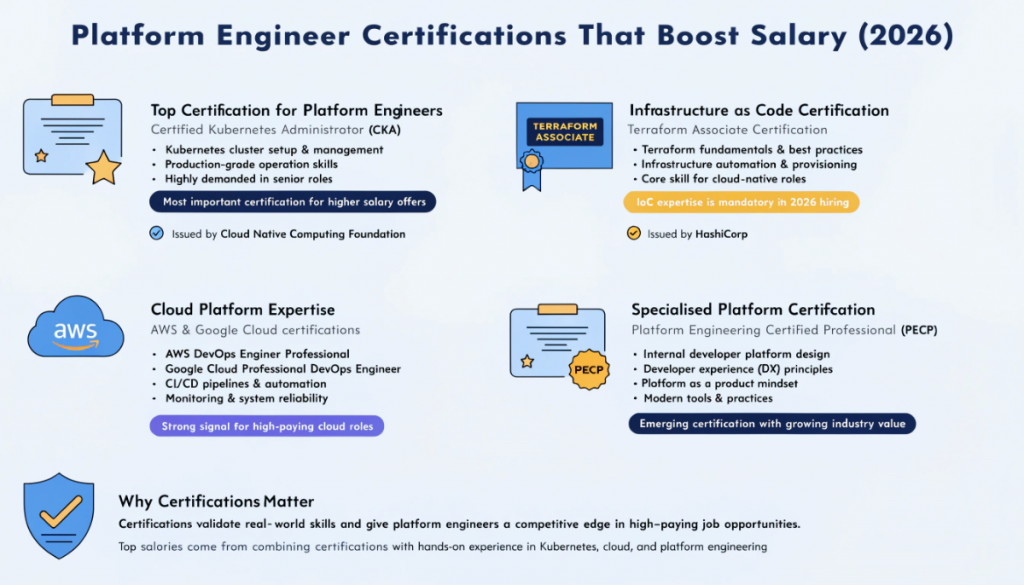
The right certifications validate your expertise and in competitive hiring situations directly support a stronger platform engineer salary offer.
Certified Kubernetes Administrator (CKA)
The Certified Kubernetes Administrator from the Cloud Native Computing Foundation is the most important professional credential in platform engineering. It validates the ability to install, configure and manage production Kubernetes clusters and is specifically required or strongly preferred by most senior platform engineer job postings. Holding the CKA is the most direct credential-based signal of Kubernetes operational competence that hiring managers look for and it supports a measurably stronger platform engineer salary offer in most markets. Platform engineers who follow it with the Certified Kubernetes Application Developer and Certified Kubernetes Security Specialist build a comprehensive credential set that covers the full Kubernetes skills spectrum.
Terraform Associate Certification
The HashiCorp Terraform Associate certification validates proficiency in using Terraform to provision and manage infrastructure as code. Terraform is the dominant IaC tool in platform engineering and holding this certification demonstrates both theoretical understanding and practical ability to use it correctly. For platform engineers targeting mid and senior roles this credential directly supports a stronger platform engineer salary case because IaC proficiency is a non-negotiable expectation at most cloud-native engineering organisations in 2026.
AWS DevOps Engineer or Google Cloud Professional DevOps Engineer
Cloud provider professional-level certifications in DevOps and platform engineering specifically are among the most valued credentials in the market. The AWS DevOps Engineer Professional and Google Cloud Professional DevOps Engineer certifications validate deep knowledge of CI/CD pipelines, monitoring, infrastructure reliability and deployment automation on the respective platforms. For platform engineers whose organisations run on AWS or Google Cloud these certifications directly signal the breadth of platform engineering capability that hiring teams are looking for and they support a stronger platform engineer salary offer particularly at companies that are deeply invested in a single cloud provider.
Platform Engineering Certified Professional (PECP)
The Platform Engineering Certified Professional from the Platform Engineering community is a newer but growing credential specifically designed for professionals in this field. It covers internal developer platform design, developer experience principles, platform as a product thinking and the key tools and practices of modern platform engineering. As platform engineering has matured as a distinct discipline separate from general DevOps, employer recognition of this credential has grown. For platform engineers who want to validate their role-specific expertise beyond general cloud certifications the PECP provides a focused credential that directly supports a platform engineer salary conversation framed around the specific value platform engineering creates.
Conclusion
Platform engineer salary is genuinely at the top of the cloud-native engineering pay spectrum and the data from 2026 confirms that consistently across all three markets. Based on verified data from Glassdoor, Indeed, ZipRecruiter, PayScale and Kube Careers, the average platform engineer salary in India is Rs 13.15 lakh nationally with New Delhi averaging Rs 23.43 lakh and senior professionals reaching Rs 32 lakh to Rs 41 lakh at top employers.
In the US the average ranges from $131,607 on Salary.com to $214,936 on Glassdoor depending on seniority with top earners at FAANG companies reaching $340,973 and beyond. In the UK the London average is GBP 70,558 with senior engineers averaging GBP 89,736 in London and GBP 78,211 nationally. Building deep Kubernetes expertise, targeting technology product companies or financial services firms and earning the CKA certification are the three most direct ways to push a platform engineer salary to the top of the market range at any career stage.

Book Your
Free Session
Connect with our experts and get personalised guidance for your career, course selection, and future goals.

📖 Sources & References
✓ Verified 2026Verified salary insights across India, US, and UK based on 2026 data.
- Glassdoor India Avg ₹13.15L | Range ₹8.5L–₹20.45L | Top ₹30.77L+
- New Delhi Glassdoor Avg ₹23.43L | Senior ₹16.75L+
- India PayScale Verified India compensation insights
- Indeed India Platform engineer salary benchmarks in India
- US Glassdoor Avg $157K–$214K | Top $340K+
- US ZipRecruiter Senior compensation and hiring trends
- US Salary.com Average US platform engineer salary data
- UK Glassdoor London avg £70.5K | Senior £115.9K+
- Kube Careers Q1 2025 Platform engineering pay vs DevOps and SRE
- PlatformEngineering.com Developer experience and platform engineering growth trends