

A skills gap analysis is one of the most practical tools an organisation or individual can use to identify exactly where they stand today versus where they need to be to perform at a higher level. In a job market where technology is changing faster than most training programmes can keep up with and where employers consistently report difficulty finding candidates with the right combination of technical and soft skills, understanding the gaps in your current skill set is not optional.
According to the World Economic Forum’s Future of Jobs Report 2023 more than half of all employees will need significant reskilling by 2025 making skills gap analysis a business priority rather than an HR formality. Whether you are an HR professional building a training plan for your workforce, a manager identifying development needs in your team or an individual mapping your own career path, a well-executed skills gap analysis gives you the clarity to act rather than guess.
This guide covers exactly what a skills gap analysis involves, how to conduct one step by step and how tools and resources like CareerTigers can help individuals close the gaps they identify
What a Skills Gap Analysis Actually Means
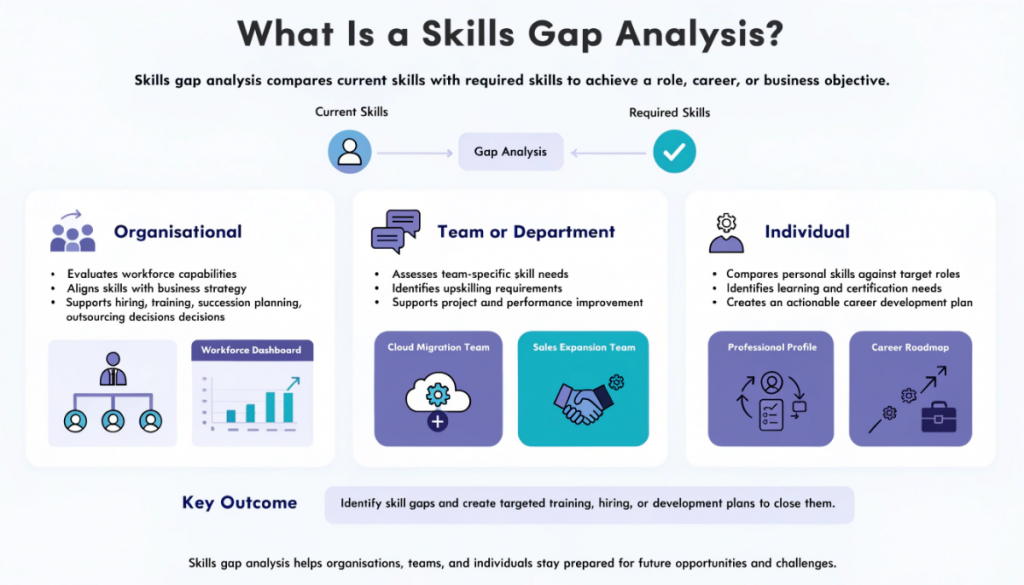
A skills gap analysis is the process of comparing the skills an individual or workforce currently has against the skills required to meet a specific goal, role or business objective. The gap between the two is what the analysis identifies and what training, hiring or restructuring plans are then built to close.
The concept applies at three levels and understanding which level you are working at determines how you structure the analysis.
Organisational Level
At the organisational level a skills gap analysis looks at the collective capability of the entire workforce against the skills the business needs to achieve its strategic objectives over the next one to three years. This is typically done by HR leadership and involves comparing current employee skills data against a skills framework derived from business strategy.
The outcome informs workforce planning decisions including hiring targets, training investment, succession planning and potential outsourcing of capabilities the organisation cannot build quickly enough internally.
Team or Department Level
At the team level a skills gap analysis examines the specific technical and behavioural skills within a department against what that team needs to deliver its function effectively. A technology team undergoing a cloud migration might conduct a skills gap analysis to understand how many of its current engineers have cloud architecture skills and how many need upskilling before the migration begins.
A sales team expanding into a new market might conduct one to identify which team members have the language skills, product knowledge and consultative selling capabilities needed for the new territory.
Individual Level
At the individual level a skills gap analysis is the process of honestly assessing your own current skills against the requirements of a target role, promotion or career transition. Career guidance platforms like CareerTigers specifically help individuals run this kind of assessment by mapping their current profile against the skill requirements of specific career paths and identifying the courses, certifications or experiences most likely to close the gaps efficiently. For anyone planning a career change or targeting a specific job role within the next six to twelve months a personal analysis is the most structured way to build an actionable development plan.
Why Doing a Skills Gap Analysis Matters More Than Ever in 2026
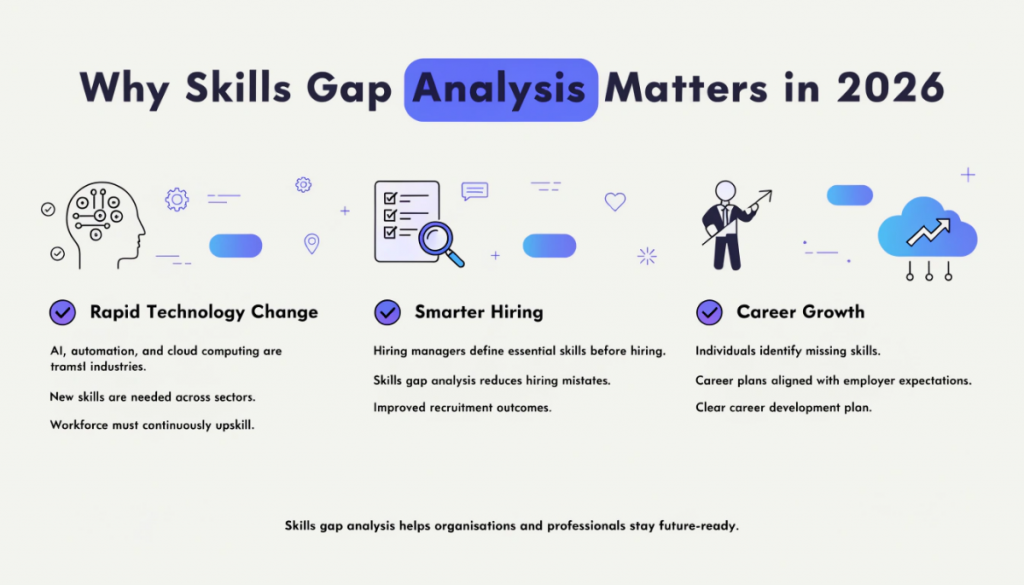
The skills gap analysis has become a more urgent business process in 2026 than it was even three years ago and there are specific structural reasons for that acceleration.
Technology Is Changing Faster Than Hiring Can Keep Up
Artificial intelligence, cloud computing, automation and data analytics have fundamentally changed the skill requirements of roles across every sector. A marketing manager in 2026 is expected to understand marketing automation platforms and data attribution in ways that were specialist skills five years ago.
A finance professional is expected to use Python or Power BI for analysis in ways that were previously the domain of data teams. These shifts happen faster than traditional degree programmes can update their curricula and faster than most organisations can hire their way to the skills they need. A skills gap analysis is the only structured way to understand exactly which of these new capability requirements your workforce or your personal profile is currently missing.
The Cost of Getting Hiring Wrong
A poor hire costs an organisation an average of 30 percent of that employee’s first-year salary according to the US Department of Labor.
When hiring decisions are made without a clear skills gap analysis to define exactly what is needed the risk of misalignment between role requirements and candidate capability increases significantly.
Running a skills gap analysis before opening a requisition forces clarity on which skills are truly essential, which can be trained on the job and which are genuinely differentiating so that the hiring process targets the right profile from the start.
Individual Career Risk Is Also Real
From an individual perspective the cost of not conducting a personal skills gap analysis is career stagnation or being passed over for opportunities you thought you were qualified for. CareerTigers specifically addresses this by helping professionals understand which skills employers in their target sector are actually demanding today rather than what the job title they are targeting conventionally required five years ago.
The difference between what candidates assume they need and what employers actually want is often where careers stall and a structured skills gap analysis is the tool that surfaces that difference clearly.
How to Conduct a Skills Gap Analysis: Step by Step
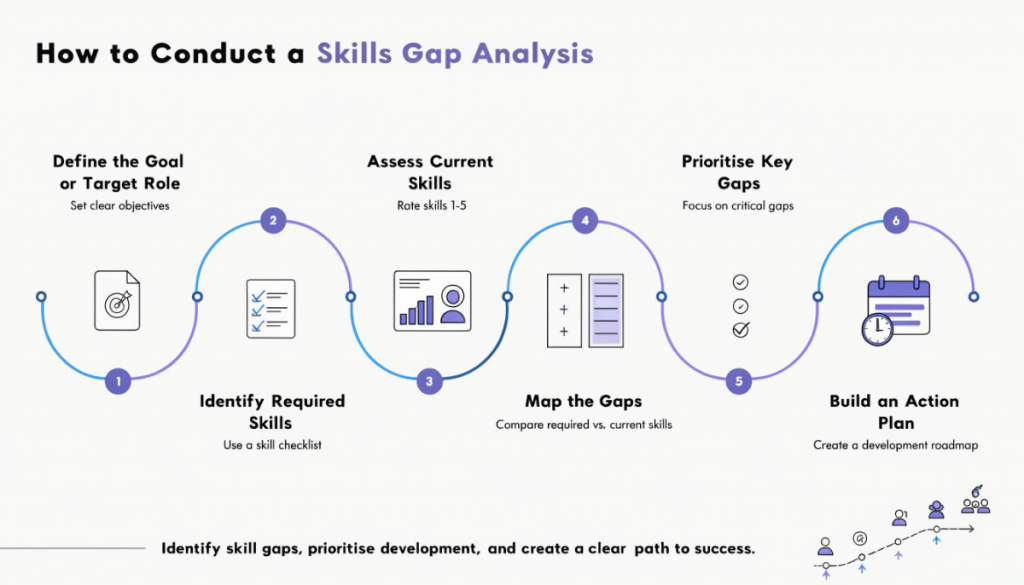
A skills gap analysis follows a clear process whether you are doing it for an organisation or for your own career. Here is the complete step-by-step approach.
Step 1: Define the Goal or Target Role Clearly
The first step is defining exactly what you are comparing current skills against. For an organisation this means specifying the business objective or future state you are planning for. For an individual this means identifying the specific role, level or career direction you are targeting.
Without a clearly defined target the skills gap analysis produces a list of generic development areas rather than a specific actionable gap map. If you are using CareerTigers as a career planning resource the role-specific guidance on the platform helps define the precise skill requirements of the career path you are targeting before the gap analysis begins.
Step 2: Identify the Skills Required for That Goal
Once the goal is defined the next step is building a comprehensive list of the skills required to achieve it. For organisations this involves:
Reviewing job descriptions for roles that will be needed in the future state
Consulting with department heads and senior leaders about what capabilities their teams need to build
Benchmarking against industry frameworks and competitor workforce compositions
Mapping skills to specific business outcomes rather than abstract competency labels
For individuals this involves researching job postings for the target role and extracting the most consistently required skills, reviewing LinkedIn profiles of people currently in that role to understand their backgrounds and using career tools to identify both technical hard skills and the behavioural soft skills that employers in that function prioritise.
Step 3: Assess Current Skills Honestly
The third step is the most uncomfortable part of the process because it requires an honest assessment of current capabilities rather than assumed ones. For organisations this typically involves:
Self-assessment surveys completed by employees rating their own proficiency in defined skill areas
Manager assessments evaluating each team member’s demonstrated skills in the same areas
Objective skills tests or technical assessments for roles where proficiency can be directly measured
Performance data analysis to identify where skill gaps are already showing up in output quality or delivery speed
For individuals the honest assessment step means rating your own current skills in each of the areas identified in step two using a simple scale such as beginner, intermediate, proficient or expert. The temptation in a personal skills gap analysis is to rate yourself generously. A more useful approach is to rate yourself based on whether you could demonstrate that skill convincingly in an interview or use it independently in a real work situation today.
Step 4: Map the Gaps
With both the required skills list and the current skills assessment complete the gap mapping step simply identifies where the two diverge. For each skill required by the target goal you now have a clear picture of whether it is absent entirely, present but underdeveloped, adequate for the current level but insufficient for the target level or fully developed. This gap map is the core output of this analysis and it is what all subsequent decisions about training, hiring and development are built on.
Step 5: Prioritise Which Gaps to Close First
Not all gaps in a skills gap analysis are equally urgent. Prioritisation depends on two factors: how critical is this skill to the target goal and how large is the current gap. Skills that are both critical and significantly underdeveloped should be addressed first. Skills that are important but only mildly underdeveloped can be addressed through on-the-job experience or lighter-touch development. Skills that are desirable but not essential can be deprioritised until the critical gaps are closed.
Step 6: Build a Specific Closing Plan
The final step is turning the gap map and prioritisation into a specific action plan. For each prioritised gap identify:
The most effective way to close it: formal training, certification, mentoring, project-based learning, job shadowing or hiring
A realistic timeline based on the urgency of the gap and the time available for development
The resources required including budget, time and access to learning platforms or external providers
A measurable success criterion so you know when the gap has actually been closed rather than just partially addressed
For individuals, resources like CareerTigers can help identify which specific courses, certifications or experiences are most valued by employers in your target career and which are most efficient for closing common skill gaps in that domain.
The Most Common Skills Gaps Across Industries in India in 2026
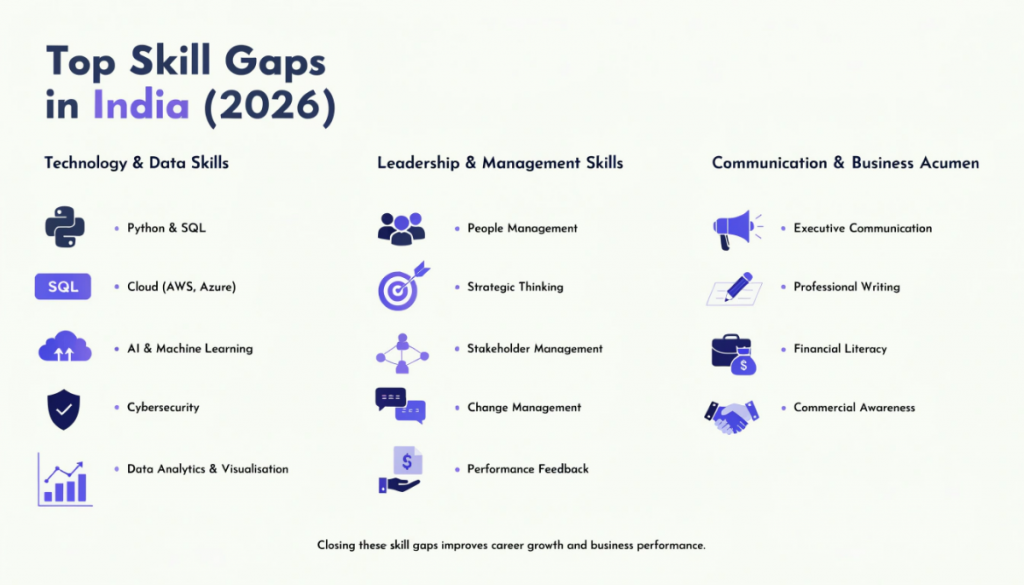
Understanding what the most prevalent skill gaps actually are across Indian industries helps organisations benchmark their own analysis and helps individuals prioritise which gaps are most commercially important to close.
Technology and Data Skills
Across every sector in India the most consistently reported skills gap in 2026 is in technology and data capabilities. This includes:
Python and SQL proficiency for data analysis roles across BFSI, e-commerce and consulting
Cloud platform skills including AWS and Azure across IT services, manufacturing and logistics
Machine learning and AI application skills across product companies and large enterprises
Cybersecurity skills across every regulated industry including banking, healthcare and government technology
Data visualisation and analytics skills for management and business roles beyond traditional IT functions
The technology skills gap is particularly significant in India because the pace of digital transformation has outrun the capacity of educational institutions to update their curricula. CareerTigers specifically addresses this by helping professionals in non-technical roles identify which technology skills are most relevant to their career context and the most efficient path to building them.
Leadership and Management Skills
The second most consistently reported gap in Indian organisations is in leadership and people management capability, particularly at the transition from individual contributor to first-time manager. Common gaps include:
Giving and receiving feedback constructively without damaging working relationships
Managing performance including having difficult conversations about underperformance
Strategic thinking and the ability to prioritise at a team or department level rather than only at a task level
Cross-functional stakeholder management and influencing without direct authority
Change management capability as organisations restructure and adopt new technologies
Communication and Business Acumen
Despite being broadly considered soft skills communication and business acumen gaps have hard commercial consequences. The specific gaps most frequently identified in skills gap analysis exercises at Indian organisations include:
Executive communication: presenting to senior stakeholders clearly and concisely with appropriate business framing
Written communication: producing clear professional documents, reports and emails that serve their purpose without being unnecessarily long
Financial literacy: understanding P&L statements, budgets and ROI calculations well enough to participate in business decisions
Commercial awareness: understanding how the broader industry, competitive landscape and economic environment affect the business
Tools and Methods That Make a Skills Gap Analysis More Accurate
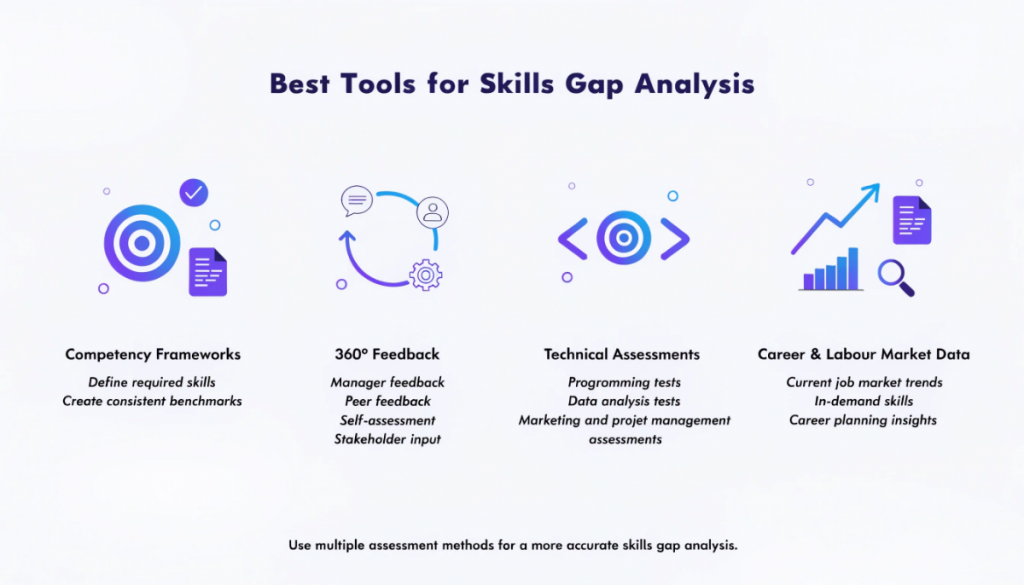
The quality of a gap analysis depends heavily on the quality of the tools and methods used to collect skills data. Here are the approaches that produce the most reliable results.
Competency Frameworks
A competency framework defines the specific skills and behaviours expected at each level of a role or career track. Building or adopting a competency framework before conducting the skills gap analysis gives the assessment a consistent reference point rather than relying on vague skill labels.
Most large organisations have existing competency frameworks for their primary functions and the analysis maps current capabilities against these defined levels. For individuals the job description and LinkedIn data of people already in target roles serves as an informal competency framework that the personal skills gap analysis can map against.
360-Degree Feedback
360-degree feedback collects skills assessments from multiple sources including the individual themselves, their direct manager, their peers and in client-facing roles their external stakeholders.
This multi-source approach significantly reduces the distortion that comes from self-assessment alone and produces a more accurate picture of where gaps genuinely exist. At the team or individual level 360-degree feedback is one of the most reliable data sources available particularly for identifying gaps in behavioural and leadership skills that are harder to assess through tests.
Technical Skills Assessments
For technical skills a direct assessment is more reliable than a self-rating. Platforms that offer objective technical assessments in areas like programming, data analysis, financial modelling, project management and digital marketing allow organisations to replace subjective self-reports with actual demonstrated capability data.
Using technical assessments produces a much more accurate gap map for technical roles than relying entirely on manager or self-assessments and it removes the grade inflation that typically occurs when professionals rate their own technical proficiency.
Career Platforms and Labour Market Data
For individuals conducting a personal skills gap analysis career platforms provide a critical external reference point that self-assessment alone cannot provide. CareerTigers helps professionals understand what skills employers in specific career tracks are actually requiring in current hiring processes rather than what candidates assume is needed based on conventional wisdom.
Cross-referencing the analysis with current labour market data ensures that the gaps you prioritise closing are the ones that actually matter to employers today rather than historically.
Turning the Skills Gap Analysis Into Actual Development That Sticks
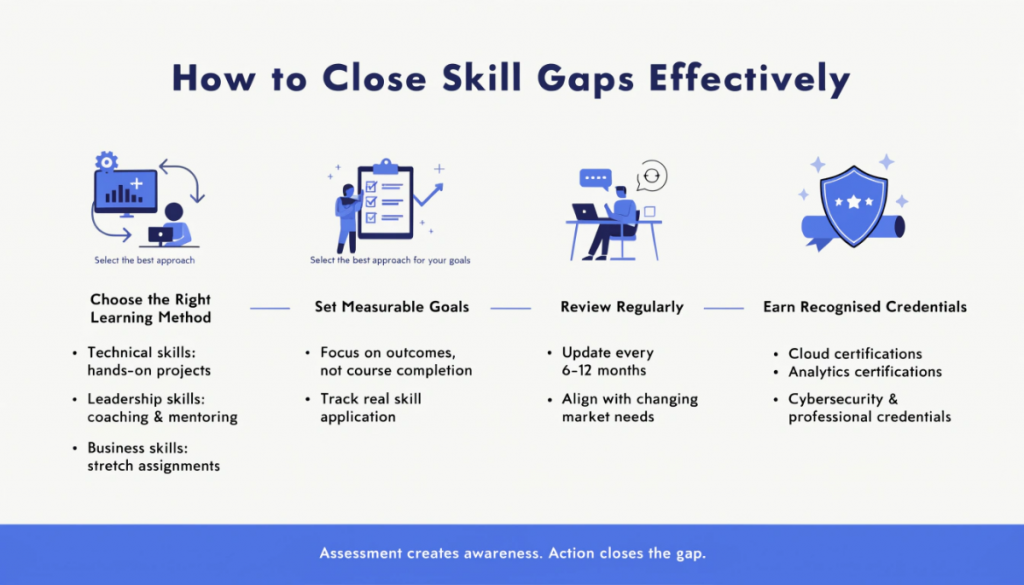
The most common failure in skills gap analysis is producing an excellent assessment and then not implementing the development plan effectively. Here is what actually works.
Match the Learning Method to the Skill Type
Different skills close best through different learning methods and matching the two is what separates development that works from training that is forgotten in a week.Technical skills like Python, SQL or cloud architecture close most effectively through hands-on project-based learning where the learner applies the skill to real problems immediately rather than absorbing theory.
Leadership and communication skills close most effectively through coaching, mentoring and practice in real situations with structured feedback. Strategic and business skills close most effectively through exposure to senior decision-making conversations, stretch assignments and cross-functional projects. Using the wrong method consistently produces poor ROI even when the analysis itself was accurate.
Set Measurable Milestones Not Vague Intentions
The most common reason gap analysis plans fail in practice is that the closing actions are defined as intentions rather than measurable outcomes. Completing a Python course is an action. Being able to independently clean a dataset, run a regression and visualise the output is a measurable outcome.
The distinction matters because the action can be completed without the skill actually being closed if the learning was passive rather than applied. Building measurable milestones into the gap closing plan from the start ensures that progress is real rather than nominal.
Review the Gap Analysis Regularly
This is not a one-time exercise. As business objectives evolve, technology changes and team compositions shift the gap map needs to be updated. Most organisations that use this process effectively build it into their annual performance review and workforce planning cycles rather than treating it as a standalone project.
For individuals revisiting the skills gap analysis every six to twelve months ensures that the development plan stays aligned with where the market is moving rather than where it was when the analysis was first conducted. Career platforms like CareerTigers are particularly useful for individual gap analysis reviews because they reflect current labour market demand rather than fixed frameworks that can become outdated quickly.
Close Gaps with Credentials Where Possible
For gaps that are commercially significant closing them with a recognised credential rather than just informal development adds verifiable proof of the skill to a professional profile.This matters because the skills gap analysis closes a gap internally but the job market only recognises externally verifiable evidence of capability.
AWS certifications for cloud skills, Google Analytics certifications for digital marketing skills, CFA for investment knowledge, SHRM for HR skills and CompTIA Security+ for cybersecurity are all examples of credentials that simultaneously close the skill gap and make the closure visible to external employers and hiring managers.
Conclusion
This process is the most practical starting point for any individual or organisation that wants to develop capability with purpose rather than spending time and money on generic training that may or may not address the actual gaps that matter. The process is straightforward: define the target, identify what is needed, assess what exists, map the difference, prioritise by urgency and build a specific closing plan with measurable outcomes.
For individuals running a personal skills gap analysis tools like CareerTigers provide the labour market context needed to ensure the gaps you are focusing on are the ones that employers actually care about rather than the ones that feel obvious from inside your own career.The analysis is only as valuable as what you do with it so the goal is not a perfect assessment document but a development plan that moves you or your team from where you are today to where you need to be.
The next-gen Career Services platform for campus learners.
Shape Your Future With Confidence
Discover the right career path through expert counselling, psychometric assessments, admission guidance, and study abroad support.