

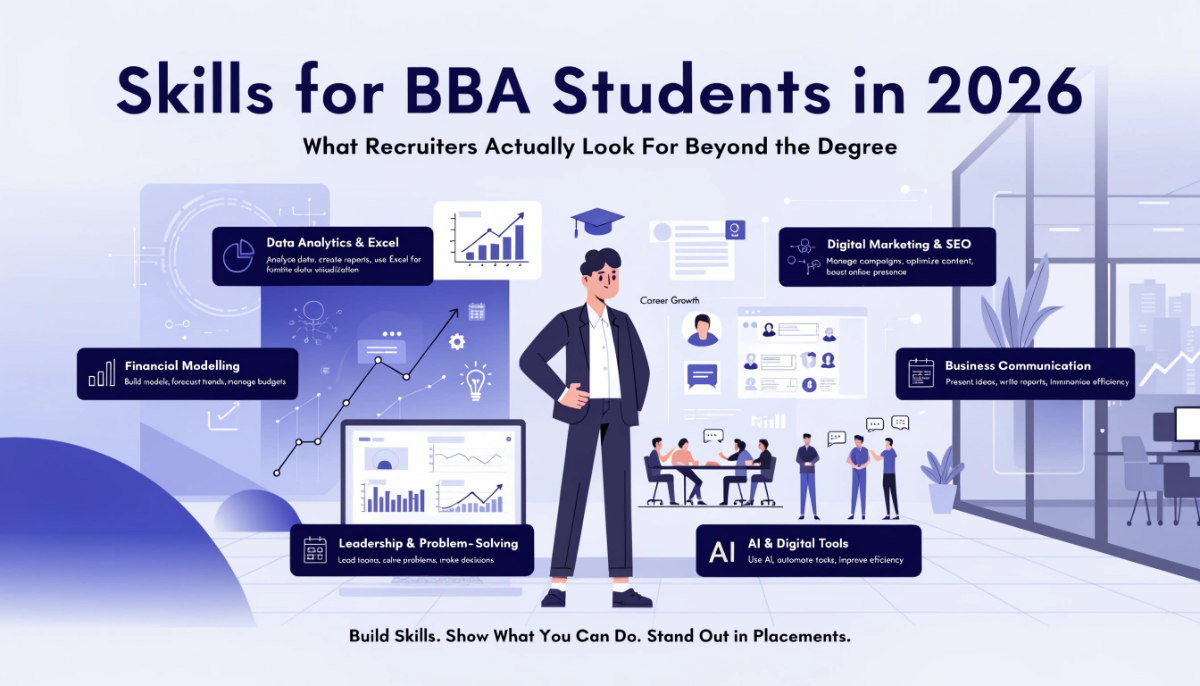
Getting a BBA is no longer enough on its own to land a good job. The market in 2026 is clear about this and recruiters across India have shifted from looking at your degree to looking at what you can actually do.
The skills for BBA students that matter most today go well beyond what any classroom covers, from data literacy and digital tools to communication, financial thinking and leadership under pressure. This blog breaks down every skill category that BBA graduates need in 2026, why each one matters, what employers are specifically testing for and how to start building these capabilities during your program rather than scrambling for them after graduation.
Why the Right Skills Matter More Than the BBA Degree Alone
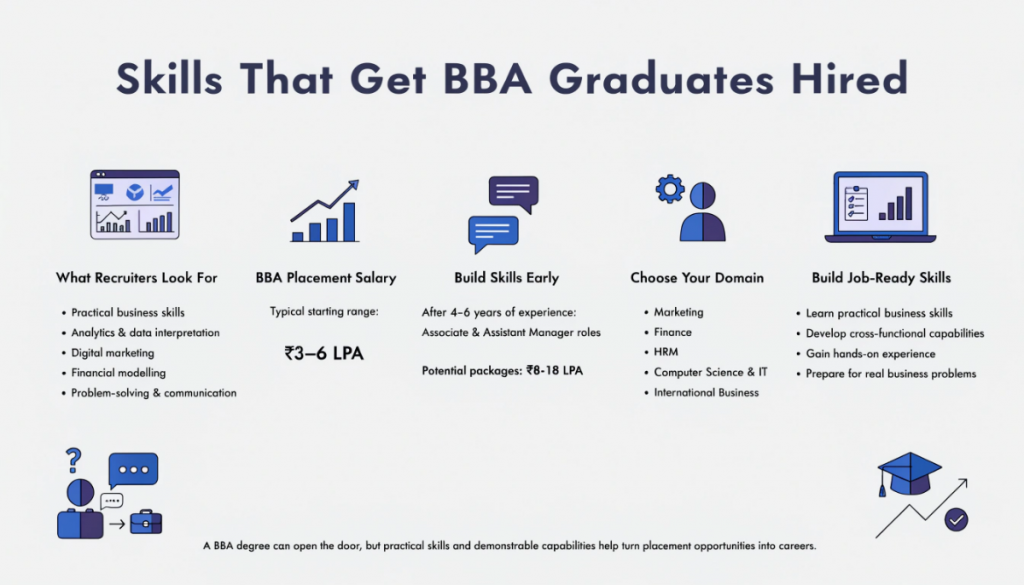
The shift in how companies hire management graduates has been gradual but it is now clearly visible at the placement level. Here is what the current picture actually looks like:
Recruiters across FMCG, BFSI, consulting, e-commerce and startups have moved to skills-based hiring at the entry level, where the degree gets you shortlisted but what you can demonstrate in interviews and assessments is what gets you the offer
Fresh BBA graduates in India start in the range of 3 to 6 LPA depending on specialisation, city and the skills they bring, while those with verifiable capabilities in analytics, digital marketing or financial modelling see starting packages of 5 to 8 LPA at campus placements
Companies with 250 or more hiring partners for BBA graduates specifically look for candidates who can contribute from day one rather than candidates who need six months of internal training before they can handle a live business problem
The BBA program that prepares you for this environment requires 10+2 from a recognised board with a minimum of 40% marks, with SC and ST candidates eligible with 35%, no entrance exam required and UGC-DEB and AICTE approval ensuring the degree is valid across both private and government sector employers
Specialisations in Marketing, Finance, HRM, Computer Science, IT and International Business give BBA students a domain to build depth in, but the cross-functional skills that every specialisation demands are what employers assess in the first interview round before domain knowledge is even tested
BBA graduates with 4 to 6 years of experience who built strong skills early in their careers consistently move into associate and assistant manager roles with packages in the 8 to 18 LPA range, while those without a skills foundation tend to plateau at the executive level for longer
The pay after placement option available in some online BBA programs is not just a financial arrangement but a signal that the institution is confident enough in its placement outcomes to defer a portion of the fee, which is only sustainable if the program is building graduates with skills that employers are actually willing to hire
Data Literacy and Analytics: The Skill Gap Most BBA Students Have
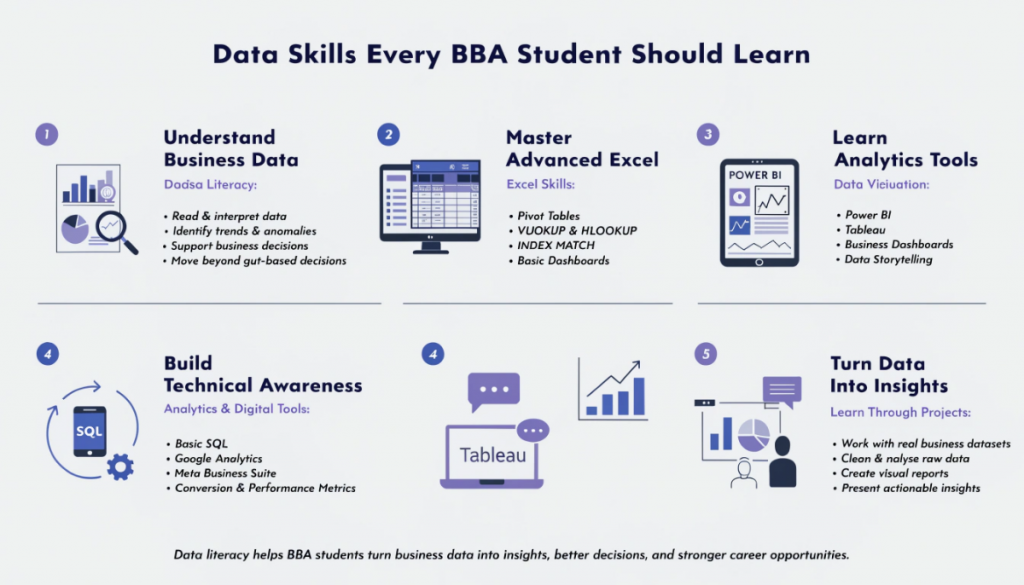
Data literacy is consistently the most cited gap between what BBA graduates know and what employers need from them. Here is what building this capability actually involves:
Data literacy for BBA students does not mean becoming a data scientist but means being able to read and interpret business data, spot trends, identify anomalies and use that information to make or support decisions rather than relying on gut feel alone
Advanced Excel including pivot tables, VLOOKUP, HLOOKUP, INDEX MATCH and basic dashboard creation is the entry-level data skill that most recruiters screen for at the first round, and BBA graduates who cannot demonstrate this competency are filtered out before domain-specific skills are ever assessed
Power BI and Tableau have moved from optional additions to expected tools for BBA graduates targeting business analyst, marketing analyst and financial analyst roles, since companies now expect management graduates to visualise and present data rather than just describe it in text
SQL at a basic level, covering SELECT statements, WHERE filters, GROUP BY aggregations and JOIN operations, is becoming a distinguishing skill for BBA graduates applying to analytics-adjacent roles in BFSI, e-commerce and consulting since these teams work with databases daily and expect management-level hires to understand the language
Google Analytics and Meta Business Suite are the digital analytics tools most directly relevant to BBA students targeting marketing and digital roles, and familiarity with reading performance dashboards, interpreting conversion metrics and attributing results to channels is now a standard expectation at digital-first companies
The practical way to build data skills during a BBA program is through actual projects using real business datasets, since the ability to take a raw dataset, clean it, analyse it and present findings in a business context is a significantly stronger resume signal than a completed online course certificate with no accompanying project
Business analytics as a BBA specialisation builds several of these skills directly into the curriculum through tools like Power BI, SAS and Tableau, but students from all specialisations benefit from adding at least Excel and basic visualisation competency to their profile regardless of whether analytics is their primary focus
Digital Marketing Skills That BBA Graduates Cannot Afford to Ignore
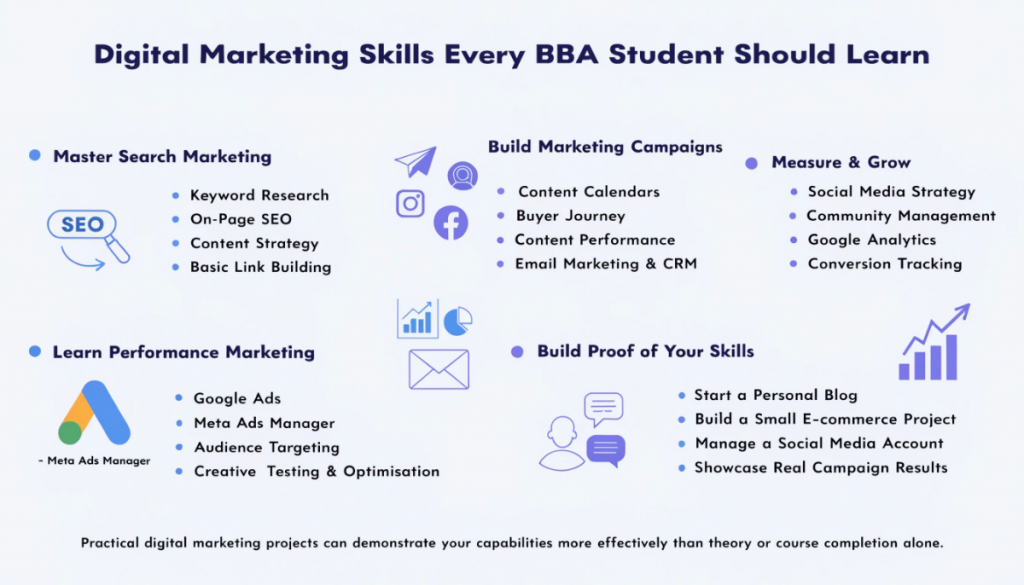
Marketing as a function has changed more in the last three years than in the previous decade and the skills gap between what BBA marketing students learn and what the job actually requires has widened significantly. Here is the breakdown:
Search engine optimisation fundamentals including keyword research, on-page optimisation, content strategy and basic link building have become standard screening criteria for marketing executive roles at startups, D2C brands and digital agencies that hire BBA graduates
Paid advertising on Google Ads and Meta Ads Manager is a tool-level skill that employers test directly in interviews for marketing roles, since managing a performance campaign requires familiarity with bid strategies, audience targeting, creative testing and cost-per-result optimisation that cannot be learned from a textbook
Content marketing strategy including understanding the buyer journey, planning content calendars, writing for different platforms and measuring content performance has become a core BBA marketing skill rather than something only content writers need to understand
Email marketing tools including Mailchimp and similar platforms are practical skills relevant for BBA graduates going into CRM, retention marketing and direct-to-consumer roles where campaign execution is part of the day-to-day job
Social media marketing for BBA students goes beyond knowing how to use Instagram and LinkedIn personally and extends to understanding organic reach strategy, platform algorithm behaviour, community management and the difference between content that builds brand awareness and content that drives conversion
Google Analytics certification is a low-cost, high-signal credential that directly validates digital marketing measurement skills and is consistently mentioned by recruiters in marketing roles as a distinguishing factor when evaluating BBA candidates with otherwise similar profiles
Digital marketing is one of the skill areas where building a personal project, whether a blog, a small e-commerce store or a social media account for a cause you care about, demonstrates capability more directly than any theoretical course completion because it produces verifiable evidence of what you can actually deliver
Financial Literacy: The Core Skill That Applies Across Every BBA Specialisation
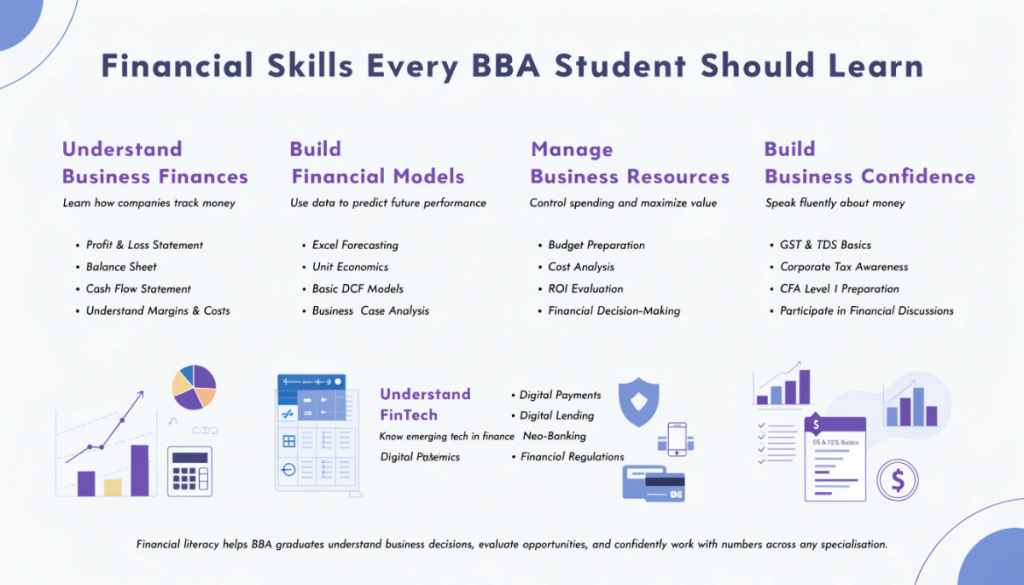
Financial literacy is not just for BBA Finance students. It is a foundational management skill that every BBA graduate needs regardless of which specialisation they chose. Here is why and what it involves:
Reading and interpreting a profit and loss statement, a balance sheet and a cash flow statement is the minimum financial literacy that any management graduate is expected to have at the entry level, and BBA graduates who cannot walk through a basic P and L in an interview are at a disadvantage in roles across all business functions
Financial modelling at a basic level, meaning the ability to build a forecast, a unit economics model or a simple DCF in Excel, is a specific skill that separates BBA Finance candidates who get shortlisted at BFSI and consulting firms from those who do not make the first cut
Fintech awareness including an understanding of digital payments, the basics of how lending platforms work, what a neo-bank does differently from a traditional bank and how regulatory frameworks like RBI’s PPI guidelines affect financial products has become a relevant knowledge area for BBA graduates across finance and marketing tracks given how much financial services work involves digital channels
CFA Level 1 preparation is a signal that many BBA Finance students use to differentiate themselves in investment banking and asset management applications, and even the act of studying for this exam rather than clearing it demonstrates a seriousness about financial depth that stands out in competitive placement environments
Working knowledge of GST, TDS and basic corporate tax structures is practical financial literacy that matters for BBA graduates going into accounting, operations and business development roles where understanding the financial implications of business decisions is a daily requirement
The goal of building financial skills during a BBA program is not to become an accountant but to be comfortable enough with numbers that you can participate meaningfully in financial conversations, evaluate business cases on their merit and not be the person in the room who goes silent when the conversation turns to margins, costs or return on investment
Communication Skills BBA Students Need to Build Before They Graduate
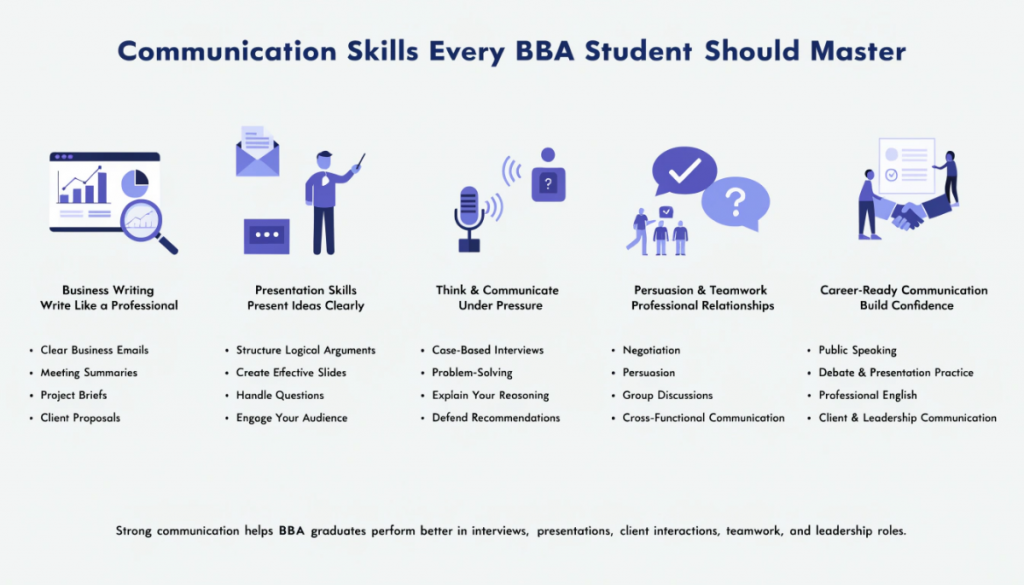
Communication is the skill that every recruiter mentions and almost no student takes seriously enough to work on deliberately. Here is what strong communication for BBA graduates actually means in practice:
Business writing skills including the ability to write a clear email, a structured meeting summary, a concise project brief or a client-facing proposal are practical competencies that differentiate graduates who can operate independently from those who need supervision for every written output
Presentation skills for BBA students go beyond making a nice-looking slide deck and extend to structuring an argument logically, knowing what to put on a slide versus what to say out loud, handling questions from the audience and holding attention for the duration of a business presentation
Case-based interview preparation has become increasingly common even at the undergraduate level, with companies screening BBA graduates through structured business problem scenarios that test how clearly you can think through a problem, communicate your reasoning and defend your recommendation under questioning
Negotiation and persuasion skills matter in sales, procurement, HR and general management roles and the BBA graduates who build these skills deliberately through role plays, group discussions and debate practice consistently perform better in commercial roles than those whose communication experience is limited to classroom presentations
Interpersonal communication in cross-functional teams, the ability to work with people from different departments who have different priorities and sometimes different languages, is a softer but genuinely valuable skill that shows up in 360-degree feedback, promotion decisions and client relationship quality at every stage of a management career
Public speaking confidence, built through deliberate practice in group discussions, debate societies, student body presentations and any other setting that puts you in front of an audience, is one of the most compounding skills a BBA student can build since its benefits show up in interviews, client meetings, management presentations and leadership roles for decades after graduation
English language proficiency at a professional level, covering writing, reading, speaking and listening in business contexts, remains a practical differentiator in the Indian job market particularly for roles in consulting, client-facing sales, international business and any role that involves communication with non-Indian counterparts
Leadership and Entrepreneurial Thinking: What Separates Good BBA Graduates from Great Ones
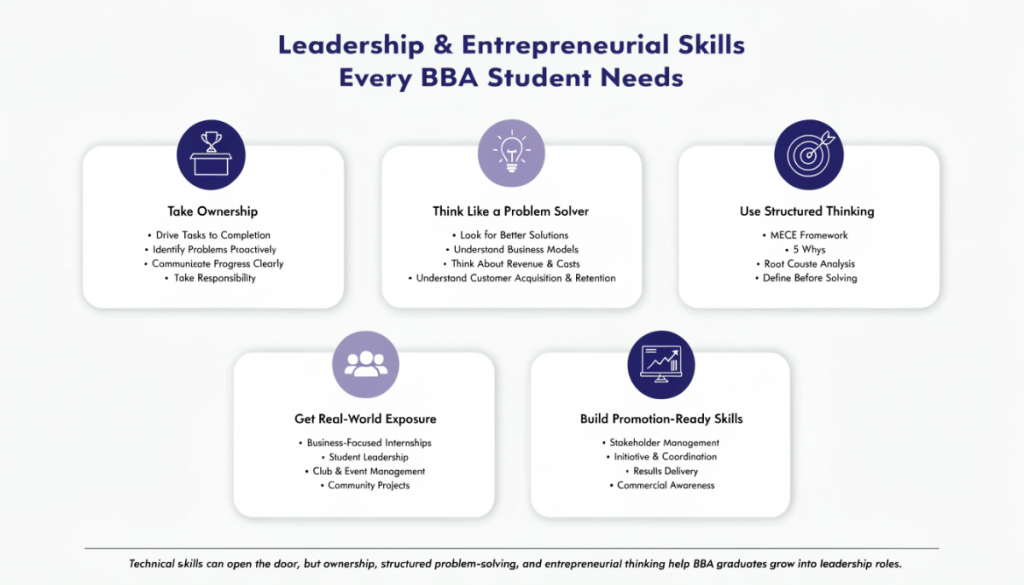
Technical skills get you in the door. Leadership and entrepreneurial thinking are what determine how far you go once you are inside. Here is what this means practically for BBA students:
Leadership for a BBA graduate at the entry level does not mean managing people but means taking ownership of a task, driving it to completion without being reminded, identifying problems proactively and communicating status to stakeholders clearly, which are behaviours that senior managers notice and associate with promotion potential
Entrepreneurial thinking means approaching every business situation with a question about what could be better rather than simply executing what is asked, which is a mindset that startups and fast-growing companies specifically look for in management hires because they cannot afford people who need to be told what to do next
Problem-solving through a structured framework, whether the MECE principle, the 5 Whys, root cause analysis or simply the habit of defining the problem clearly before proposing a solution, is a skill that recruiters test explicitly in case interviews and implicitly in every conversation about how you handled a challenge
Internship experience that involved real business responsibility rather than administrative tasks is the most credible evidence of leadership and entrepreneurial thinking that a BBA student can have at the time of placement, since it demonstrates that someone in an actual organisation trusted you with something that mattered
Student body leadership, club management, event organisation and community projects are the contexts where BBA students who do not yet have internship experience can demonstrate initiative, coordination ability, stakeholder management and results delivery in a verifiable way
The average package for well-placed BBA graduates who combine domain skills with leadership competency ranges from 4 to 5 LPA broadly, with top performers at companies like Accenture, Genpact, Aditya Birla Group and ICICI Bank seeing packages significantly higher than this average through campus placement drives
Entrepreneurial thinking for BBA students also means understanding what a business model is, how revenue is generated in different types of organisations and what it actually costs to acquire and retain a customer, since this commercial awareness is what allows a fresh graduate to have meaningful conversations with business leaders rather than conversations that are entirely theoretical
Conclusion
The skills for BBA students that actually determine placement outcomes and long-term career trajectory in 2026 fall into a clear set of categories. Data literacy and analytics,digital marketing tools, financial understanding, strong communication, leadership thinking and AI literacy together form the profile that employers across India are specifically looking for when they hire management graduates. None of these skills requires years of specialised training.
Each one can be built deliberately during a three-year BBA program through a combination of coursework, internships, personal projects and consistent self-directed practice. The students who start building these skills in the first year graduate with a portfolio of real capabilities rather than a degree and a hope. That is the difference between a good placement and a missed one.

Book Your
Free Session
Connect with our experts and get personalised guidance for your career, course selection, and future goals.
📖 Sources & References
✓ Verified 2026Verified BBA career skills, employability trends, digital capabilities, financial literacy, communication and leadership skills based on recognised educational, government and industry sources.
- World Economic Forum Future of Jobs research, emerging skills, analytical thinking, leadership and workplace skill trends
- NASSCOM India technology workforce trends, digital skills demand and employability insights
- National Career Service Career guidance, employability resources, professional skills and job-market information
- UGC India Higher education standards, undergraduate programme regulations and academic quality guidelines
- Ministry of Education National education policies, skill development initiatives and higher education reforms
- LinkedIn Workforce Insights Hiring trends, in-demand skills, workforce development and professional career insights
- Microsoft WorkLab AI skills, workplace productivity, digital transformation and evolving workforce practices
- Google Analytics Digital analytics, measurement, reporting and website performance resources for marketing professionals
- Shoolini Online BBA programmes, management education, career guidance and industry-focused learning resources
- National Education Policy 2020 Skill-based education, multidisciplinary learning and employability-focused higher education reforms