
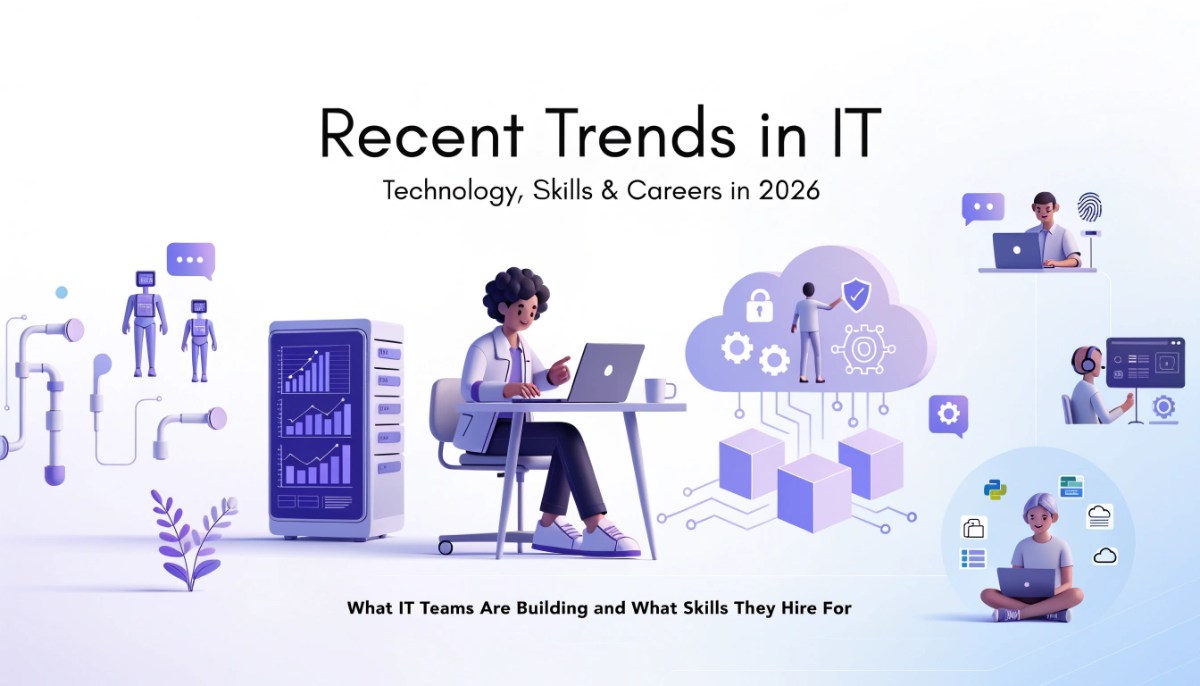
The IT industry changes faster than almost any other field. Tools that were popular three years ago are now routine and new ones arrive every few months. Knowing the recent trends in IT helps students pick the right course and helps working professionals decide what to learn next. This blog looks at how software is built and where it runs and how it is protected. It also covers data and jobs and the eligibility for an online BCA or MCA if you want to enter the field.
Recent Trends in IT: AI Native Software Development
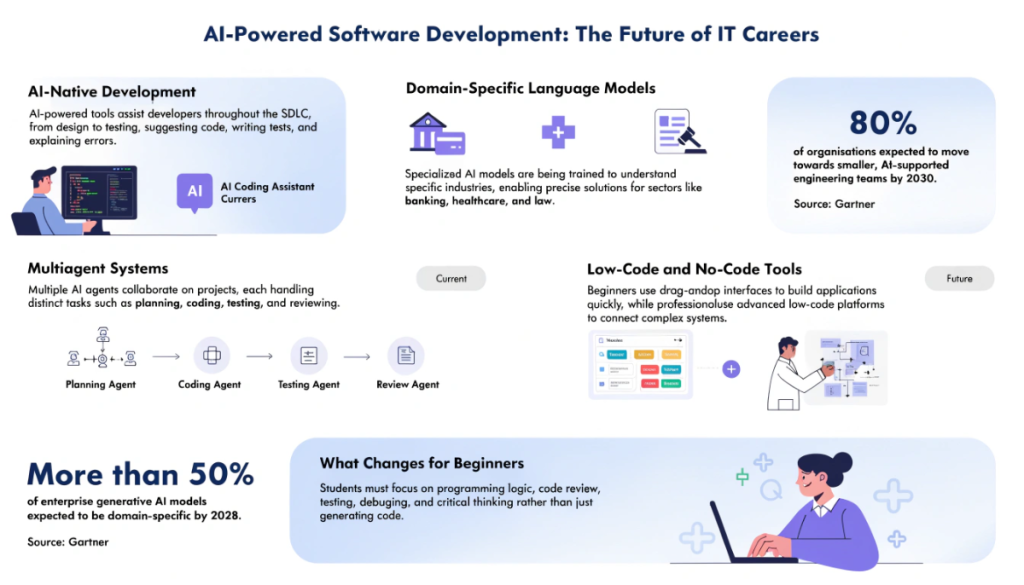
The biggest of the recent trends in IT is the way software gets built. AI tools now sit inside the daily work of developers. They suggest code and write tests and explain errors. Analyst firms such as Gartner list AI native development platforms among the top strategic technology trends for 2026.
The biggest of the recent trends in IT is the way software gets built. AI tools now sit inside the daily work of developers. They suggest code and write tests and explain errors. Analyst firms such as Gartner list AI native development platforms among the top strategic technology trends for 2026.
What AI Native Development Means
- Development platforms are being designed around AI from the start and not just adding a chatbot to an old tool, which means whole workflows from design to testing can be assisted.
- Gartner predicts that by 2030 about 80 percent of organisations will turn large engineering groups into smaller teams supported by AI, so team structures are already changing.
- Developers spend less time on repetitive code and more time on design and review, which raises the value of problem solving.
Domain Specific Language Models
- Instead of one general model for everything, companies are building models tuned for one field such as banking or healthcare or law.
- Gartner expects that by 2028 more than half of the generative AI models used by enterprises will be domain specific, which means jobs that mix IT skill with industry knowledge will grow.
Multiagent Systems
- Several AI agents can now work together on one larger task, with each agent handling a different step.
- IT teams need people who can design these workflows and set limits and monitor results, since errors can spread quickly across connected agents.
Low Code and No Code Tools
- Low code platforms let people build simple apps with drag and drop screens, which means business teams can solve small problems without waiting for developers.
- Professional developers still build the complex parts and connect these tools to company systems, so the skill is changing and not disappearing.
What Changes for Beginners
Entry level work is changing the most. Simple tasks that once trained juniors are now partly automated. Beginners need to show stronger basics in logic and testing and code review. Anyone studying IT should learn to read and question code written by a tool and not just accept it.
Recent Trends in IT Infrastructure: Cloud, Hybrid and Green Computing
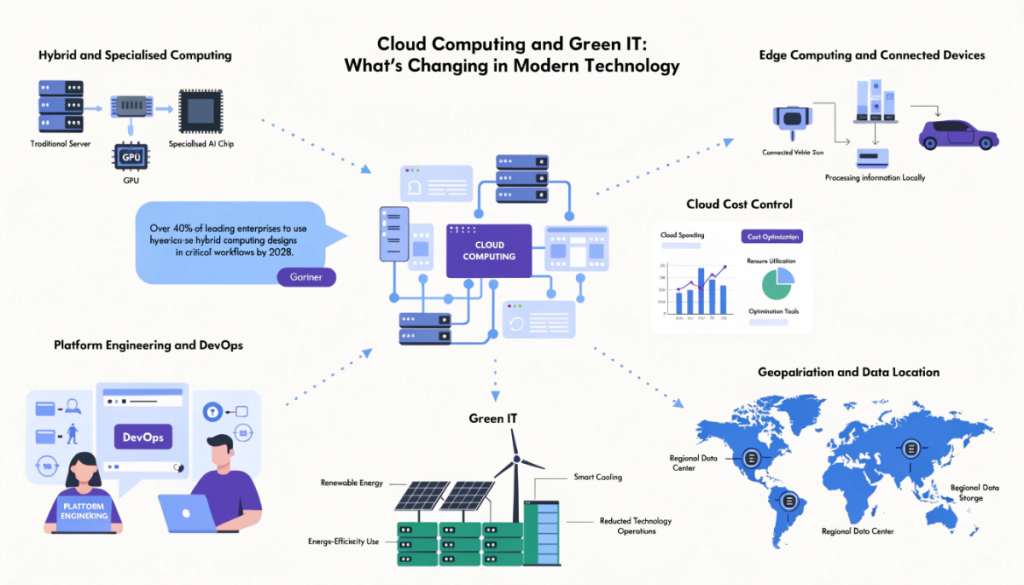
Where software runs is also changing. Cloud computing is no longer new. It is now the base layer and the recent trends in IT focus on how to use it smartly and cheaply.
Hybrid and Specialised Computing in Recent Trends in IT
- Companies now mix several kinds of computing such as standard servers and graphics processors and special AI chips, so each task runs on the hardware that suits it best.
- Gartner predicts that by 2028 more than 40 percent of leading enterprises will use hybrid computing designs in critical workflows, up from a small share today.
- This creates demand for engineers who understand how to place workloads and control costs.
Platform Engineering and DevOps
- Large companies build internal platforms so developers can deploy code without handling every setup detail, which means faster releases and fewer mistakes.
- Container tools and automation remain core skills, so learning them is a safe investment.
Cost Control in the Cloud
- Cloud bills can grow quickly if nobody watches them, so teams now track spending closely and tune systems to save money.
- Roles that combine cloud knowledge with cost analysis are becoming more common.
Geopatriation and Data Location
- Geopatriation means moving data and workloads to local or regional providers because of legal and political reasons.
- Rules about where data may be stored are growing, so IT teams must understand compliance as well as technology.
Edge Computing and Connected Devices
- Processing data close to the device such as a camera or sensor reduces delay, which matters for factories and vehicles and smart buildings.
- Edge work blends hardware and software skills, so graduates who understand both are well placed.
Green IT
Data centres use large amounts of electricity. Companies now measure the energy use of their systems and look for ways to cut it. Efficient code and better hardware and smarter scheduling all help. Sustainability is turning into a normal requirement in IT projects and not an optional extra.
Recent Trends in IT Security: Preemptive Defence and Trust
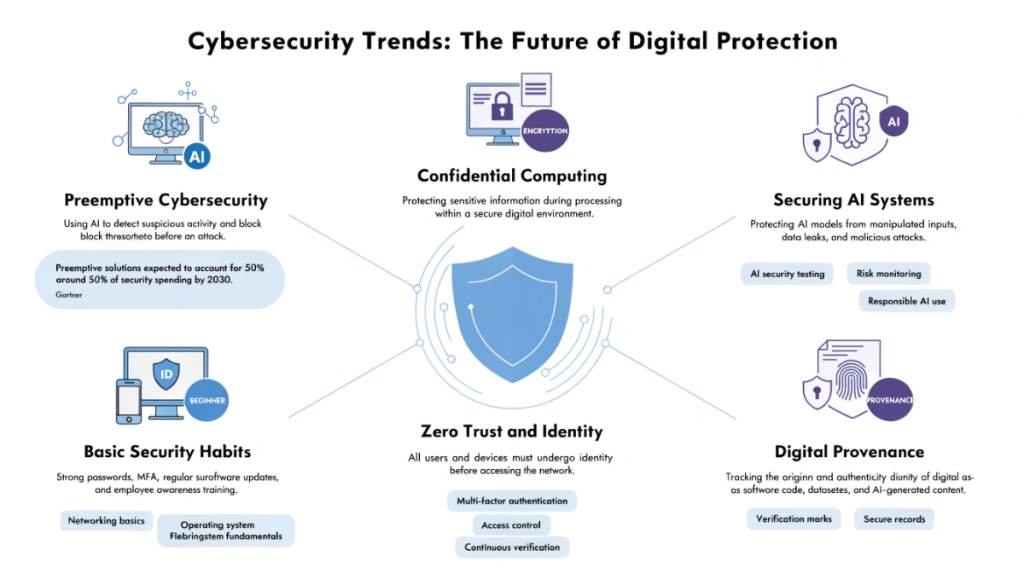
Security is one of the most active areas among the recent trends in IT. Attackers use AI too so defenders must move earlier than before.
Preemptive Cybersecurity
- Instead of only reacting after an attack, teams try to predict and block threats before damage happens.
- Gartner forecasts that by 2030 preemptive solutions will account for about half of all security spending, so budgets are shifting in this direction.
Confidential Computing
- This protects data while it is being processed and not only when it is stored or sent, which closes a gap that older methods left open.
- Gartner predicts that by 2029 over three quarters of operations on untrusted infrastructure will be protected this way.
Securing AI Systems
- AI tools bring new risks such as manipulated inputs and leaked data, so dedicated AI security platforms are emerging.
- Teams need people who can test AI systems for weaknesses and set rules for how they are used.
Digital Provenance
- Digital provenance tracks where software and data and AI generated content came from, which helps prove they are genuine.
- Companies that cannot show where their code and data originated may face legal and sanction risks, so this area is gaining attention.
Zero Trust and Identity
- Zero trust means no user or device is trusted by default, so every request is checked, which reduces the damage when one account is stolen.
- Identity management has become a core part of IT security work. It is one of the steadier recent trends in IT for job seekers.
Basic Habits Still Matter
New tools do not remove the need for basics. Strong passwords and multi factor login and regular updates and employee training still stop most common attacks. A beginner who understands networking and operating systems and these basic habits will always be useful to a security team.
Recent Trends in IT Data and Analytics
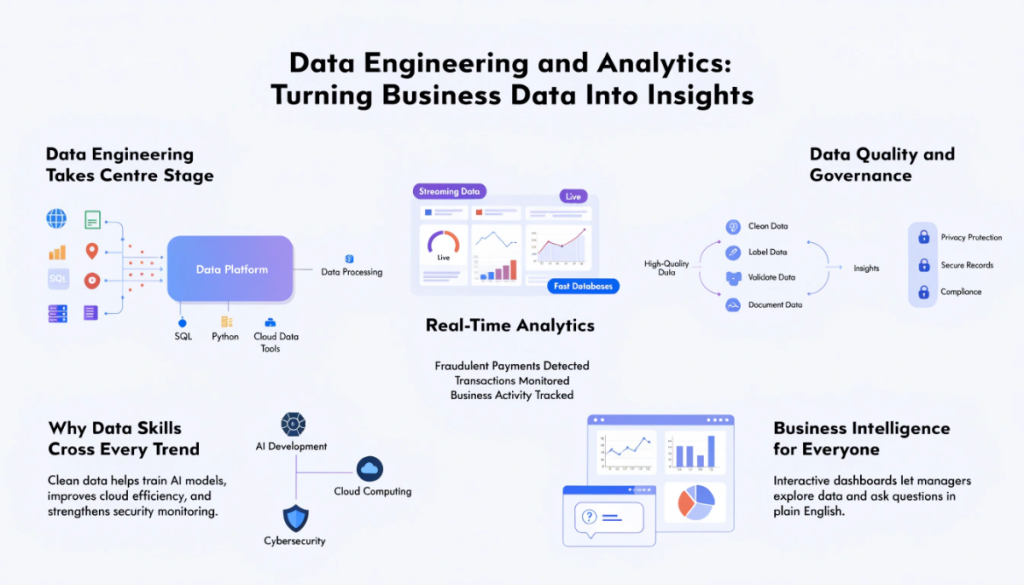
Every system in a company produces data. The recent trends in IT include better ways to store and clean and use that data.
Data Engineering Takes Centre Stage
- Data engineers build the pipelines that move data from many sources into one place, which means every analytics and AI project depends on their work.
- Demand for this role has grown steadily. SQL and Python and cloud data tools are the usual requirements.
Real Time Analytics
- Companies increasingly want answers in seconds, such as spotting a fraudulent payment as it happens.
- Streaming tools and fast databases are therefore part of many job descriptions.
Data Quality and Governance
- AI is only as good as the data behind it, so companies invest in cleaning and labelling and documenting data.
- Privacy laws also require careful handling of personal data, which creates roles in governance and compliance.
Why Data Skills Cross Every Trend
- AI development needs clean data and cloud costs depend on how data is stored, so data skill helps in almost every area covered above.
- Security teams also analyse logs and alerts, which means analysis skill is useful even outside pure data roles.
Business Intelligence for Everyone
Dashboards and self service tools let managers explore data without waiting for a technical team. Natural language features even let users ask questions in plain words. IT professionals who build and maintain these tools and teach others to use them are in demand.
How Recent Trends in IT Change Jobs and Skills
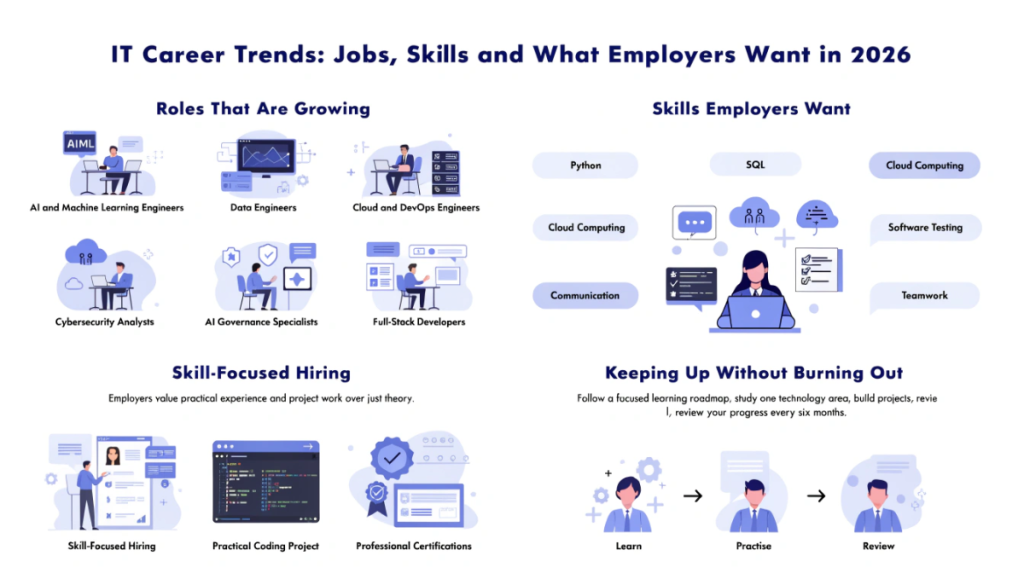
Trends only matter if they change hiring. The recent trends in IT point to a few clear shifts in what employers want.
Roles That Are Growing Because of Recent Trends in IT
- AI and machine learning engineers and data engineers are growing, since almost every trend above depends on them.
- Cloud and DevOps engineers remain in demand because companies keep moving and tuning their systems.
- Security analysts and AI governance specialists are growing as risks and regulation increase.
- Full stack developers continue to find openings, though they are expected to work well with AI tools.
Skills Employers Keep Asking For
- Python and SQL appear in a huge share of job listings, so they are the safest first skills to learn.
- Cloud basics and version control and testing are expected from most developers.
- Clear communication and teamwork matter more as teams get smaller and each person owns more.
Hiring Is Becoming More Skill Focused
- Employers look at projects and practical tests more than they used to, which means a strong portfolio can beat a higher grade.
- Certifications in cloud and security and data are a quick way to show focused skill.
Keeping Up Without Burning Out
You cannot learn every new tool. Pick one area from the recent trends in IT and learn it well. Follow a few trusted sources and ignore the rest. Revisit your plan every six months. This steady approach keeps your skills fresh without turning learning into a source of stress.
Learning Recent Trends in IT Through an Online Degree
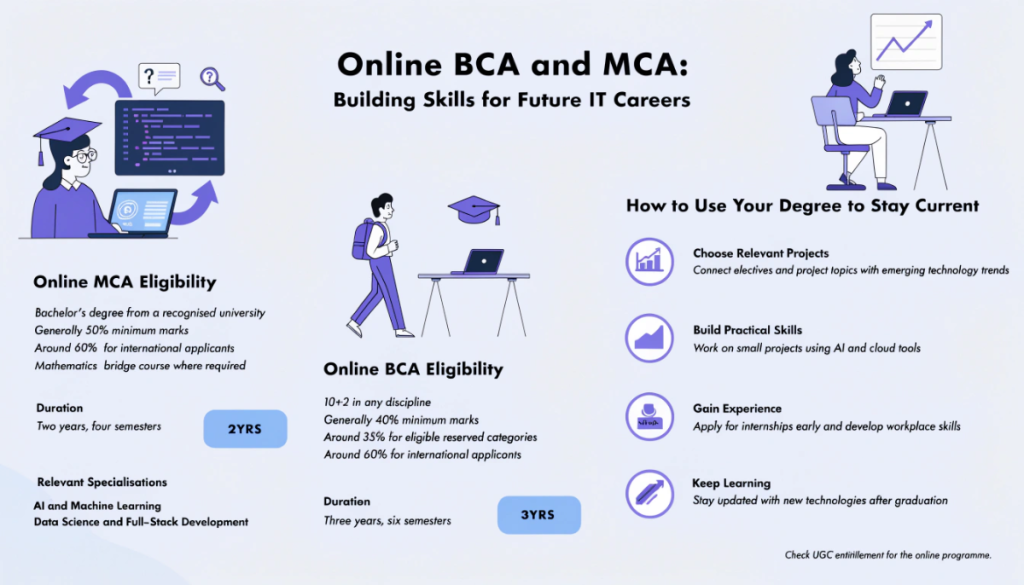
A structured degree gives you the basics that every trend builds on. An online format lets you learn while you work or prepare for exams.
Eligibility for an Online MCA
An online MCA is a good choice for graduates who want deeper technical skills. A candidate generally needs a bachelor’s degree in any discipline from a recognised university with at least 50 percent marks. International applicants are usually expected to have around 60 percent marks. Students who did not study mathematics at 10+2 or graduation level are asked to complete a bridge course. The program runs for two years across four semesters. Tracks such as artificial intelligence and machine learning and data science and full stack development line up closely with the trends in this blog.
Eligibility for an Online BCA
An online BCA suits students who have just finished school. A candidate generally needs to have passed 10+2 in any discipline with at least 40 percent marks. Reserved category candidates often get a relaxation to about 35 percent. International applicants are usually expected to have around 60 percent marks. The program runs for three years across six semesters. Confirm in both cases that the program is approved by UGC for the online mode so the degree is valid for jobs and further study.
How to Use the Degree to Stay Current
- Pick your electives and project topics from the trends that interest you, so your coursework doubles as a portfolio.
- Build small projects with cloud and AI tools, since practice teaches more than lecture notes alone.
- Apply for internships early, because many of them lead to full time offers.
- Keep learning after graduation, because the next wave of recent trends in IT is already forming.
Conclusion
The recent trends in IT point in one direction. AI is changing how software is built and the systems that run it are getting more specialised and more carefully secured. Data is becoming the raw material for almost every project. For anyone entering the field the plan is simple. Build strong basics and add one or two focus areas and prove your skills with projects. A flexible online degree can give you the structure and your own practice will give you the edge.
Sources & References
✓ Verified 2026These official resources and technical references provide further information on the recent IT developments discussed in this article, including AI-native software development, cloud infrastructure, cybersecurity, confidential computing, data engineering and online computer application programmes.

Book Your
Free Session
Connect with our experts and get personalised guidance for your career, course selection, and future goals.