
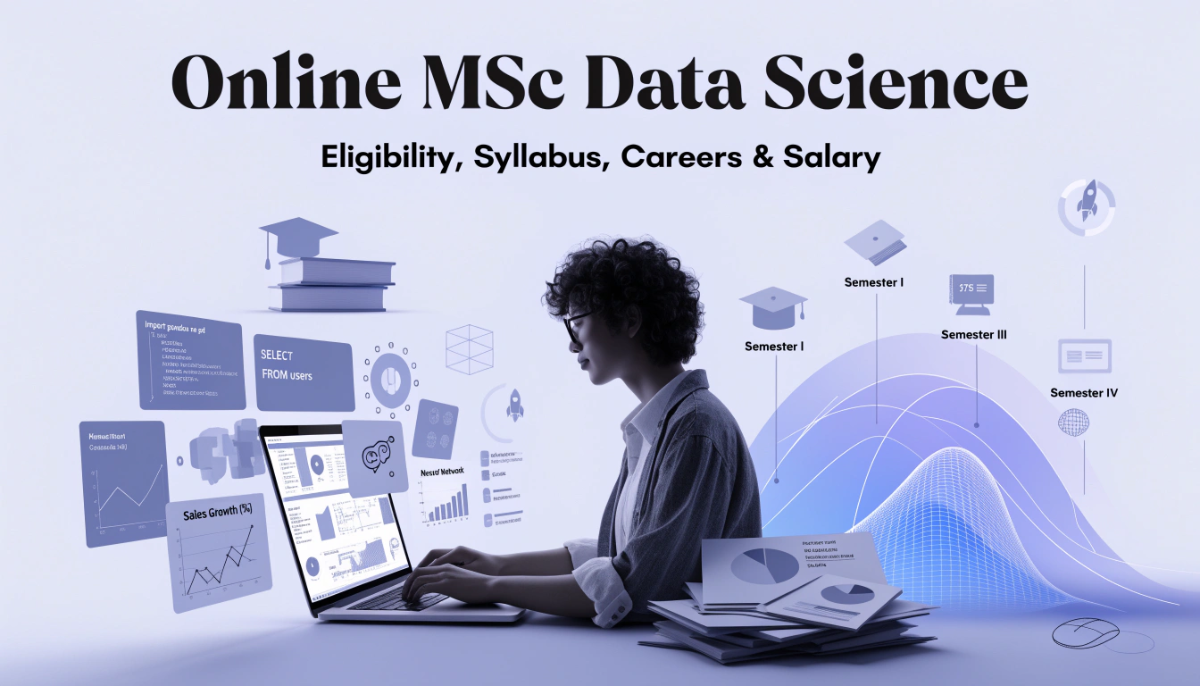
Almost every company now collects data but very few know how to use it well. People who can clean and study that data and turn it into decisions are in short supply. An online MSc Data Science is a two year postgraduate degree built to train such people. It covers programming and statistics and machine learning and big data in a flexible format. You can study while you continue to work. This blog explains who can apply and what the syllabus covers. It also lists the job roles and gives a realistic view of pay.
What an Online MSc Data Science Program Really Is
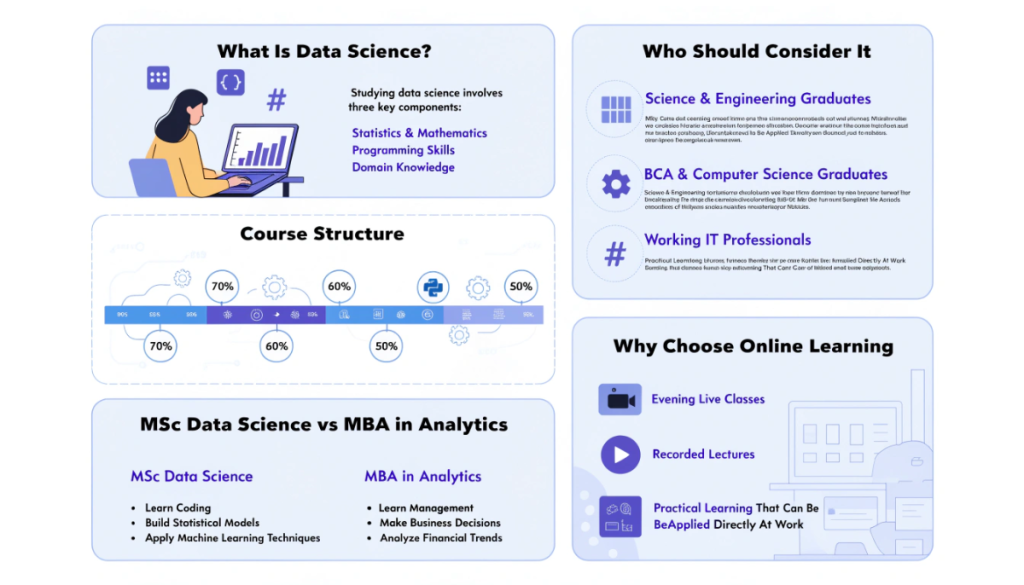
An online MSc Data Science is a postgraduate science degree focused on extracting useful information from large sets of data. You learn the maths and the coding and the tools together. The online format delivers lectures and practice material through a learning platform so you can study around your schedule.
The Basic Meaning
- Data science mixes statistics and programming and domain knowledge, which means you learn to ask a question and then answer it with data.
- The program usually runs for two years across four semesters, so the timeline is predictable and similar to a regular master’s degree.
- Later semesters move into machine learning and artificial intelligence and big data, which are the fields driving most hiring today.
How It Differs From an MBA in Analytics
- An MBA in analytics focuses on using data for business decisions, so management subjects take up a large share of the course.
- An online MSc Data Science goes deeper into coding and statistics and model building, which means graduates are more technical.
- Both lead to analytics jobs but the MSc suits people who enjoy programming and maths more than people management.
Who Should Consider It
- Science and engineering graduates who want a specialised postgraduate degree, since the course builds on subjects they already know.
- BCA and computer science graduates who want to move from general software work into data roles.
- Working professionals in IT or testing or reporting who want to move into analytics without leaving their job.
Why the Online Mode Suits Working Learners
Data science skills improve with steady practice. An online MSc Data Science lets you attend live sessions in the evening and revisit recordings when a topic is hard. You can also apply new skills at your job the same week. That loop between learning and practice is one of the biggest advantages of the format.
Online MSc Data Science Eligibility and Admission
The entry rules for an online MSc Data Science are simple compared with many technical degrees. Rules differ slightly between programs so read the notice for your chosen program carefully.
Academic Requirement
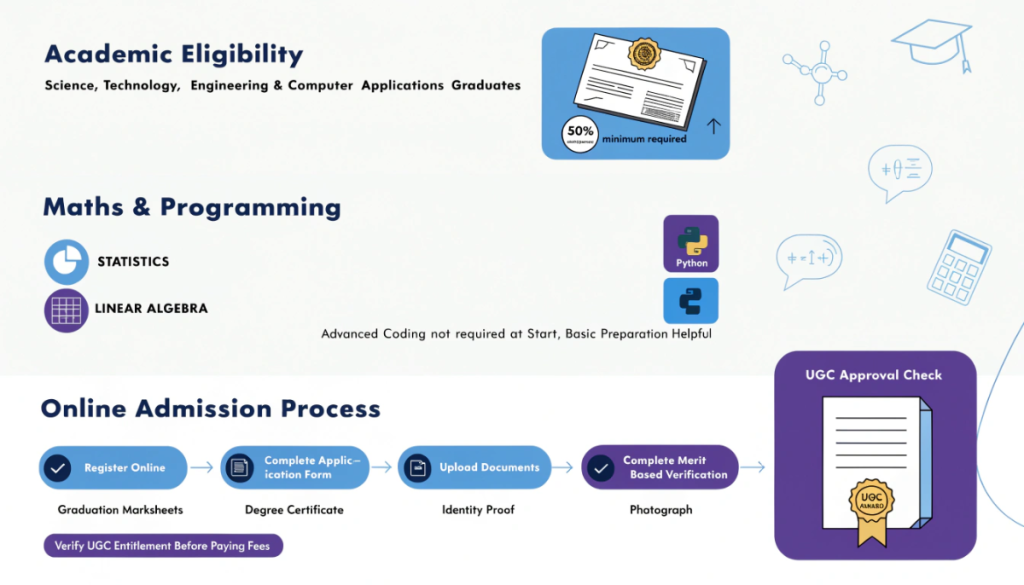
- A bachelor’s degree from a recognised university is required. Most programs ask for at least 50 percent marks in graduation.
- Graduates in science and technology and engineering and computer applications are the most common applicants, since the subjects match the syllabus.
- Some programs also accept graduates from other disciplines, so check whether yours asks for a particular background.
Maths and Programming Readiness
- The course uses statistics and linear algebra and basic coding from the first semester, which means you should revise school level maths before you start.
- You do not need advanced programming skills on day one, since the first semesters teach programming from the basics.
- Learning a little Python or C in advance makes the early papers much easier.
Admission Process
- Admission is done online through an application where you register and fill in details and upload documents.
- Most online programs select on merit without an entrance exam, so your graduation marks and document checks decide the outcome.
- Documents normally include graduation marksheets and a degree or provisional certificate and identity proof and a photograph.
Approval to Confirm
Before you pay any fee confirm that the program is entitled by UGC to run in the online mode. Under the UGC rules of 2020 a degree earned online from an approved institution is treated as equal to the same degree earned on campus. This matters for jobs and for further study.
Online MSc Data Science Syllabus and Skills
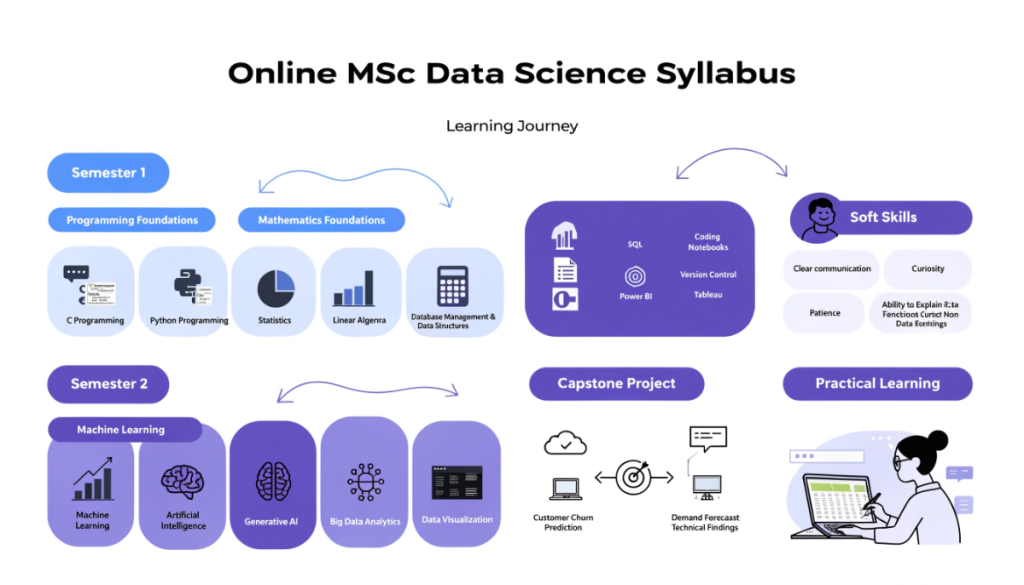
The syllabus of an online MSc Data Science runs across four semesters. The early semesters build the foundation. The later semesters bring in advanced data topics and a project.
Foundation Subjects in the First Year
- Programming languages such as C and Python form the base, which means you learn how to turn logic into working code.
- Computational mathematics and statistics give you the tools for probability and linear algebra, since every data model depends on them.
- Database management and data structures teach how to store and organise information, which is the starting point of every data project.
- Communication and English papers may be included, because data professionals must explain results clearly.
Advanced Data Subjects
- Machine learning teaches methods like regression and classification and clustering, which are the standard tools in real projects.
- Artificial intelligence and generative AI topics show how modern language and image models are built and used.
- Big data analytics covers how to handle data too large for a normal computer, which matters in most large companies.
- Data visualisation teaches how to present findings in charts and dashboards that managers can understand quickly.
Practical Work and Capstone Project
Good online MSc Data Science programs include virtual labs and coding modules and a final capstone project. Pick a real question such as predicting customer churn or forecasting demand. Collect the data and clean it and build a model and present your findings. A solid project becomes the main piece in your portfolio.
Soft Skills That Matter Too
- Clear explanation of technical results to non technical people, since data professionals often present to managers and clients.
- Curiosity and patience, because models rarely work on the first attempt and fixing them takes steady effort.
Tools You Will Use
- Python and its data libraries, which are the standard tools in almost every data science job.
- SQL for pulling data from databases, since most company data lives in them.
- Notebook environments and version control, so your experiments stay organised and shareable.
- Visualisation tools such as Power BI or Tableau, which help you present results to non technical people.
Career Options After an Online MSc Data Science
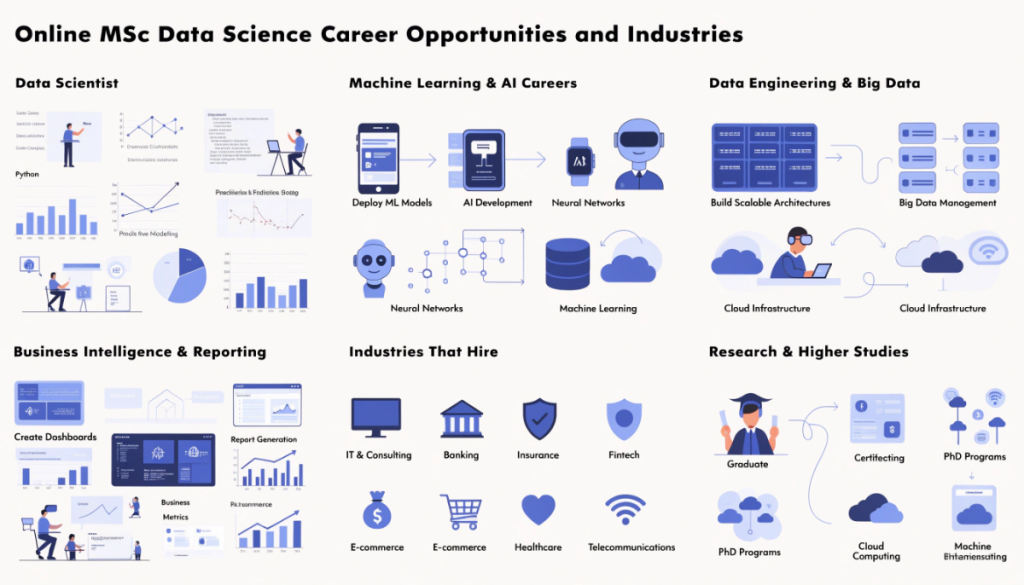
Graduates of an online MSc Data Science can work in nearly every industry. The roles below are the most common starting points.
Data Scientist and Data Analyst
- Data scientists build models that predict and classify and recommend, so strong Python and statistics matter most.
- Data analysts clean and study data and report findings, which makes them a good entry role for fresh graduates.
Machine Learning and AI Roles
- Machine learning engineers put models into real applications, so coding quality and deployment skills are important.
- AI developers add intelligent features to products. Demand has grown quickly with generative AI.
Data Engineering and Big Data
- Data engineers build the pipelines that move and store data, which means they keep the whole data system running.
- Big data developers work with large scale tools, so this path suits people who like systems and infrastructure.
Business Intelligence and Reporting
- BI analysts and dashboard developers build reports that managers check every day, so a good eye for design helps.
- Roles in reporting and MIS use the same skills and offer steady entry points in large companies.
Industries That Hire
- IT services and consulting firms hire in large numbers, which makes them a common first employer.
- Banks and insurance and fintech companies use data for risk and fraud and customer decisions.
- E-commerce and healthcare and telecom companies use it for demand and personalisation and operations.
Research and Higher Study
Some graduates move into research labs or doctoral programs in machine learning or statistics. A strong dissertation or project during the MSc helps your application. Others add professional certifications in cloud or machine learning to deepen a niche. Either path rewards steady learning.
Benefits, Limits and Salary of an Online MSc Data Science
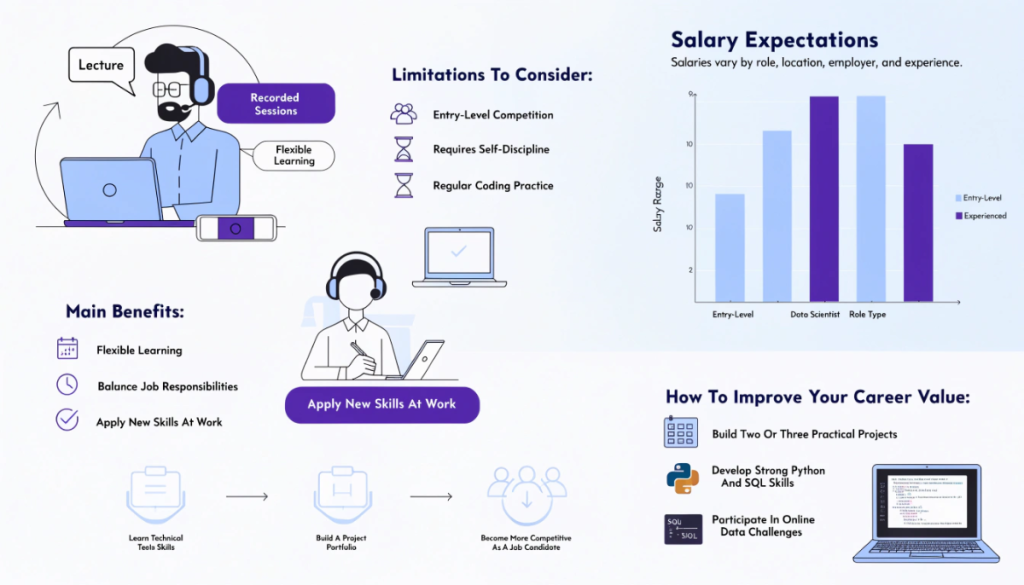
An online MSc Data Science has clear strengths. It also has limits that are worth knowing before you enrol.
Main Benefits of an Online MSc Data Science
- You can keep working while you study, so there is no income gap and you can apply lessons at your job.
- An online MSc Data Science gives a structured path into a high demand field for people who may not have a pure data background.
- Recorded lectures help with tough topics like probability and model tuning, since you can replay them as many times as needed.
Limits to Keep in Mind
- Data science needs regular practice with real data, so passive watching of lectures is not enough.
- Competition for entry level data roles is high, so projects and skills matter as much as the degree.
- Online study needs self discipline because nobody checks your attendance daily.
Salary Expectations
Pay depends on role and city and employer. Career sites often show entry level pay for data analyst roles in the range of about 4 to 8 LPA. Data scientist roles pay higher and mid career figures can go well past 10 LPA for people with strong skills and experience. These are rough figures from salary surveys so check current job listings before you plan around any number.
How to Raise Your Value
- Build two or three solid projects and host the code publicly, so recruiters can see real work.
- Learn SQL and Python deeply, because these two skills appear in almost every data job listing.
- Take part in online data challenges, since they show skill under time pressure and give you visible results.
How to Choose and Prepare for an Online MSc Data Science

A little preparation before you enrol makes the course far more useful. Check the program details and build a few basic skills early.
Checklist Before You Apply
- Confirm that the program is entitled by UGC for the online mode, since recognition affects jobs and further study.
- Read the syllabus for Python and machine learning and big data, because outdated papers will not help in interviews.
- Ask about live sessions and doubt support, which tells you how much real interaction you can expect.
- Check what project and career support is offered and what it actually includes, so you are not relying on vague promises.
Skills to Start Before Your Online MSc Data Science Begins
- Revise basic statistics and linear algebra, since you will use them from the first semester.
- Try a free Python course for a few weeks, so the first coding papers feel familiar.
- Practise spreadsheet work with formulas and pivot tables, because every analysis starts with data cleaning.
Mistakes to Avoid
- Chasing every new tool without learning the basics, which means you struggle when interviewers ask how a model actually works.
- Skipping projects and relying only on marks, since employers want to see working examples.
- Waiting until the last semester to look for internships, because the best openings fill early.
A Simple Plan for the First Year
Set fixed weekly study hours and treat them like work meetings. Solve problems after every lecture while the idea is fresh. Pick one public dataset each month and write a short analysis. Join one online community of data learners to ask questions. Small steady steps build both skill and confidence.
Conclusion
An online MSc Data Science is a strong choice if you enjoy maths and coding and want a career in one of the fastest growing fields. The eligibility is open to graduates with a suitable background and the format fits around work. What decides your outcome is the practice you put in alongside the syllabus. Check the approval and the syllabus before you enrol. Then learn the tools and build projects as you go. That approach turns a flexible degree into a solid career step.
Sources & References
✓ Verified 2026These official education, programming and industry resources provide further information on online MSc Data Science eligibility, UGC recognition, statistics, Python, machine learning, data analysis, big data technologies and career opportunities.
Book Your
Free Session
Connect with our experts and get personalised guidance for your career, course selection, and future goals.