

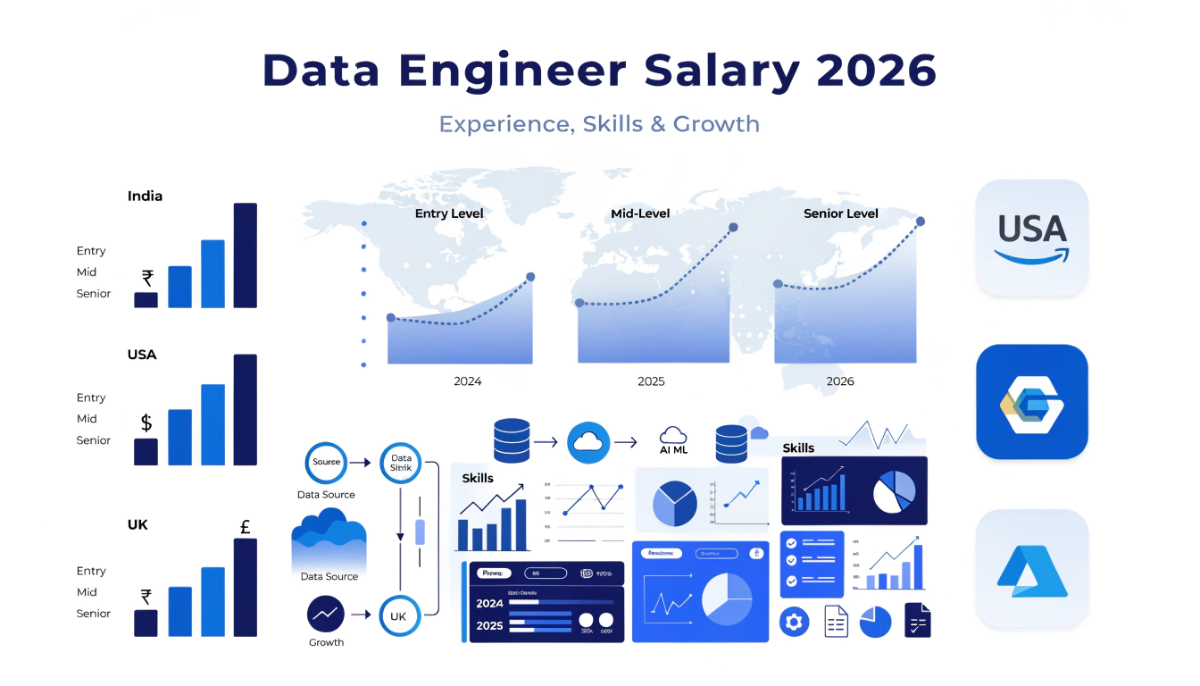
Data engineer salary is consistently one of the strongest in the entire technology sector and for good reason. Companies across banking, e-commerce, healthcare and SaaS are building increasingly complex data systems and they need skilled engineers to design and maintain the infrastructure that keeps those systems running. If you are planning to enter data engineering or are already in the field and want to know whether your pay is competitive, this guide gives you the actual verified numbers from Glassdoor, Indeed and PayScale.
Data engineer salary varies meaningfully based on your experience level, the city you are based in and the industry you work for. This guide covers all of it clearly so you can benchmark your own pay and understand what to target at each stage of your career.
What a Data Engineer Does: The Role Behind the Data Engineer Salary
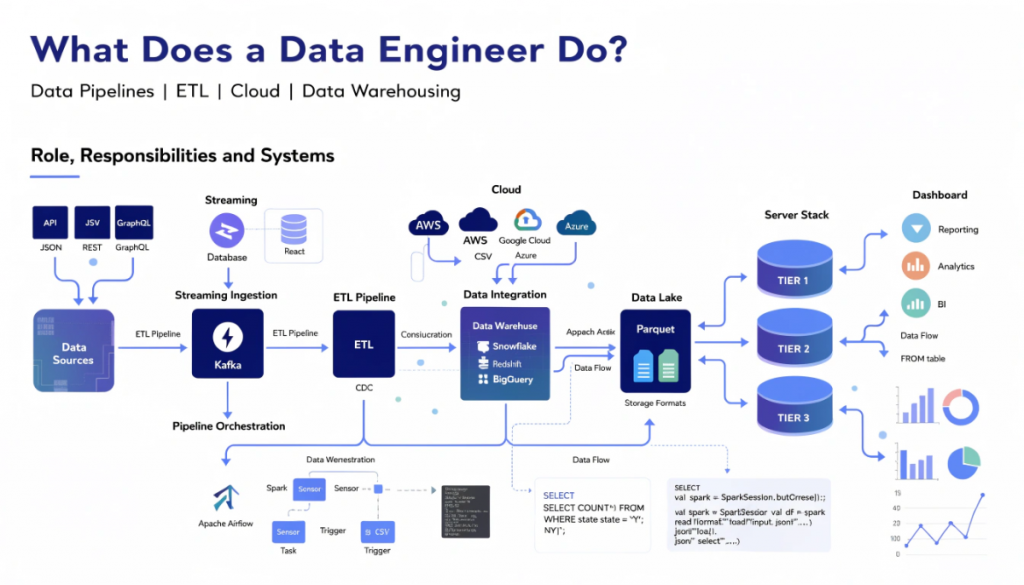
Before looking at data engineer salary figures it is worth understanding what the role actually involves because the scope and complexity of the work explains why pay is as strong as it is. A data engineer builds and maintains the systems that allow organisations to collect, store, process and access data reliably and at scale.
The core responsibilities include designing and building data pipelines that move data from source systems into storage layers like data warehouses or data lakes. A data engineer writes code to extract, transform and load data using tools like Apache Spark, Apache Airflow and dbt. They manage databases in both SQL and NoSQL formats, work with cloud infrastructure on platforms like AWS, Google Cloud and Azure and ensure data quality and reliability throughout the entire pipeline.
At a senior level the work expands to include architecting entire data platforms, making key decisions on tooling and infrastructure, mentoring junior engineers and working closely with data scientists and analysts to ensure data is structured in a way that supports their work. The more complex and business-critical the infrastructure a data engineer owns, the higher the data engineer salary tends to be. This is why senior and lead level roles pay dramatically more than entry level positions even within the same organisation.
Data Engineer Salary in India, US and UK: What the Numbers Actually Say
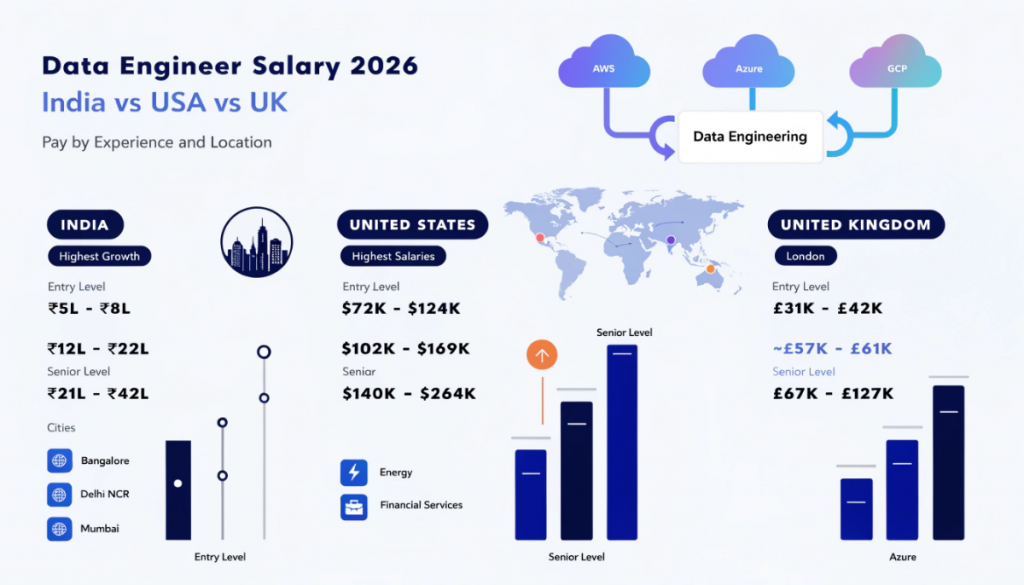
Data engineer salary varies significantly across markets but the direction is the same everywhere: it rewards experience heavily and sits comfortably above the average for technology roles. Here are the verified figures across all three markets side by side.
| Country | Average Salary | Entry Level | Mid Level | Senior / Top Range | Key Insights |
|---|---|---|---|---|---|
| India | ₹10.1L | ₹5.18L – ₹8.10L | ₹12L – ₹22L |
₹21.44L avg Top: ₹42.23L |
Bangalore leads (~₹11.93L), followed by Delhi NCR (~₹13L) and Mumbai (~₹9.2L). Strong growth with experience. |
| United States | $131,529 |
$72,141 – $124,394 Avg: $94,267 |
$102,955 – $169,787 |
$173,395 avg Top: $264,262 |
Energy ($142K) and Financial Services ($138K) are top-paying industries. Among highest-paid tech roles globally. |
| United Kingdom | £61,043 | £31,758 – £42,275 | ~£50K – £70K |
£81,916 avg Top: £127,841 |
London leads (£57K avg). Other cities (Manchester, Bristol, Leeds) pay ~15–20% less but remain strong markets. |
Skills That Directly Affect Your Data Engineer Salary
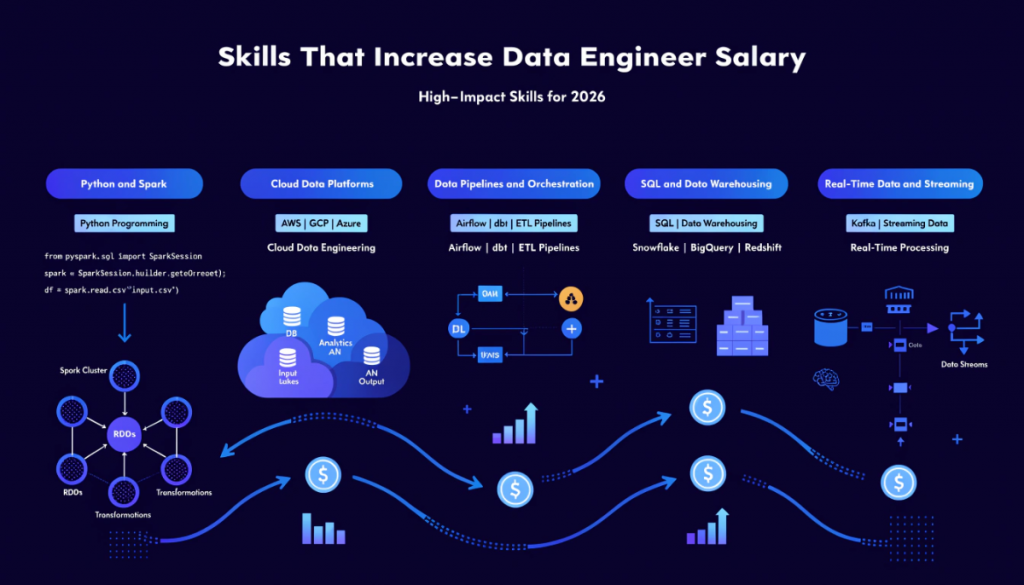
Beyond experience and location the skills you develop have a direct impact on where your data engineer salary lands. These are the ones that consistently make the biggest difference across all markets.
Python and Spark
Python is the primary programming language for data engineering work and proficiency in it is non-negotiable at any level. Apache Spark is the leading framework for large-scale distributed data processing and engineers who can build and optimise Spark jobs are in high demand. Professionals who combine strong Python skills with practical Spark experience consistently command higher data engineer salary offers compared to those who work only with SQL-based tools.
Cloud Data Platforms
Proficiency in at least one major cloud platform is essential for a competitive data engineer salary in 2026. AWS services like Redshift, Glue and S3 form the backbone of many enterprise data architectures. Google Cloud’s BigQuery and Dataflow are widely used in SaaS and technology companies. Microsoft Azure’s Synapse Analytics and Data Factory dominate in enterprise and banking environments. Engineers who hold a cloud certification alongside practical project experience consistently earn above the baseline data engineer salary in their market.
Data Pipeline and Orchestration Tools
Apache Airflow is the most widely used workflow orchestration tool in modern data engineering. Knowing how to build, schedule and monitor data pipelines using Airflow is a skill listed in the majority of data engineer job postings globally. Tools like Prefect and Dagster are growing in adoption and familiarity with any of these significantly strengthens your data engineer salary negotiating position. Additionally, dbt has become a standard tool for data transformation and engineers comfortable with the modern data stack including Airbyte and Fivetran for ingestion are particularly valued.
SQL and Data Warehousing
Strong SQL skills remain foundational to every data engineer salary discussion regardless of seniority. Beyond basic querying, data engineers are expected to write optimised complex queries, design data warehouse schemas and manage performance at scale in platforms like Snowflake, BigQuery or Redshift. Engineers who understand dimensional modelling and can design clean, well-structured data models that serve the analytical needs of an organisation are consistently among the better paid professionals in this field.
Real-Time Data and Streaming
Real-time data processing using tools like Apache Kafka, Flink or Spark Streaming is an increasingly important skill that carries a premium in the data engineer salary market. As more organisations move from batch processing to real-time event-driven architectures, engineers who can design and maintain streaming pipelines are in short supply and strong demand. This specialisation is particularly valued at fintech companies, ride-sharing platforms and any business where decisions need to be made on live data.
Data Engineer Roadmap: A Clear Path From Beginner to Senior
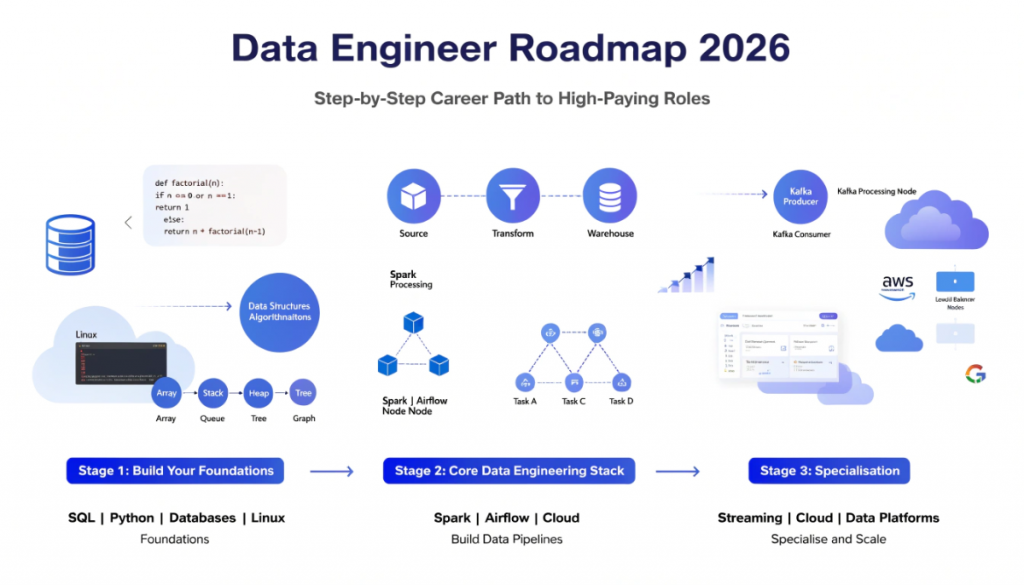
If you are mapping out how to build a data engineering career, following a structured data engineer roadmap saves you time and helps you focus on the skills that actually matter to employers. Here is a realistic data engineer roadmap for 2026.
Stage 1: Build Your Foundations
The first stage of any data engineer roadmap starts with core fundamentals. Learn SQL thoroughly because it underpins almost everything in data engineering. Pick up Python and get comfortable with data structures, file handling and working with libraries like Pandas. Understand the basics of how relational databases work and get familiar with Linux command line. Most data engineers also study computer science fundamentals like algorithms and data structures at this stage even if they come from a non-CS background.
Stage 2: Learn the Core Data Engineering Stack
The second stage of the data engineer roadmap involves building hands-on skills with the main tools used in production environments. This means learning Apache Spark for distributed processing, Apache Airflow for pipeline orchestration and at least one cloud platform deeply. Build your first end-to-end pipeline that ingests raw data, transforms it and loads it into a data warehouse. This practical project experience is what hiring managers look for when evaluating candidates for your first proper data engineer salary.
Stage 3: Specialise and Go Deeper
Once you have the fundamentals and core tools covered the next part of the data engineer roadmap is choosing a specialisation direction. Some engineers go deep into streaming and real-time data with Kafka and Flink. Others focus on cloud-native architectures and earn platform certifications from AWS, GCP or Azure. Some move toward data platform engineering where they build the internal tools that other data teams rely on. Specialisation at this stage is what drives your data engineer salary from the mid level range to the senior level range significantly faster than generalist experience alone.
Certifications That Strengthen Your Data Engineer Salary and Profile
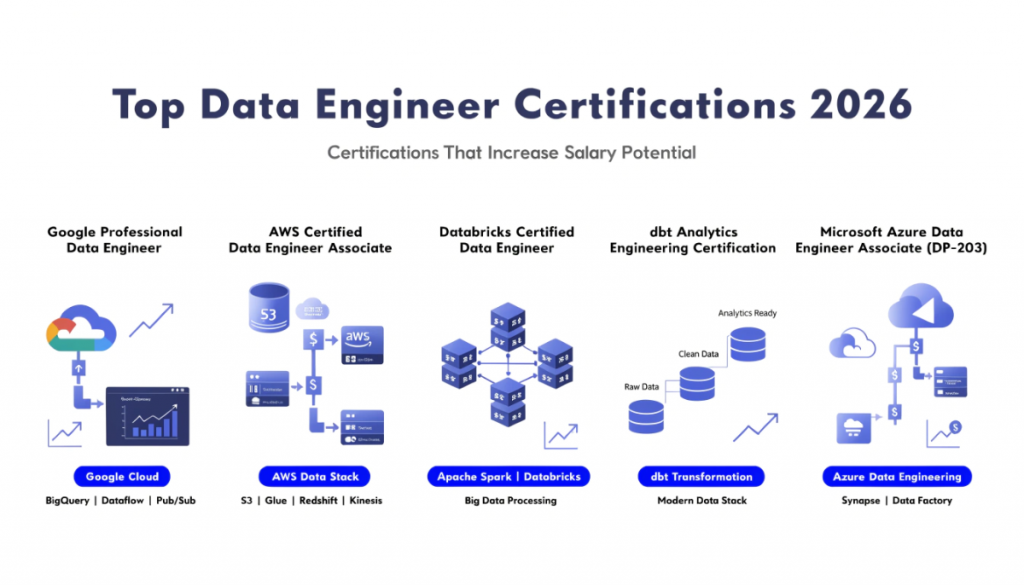
The right certifications in data engineering signal genuine competence in the tools and platforms employers use every day. They also have a measurable impact on data engineer salary especially at the point of switching roles or negotiating a promotion. Here are the certifications most worth investing in.
Google Professional Data Engineer
The Google Professional Data Engineer certification is one of the most respected credentials in the field. It validates your ability to design, build and productionise data processing systems on Google Cloud including BigQuery, Dataflow and Pub/Sub. Because BigQuery has become one of the most widely adopted cloud data warehouses globally, this certification carries genuine weight with employers. Professionals who hold it alongside real project experience consistently report a stronger data engineer salary in hiring negotiations particularly at SaaS and technology companies that run their infrastructure on GCP.
AWS Certified Data Engineer Associate
Amazon Web Services launched the AWS Certified Data Engineer Associate certification to validate skills in designing and maintaining data pipelines on AWS. This covers S3, Glue, Redshift, Kinesis and Lambda among other core services. Given that AWS holds the largest share of the cloud infrastructure market, this certification is highly relevant for professionals working in or targeting enterprise technology environments. Holding it alongside practical AWS project experience is one of the more direct ways to justify a higher data engineer salary at companies running data workloads on AWS.
Databricks Certified Data Engineer Associate and Professional
Apache Spark powers a large proportion of the world’s production data pipelines and Databricks is the leading platform built around it. The Databricks Certified Data Engineer certifications at both associate and professional level validate your ability to build and optimise Spark workloads on the Databricks platform. These certifications are particularly valuable because Databricks adoption has grown rapidly across financial services, healthcare and e-commerce companies. Professionals with Databricks certification typically earn above the average data engineer salary in roles where Spark and Databricks form part of the core data stack.
dbt Analytics Engineering Certification
dbt has become a standard tool for data transformation in the modern data stack and the dbt Analytics Engineering Certification validates your ability to build reliable and well-tested transformation layers using it. While this certification sits slightly more on the analytics engineering side of the spectrum, data engineers who work with dbt regularly will benefit from the structured credential. It signals to employers that your data transformation work is production-grade and maintainable which is a quality that supports a stronger data engineer salary particularly at data-mature organisations.
Microsoft Azure Data Engineer Associate (DP-203)
The Microsoft Azure Data Engineer Associate certification covers data storage, processing and security on the Azure platform including Synapse Analytics, Data Factory and Azure Databricks. This certification is particularly valuable in banking, insurance and large enterprise environments where Microsoft Azure is the dominant cloud provider. Professionals targeting a data engineer salary in these sectors find that Azure certification often accelerates the hiring process because it reduces the employer’s risk in evaluating technical competency for Azure-specific roles.
Data Engineer Interview Questions: What Comes Up Most Frequently
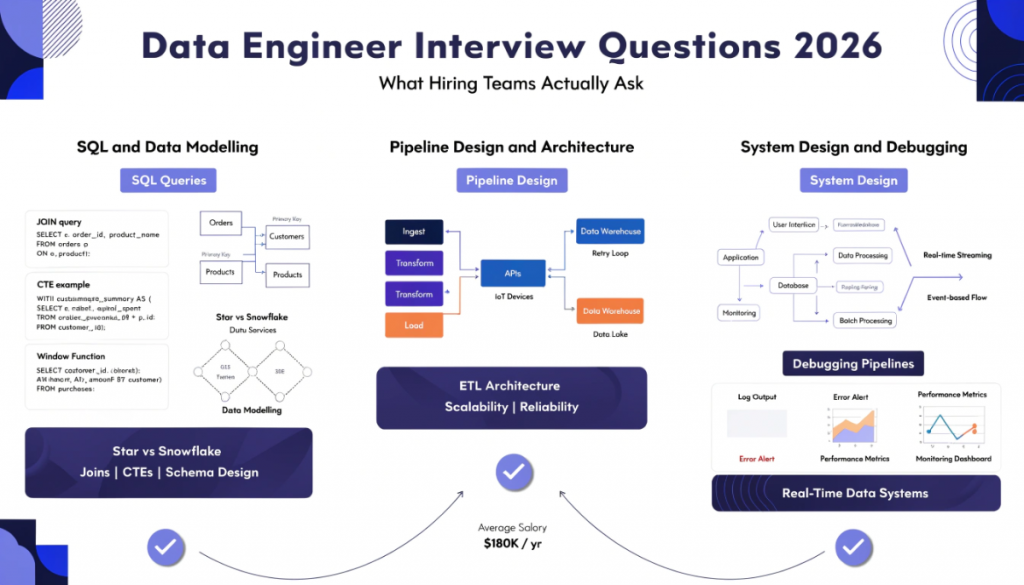
Preparing for the right data engineer interview questions is as important as understanding your data engineer salary worth. Strong interview preparation is what converts a good profile into an actual offer. Here is what hiring teams consistently ask.
Technical Questions on SQL and Data Modelling
SQL questions are almost universal in data engineer interview questions at every level. Expect questions on writing complex joins, window functions, CTEs and query optimisation. Data modelling questions ask how you would design a schema for a specific use case such as an e-commerce order system or a user events table. Being able to discuss the trade-offs between a star schema and a snowflake schema and when you would choose one over the other is particularly common in senior data engineer interview questions.
Pipeline Design and Architecture Questions
Interviewers regularly ask data engineer interview questions around how you would design a data pipeline for a specific scenario. For example, how would you build a pipeline to ingest data from ten different source systems into a centralised warehouse while handling failures gracefully? These questions assess your ability to think about reliability, scalability and maintainability in equal measure. Talking through your reasoning clearly using real tools and explaining the trade-offs in your design decisions is what distinguishes strong candidates in these conversations.
System Design and Debugging Questions
At the mid to senior level, data engineer interview questions often include system design problems. You might be asked to design a real-time fraud detection pipeline or architect a data platform that serves multiple downstream teams with different latency requirements. Additionally, debugging questions present a broken pipeline or a performance issue and ask you to diagnose and fix it.
The ability to think systematically under pressure and articulate your debugging process clearly is a skill that directly affects what data engineer salary you are able to negotiate post-interview.
Conclusion
Data Engineer salaries are strong across markets and grow steadily with experience, specialisation, and the ability to build reliable production systems. In 2026, the average salary in India is around ₹10.1 lakh, with senior professionals earning ₹21.44 lakh and top roles reaching ₹42 lakh. In the US, the median stands at $131,529 with senior engineers averaging $173,395, while in the UK, the average is £61,043, with senior London roles going up to £102,059.
Career growth depends on following a clear roadmap, building cloud and data pipeline expertise, and preparing well for interviews. Whether you’re starting out or moving to senior roles, the earning potential remains strong, and demand in 2026 continues to stay high.
Online MBA in Data Science
Develop skills in data engineering and business strategy with a flexible Online MBA program designed for working professionals.
View Program