

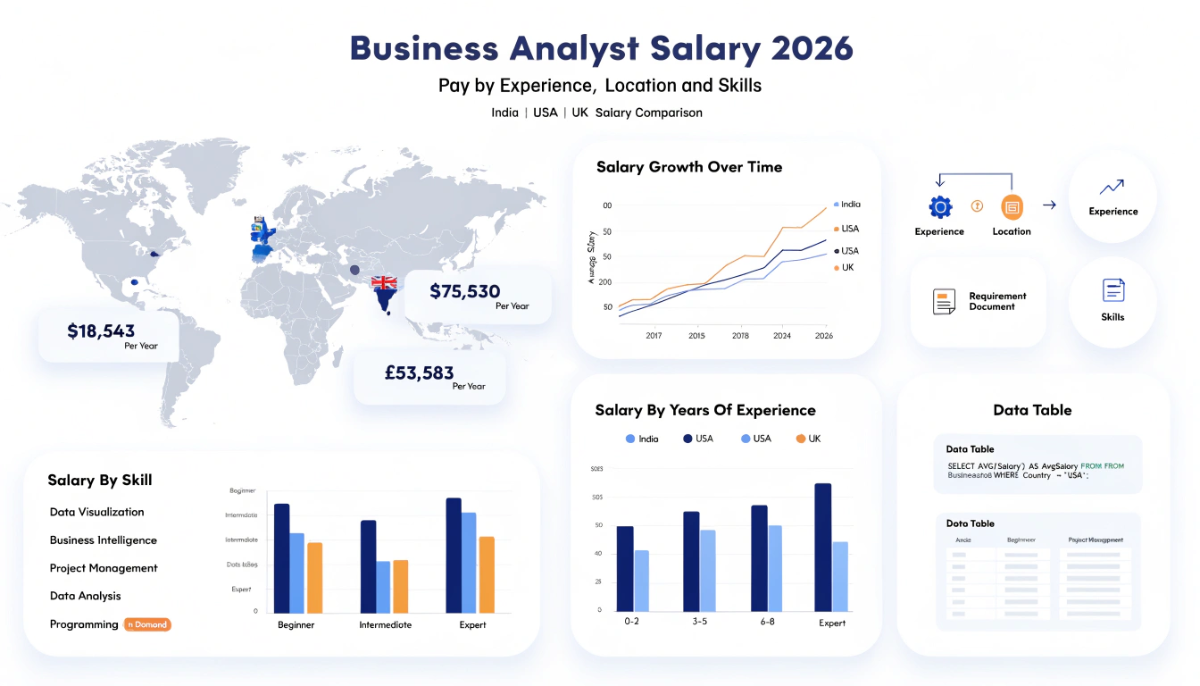
Business analyst salary is one of the most looked up topics by people planning to enter or grow in this field and the numbers are genuinely worth understanding before you make any career decisions. The business analyst role has become one of the most consistently in-demand positions across IT, finance, consulting and e-commerce because companies need professionals who can bridge the gap between business problems and technical solutions. Whether you are just starting out or a few years in and wondering if you are being paid fairly, this guide gives you the actual verified figures alongside everything else that shapes what a business analyst earns. Business analyst salary depends on your experience level, the city you are in, the industry you work for and the certifications you hold. This guide covers all of it clearly so you can benchmark your own business analyst salary and plan your next move with real information.
What a Business Analyst Does: The Role Behind the Salary
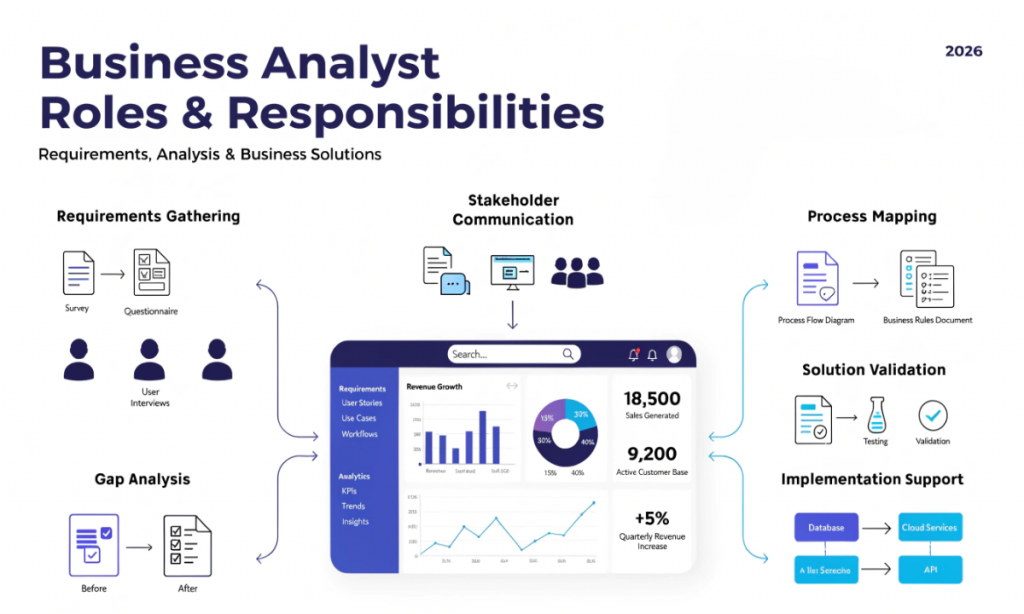
Understanding business analyst roles and responsibilities is the first step because the scope of the work directly explains why salary varies so much across different positions and organisations. A business analyst is the professional who sits between business stakeholders and technical teams, translating what the business needs into something developers, data teams or product managers can actually build and deliver.
The core business analyst roles and responsibilities include gathering and documenting business requirements from stakeholders, conducting gap analysis to identify where current processes fall short and drafting functional specifications that guide technical teams. They also create process flow diagrams, run workshops with department heads, validate solutions against original requirements and support testing and implementation phases to make sure the delivered output actually solves the problem it was designed to address.
Beyond the technical side, a business analyst needs strong communication skills because a big part of the job is managing expectations across different groups who often have conflicting priorities. At a senior level the business analyst roles and responsibilities expand to include leading requirement workshops, owning the business case for major projects and advising on change management when new systems go live. Understanding this scope is why business analyst salary varies so widely between someone doing basic documentation and someone running enterprise-level transformation projects. The broader and more complex the responsibilities, the stronger the business analyst salary tends to be.
Business Analyst Salary in India, US and UK: Global Pay Compared
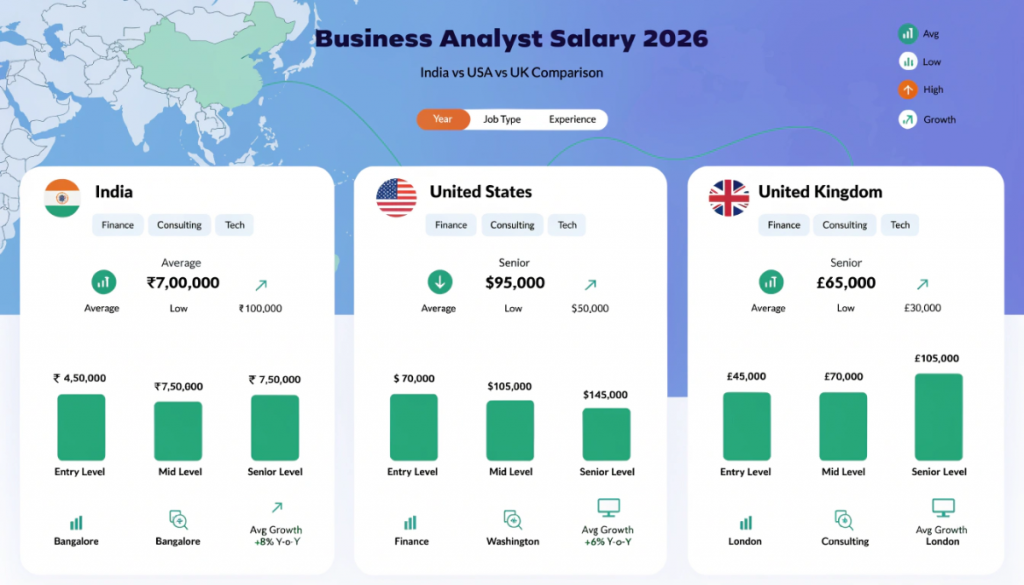
The business analyst salary figures across India, the US and the UK show how much geography shapes earning potential. Here is a clear country-by-country breakdown based on verified 2026 data.
India
In India the business analyst salary averages Rs 7.95 lakh per year at the broad market level according to Glassdoor February 2026 data. Entry level professionals earn between Rs 5.29 lakh and Rs 11 lakh annually. Senior business analyst salary in India averages Rs 13.8 lakh with the range sitting between Rs 9.9 lakh and Rs 20 lakh. At the lead level the business analyst salary averages Rs 19.5 lakh per year with top earners reaching Rs 33.85 lakh. Bangalore and Delhi NCR offer the strongest city-level business analyst salary benchmarks with averages of Rs 9.5 lakh and Rs 9 lakh per year respectively.
United States
In the United States the business analyst salary typically ranges between $78,000 and $120,000 per year according to data from Indeed and Glassdoor from 2026. Glassdoor’s January 2026 data puts the base salary range at $68,000 to $108,000 per year at the broad market level. At the top paying industries, agriculture leads with a median of $102,013 followed by energy and utilities at $100,814 and management consulting at $99,776. States like Washington, California, New Jersey and Oregon offer the strongest packages with Washington averaging $88,037 per year. Business analysts in finance earn around $91,000 annually in the US while those in healthcare earn approximately $86,000 per year according to Glassdoor and DataCamp analysis based on Bureau of Labor Statistics data.
United Kingdom
In the United Kingdom the business analyst salary in London averages GBP 50,593 per year according to Glassdoor February 2026 data based on 11,201 salary submissions. The typical pay range in London sits between GBP 37,311 at the 25th percentile and GBP 69,372 at the 75th percentile annually. Top earners at the 90th percentile reach GBP 93,330 per year. For entry level business analysts across the UK the average is GBP 46,150 per year with the range between GBP 34,226 and GBP 62,939 based on Glassdoor February 2026 UK data across 34,048 salary submissions. The DataCamp salary guide for 2026 puts the UK average at GBP 42,000 overall which aligns closely with the Glassdoor national figures. Outside London cities like Manchester, Bristol and Leeds typically pay 15 to 20 percent below the London average.
Skills That Actually Move Your Business Analyst Salary Up
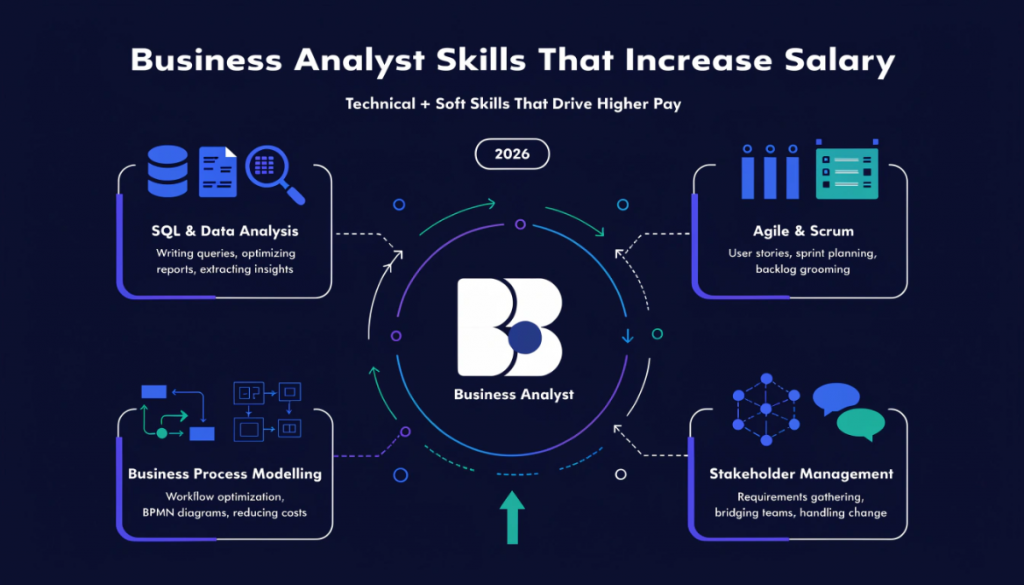
Beyond experience and location, the specific skills you bring directly affect where your business analyst salary lands. Professionals who combine technical skills with strong communication consistently earn more than those who develop only one side of that equation. These are the skills that make the biggest difference to your business analyst salary in any market.
SQL and Data Analysis
Business analysts who can query databases directly using SQL are significantly more self-sufficient and therefore more valuable to employers. Being able to extract, filter and analyse data independently rather than relying on a data team means faster turnaround on insights and better quality requirements. SQL proficiency consistently appears as a high-impact factor in business analyst salary negotiations particularly at technology companies and financial services firms. Analysts who can work directly with data without depending on engineering teams are among the highest paid at every level.
Agile and Scrum Knowledge
Most technology projects now run in agile frameworks which means business analysts need to understand how to write user stories, manage backlogs and participate in sprint ceremonies effectively. Agile-certified business analysts are in higher demand than those who only understand waterfall methodology. That demand shows up directly in the business analyst salary they can command particularly at product-led companies and consulting firms where agile delivery is the standard working model.
Business Process Modelling
The ability to map and document business processes clearly using tools like Visio, Lucidchart or BPMN notation is a core technical skill that strengthens your value as a business analyst. Process modelling skills help stakeholders visualise how proposed changes will affect their operations which reduces the risk of poorly specified requirements. This capability is particularly valued at large organisations running complex transformation programmes.
Stakeholder Management
A business analyst who can manage difficult stakeholders, facilitate productive workshops and navigate conflicting priorities without losing the trust of any party is worth significantly more than one who can only document requirements cleanly. Stakeholder management is a soft skill but it has a hard impact on business analyst salary. It determines how effective you are in high-stakes environments where requirements are contested and timelines are tight. Senior business analyst salary increases in most organisations are directly tied to demonstrated stakeholder management capability.
Certifications That Directly Impact Your Business Analyst Salary
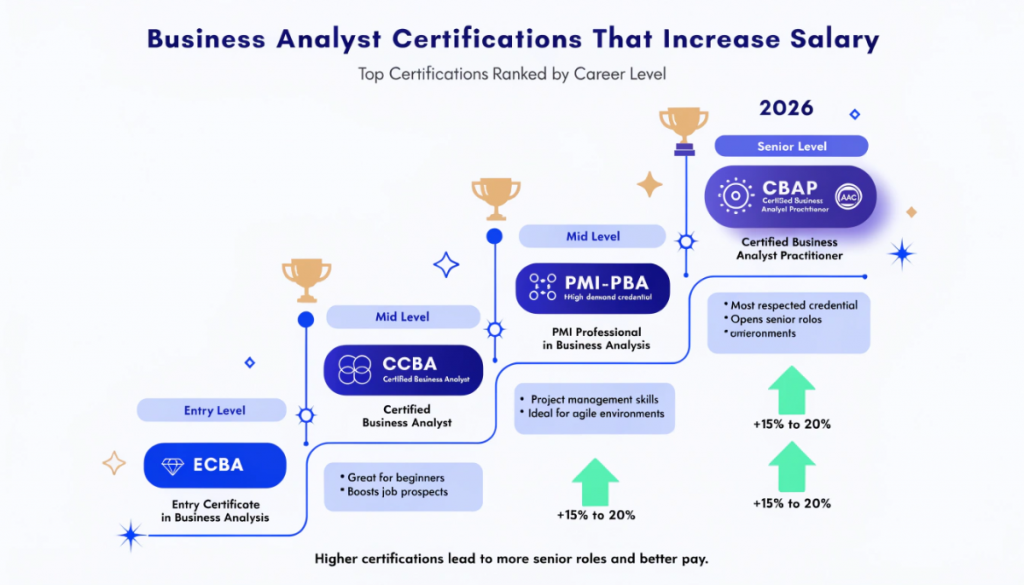
Certifications have a measurable impact on business analyst salary. According to IIBA’s 2026 salary survey, certified business analysts earn 15 to 20 percent more than non-certified peers at the same experience level. Choosing the right certification for your career stage is important because not all of them carry equal weight with employers. Here are the ones that make the biggest difference.
ECBA: Entry Certificate in Business Analysis
The ECBA from IIBA is the right starting point for anyone new to the field. It requires no prior BA experience which makes it accessible for career changers and recent graduates. Holding the ECBA signals to hiring managers that you have a structured understanding of business analysis fundamentals and it gives your application more credibility when competing for your first business analyst salary. The exam covers the BABOK Guide and can be completed within a few weeks of focused preparation.
CCBA: Certification of Competency in Business Analysis
The CCBA is the mid-level credential from IIBA and requires a minimum of 3,750 hours of BA work experience before you can sit the exam. It is well suited for professionals who have two to four years of hands-on experience and want to validate their competency formally. Holding the CCBA consistently supports a stronger business analyst salary at the mid level because it demonstrates that your skills have been independently assessed against a global standard rather than just employer feedback.
CBAP: Certified Business Analysis Professional
The CBAP is the most recognised and respected business analyst certification globally. It requires at least 7,500 hours of BA work experience over the past ten years which means it is aimed at senior professionals. A CBAP holder commands a noticeably higher business analyst salary in most markets. According to IIBA data, CBAP certified professionals earn an average of 22 percent more than non-certified counterparts. At the senior level in India, holding a CBAP can push your business analyst salary from the Rs 13.8 lakh average closer to the Rs 20 lakh to Rs 28 lakh range.
PMI-PBA: Professional in Business Analysis
The PMI-PBA from the Project Management Institute is particularly valuable for business analysts who work closely with project management teams or who operate in environments where PMI methodology is standard. It requires 4,500 to 7,500 hours of BA experience depending on your education level. The PMI-PBA is widely recognised in consulting firms, government projects and large IT services companies where PMI frameworks are common. It supports a stronger business analyst salary particularly in the consulting and IT services sectors which are among the largest employers of business analysts in India.
Agile Analysis Certification (AAC)
The AAC from IIBA is designed for business analysts working in agile delivery environments. As more organisations move away from waterfall project management, the demand for business analysts who understand agile frameworks is rising steadily. The AAC validates your ability to work effectively in sprint-based environments, write user stories, manage backlogs and collaborate with product owners. This certification is particularly relevant for those targeting product companies and technology startups where agile is the standard working model and where the business analyst salary for agile-skilled professionals sits above the market average.
Business Analyst Interview Questions: What to Expect When You Apply
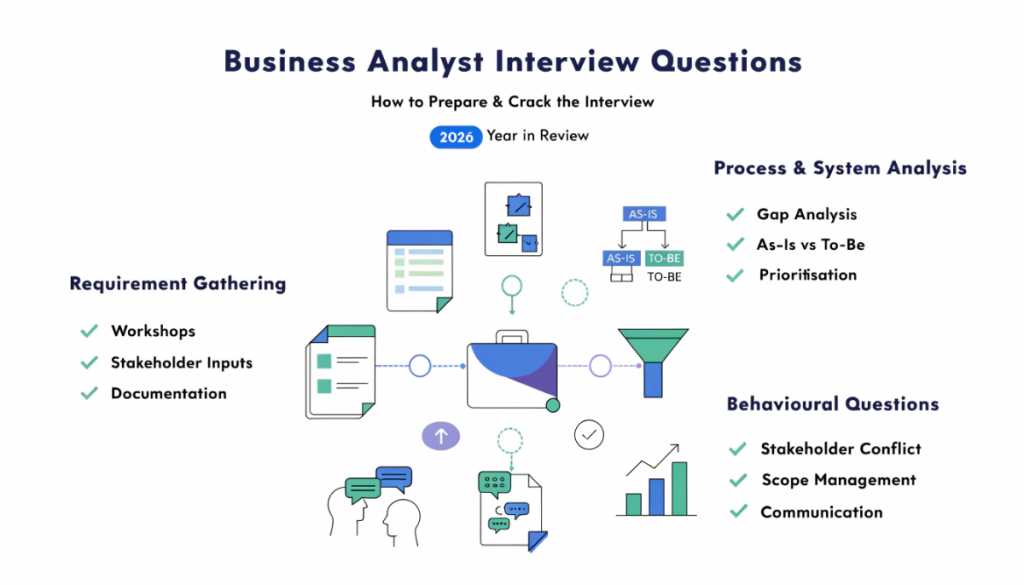
Preparing for the right business analyst interview questions is as important as knowing your business analyst salary worth. Performing well in interviews is what gets you the offer and the negotiating room to push your business analyst salary to the top of the range. Here is what comes up most frequently across experience levels.
Requirement Gathering and Documentation Questions
Interviewers almost always ask about how you approach requirement gathering. Common business analyst interview questions in this area include how you handle incomplete or conflicting requirements from stakeholders, how you decide which requirements are in or out of scope and what techniques you use to elicit requirements from stakeholders who are not sure what they want. Being specific about methods like workshops, interviews, surveys and use case analysis with real examples from your experience is what separates strong candidates from average ones.
Process and Systems Analysis Questions
Another common area in business analyst interview questions covers your ability to analyse processes and systems. You may be asked to walk through how you would conduct a gap analysis, how you would document an as-is process versus a to-be process or how you would prioritise requirements when time and budget are constrained. Practical examples from previous projects with clear outcomes are the most compelling way to answer these questions.
Behavioural and Situational Questions
Expect business analyst interview questions that ask about how you handled a stakeholder who pushed back on your analysis, how you managed scope creep on a project or how you communicated a requirement change that affected the project timeline. These questions assess your composure, communication ability and professional judgement. All of these qualities directly affect how useful you are in complex projects and therefore what business analyst salary you can justify in your next negotiation.
How to Become a Business Analyst: A Realistic Path
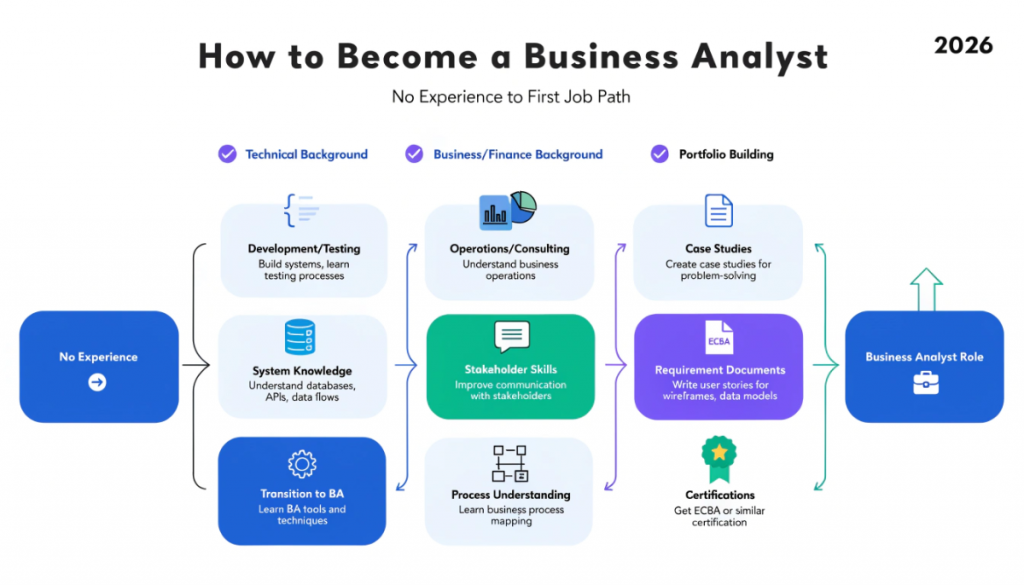
One of the most common questions people researching business analyst salary and career prospects ask is how to become a business analyst with no prior experience in the field. The honest answer is that there are several entry points depending on your background and each one leads to a credible first business analyst salary within one to two years of deliberate preparation.
Starting from a Technical Background
If you come from software development, testing or data analysis, the transition to a business analyst role is relatively straightforward because you already understand how technical systems work. The main skills to develop are stakeholder communication, requirements documentation and process mapping. Many developers make this move after three to five years in technical roles because they enjoy the problem-solving aspect of the work but want more client interaction, strategic involvement and a business analyst salary that reflects a broader skill set.
Starting from a Business or Finance Background
Professionals coming from business operations, finance, project coordination or consulting have a head start on the stakeholder and process side of how to become a business analyst. What they typically need to develop is familiarity with how technology projects are structured and the documentation standards that technical teams expect. Taking a course in SDLC fundamentals, agile methodology and tools like JIRA or Confluence alongside IIBA’s ECBA certification is a practical first step for this group.
Building Your Portfolio Before Your First Role
One practical approach to how to become a business analyst without prior direct experience is to build a portfolio of work that demonstrates your capability. This can include documenting a process you improved in your current role, creating a requirements document for a hypothetical product and completing an IIBA certification. Many hiring managers care more about evidence of analytical thinking and communication clarity than specific job title history when evaluating candidates for junior roles. Building this kind of portfolio is one of the fastest ways to access your first business analyst salary without years of prior direct experience.
Conclusion
Business analyst salary is strong at every level of the career and it grows consistently as you build experience, develop specialist skills and take on greater responsibility. The verified numbers from Glassdoor, AmbitionBox and PayScale for 2026 show a clear picture: entry level professionals in India earn between Rs 5.29 lakh and Rs 11 lakh per year, senior business analysts average Rs 13.8 lakh with top earners reaching Rs 28 lakh, and lead professionals average Rs 19.5 lakh with top earners reaching Rs 33.85 lakh. In the US the range sits between $78,000 and $120,000 per year and in London the average is GBP 50,593 with senior professionals reaching GBP 93,330.
Understanding business analyst roles and responsibilities clearly, preparing well for business analyst interview questions and knowing how to become a business analyst from your specific background are all part of making smart career decisions in this field. The demand for qualified business analysts continues to grow in 2026 and so does the business analyst salary at every level. Monitoring your business analyst salary against current market benchmarks every year is one of the simplest ways to make sure you are always being paid fairly. Build your technical skills, earn a recognised certification and track your impact on projects carefully. That combination is the most reliable path to a stronger business analyst salary over time.
Explore our online programs to become future-ready
Transform your career with industry-aligned courses designed by experts.
View All Courses