

Companies today collect more data than they can read. They need managers who can turn that data into decisions about pricing and customers and costs. An MBA in business analytics is built to train exactly those managers. It combines core management subjects with statistics and programming and data tools. The online format lets you study while you continue to work. This blog explains who can apply and what you will study. It also covers the job roles and gives a realistic view of pay.
What an MBA in Business Analytics Really Is
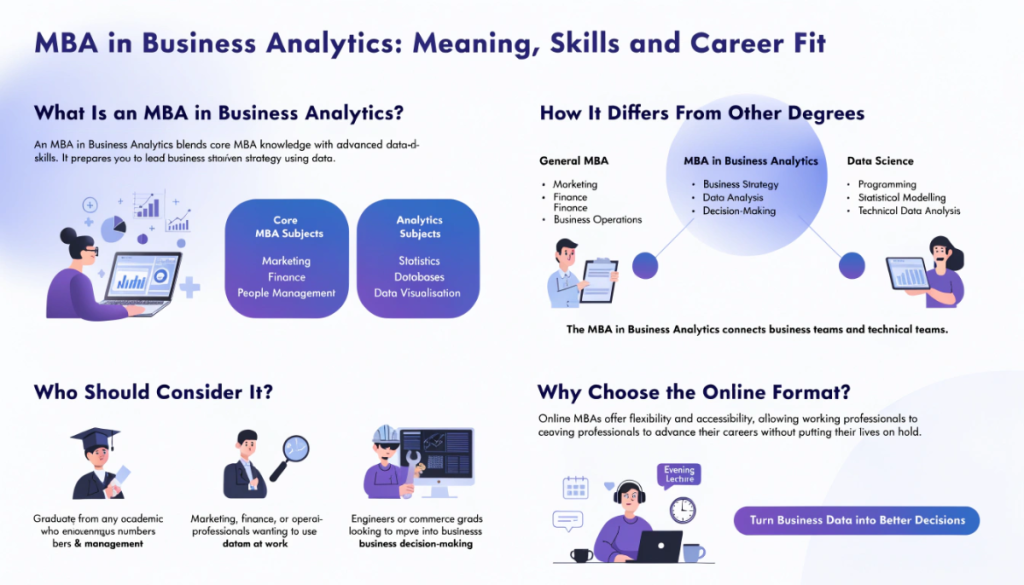
An MBA in business analytics is a two year postgraduate degree that teaches you to use data to solve business problems. You learn the same core management subjects as any MBA student. Then you add analytics papers that show how to collect and clean and study data so a business can act on it.
The Basic Meaning
- The first year covers marketing and finance and people management, which means you build a business base before you specialise.
- The analytics papers add statistics and databases and data visualisation, so you can answer questions with numbers instead of opinions.
- The goal is to link data work with business goals, which makes an MBA in business analytics different from a pure coding degree.
How It Differs From Data Science and a General MBA
- A data science degree goes deep into coding and model building, so graduates spend most of their time on technical work.
- A general MBA covers many functions without much data depth, so graduates may rely on others to read the numbers.
- An MBA in business analytics sits in the middle, which means you can talk to both the technical team and the business leaders.
Who Should Consider It
- Graduates from any stream who like numbers and want a management career, since the program does not require a computer science background.
- Working professionals in marketing or finance or operations who want to use data in their current roles.
- Engineers and commerce graduates who want to move from a technical or accounting job into business decision making.
Why Many Students Choose the Online Format
Most working learners pick an online MBA in business analytics because it fits around a job. You can attend live sessions in the evening and watch recordings later. You can also apply a new skill at work the same week you learn it. That quick link between study and practice makes analytics easier to remember.
Eligibility and Admission for an MBA in Business Analytics
The entry rules for an online MBA in business analytics are simple. You do not need prior analytics experience or a technical degree.
Academic Requirement
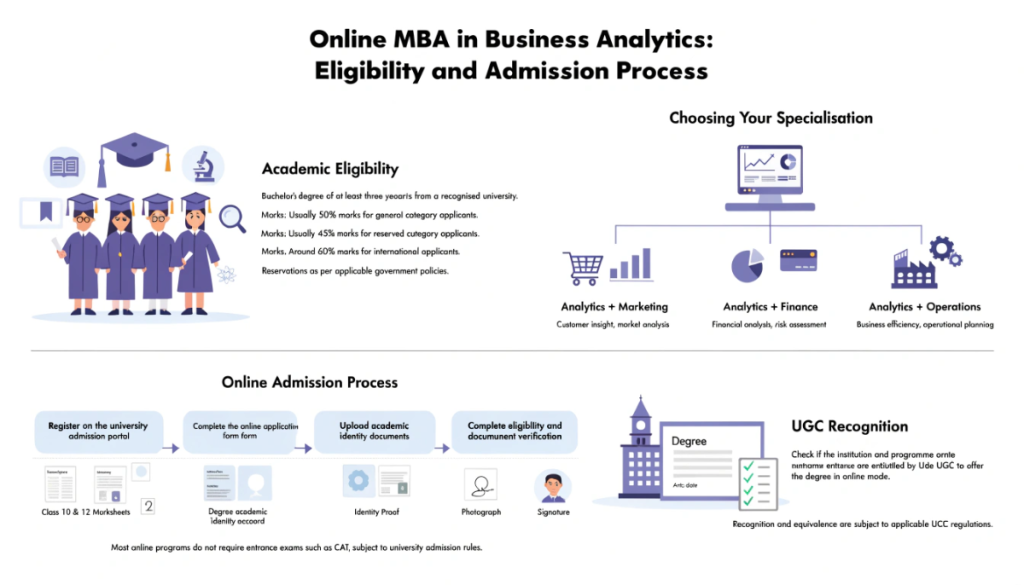
- A bachelor’s degree of at least three years from a recognised university is required, so graduates from arts and science and commerce and engineering can all apply.
- The usual minimum is 50 percent marks in the qualifying degree, with a lower cut off of 45 percent for candidates from reserved categories.
- International applicants are generally expected to have around 60 percent marks in the qualifying examination.
- Seats are reserved as per government policies, so reserved category candidates should confirm details with the admission team.
How the Specialisation Is Chosen
Many online MBA programs offer analytics as one of several subject areas. Some let you pick a major and a minor so you can pair analytics with marketing or finance or operations. A pairing such as analytics and marketing suits customer insight roles. Analytics and finance suits risk and financial analysis roles. Check how your program handles this before you apply.
Admission Process
- Admission is done online through an application where you register and fill in details and upload documents.
- Most online programs have no entrance exam such as CAT, so selection depends on eligibility and document checks.
- Documents normally include Class 10 and Class 12 grade sheets and graduation grade sheets and a degree or provisional certificate and identity proof and a photograph and a signature copy.
Recognition to Confirm
Check that the program is entitled by UGC to run in the online mode. Under the UGC rules of 2020 a degree earned online from an approved institution is treated as equal to the same degree earned on campus. This matters for jobs and for further study.
MBA in Business Analytics Syllabus and Skills
The syllabus of an MBA in business analytics runs across four semesters. The first year builds management knowledge. The second year moves into data tools and a final project.
Core Management Subjects
- Marketing management and organisational behaviour and financial accounting teach how businesses sell and organise and track money.
- Human resource management and financial management and managerial economics show how to manage people and funds and set prices.
- Statistics for management is especially important, since every analytics method rests on it.
- Legal aspects of business and sales management round out the core so you understand the wider business setting.
Analytics Subjects You Can Expect
- Data analysis using Python covers cleaning and exploring data, which is the daily work of most analysts.
- Databases and SQL teach you how to pull data from company systems. Almost every analytics job uses this skill.
- Data visualisation and business intelligence tools such as dashboards help you present results to managers.
- Predictive modelling and machine learning basics show how to forecast sales and customer behaviour.
- Decision analytics teaches how to turn findings into clear recommendations, which is the real goal of the field.
Capstone Project or Internship
Most programs end with a project or internship. In an MBA in business analytics this is the best place to show real skill. Pick a real problem such as predicting customer churn or improving a sales forecast. A solid project gives you something concrete to show in interviews. It also proves that you can handle a whole analysis from raw data to final advice.
Skills You Build
- Technical skills in Python and SQL and a dashboard tool, which are listed in most analytics job postings.
- Business thinking, which helps you ask the right question before you touch any data.
- Communication and storytelling with data, since managers act on clear messages and not on raw tables.
Career Options After an MBA in Business Analytics
Graduates with an MBA in business analytics can work in almost every industry. The roles below are the most common starting points.
Business Analyst and Data Analyst
- Business analysts study how a company works and suggest improvements, so the role mixes data with communication.
- Data analysts focus more on cleaning and reporting data, which means strong SQL and spreadsheet skills matter most.
Business Intelligence Roles
- BI analysts and dashboard developers build reports that managers check every day, so a good eye for design helps.
- Reporting and MIS roles in large companies use the same skills and offer steady entry points.
Functional Analytics Roles
- Marketing analysts study campaigns and customer data to improve results.
- Operations and supply chain analysts find delays and costs in processes, which suits people who like fixing systems.
- Finance and risk analysts study numbers to judge credit and investment decisions, so this suits those with a finance interest.
- HR analysts study hiring and attrition data. The field is growing as companies track people metrics.
Consulting and Product Roles
- Analytics consultants help clients solve problems with data. The work involves travel and varied projects.
- Product analysts study how users behave inside an app or website, so they support product managers with evidence.
- Data scientist roles are possible for those who add strong programming and machine learning skills, though they usually need extra self study.
Industries That Hire
- IT services and consulting firms hire in large numbers, which makes them a common first employer.
- Banks and insurance and fintech companies use analytics for risk and customer decisions.
- E-commerce and retail and healthcare companies use it for demand and pricing and operations.
Benefits, Limits and Salary of an MBA in Business Analytics
An MBA in business analytics has clear strengths. It also has limits that are worth knowing before you enrol.
Main Benefits of an MBA in Business Analytics
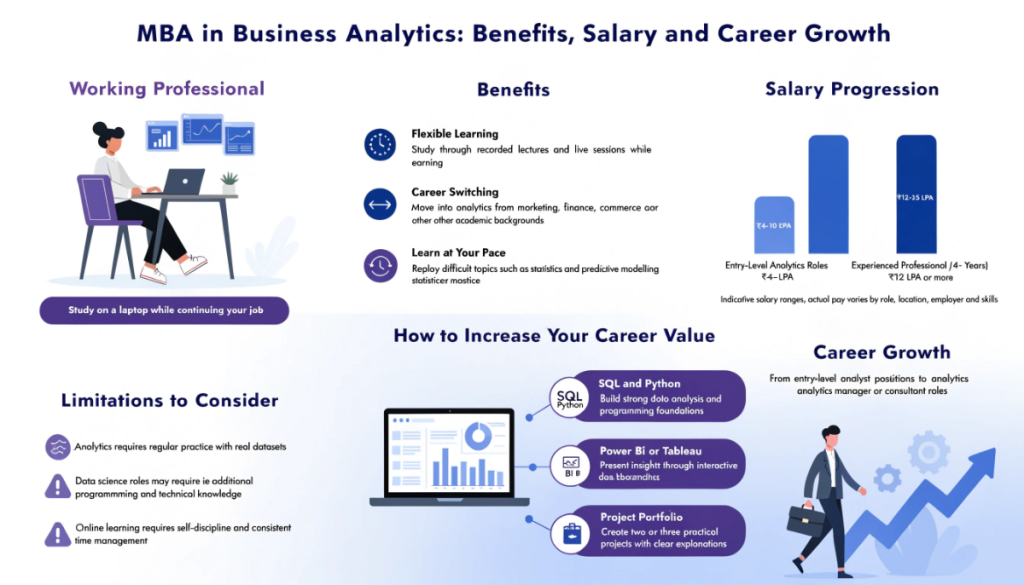
- You can keep working while you study, so there is no income gap and you can use new skills at your job.
- The degree opens a path into analytics for people without a technical background, which means career switching is possible.
- Recorded lectures help with tough topics such as statistics and modelling, since you can replay them as many times as needed.
Limits to Keep in Mind
- Analytics needs regular practice with real data, so passive watching of lectures is not enough.
- Pure data science roles often expect deeper coding than an MBA covers, so extra learning may be needed.
- Online study needs self discipline because nobody checks your attendance daily.
Salary Expectations
Pay depends on role and city and employer. Career sites often show entry level salaries for analytics roles in the range of about 4 to 10 LPA. Experienced professionals with four to six years of work can reach 12 to 25 LPA or more in roles like analytics manager and consultant. Data scientist roles can pay higher but they expect stronger technical skills. These are rough figures from salary surveys so check current job listings before you plan around any number.
How to Raise Your Value
- Learn SQL and Python well, because these two skills appear in almost every analytics job listing.
- Pick up one dashboard tool such as Power BI or Tableau, so you can show your work visually.
- Build a portfolio of two or three projects with clear write ups, since recruiters like to see real examples.
How to Choose and Prepare for an MBA in Business Analytics
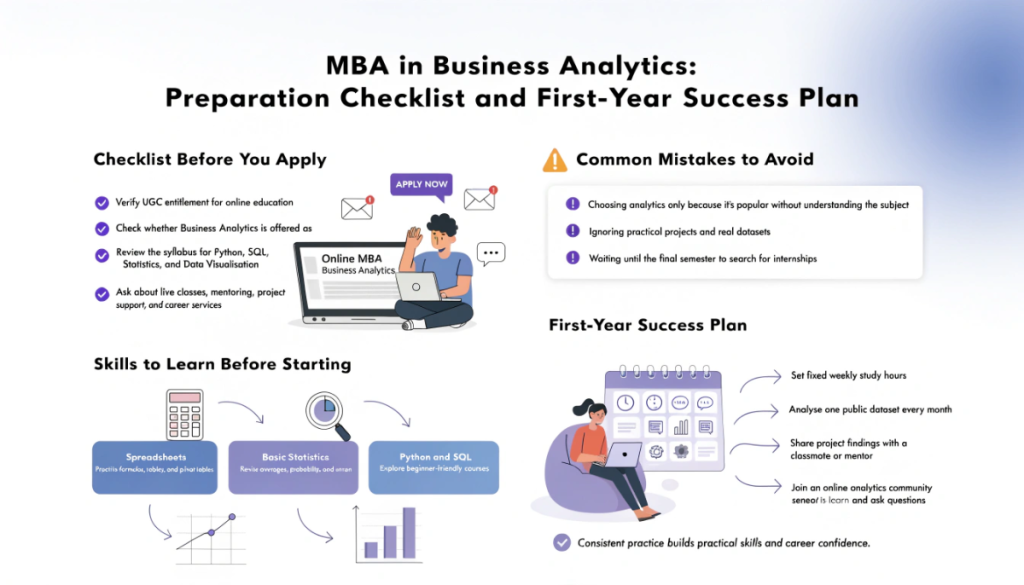
A little preparation before you enrol makes the course far more useful. Check the program details and build a few basic skills early.
Checklist Before You Apply
- Confirm that the program is entitled by UGC for the online mode and that analytics appears as a subject area on your degree.
- Read the syllabus for Python and SQL and statistics and visualisation, because these carry the career value.
- Ask about live sessions and mentoring and project support, which tells you how much real guidance you will get.
- Check what career support is offered and what it actually includes, so you are not relying on vague promises.
Skills to Start Before Your MBA in Business Analytics Begins
- Practise spreadsheets with formulas and pivot tables, since they are the base of most analysis work.
- Revise school level statistics such as averages and probability, which you will use from the first semester.
- Try a free Python or SQL course for a few weeks, so the first technical papers feel familiar.
Mistakes to Avoid
- Choosing analytics only because it sounds popular, which means you may lose interest when the maths starts.
- Ignoring practical work, since employers prefer candidates who have handled real data.
- Waiting until the last semester to look for internships, because good openings fill early.
A Simple Plan for the First Year
Set fixed weekly study hours and treat them like work meetings. Pick one public dataset each month and write a short analysis of it. Share your work with a classmate or a mentor for honest feedback. Join one online community of analysts to ask questions and see how others work. Small steady steps build both skill and confidence.
Conclusion
An MBA in business analytics is a strong choice if you want a management career built on data. The eligibility is open to graduates from any background and the format fits around work. What decides your outcome is the practice you put in alongside the syllabus. Check the approval and the subject details before you enrol. Then learn the tools and build projects as you go. That combination can turn a flexible degree into a solid career step.
Sources & References
✓ Verified 2026These official education, technology and industry resources provide further information on online MBA recognition, business analytics, admission requirements, analytical tools, industry skills and career opportunities.