

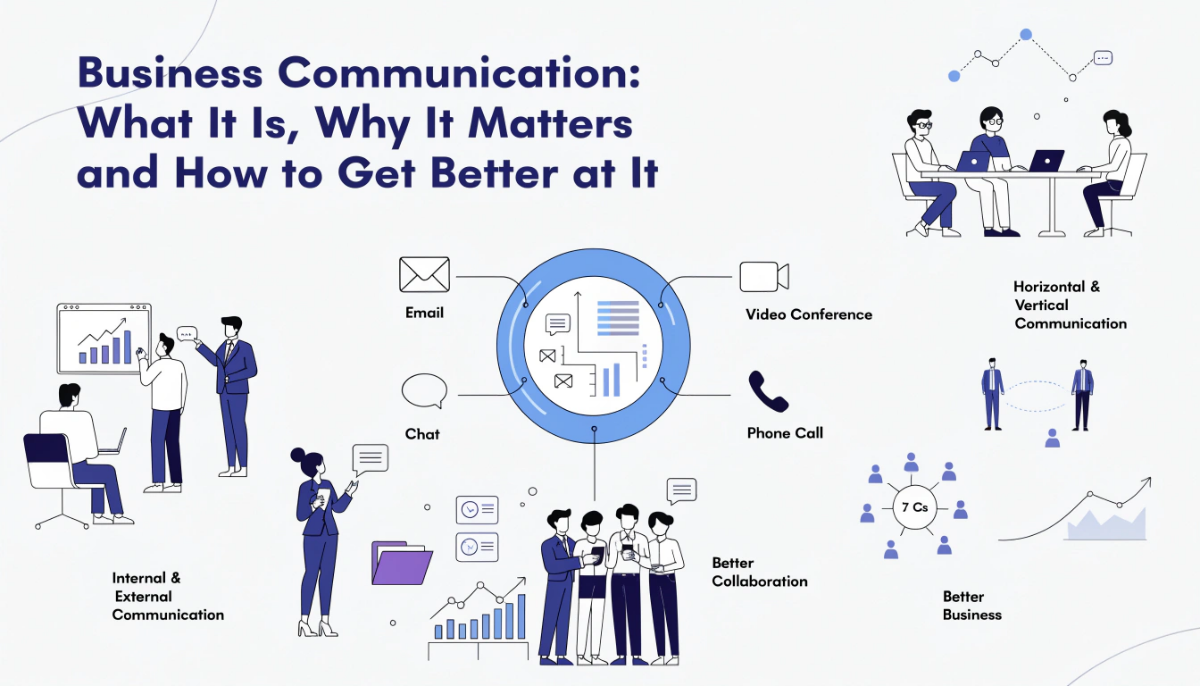
Business communication is what keeps every part of an organisation connected and functioning, yet most companies underinvest in it until a failed project, a client complaint or a team conflict makes the gap impossible to ignore. At its core, business communication is the process of exchanging information between people inside and outside an organisation in a way that drives action, builds understanding and supports the goals the business is trying to achieve.
Poor business communication is not just a soft problem. It costs companies money through delayed decisions, repeated errors, low employee engagement and damaged client relationships. This blog covers what business communication actually involves, why the different types matter, what the seven Cs of effective communication look like in practice, what blocks communication from working and how to improve it at both the individual and organisational level.
What Business Communication Is and Why the Definition Matters
Business communication is a term that covers a wider range of activities than most people realise when they first encounter it. Here is a clear and practical breakdown:
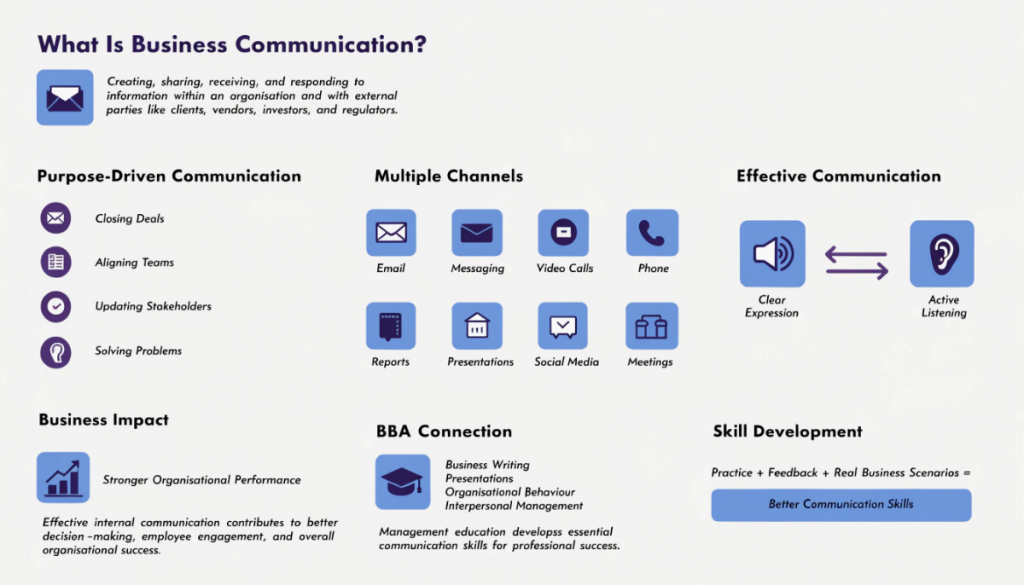
Business communication refers to all the processes through which information is created, shared, received and responded to within an organisation and between an organisation and its external stakeholders including clients, vendors, investors and regulatory bodies
What separates business communication from general communication is its purposeful nature: every piece of communication in a business context is designed to achieve something, whether that is closing a deal, aligning a team, updating a stakeholder or solving a problem, rather than simply conveying information for its own sake
Business communication operates across multiple channels simultaneously in 2026, including email, messaging platforms, video calls, phone, formal reports, presentations, social media and in-person meetings, and the skill of choosing the right channel for the right message is itself an important part of business communication competence
The difference between effective and ineffective business communication is measurable: a McKinsey study found that companies with highly effective internal communication deliver 47 percent higher total returns to shareholders compared to companies with poor communication, confirming that the quality of business communication directly affects financial performance
Business communication is also a two-way process rather than a broadcasting activity, which means effective business communication requires the ability to listen, interpret and respond accurately and not just the ability to express ideas clearly
A BBA program directly builds business communication skills through coursework in business writing, presentation, organisational behaviour and interpersonal management, with the eligibility being 10+2 in any discipline with 45% marks and no entrance exam required, making it the most accessible formal foundation for professional business communication skills
Understanding business communication at the level required for professional roles is not an innate talent but a learnable set of skills that improve with structured practice, feedback and the kind of exposure to real business scenarios that a management education program provides
The Three Types of Business Communication Every Professional Must Understand
Business communication flows in three distinct directions within and around an organisation, and each type serves a different purpose. Here is how they work:
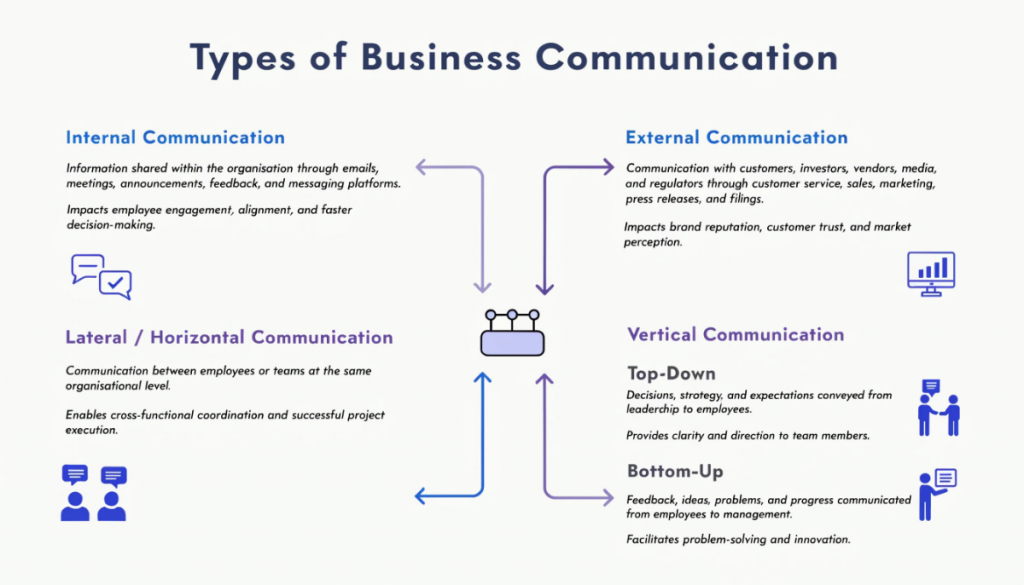
Internal business communication covers all information exchange that happens within the organisation itself, including emails between colleagues, team meetings, company-wide announcements, performance feedback sessions, departmental briefings and the informal conversations that happen through messaging platforms during the workday
The quality of internal business communication determines employee engagement, alignment on organisational goals and the speed at which decisions get made and implemented, which is why organisations with strong internal communication consistently report higher productivity and lower attrition than those where internal messaging is fragmented or inconsistent
External business communication covers all interactions between the organisation and parties outside it including customer service correspondence, sales pitches, marketing content, press releases, investor communications, vendor negotiations and regulatory filings
External business communication directly shapes how a brand is perceived by its market, and a company that communicates clearly and consistently in its external messaging builds a reputation that attracts customers, retains them and supports premium pricing in a way that inconsistent or poorly crafted external communication cannot achieve
Lateral or horizontal business communication refers to the exchange that happens between people at the same level of the organisation whether within the same department or across departments, and it is the type of business communication that most directly determines how well cross-functional projects get executed
Many organisations focus heavily on top-down communication and underinvest in lateral communication systems, which is one of the most common reasons that well-planned initiatives fail at the execution stage when different teams cannot effectively coordinate with each other
Vertical business communication within an organisation includes both top-down communication where leadership shares decisions, strategy and expectations with the team and bottom-up communication where team members share feedback, problems, ideas and progress reports with management, and both directions are necessary for an organisation to operate with full situational awareness
Why Business Communication Is Central to Organisational Success
The importance of business communication goes well beyond etiquette and professionalism. Here is a specific account of what it actually affects:
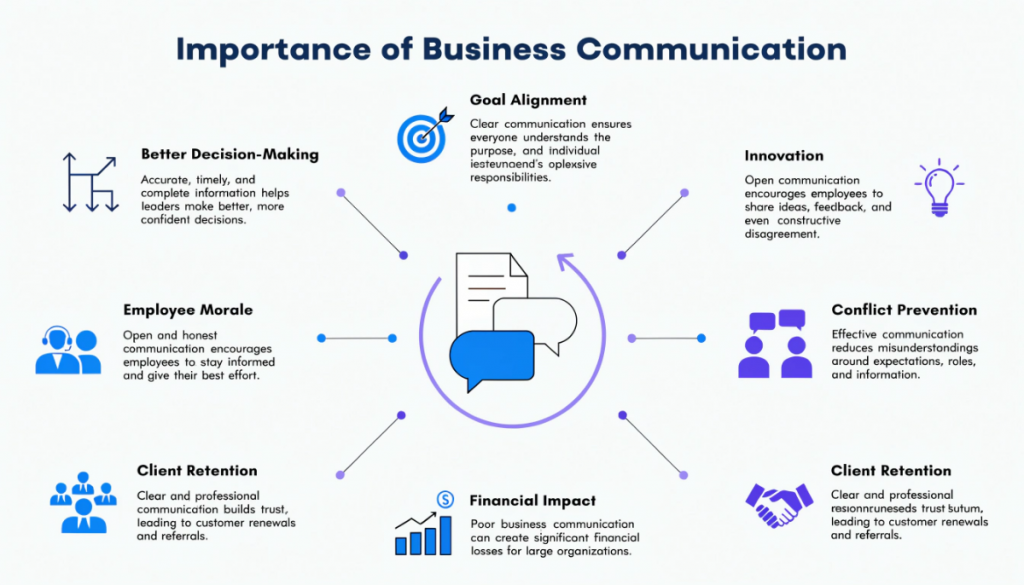
Goal alignment is the first and most direct benefit of effective business communication, since a team that clearly understands what they are working toward, why it matters and what their individual role in achieving it is will outperform a team working toward the same goal but without that shared understanding
Decision quality improves directly when business communication is effective because managers and leaders who receive accurate, timely and complete information from their teams make better decisions than those who operate on incomplete or delayed information
Employee morale is more strongly influenced by communication quality than by most other management variables, with research from Gallup in 2025 confirming that employees who feel their organisation communicates openly and honestly are 4.6 times more likely to give their best effort at work compared to those who feel poorly informed
Client retention depends heavily on business communication quality because a client who receives clear, timely and professional communication from a service provider throughout a project is far more likely to renew and refer than one who experiences gaps, ambiguity or inconsistency in how the provider communicates with them
Conflict prevention is a less visible but highly valuable benefit of good business communication, since many workplace conflicts begin not from genuine disagreement but from misunderstood expectations, unclear role definitions or information that reached the wrong people in the wrong format
Innovation is also directly connected to business communication because organisations where people feel safe to share ideas, disagree with proposals and offer feedback generate more usable new ideas than those where communication norms discourage candour or reward conformity
The financial cost of poor business communication is estimated at around 62.4 million dollars per year for large organisations according to a study by the Society for Human Resource Management, which frames the return on investment from improving business communication in concrete financial terms rather than as a soft benefit
Business Communication Channels and How to Choose the Right One
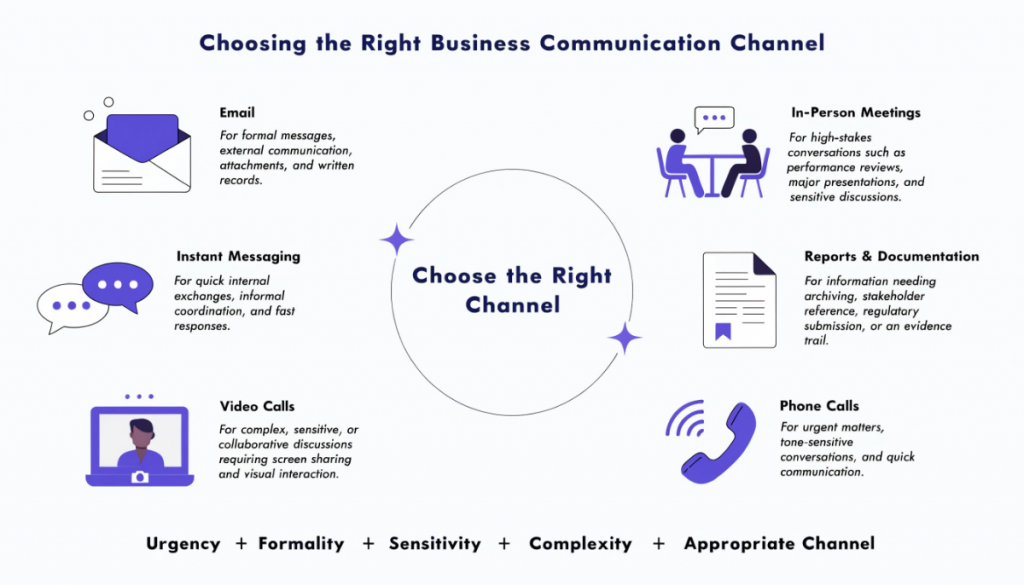
Choosing the wrong channel for a business communication is one of the most common and most avoidable reasons messages fail to land. Here is how to think about channel selection:
Email remains the standard channel for formal written business communication in 2026, appropriate for messages that need a written record, involve external parties, contain attachments or require a considered and structured response rather than an immediate conversational reply
Instant messaging platforms including Slack, Microsoft Teams and WhatsApp Business are the right channel for quick internal exchanges, informal coordination and team conversations where the expectation is a fast response and the message does not require documentation or legal standing
Video calls through Zoom, Google Meet or Teams are the most effective replacement for in-person meetings when the conversation involves multiple participants, requires screen sharing, needs to cover complex or sensitive topics or benefits from the visual feedback that voice-only calls cannot provide
Phone calls are underused in professional settings in 2026 but remain the right channel when a matter is urgent, when tone and intent are at risk of being misread in written form or when a rapid back-and-forth exchange would take ten email messages but three minutes on a call
Formal reports and documentation are the right channel for business communication that needs to be archived, referenced by multiple stakeholders over time, submitted to regulatory authorities or used as the basis for significant business decisions that need an evidence trail
In-person meetings remain the highest-bandwidth channel for business communication because they allow the full range of verbal and non-verbal signals to be exchanged simultaneously, which makes them the most appropriate channel for high-stakes conversations including performance reviews, major client presentations and sensitive interpersonal discussions
The principle for channel selection in business communication is to match the formality, urgency, sensitivity and complexity of the message to the capabilities of the channel, and the professionals who consistently make this matching well are significantly more effective communicators than those who default to a single preferred channel regardless of the situation
The 7 Cs of Business Communication and What Each One Means in Practice
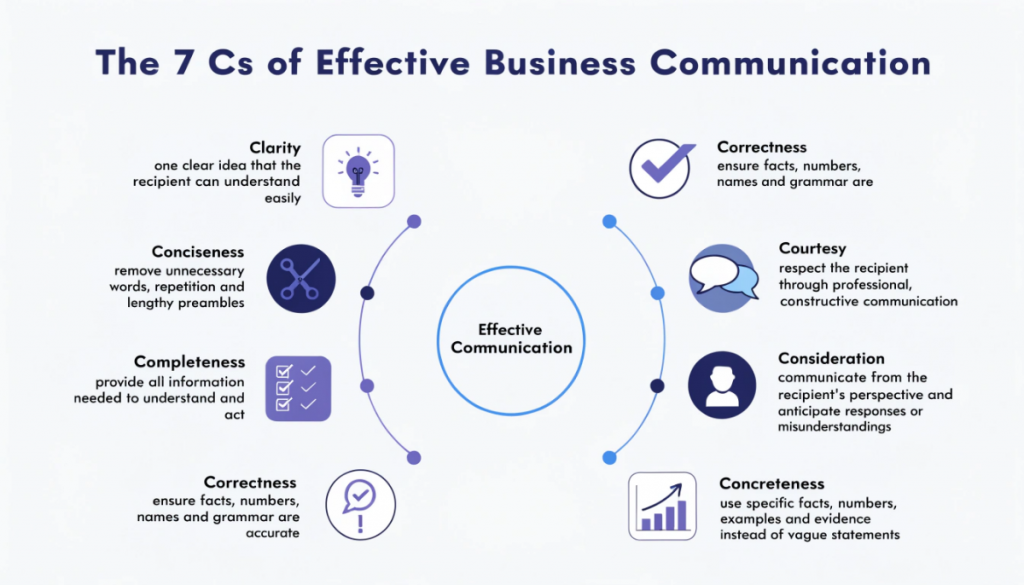
The 7 Cs are the most widely taught framework for effective business communication and each one represents a practical standard that a message should meet. Here is what they mean beyond the definition:
Clarity means that your business communication expresses one specific idea at a time in language that the recipient can understand without having to work to decode it, and the test of clarity is whether the recipient can accurately explain back to you what you meant after reading or hearing the message once
Conciseness means removing every word that is not doing useful work in the message, which in practice means cutting preamble, avoiding repetition, eliminating hedging phrases that dilute the main point and trusting the recipient to ask a follow-up question if they need more detail rather than pre-emptively including every possible piece of context
Completeness means that your business communication contains everything the recipient needs to understand the situation and take the required action without coming back to you with a follow-up question that you could have anticipated, which requires thinking about the communication from the recipient’s perspective rather than your own
Correctness covers both factual accuracy and grammatical precision, since a business communication that contains incorrect numbers, wrong names or grammatical errors signals a lack of care that undermines the recipient’s confidence in the sender’s professional competence regardless of how strong the underlying idea is
Courtesy in business communication means treating the recipient’s time and perspective with respect, which in practice means acknowledging receipt of messages, using professional greetings and closings, framing feedback constructively rather than critically and avoiding a tone that is unnecessarily abrupt or dismissive
Consideration means thinking about your message from the recipient’s viewpoint before sending it, including what they already know, what they are likely to misunderstand, what their likely response or objection might be and whether the timing of the communication respects their priorities and workload
Concreteness means grounding your business communication in specific facts, numbers, examples and evidence rather than vague generalisations, since a message that says the project is progressing well tells the recipient nothing useful while a message that says three of five milestones are complete on schedule and two have been flagged for review gives the recipient something they can act on
Business Communication Barriers That Kill Clarity and How to Remove Them
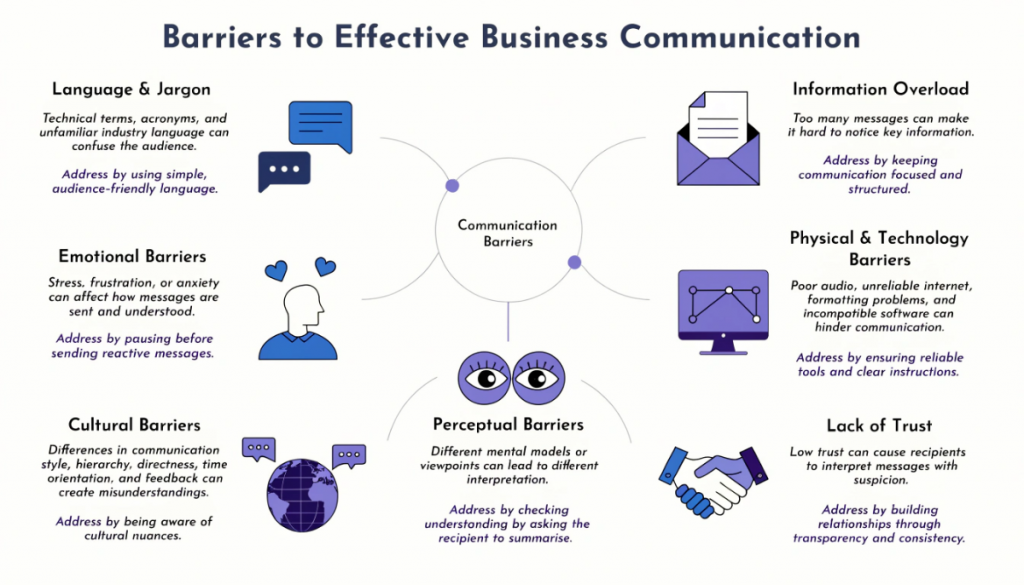
Even when business communication is well-crafted, barriers can prevent it from achieving its intended effect. Here is what the most common barriers look like and how to address them:
Language and jargon barriers occur when business communication uses technical terminology, acronyms or industry-specific language that not all recipients understand equally well, and the fix is to write at the level of the least experienced person in the intended audience rather than the most experienced
Emotional barriers arise when a sender or recipient is experiencing stress, frustration or anxiety that distorts how a message is delivered or interpreted, and the professional response is to delay sending a reactive message written in an emotional state until you have had enough distance to revise it calmly
Cultural barriers become increasingly significant as Indian businesses work with international clients and manage geographically distributed teams, with differences in communication directness, hierarchy sensitivity, time orientation and feedback style all creating misunderstandings that have nothing to do with the content of the message itself
Information overload is a barrier to business communication that has grown significantly in 2026 as the volume of messages professionals receive has increased, and the practical response is to be disciplined about what you send, choose the right channel so your message reaches the right audience and structure messages so the key point is immediately visible rather than buried
Physical and technological barriers including poor audio quality on calls, unreliable internet connections, poorly formatted documents and incompatible software create friction that prevents business communication from landing cleanly even when the content is well-prepared
Lack of trust is one of the most significant invisible barriers to business communication, since people who do not trust the person communicating with them will interpret the same message with suspicion that they would receive openly from someone they trust, making the interpersonal relationship as important as the quality of the communication itself
Perceptual barriers arise when sender and recipient have genuinely different mental models of a situation, project or relationship and each is interpreting the communication through their own frame without realising the frames are different, which is why the most effective business communicators habitually check understanding by asking the recipient to summarise what they have understood rather than assuming the message was received as intended
Conclusion
Business communication is the connective tissue of every organisation that functions well and its absence is the invisible cause behind most instances of missed targets, failed projects, client churn and team dysfunction. The three types, internal, external and lateral, each serve a different purpose. The seven Cs provide a practical quality standard that every business communication can be measured against.
The most common barriers, from jargon and emotional state to cultural difference and information overload, are all addressable once you know what to look for. And the improvement path is straightforward: write more, revise deliberately, present regularly, listen actively and get specific feedback. Business communication is not a background skill that takes care of itself. It is a core professional competency that separates the managers, executives and founders who consistently influence outcomes from those who have equally good ideas but cannot get them across.

Book Your
Free Session
Connect with our experts and get personalised guidance for your career, course selection, and future goals.
📖 Sources & References
✓ Verified 2026Verified business communication, workplace collaboration, professional skills and organisational communication insights based on authoritative institutional and professional sources.
- Harvard Business Review – Communication Research and practical insights on effective communication, leadership, workplace interactions and organisational performance
- World Economic Forum – Future of Jobs Report 2025 Communication, collaboration, leadership, analytical thinking and other skills shaping the modern workplace
- Gallup – State of the Global Workplace Employee engagement, workplace communication, manager effectiveness and organisational culture insights
- CIPD – Communication and Consultation Evidence and professional guidance on employee voice, consultation, workplace communication and engagement
- International Labour Organization – Workplace Cooperation Workplace dialogue, cooperation, employee participation and communication between organisational stakeholders
- U.S. Department of Labor – Workplace Communication Professional workplace skills, employee development and communication-related competencies
- National Career Service – Government of India Career development, employability skills and professional competencies relevant to the Indian workforce
- Ministry of Education – Government of India Higher education, professional development and education frameworks supporting communication and employability skills
- UGC – University Grants Commission Higher education standards, academic frameworks and recognised degree-related information in India
- Shoolini Online – Business & Management Education Business and management education, professional skill development and programmes designed for career-focused learners