

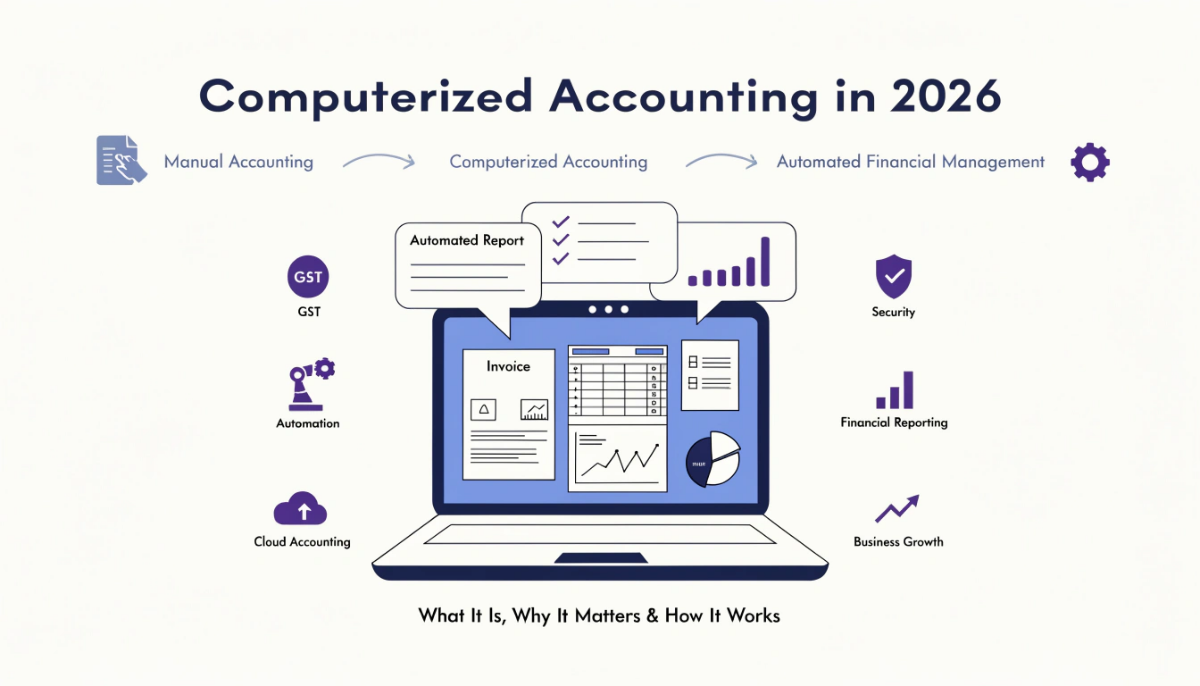
Computerized accounting has shifted from being an advanced option that larger businesses adopted to being the baseline expectation for financial management at organisations of every size in India.A business that still relies on manual ledgers or spreadsheet-only bookkeeping in 2026 is spending significantly more time on data entry, experiencing avoidable errors in tax compliance and missing the real-time financial visibility that even small businesses now have access to through affordable accounting software.
Computerized accounting is not a technology luxury but a practical operational necessity, and understanding what it involves, why it is important, what types of systems exist and which one fits a particular business is the kind of knowledge that every commerce and finance professional needs to have ready. This blog covers all of that in straightforward terms without unnecessary complexity.
What Computerized Accounting Is and How It Differs From Manual Methods
Computerized accounting is one of those terms that most people have heard but fewer can define precisely. Here is a clear and grounded explanation:
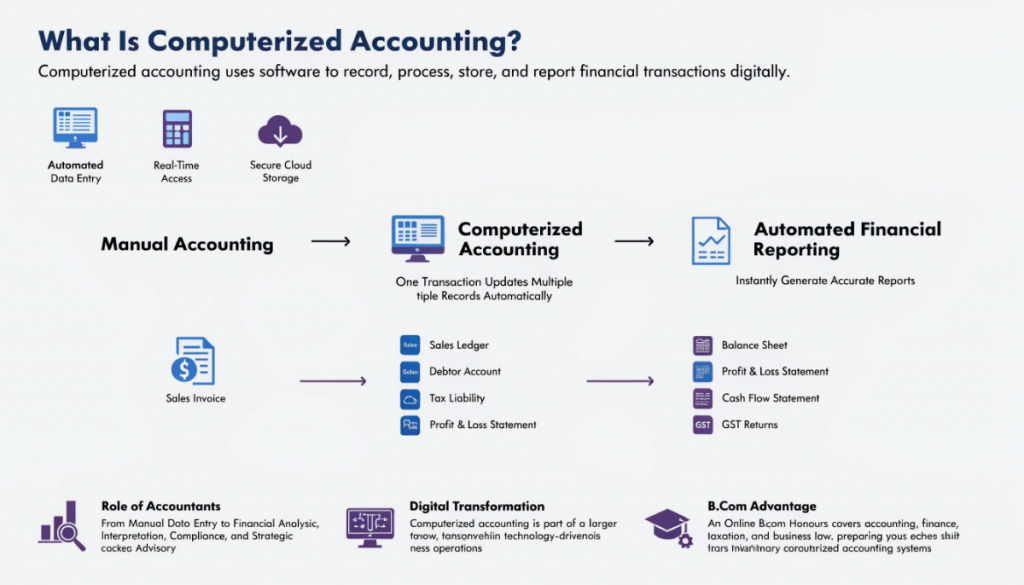
Computerized accounting refers to the use of accounting software to record, process, store and report financial transactions, replacing the manual process of maintaining physical ledgers, day books, cash books and trial balance sheets that traditional accounting required
The most fundamental difference between computerized accounting and manual accounting is that in a computerized system, a transaction entered once automatically updates every relevant record simultaneously, whereas in a manual system each update to each register has to be made separately, which multiplies the risk of error and the time cost of every transaction
In a computerized accounting system, the moment a sales invoice is generated it simultaneously updates the sales ledger, the debtor’s account, the tax liability account and the profit and loss statement without any additional data entry from the accountant
Computerized accounting systems can generate financial reports including balance sheets, profit and loss accounts, cash flow statements and GST returns in minutes from a complete and up-to-date dataset, whereas manual accounting requires days or weeks of cross-referencing and compilation to produce the same outputs
The automation built into computerized accounting does not eliminate the need for accountants but changes what accountants spend their time on, shifting the focus from data entry and ledger maintenance to data interpretation, financial analysis, compliance verification and strategic financial advisory
India’s technology sector grew at 5.1 percent year-on-year in FY25 according to NASSCOM’s Technology Sector Strategic Review 2025, reflecting the broader digital transformation of business operations that has made computerized accounting a standard rather than a differentiator across Indian industries
An online B.Com Honours is the most directly relevant undergraduate qualification for someone who wants to work with computerized accounting systems professionally, with the eligibility being 10+2 in any discipline with a minimum of 40% marks and no entrance exam required, and the curriculum covering accountancy principles, financial management, taxation and the business law context in which accounting systems operate
Key Components That Make a Computerized Accounting System Work
A computerized accounting system is not a single tool but a set of integrated components that work together to manage financial data reliably. Here is what each component does:
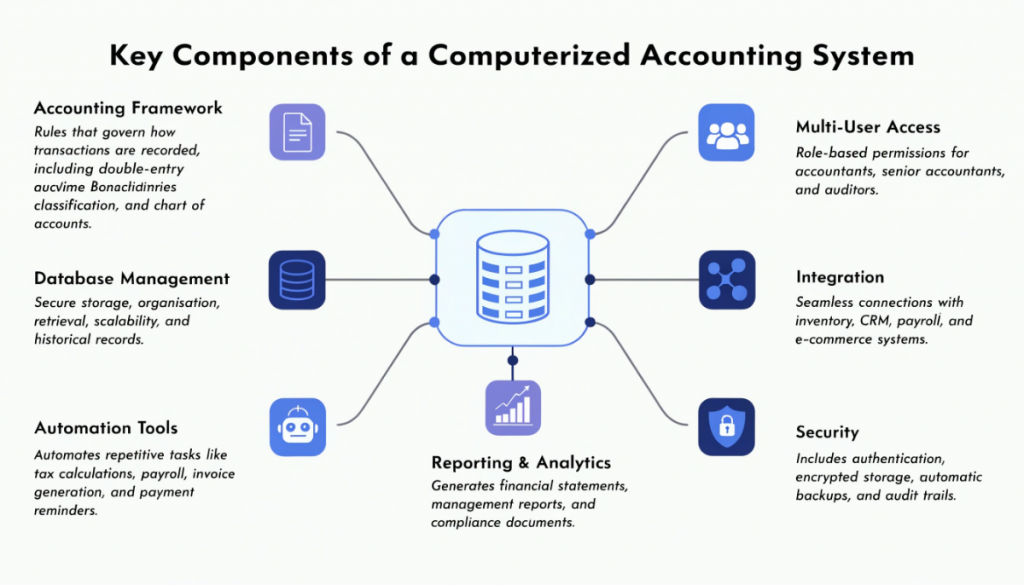
The accounting framework is the rules and principles layer of a computerized accounting system, defining how transactions are classified, how double-entry bookkeeping is applied and how the chart of accounts is structured, which ensures that the financial data the system processes is consistent and comparable across periods
Database management is the component that handles how financial data is stored, organised and retrieved, and the quality of the database architecture directly determines how quickly a user can pull a report, how securely historical records are protected and how easily the system can scale as the volume of transactions grows
Automation tools within a computerized accounting system handle tasks that previously required manual intervention at every step, including automatic tax calculation on each transaction, payroll processing against employee records, invoice generation from sales orders and payment reminders to debtors based on outstanding balance age
Reporting and analytics capability is one of the most valuable components of computerized accounting because it converts raw transaction data into formatted financial statements, management reports and compliance documents that decision-makers can act on and regulatory authorities can verify
Multi-user access with role-based permissions is a component that matters particularly for businesses with multiple finance team members, allowing an accountant to post entries, a senior accountant to approve them and an auditor to review them without giving every user full administrative access to modify or delete historical records
Integration capability is increasingly important in 2026 because a computerized accounting system that connects with other business systems such as inventory management, CRM, payroll software and e-commerce platforms eliminates the need to manually transfer data between systems, which is one of the largest remaining sources of error in financial management
Security features including user authentication, encrypted data storage, automatic backup and audit trails that record every change made to a financial record are foundational components that distinguish a professional computerized accounting system from a basic spreadsheet or informal digital record-keeping approach
Why Computerized Accounting Has Become Non-Negotiable for Indian Businesses
The importance of computerized accounting goes beyond convenience. Here is a breakdown of why it is now operationally essential for businesses operating in India in 2026:
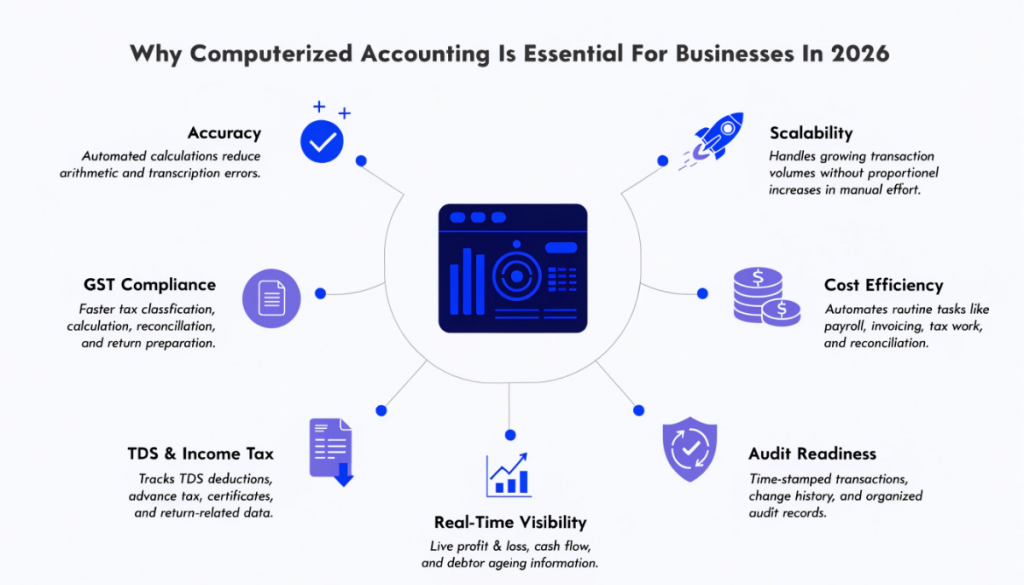
Accuracy and error elimination is the most immediate benefit of computerized accounting, since the system performs all calculations automatically and a correctly entered transaction cannot result in a mathematical error, which is in sharp contrast to manual accounting where arithmetic mistakes and transcription errors are a constant and costly risk
GST compliance is one of the clearest reasons Indian businesses need computerized accounting because the GST return filing process requires reconciliation of purchase and sales data across multiple categories and tax rates, a task that is practically impossible to manage accurately at any significant transaction volume without software that automates the classification and calculation
TDS management, advance tax calculation and income tax return preparation all benefit from computerized accounting because the system can maintain continuous running totals of deductible amounts, flag transactions that trigger TDS requirements and generate the required certificates and returns from the same dataset without manual recompilation
Real-time financial visibility is a benefit of computerized accounting that directly affects business decision-making quality, since a business owner or CFO who can access a live profit and loss statement, a current cash flow position or an up-to-date debtor aging report at any point in time makes meaningfully better decisions than one who can only see last month’s manually compiled figures
Audit readiness is dramatically improved by computerized accounting because the system maintains a complete, time-stamped record of every transaction and every change made to any record, which makes the preparation of documents for a statutory or internal audit a matter of generating pre-formatted reports rather than manually locating and presenting physical ledgers
Cost efficiency over time is a genuine benefit of computerized accounting that offsets the software cost, since a system that automates payroll, invoicing, tax filing and reconciliation reduces the number of person-hours required for routine accounting tasks and allows the same finance team to manage a significantly larger transaction volume without proportional headcount growth
Scalability is one of the most practically valuable aspects of computerized accounting for growing businesses because a well-implemented system can handle the same transaction volume whether the business processes 100 invoices a month or 10,000, without requiring a proportional increase in manual effort or a structural overhaul of the finance function
Types of Computerized Accounting Systems and Which Business Each One Fits
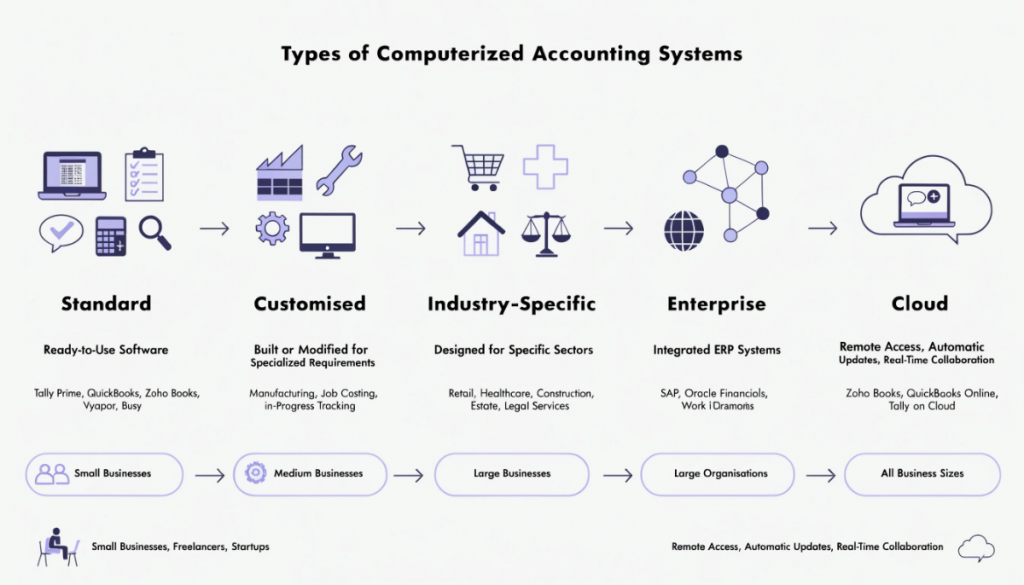
Not every computerized accounting system is built for the same scale or type of business. Here is a clear breakdown of the main types and when each one makes sense:
Ready-to-use accounting software is the most widely used type of computerized accounting in India and covers off-the-shelf solutions including Tally Prime, QuickBooks, Zoho Books, Vyapar and Busy, which come pre-configured with standard accounting functions, GST compliance features, basic inventory management and financial reporting without requiring any custom development
This type of computerized accounting system suits small businesses, sole proprietors, freelancers and startups because it is affordable, quick to implement, requires minimal training and covers the full range of standard accounting tasks including invoicing, bank reconciliation, ledger maintenance and tax return preparation
Customised accounting software is built or significantly modified for businesses with accounting requirements that standard off-the-shelf products cannot meet, such as a manufacturing company that needs its accounting system to track job costing and work-in-progress inventory in a way that integrates directly with its production planning data
Industry-specific accounting software sits between ready-to-use and fully customised solutions, covering sectors like retail, healthcare, construction, real estate and legal services, where the standard accounting functions need to be supplemented with sector-specific modules such as billing for professional time, project cost tracking or property management accounting
Enterprise Resource Planning systems represent the most comprehensive type of computerized accounting, integrating financial accounting with sales, procurement, HR, production, supply chain and customer relationship management in a single unified platform used by large organisations including multinationals, government-linked entities and large manufacturing and services companies
ERP systems such as SAP, Oracle Financials and Microsoft Dynamics are the standard for organisations that operate across multiple entities, currencies, tax jurisdictions and business units simultaneously, requiring a single system to maintain consolidated financial reporting while allowing each business unit its own financial records within the same platform
Cloud-based accounting software is the fastest-growing category of computerized accounting in India in 2026, with platforms like Zoho Books, QuickBooks Online and Tally on Cloud allowing businesses to access their accounts from any device and location, automatically receive software updates and compliance changes without manual installation and share real-time financial data with their accountant or auditor remotely
Computerized Accounting vs Manual Accounting: Where the Real Differences Show Up
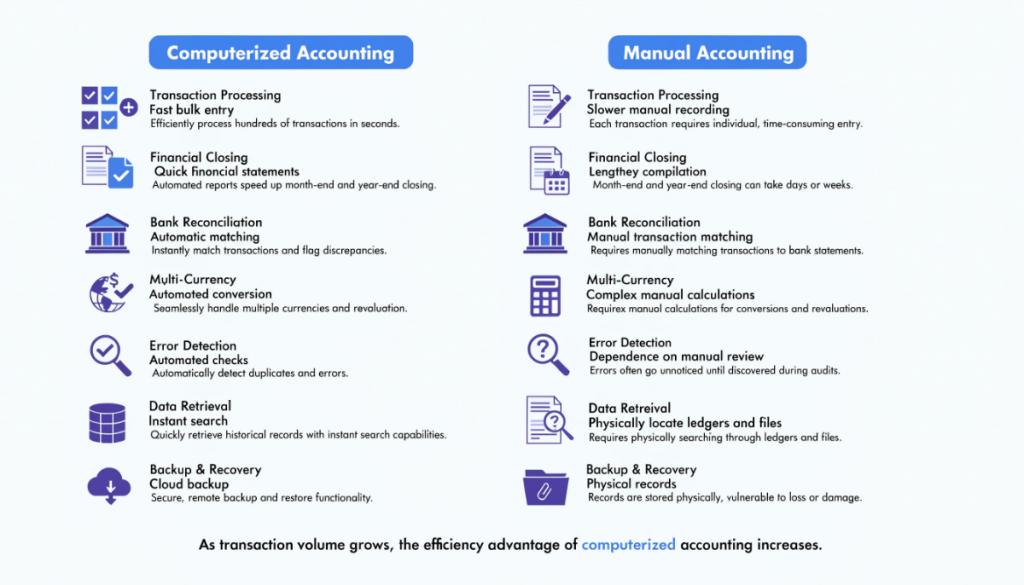
The comparison between computerized accounting and manual accounting is worth making specific rather than general because the practical differences show up in particular situations rather than as a constant uniform advantage. Here is where it actually matters most:
Speed of transaction processing is the most visible everyday difference, since a trained data entry operator working on a computerized accounting system can post a hundred sales invoices in the time it takes to manually write and cross-post ten, which means the efficiency advantage compounds as transaction volume grows
Month-end and year-end close processes take days or weeks in a manual accounting system as staff manually total ledgers, prepare trial balances and compile financial statements from physical records, while a computerized accounting system with current data can generate a complete set of financial statements in minutes from the same dataset
Bank reconciliation, which involves matching every transaction in the company’s books against the bank statement and identifying discrepancies, is a task that takes hours per month in manual accounting and is performed automatically in most computerized accounting systems, which flag unmatched items for review rather than requiring the accountant to match every line manually
Multi-currency transactions are practically unmanageable at any significant volume in a manual accounting system because each transaction requires manual conversion, separate recording and periodic revaluation, while a computerized accounting system handles all of this automatically using current exchange rates and produces the correctly consolidated reporting
Error detection in manual accounting depends entirely on the vigilance of the individual preparing the accounts, while computerized accounting systems perform automatic checks including trial balance verification, duplicate transaction detection and logical consistency testing that flag errors as they occur rather than allowing them to compound through subsequent entries
Data retrieval in manual accounting requires physically locating and reading through ledger books or filing cabinets, which becomes progressively more time-consuming as the volume of historical records grows, while computerized accounting allows any transaction or report to be retrieved in seconds regardless of how far back it dates
Backup and disaster recovery is simply not possible with manual accounting in the way it is with computerized systems, since a physical ledger destroyed by fire, flood or theft is irreplaceable, whereas a computerized accounting system with proper cloud backup can restore complete financial records to the moment of the last backup regardless of physical damage to equipment
Popular Computerized Accounting Software Used in India and What Each One Does
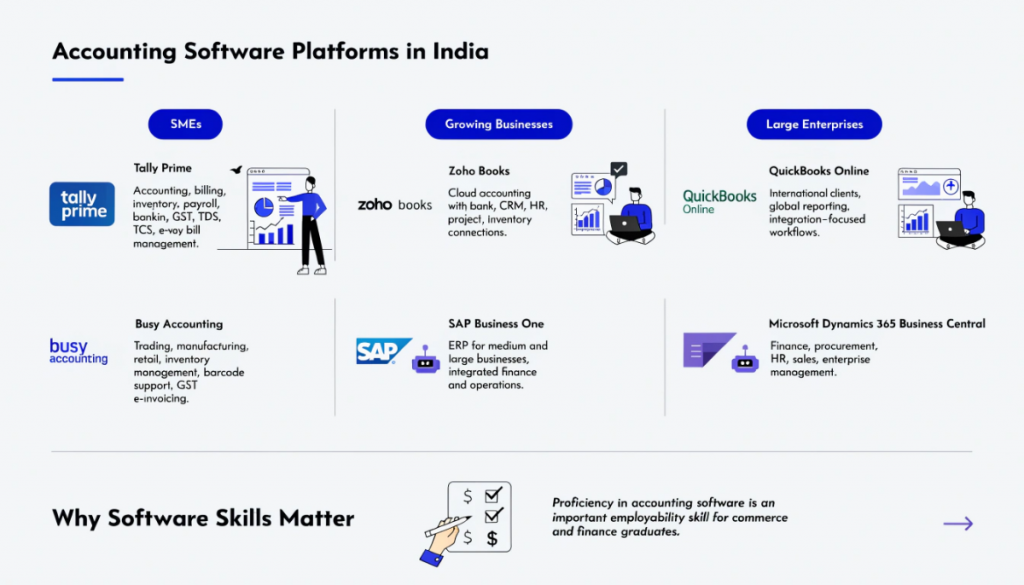
Knowing about computerized accounting in theory is one thing. Knowing which specific platforms dominate the Indian market and what each one is used for is what actually helps you work in this space. Here is the practical breakdown:
Tally Prime is the most widely used computerized accounting software in India across small, medium and large businesses, covering accounting, billing, inventory, payroll, banking and GST compliance in a single desktop and cloud platform that most Indian accounting professionals are trained to use
Tally Prime’s dominance in the Indian market comes from its deep GST integration, its ability to handle the specific compliance requirements of Indian businesses including TDS, TCS and e-way bills and its extensive network of trained support professionals and implementation partners across Tier-1, Tier-2 and Tier-3 cities
Zoho Books is a cloud-first computerized accounting platform that is growing rapidly among Indian startups, SMEs and service businesses because of its clean interface, strong GST features, direct bank feed integration and seamless connection with other Zoho applications covering CRM, HR, projects and inventory
QuickBooks Online is used primarily by businesses that have international clients or that follow international accounting standards alongside Indian requirements, since its reporting formats and integration capabilities are more aligned with global business workflows than purely India-specific platforms
Busy Accounting Software is a strong competitor to Tally in the trading, manufacturing and retail sectors in India, offering multi-location inventory management, barcode integration and GST e-invoicing alongside standard financial accounting in a format familiar to traditional business owners
SAP Business One and Microsoft Dynamics 365 Business Central are the ERP-level computerized accounting platforms used by mid-to-large Indian companies that need financial accounting fully integrated with production planning, procurement, HR and sales within a single system
Knowing how to work with at least one of these computerized accounting platforms is now a practical employability requirement for finance and commerce graduates in India, since most accounting roles at SMEs, large companies and accounting firms specify software proficiency alongside academic qualifications in their job descriptions
Conclusion
Computerized accounting in 2026 is the standard way that financial information is managed at every type of organisation that operates seriously in India, from a sole trader using Zoho Books on a phone to a manufacturing conglomerate running SAP across twelve entities.
The benefits over manual accounting are specific, measurable and impossible to replicate at scale through any non-digital approach: accuracy through automation, compliance through real-time tax integration, speed through instant report generation and reliability through cloud backup. The types of systems available cover every business size and budget, from affordable ready-to-use software to fully integrated ERP platforms.
For students and professionals in commerce and finance, understanding computerized accounting at both the conceptual and practical level is not optional but is the baseline expectation that any employer in accounting, auditing, consulting or financial management will bring to the first conversation.

Book Your
Free Session
Connect with our experts and get personalised guidance for your career, course selection, and future goals.
📖 Sources & References
✓ Verified 2026Verified accounting, electronic record-keeping, GST compliance and digital accounting insights based on official government, professional and accounting-software sources.
- CBIC – Accounts and Records under GST Requirements for maintaining accounts, stock records, invoices and electronic accounting records under GST
- CBIC – CGST Act, Section 35 Accounts and records relating to production, supplies, stock, input tax credit and output tax
- CBIC – Electronic Records and Audit Trail Electronic record maintenance, backups, audit trails, edited or deleted entries and record accessibility
- Income Tax Department – Maintenance of Books of Accounts Official guidance on maintenance of books of account for specified businesses and professions
- ICAI – Digital Accounting and Assurance Board Professional resources and guidance addressing accounting, assurance, technology and digital-era accounting practices
- ICAI – Digital Accounting Resources Professional publications covering digital assurance, automation, technology adoption and cloud computing for accountants
- TallyPrime – Accounting and Business Management Accounting, inventory, banking, invoicing, compliance, reporting and business-management capabilities
- TallyPrime Help – Features and Capabilities Accounting, inventory, payroll, banking, taxation, compliance, reporting and edit-log functionality
- CBIC – GST Accounts and Records Guidance Electronic record preservation, digital authentication, backups and accounting-record requirements under GST