

The MBA skills in demand in 2026 are not the same list that was relevant five years ago. Employers have shifted significantly in what they prioritise when hiring MBA graduates, and the gap between what a standard MBA teaches and what the market is actively paying a premium for has widened in specific and predictable ways.
More than one in three employers surveyed by GMAC in 2026 said they plan to increase MBA hiring this year and the same survey found that AI fluency, the ability to quantify business impact and a portfolio of applied work have replaced vague leadership potential as the top evaluation criteria.
This blog covers every MBA skill in demand right now across data and analytics, leadership, digital and technology, finance, communication and cross-functional strategy so you can make informed decisions about where to invest your learning time during your MBA program.
Why the MBA Skills in Demand Have Shifted So Significantly in 2026
Before getting into each specific skill, it is worth understanding why the MBA skills in demand list looks so different from even three years ago. Here is the data-backed picture:
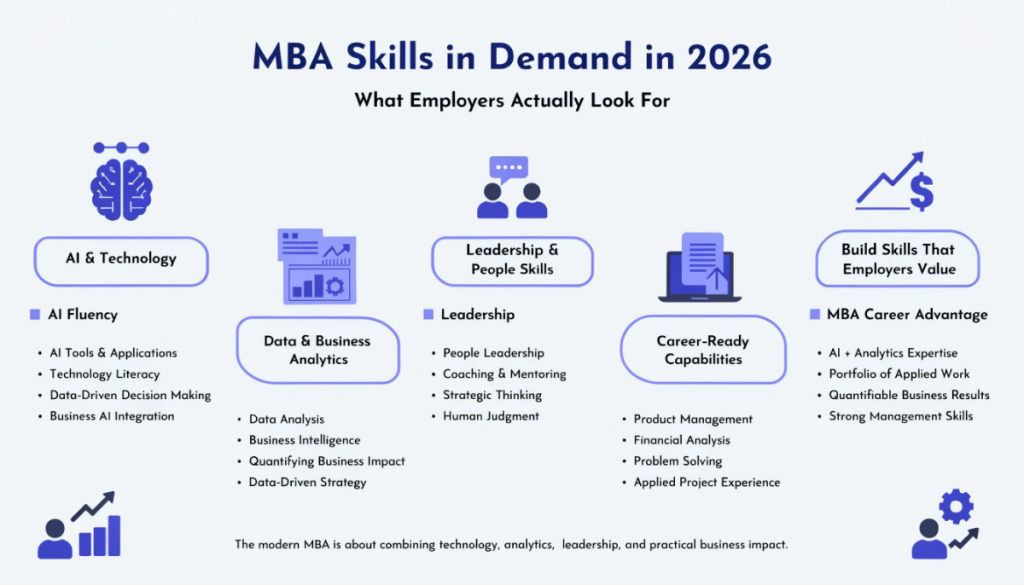
The World Economic Forum Future of Jobs Report 2025 projects that while 92 million roles will disappear by 2030, 170 million new ones will be created, and the majority of those new roles require a combination of analytical ability, technology literacy and human judgment that a well-designed MBA is uniquely positioned to deliver
GMAC’s 2026 employer survey found that AI fluency is now the most valued hiring criterion at 35 percent of employer responses, followed by the ability to quantify business impact at 31 percent and a portfolio of applied work at 25 percent, which represents a fundamental shift away from the credential-and-personality model of MBA hiring that dominated even five years ago
37 percent of employers in the same survey said they expect to increase their MBA hiring in 2026, with 47 percent offering a salary premium of 5 to 9 percent and 33 percent offering a premium of 10 percent or more, confirming that the MBA qualification still commands a meaningful salary differential when the right skills are present
The most noticeable skill gaps among recent MBA hires identified by employers are people leadership and coaching at 30 percent and proficiency in AI tools at 23 percent, which tells you both what the market needs and where current programs are most visibly falling short
Business Analytics and Data Science MBA is the fastest-growing specialisation in India with 28 percent year-on-year growth in hiring according to NASSCOM and LinkedIn India’s hiring index for 2026, followed by Finance in the BFSI sector and Product Management growing at 15 percent year-on-year
MBA graduates with strong data analytics skills earn between 12 and 28 LPA in India in 2026, while those without analytics skills are seeing a typical salary range of 8 to 12 LPA for the same management roles, which means the analytics skill set is delivering a 40 to 80 percent salary premium in direct comparisons
The eligibility to pursue an MBA and build these in-demand skills is a bachelor’s degree in any stream with a minimum of 50% marks, with 45% for reserved category candidates, and no entrance exam required for online MBA programs, making this qualification accessible to working professionals who want to upgrade without pausing their career
Data Analytics and Business Intelligence: The MBA Skill Employers Pay the Most For
Data and analytics consistently rank at the top of every current MBA skills in demand list and the salary evidence supports why. Here is what this skill set involves and where it leads:
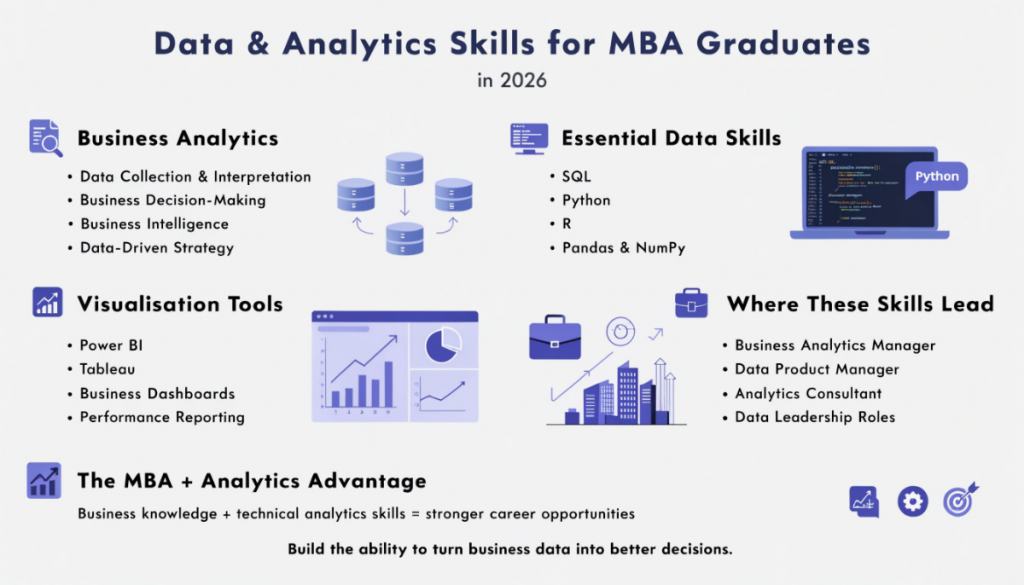
Business analytics capability means being able to collect, structure, interpret and present data in ways that directly support a specific business decision, which is different from pure data science and requires both technical competence and the business context to know which questions are worth answering
SQL proficiency is the baseline data skill for any MBA graduate targeting analytics-adjacent roles, since the ability to query databases directly without waiting for a data team allows managers to answer their own questions faster and make decisions with better information than those who cannot access data independently
Python and R are the next layer for MBA students who want to build genuine analytics depth, with Python being the more widely used in business analytics roles in 2026 and libraries like Pandas, NumPy and Scikit-learn enabling everything from data cleaning to basic machine learning without needing a computer science degree to use them effectively
Data visualisation using Power BI or Tableau is one of the most directly employable analytics skills for MBA graduates since the ability to build dashboards that communicate business performance to non-technical stakeholders is a requirement in management consulting, BFSI, FMCG and e-commerce roles rather than a specialist skill
Mid-level analytics managers and data product managers in India are earning between 18 and 35 LPA in 2026, with senior data leadership roles at large technology companies reaching 40 to 70 LPA, which illustrates the salary ceiling available to MBA graduates who build genuine analytics depth alongside management expertise
Companies actively hiring MBA graduates with analytics skills in India include Amazon, Flipkart, Google, Microsoft, McKinsey, Deloitte, ICICI Bank, HDFC and Reliance, which spans consulting, technology, banking and consumer goods and reflects how universal this skill demand has become across industries
MBA graduates who add analytics skills to a business management qualification have become what one hiring research report described as the rarest combination in 2026, since business context is common among MBAs and technical skills are common among data professionals but both together is what McKinsey, Amazon and Deloitte are actively competing to hire
AI Fluency: The MBA Skill in Demand That Is Now a Baseline Expectation
AI fluency has moved from a differentiator to a baseline expectation in employer hiring decisions for MBA graduates in 2026. Here is what that actually means in practice:
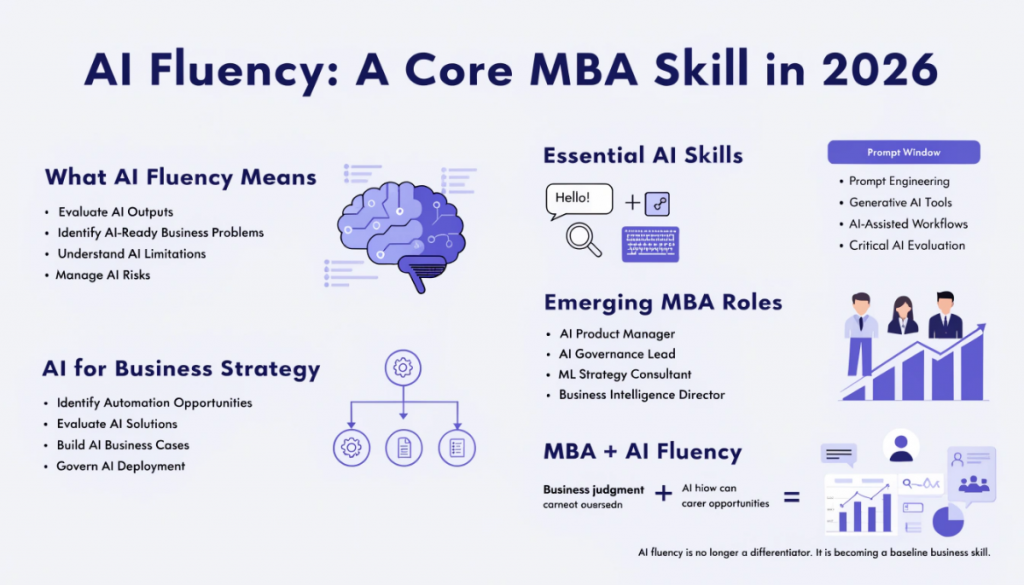
AI fluency for MBA graduates does not mean writing machine learning models from scratch but means understanding how AI tools work well enough to evaluate their outputs critically, identify which business problems AI can reliably solve and govern the risks that come with deploying AI in customer-facing or financial decision-making contexts
Prompt engineering, the ability to structure inputs to large language models effectively to produce reliable and useful outputs, has become a practical workplace skill that differentiates MBA graduates who use AI tools productively from those who interact with them at a surface level and get inconsistent results
Generative AI tools including ChatGPT, Claude, Gemini and Copilot are now embedded in financial reporting, marketing copy, contract review, presentation building and customer service at most large organisations, which means MBA graduates who are fluent in using these tools professionally have a workflow advantage from the first week on the job
AI for business strategy is the leadership-level dimension of AI fluency, involving the ability to identify which operational workflows are most suitable for AI augmentation, evaluate vendor tools against specific business requirements, build the business case for AI investment and govern the ethical and regulatory risks that AI deployment creates
The skill gap data from GMAC’s 2026 employer survey shows that 23 percent of employers identified AI tool proficiency as the most noticeable gap in recent MBA hires, which represents both a warning for graduates who have not built this skill and an opportunity for those who have
MBA programs that include AI and analytics in their curriculum directly address this skill gap, building both the conceptual literacy to understand what AI systems can and cannot do and the practical experience with tools like Python, SQL and Tableau that allow graduates to work alongside AI systems rather than being displaced by them
Roles specifically created by AI adoption and now appearing regularly in MBA hiring pipelines include AI product manager, AI governance lead, machine learning strategy consultant and business intelligence director, all of which require the management judgment of an MBA alongside the AI literacy that was not on the MBA curriculum five years ago
Leadership and People Management: The MBA Skill in Demand That Soft Skill Labels Undersell
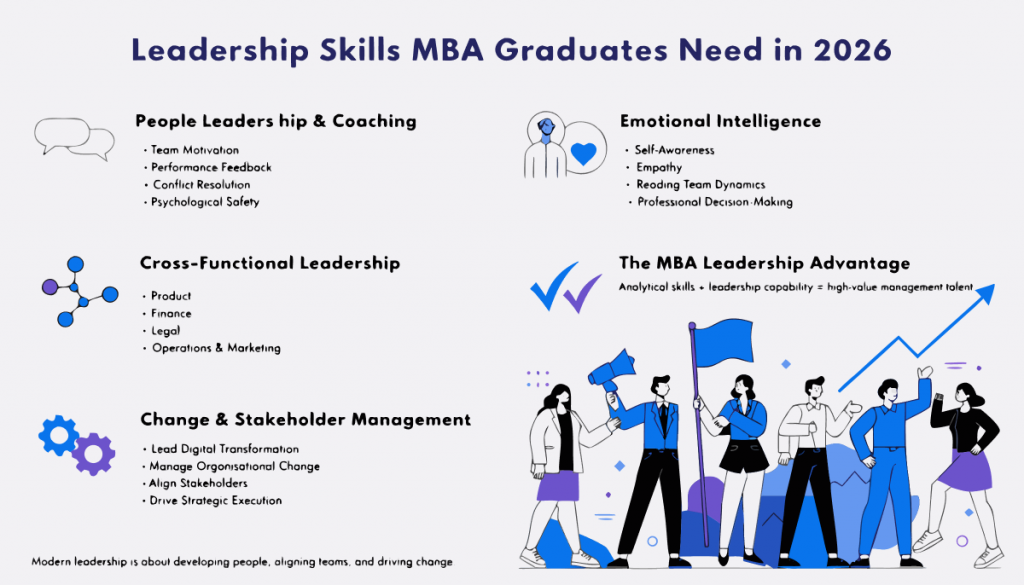
Leadership is consistently cited as an MBA skill in demand but it is worth being specific about what employers actually mean by this in 2026 because the definition has changed. Here is the practical picture:
People leadership and coaching ranked as the top skill gap in recent MBA hires according to 30 percent of employers in GMAC’s 2026 survey, which means leadership is not just valued but specifically missing in a large proportion of MBA graduates entering the workforce
What employers mean by leadership in 2026 is specifically the ability to motivate and develop a team, give performance feedback that changes behaviour, resolve interpersonal conflict without escalating it and create psychological safety in a team environment where people can raise problems early
Cross-functional collaboration is the leadership skill that comes up most frequently in job descriptions for senior MBA hire roles in consulting, BFSI and technology since complex business problems in 2026 require coordinating between product, finance, legal, operations and marketing teams simultaneously
Change management capability, knowing how to lead an organisation through a significant operational or strategic change while maintaining engagement and performance, has become a specifically sought-after MBA skill in demand as companies navigate digital transformation, AI adoption and post-merger integration
Stakeholder management, the ability to map, communicate with and align different groups with different interests around a shared business objective, is a skill that technical roles rarely develop but MBA programs with case-based learning and live project work tend to build effectively
Emotional intelligence as a leadership skill is not about being likable but about the specific managerial competencies of self-awareness, empathy in professional contexts, the ability to read a room and the discipline to separate personal reactions from professional decisions, all of which improve team performance in measurable ways
MBA graduates who combine analytical skills with demonstrated leadership capability are specifically the profile that consulting firms, BFSI organisations and e-commerce companies are willing to pay the highest premiums for since each function alone is increasingly commoditised but the combination at the management level remains genuinely scarce
Financial Acumen: Still One of the Core MBA Skills in Demand Across Every Industry
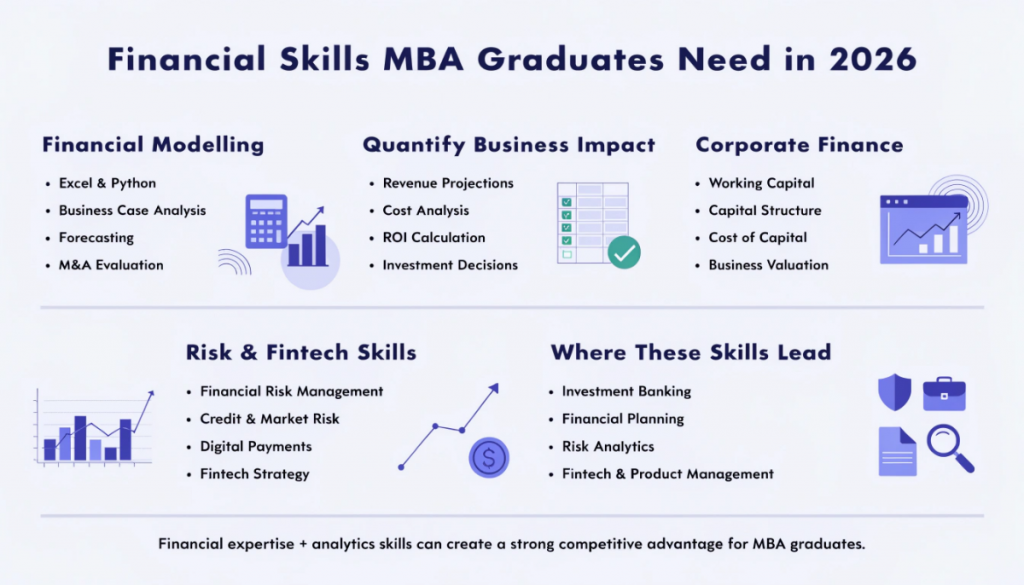
Financial skills are sometimes taken for granted in discussions about MBA skills in demand but they remain foundational across every sector. Here is what specific financial skills matter most in 2026:
Financial modelling in Excel and Python is the practical skill that underpins investment analysis, business case building, M&A evaluation and budget planning, and MBA graduates who can build, audit and stress-test a financial model independently are considerably more useful in their first year than those who can only interpret one someone else has built
The ability to quantify business impact in financial terms was cited as the second most valued hiring criterion by employers at 31 percent in the GMAC 2026 survey, which means MBA graduates who can translate a strategic recommendation into a financial case with revenue projections, cost analysis and return on investment calculation are specifically more hireable than those who cannot
Corporate finance knowledge covering working capital management, capital structure decisions, cost of capital calculation and valuation methods is the domain expertise that underpins investment banking, private equity, corporate treasury and CFO-track roles at every company size
Risk management skills covering financial, operational, credit and market risk have grown in employer priority as organisations face more complex and interdependent risk environments in 2026, and MBA graduates with quantitative risk modelling capability are specifically sought in BFSI, consulting and energy sector roles
BFSI is one of the strongest hiring sectors for MBA graduates in India in 2026, with finance specialisation consistently ranking as the second most in-demand MBA specialisation after business analytics, and roles in investment banking, wealth management, credit analysis and financial planning all showing positive hiring momentum
Fintech investment has surged significantly over the past decade and fintech companies are now among the most active recruiters of MBA graduates with financial acumen, particularly for roles in product management, risk analytics, regulatory compliance and commercial strategy where business and finance knowledge intersects
MBA graduates with financial modelling and analytics skills combined are specifically the profile that commands the highest salaries in the business analytics specialisation, with average packages ranging from 12 to 18 LPA at entry level and significantly higher at experienced levels in companies that need people who can work across both quantitative domains
Digital Marketing and Growth Skills: The MBA Skills in Demand in Consumer-Facing Roles
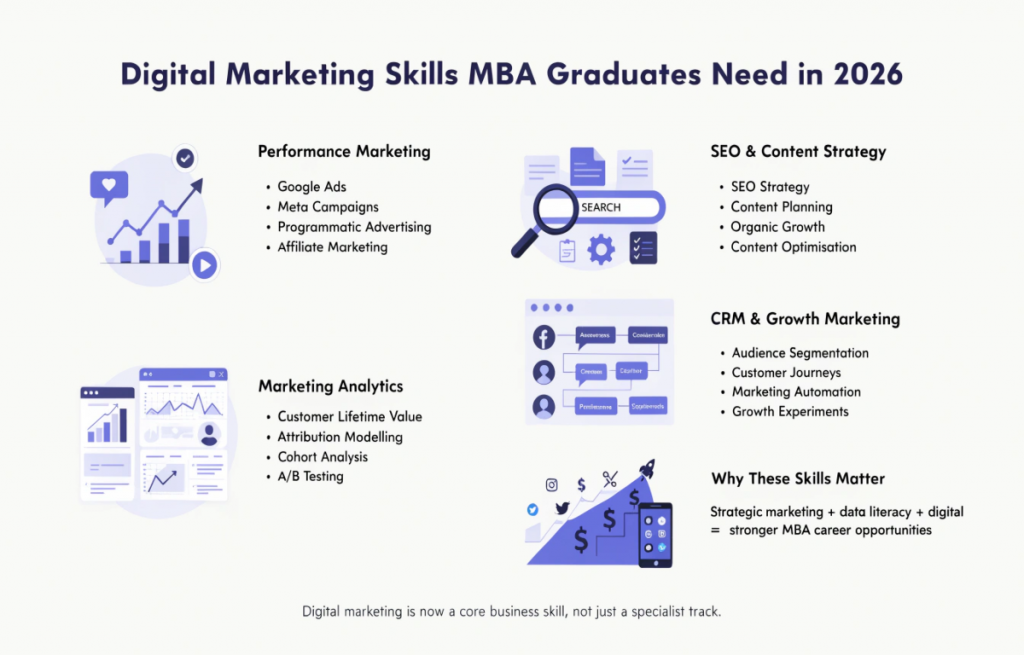
Digital marketing has become a core MBA skill in demand rather than a specialist track as more industries move their customer acquisition and retention online. Here is what the skill set looks like:
Performance marketing skills including managing Google Ads, Meta campaigns, programmatic advertising and affiliate channels have become expected knowledge for MBA graduates entering brand management, product marketing and growth roles at FMCG, e-commerce and D2C companies
Marketing analytics covering customer lifetime value calculation, attribution modelling, cohort analysis and A/B testing methodology is the layer of digital marketing that distinguishes MBA graduates who can drive business outcomes from those who only manage campaign execution
SEO strategy and content marketing are increasingly relevant for MBA graduates in product and growth roles since organic customer acquisition has become a significant competitive lever and the ability to brief, review and optimise content at a strategic level is expected at the manager level in most digital-first businesses
CRM and customer data platform management, including the ability to segment audiences, design customer journeys and use marketing automation tools, has become a practical skill expectation for MBA graduates in marketing roles at any company with more than a few thousand customers
The rise of e-commerce in India has created strong demand for MBA graduates who understand both the business fundamentals of retail and the digital mechanics of marketplace performance, category management and customer acquisition, making this one of the MBA skills in demand that is likely to strengthen further through 2030
Growth hacking frameworks including experimentation design, rapid hypothesis testing and cross-channel funnel optimisation are skills that MBA graduates targeting startup and D2C roles are expected to have, and those who demonstrate practical experience with these methods in a portfolio consistently receive faster interview progression than those who can only discuss them conceptually
MBA programs that include digital marketing, business analytics and product management as part of the curriculum directly address this skills gap, since the combination of strategic marketing knowledge with data literacy and digital tool familiarity is what consumer-facing employers are specifically shortlisting for in 2026
Conclusion
The MBA skills in demand in 2026 span a clear and well-documented range: data analytics and AI fluency at the technical end, leadership and communication at the human end and financial acumen and strategic thinking as the connective tissue that makes both sides useful in a management context.
The salary evidence is specific and consistent: MBA graduates who combine business management knowledge with analytics and AI literacy earn 40 to 80 percent more than those with management skills alone, and employers who are increasing their MBA hiring are explicitly looking for this combination rather than the credential by itself.
The most practical conclusion from all this employer data is that choosing an MBA program with analytics, AI and digital skills built into the curriculum rather than treated as electives is the single most important program selection criterion for anyone enrolling in 2026.

Book Your
Free Session
Connect with our experts and get personalised guidance for your career, course selection, and future goals.
📖 Sources & References
✓ Verified 2026Verified MBA employability trends, AI and analytics skills, leadership capabilities, financial expertise and digital business skills based on recognised educational, government and industry sources.
- GMAC MBA employer hiring trends, in-demand skills, AI fluency and business school graduate employability insights
- World Economic Forum Future of Jobs research covering analytical thinking, AI, technology literacy, leadership and workforce skills
- NASSCOM India technology hiring trends, AI adoption, analytics skills and digital workforce insights
- LinkedIn Workforce Insights Hiring trends, emerging skills, workforce development and professional career insights
- McKinsey & Company AI adoption, business analytics, digital transformation and management capability research
- Deloitte Insights AI, leadership, workforce transformation, digital business and enterprise skills research
- National Career Service Career guidance, employability resources, professional skills and job-market information
- Ministry of Education Higher education policy, skill development initiatives and management education frameworks
- Shoolini Online Online MBA programmes, AI and analytics-focused management education, career guidance and professional development resources
- UGC India Recognition of higher education programmes, online learning regulations and academic quality standards