

Hackathons are one of the fastest ways for BCA students to build real skills, get noticed by recruiters and create a portfolio that actually stands out in placements.
The problem is that most BCA students either skip hackathons because they think they are not good enough or show up without any preparation and walk away confused about why their team did not make it past the first round.
This BCA hackathon guide covers everything you need, from picking the right event and building the right team to choosing a problem statement, building a working prototype, pitching to judges and using the experience to get internship and job offers. Whether you are joining your first hackathon or looking to go from participant to finalist, this guide gives you a practical, no-fluff roadmap for 2026.
Why Hackathons Matter Specifically for BCA Students in 2026
Before getting into the BCA hackathon guide itself, it is worth being clear about why participating matters and what you actually get out of it. Here is the honest picture:
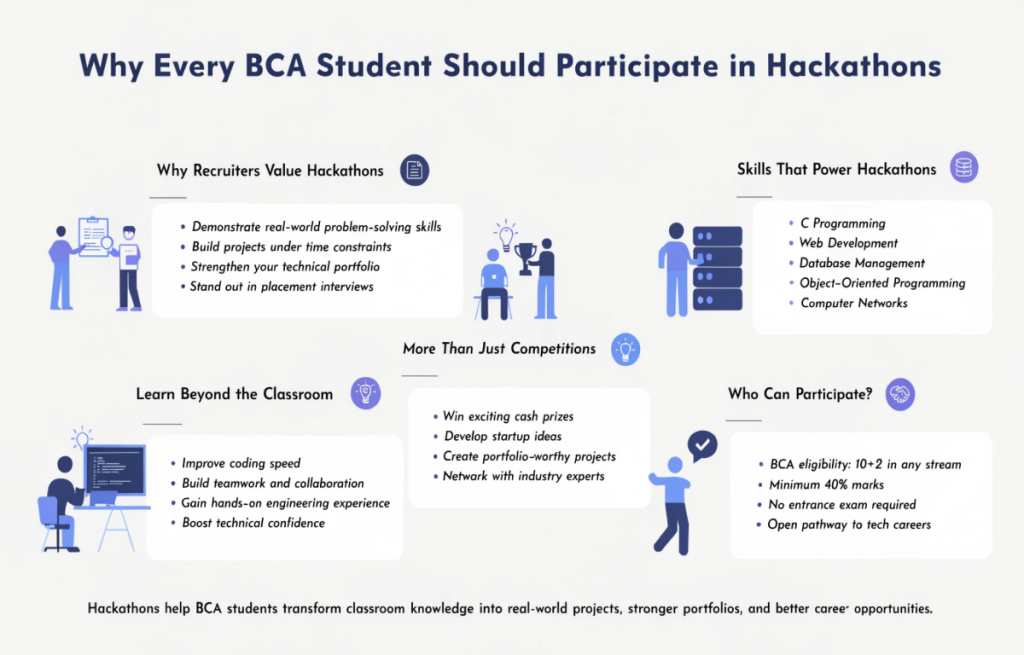
74 percent of global tech recruiters view hackathon projects as direct proof of problem-solving ability, which means a hackathon project on your resume carries more weight than a certificate from a course because it demonstrates that you can build something real under pressure
BCA students who participate in two to three hackathons per year consistently report stronger technical confidence, faster coding speed and better ability to work in teams compared to those who only do coursework, since hackathons compress real-world engineering experience into 24 to 48 hours
India’s top hackathons now offer combined prize pools exceeding 2 crore rupees annually, with the Smart India Hackathon alone distributing more than 1 crore in prizes, which means the financial upside for BCA students who compete seriously is not trivial
68 percent of hackathon participants continue building their projects even after the event ends, which means a hackathon is often the starting point for a real product, a startup idea or a capstone project that goes on a portfolio long after the event
Recruiters from companies that conduct campus drives consistently confirm that BCA students who can point to a specific hackathon project and explain what they built, what broke and what they learned are far more memorable in interviews than students who can only discuss coursework
The BCA program with a Computer Science and IT specialisation builds exactly the technical foundation needed to compete in hackathons, covering problem solving in C, web technology, database management, object oriented programming and computer networking, all of which are directly applicable to the kind of projects hackathons require
The eligibility for a BCA program that prepares you for hackathons is 10+2 in any discipline with a minimum of 40% marks from a recognised board, with no entrance exam required, which means a wide range of students can build this technical foundation regardless of which stream they studied in school
BCA Hackathon Guide: Choosing the Right Event to Enter First
Not every hackathon is the right starting point for a BCA student. Picking the wrong event for your experience level is one of the most common reasons first-timers have a bad experience and do not go back. Here is how to choose:
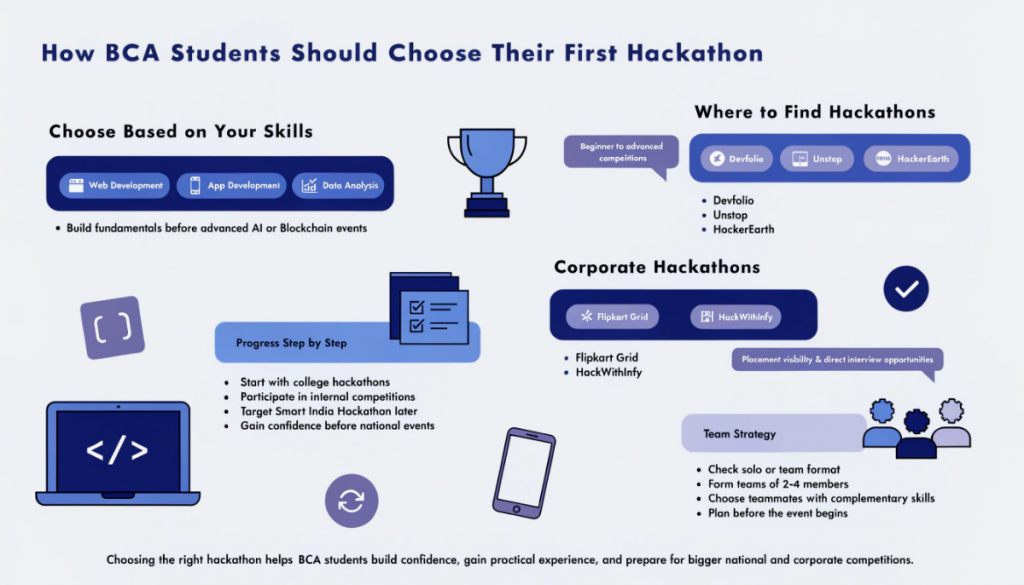
Start with theme-based hackathons that align with skills you already have such as web development, app development or data analysis rather than jumping into AI or blockchain hackathons before you have the foundational skills for those domains
Devfolio is one of India’s most trusted hackathon platforms and hosts events across web3, fintech and AI with a mix of beginner-friendly and advanced competitions, making it a reliable starting point for BCA students who want to discover events relevant to their skill level
Unstop and HackerEarth are two other platforms that regularly list hackathons specifically open to BCA and BCA-equivalent students with problem statements designed for undergraduate technology programs rather than exclusively for postgraduate or specialised engineers
Smart India Hackathon is the largest national hackathon in India and is highly competitive, making it a better target for your second or third hackathon rather than your first, since the team structure, problem statement complexity and judging standards are demanding for complete beginners
Flipkart Grid, HackWithInfy and similar corporate hackathons are excellent for placement visibility since companies use these events as part of their recruiting funnel, and BCA students who perform well in corporate hackathons have a documented path to interview calls that bypasses the standard application queue
College-level and internal hackathons are the ideal starting point because the environment is familiar, the judging is more supportive and the pressure is lower, which gives you a chance to work through the process of forming a team, picking a problem statement and building a prototype before doing so in front of a national audience
Check whether a hackathon is solo or team-based before registering since most hackathons in India allow teams of two to four people and forming the right team before the event starts is consistently one of the biggest determinants of whether you place well or struggle
Building the Right Team: The Part Every BCA Hackathon Guide Underemphasises
Your team composition determines more about your hackathon outcome than almost any other factor. Here is exactly what a strong hackathon team for BCA students looks like:
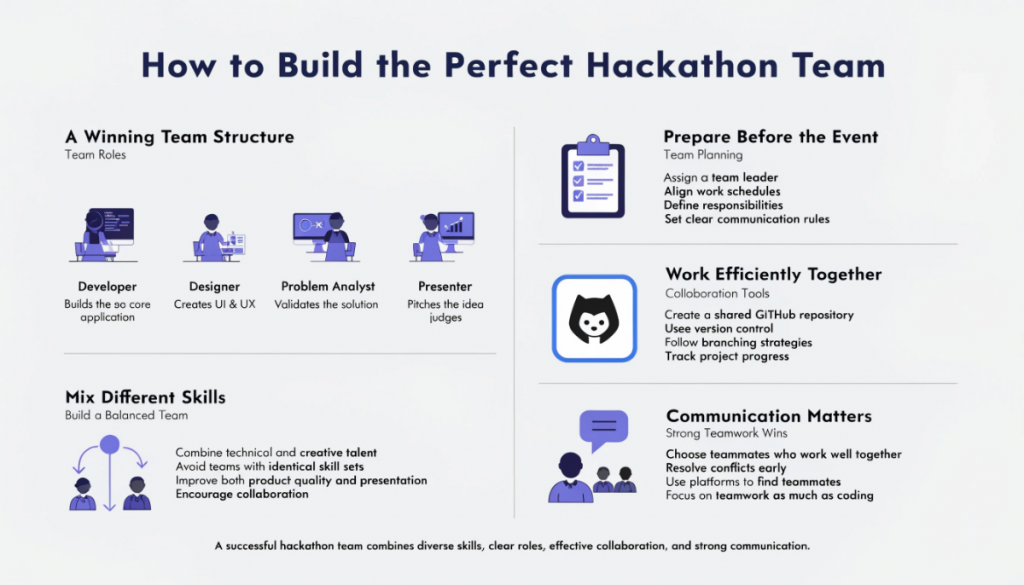
A team of four with clearly defined roles works better than a team of four where everyone does the same thing, and the four roles that win most hackathons are a developer who writes the core logic, a designer who handles the interface and user experience, a data or problem analyst who validates the solution approach and a presenter who communicates the idea to judges
Do not form a team entirely of people with the same skill set, since a team where all four members are backend developers will build a functional but ugly and poorly explained solution, while a mixed team with a designer and a communicator typically performs significantly better in front of judges even if the code is slightly less polished
Align on work style before the event starts since a team where one member wants to work through the night and another prefers stopping at midnight will run into conflict exactly when the pressure is highest, and having a brief conversation about working preferences in advance prevents this
Assign a team lead before the event begins rather than figuring it out during the hackathon, since leaderless teams consistently make slower decisions and waste time debating direction when every hour of build time matters
Your team should have a shared code repository set up on GitHub before the event starts, with branching conventions agreed in advance, since teams that start pushing to a shared repository on day one without any version control discipline often end up with broken code at the worst possible moment
Avoid teams with interpersonal conflict from the start since hackathons compress stress into a short window and pre-existing friction between team members becomes significantly worse under time pressure, while teams that genuinely like each other and communicate well outperform more technically skilled but friction-heavy groups regularly
If you cannot find a team through your own network, platforms like Devfolio and Unstop have team formation features that allow solo participants to connect with others looking for teammates, which is worth using rather than entering solo or skipping the event entirely
Picking and Understanding the Problem Statement: Where BCA Hackathon Preparation Really Starts
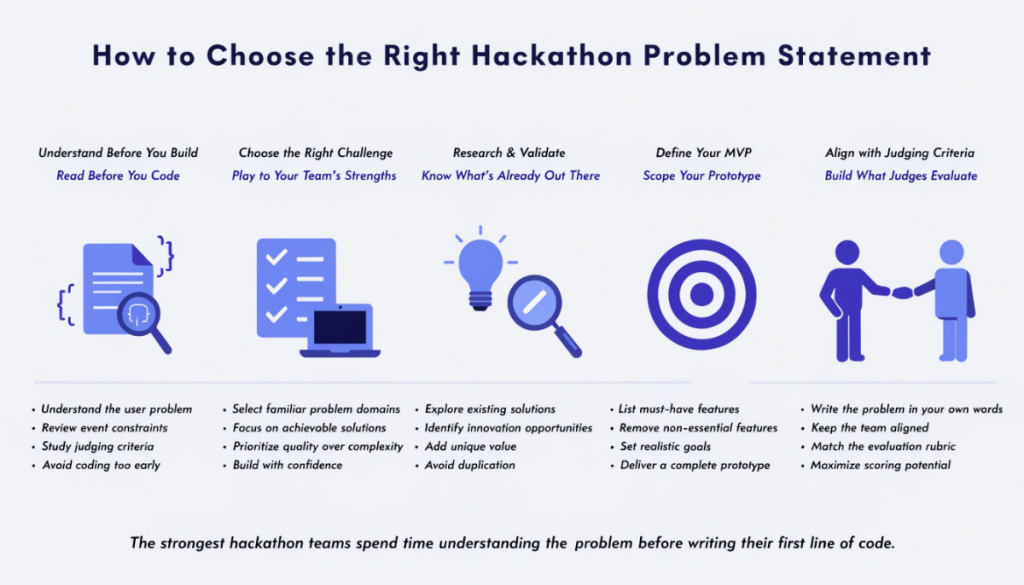
The problem statement you pick and how well you understand it before writing a single line of code determines more about your outcome than any technical skill. Here is what this BCA hackathon guide says about getting this right:
The single biggest reason teams fail at hackathons is starting to code before they fully understand the problem, which is a mistake that is completely avoidable and consistently separates teams that place from those that do not
Spend at least the first hour of any hackathon reading the problem statement as a team, identifying what the actual user need is, what an acceptable solution would look like, what constraints apply and what the judging criteria are, since every one of these details shapes the product you build
Pick a problem that aligns with your team’s collective strengths rather than the one with the biggest prize or the most visible theme, since a team that builds a modest but complete solution in a domain they understand beats a team that attempts an ambitious solution in an unfamiliar domain and does not finish
Research what existing solutions look like for the problem you choose, not to copy them but to understand what has already been tried so that your solution adds something rather than simply duplicating what is already available, since judges at national hackathons are specifically looking for novelty alongside execution
Define a minimal viable product scope within the first 90 minutes of the event, listing specifically which features are in scope for the prototype and which are out of scope, since teams that define scope early ship complete solutions while those that leave scope undefined tend to run out of time before completing core functionality
Write a one-paragraph problem statement in your own words as a team exercise before starting to build, since if every team member cannot articulate the problem clearly in plain language then the team does not yet understand it well enough to solve it, and this exercise surfaces misalignment early rather than after hours of building in the wrong direction
Match your problem choice to the judging criteria shown in the event rules, since a solution that perfectly solves the stated problem but ignores the judging rubric will score lower than a solution that explicitly addresses each criterion the judges have been asked to evaluate
Building a Working Prototype Fast: The Core Technical Section of This BCA Hackathon Guide
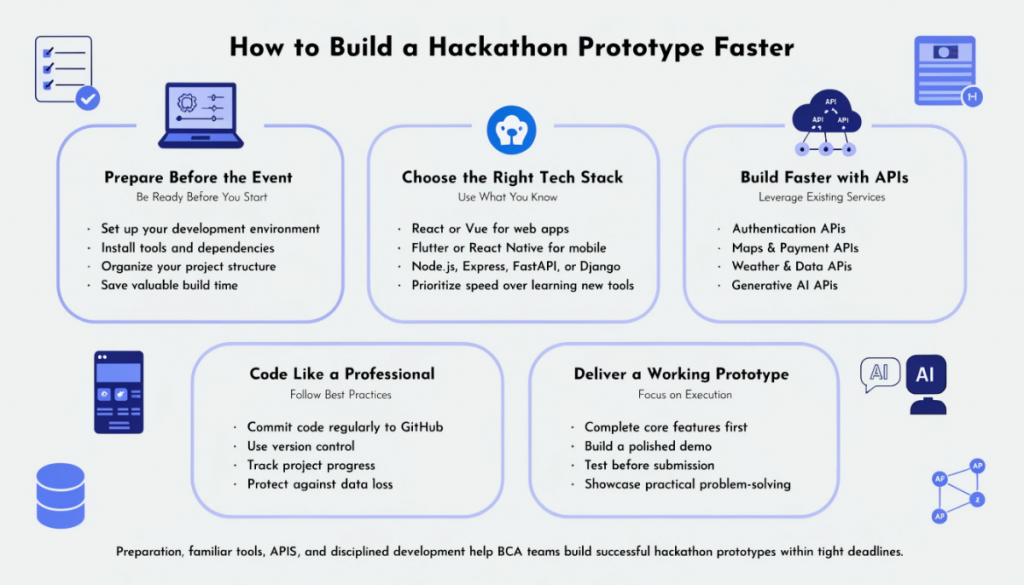
Speed of execution during a hackathon depends on preparation before it starts. Here is how to build a working prototype quickly and reliably as a BCA team:
Set up your development environment, tool stack and project structure before the hackathon begins rather than spending the first two hours configuring laptops and installing dependencies, since this preparation alone can save you three to four hours of effective build time
Choose a tech stack you are already comfortable with rather than trying to learn a new framework during the event, since a working web app built with tools you know well is far more valuable to your placement outcome than an incomplete project built in a trendy framework you read about the night before
Use a frontend framework like React or Vue for web applications and Flutter or React Native for mobile projects if your team has experience with them, since these tools allow you to build polished interfaces significantly faster than writing vanilla HTML, CSS and JavaScript from scratch
For backend logic, Node.js with Express or Python with FastAPI or Django are the most time-efficient choices for a hackathon since they have large communities, abundant documentation and a wide range of ready-to-use libraries that reduce the amount of code you need to write from scratch
APIs are your best friends in a hackathon since using existing services for payments, maps, authentication, AI features, weather data or any other functionality you need saves hours of build time compared to building these from scratch, and judges reward creativity in problem-solving rather than penalising the use of third-party services
Generative AI APIs including OpenAI, Google Gemini and Anthropic are particularly powerful hackathon tools in 2026 since they can add natural language processing, content generation and intelligent response capabilities to a project in hours rather than the weeks it would take to build equivalent functionality from scratch
Commit your code to GitHub every 30 to 60 minutes during the hackathon without exception, since this protects you against machine failures, creates a progress trail that judges can review after the event and demonstrates professional development practices that stand out when the repository is reviewed as part of your portfolio
Pitching to Judges: The Part Most BCA Hackathon Guides Skip Over
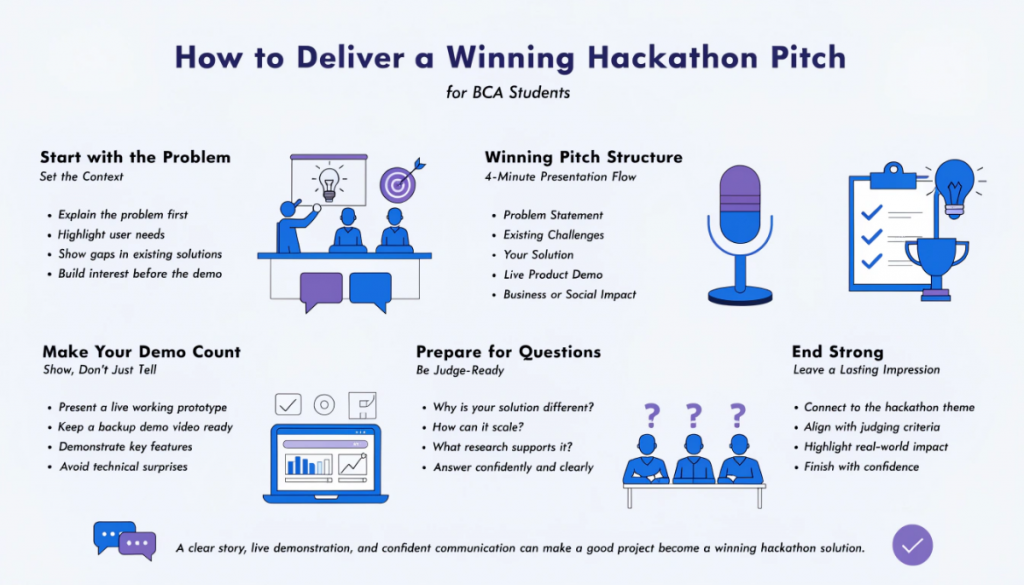
A strong project with a weak pitch loses to a decent project with a strong pitch more often than you would expect. Here is how to pitch well as a BCA hackathon team:
Start your pitch with the problem rather than your solution, since judges who understand the problem first will evaluate your solution with context rather than trying to work backwards from your demo to figure out what you were trying to solve
A four-minute pitch structure that consistently works at hackathons follows this order: the problem in one sentence, why existing solutions fail in two sentences, your solution in three to four sentences, a live demo of the working prototype and then the business or social impact of what you built
The demo is the most important part of any hackathon pitch and it should be live rather than a screen recording or a set of screenshots, since judges who see a working product function correctly have a dramatically more positive impression than those who see slides claiming a product works without demonstrating it
Prepare a backup demo video before the event ends just in case your live demo encounters a technical issue during the pitch, since a demo that crashes or fails to connect to the internet in front of judges is one of the most avoidable ways to lose points on a submission that is otherwise strong
Assign the pitch to the team member who communicates most clearly under pressure rather than the one who built the most of the product, since technical depth does not help if the audience cannot follow the explanation and judges are evaluating the whole team’s ability to communicate as well as the quality of the solution
Anticipate the three most obvious questions a judge would ask about your solution, including why users would switch from existing options, how you would scale it and what data or research supports your problem framing, and prepare concise answers in advance since judges consistently use Q and A to separate teams that understand their own product from those that built something without fully thinking it through
After the event end your pitch by explicitly connecting your solution to the hackathon’s theme, sponsor’s industry or the stated judging criteria since judges evaluate multiple teams in sequence and a pitch that clearly links back to the evaluation framework is easier to score highly than one that leaves the connection implicit
Conclusion
This BCA hackathon guide comes down to a few things that are fully within your control. Pick the right event for your current skill level rather than jumping into the most prestigious competition first. Build a team with complementary skills and clear roles before the event starts. Understand the problem deeply before writing any code. Build a working prototype rather than an impressive incomplete one.
Pitch clearly with a live demo. And use the experience systematically for portfolio, LinkedIn and recruiter conversations after the event ends. Hackathons are one of the few opportunities BCA students have to demonstrate real technical ability in a public setting with a time limit and judges watching. The students who treat this guide as a checklist and execute it consistently are the ones who show up in placement conversations with something genuinely worth talking about.

Book Your
Free Session
Connect with our experts and get personalised guidance for your career, course selection, and future goals.
📖 Sources & References
✓ Verified 2026Verified hackathon platforms, software development best practices, portfolio building, open-source collaboration and technology career insights based on recognised educational and industry sources.
- Smart India Hackathon Official hackathon guidelines, problem statements, participation process and innovation initiatives
- Devfolio Hackathon discovery platform, team formation, project showcases and developer competitions
- HackerEarth Coding competitions, hackathons, technical challenges and developer skill assessments
- GitHub Version control, collaborative software development, project repositories and portfolio hosting
- OpenAI Generative AI APIs, developer resources and AI-powered application development
- Google AI Gemini AI models, developer tools, machine learning resources and AI application guidance
- NASSCOM Technology hiring trends, software engineering skills and digital workforce reports
- National Career Service Technology career guidance, internship opportunities and employability resources
- Shoolini Online Online BCA programme, project-based learning, career guidance and industry-focused education
- UGC India Recognition of higher education programmes, online learning regulations and academic quality standards