

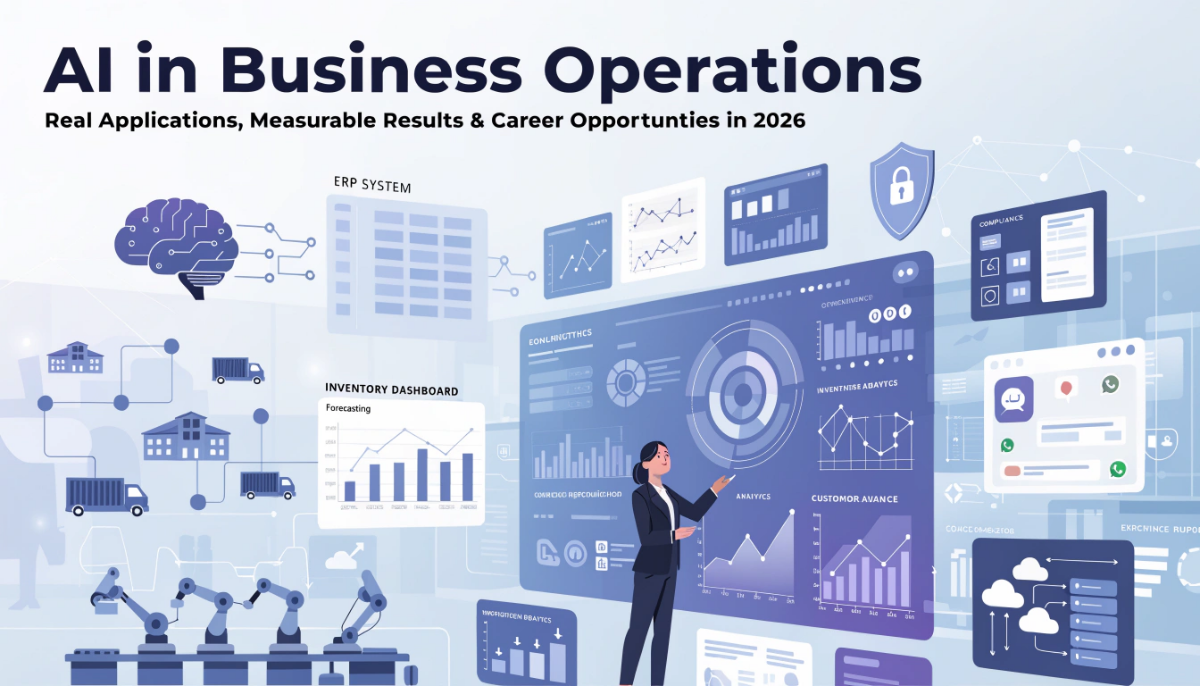
AI in business operations has moved past the pilot stage. In 2026 companies across India and globally are using it inside their daily workflows to cut costs, reduce errors, speed up decisions and remove the repetitive manual work that used to consume significant amounts of operational time.
The businesses seeing real ROI from AI in business operations are not the biggest spenders on technology but the ones that identified specific operational problems first and then matched the right tools to those problems.
This blog covers every major area where AI in business operations is delivering verifiable results in 2026, from supply chain and customer service to quality control and financial processes, along with what it means for professionals who want to build careers at the intersection of operations and data-driven decision making.
What AI in Business Operations Actually Looks Like Today
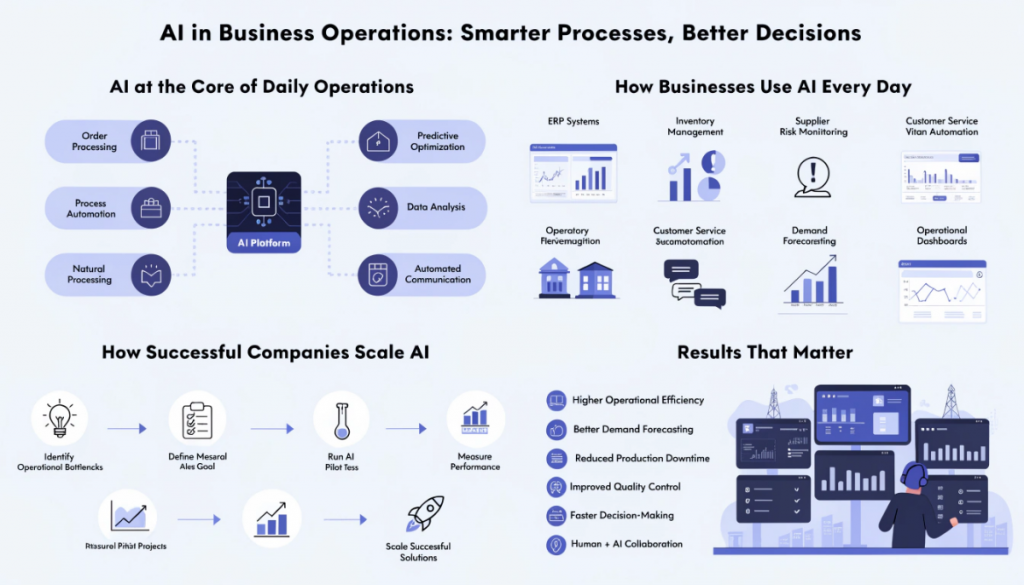
There is a gap between how AI in business operations is described in marketing material and what it actually involves at the ground level. Here is the honest picture:
AI in business operations refers to using machine learning, automation, predictive analytics and natural language processing to improve how a business runs its core day-to-day functions rather than just its strategic or customer-facing activities
In 2026 AI is embedded infrastructure in most operational platforms rather than a separate tool that employees have to switch to, which means it surfaces in the ERP system flagging a supplier risk, in the inventory dashboard predicting a stockout or in the customer service queue auto-resolving a refund request
The companies that have moved furthest with AI in business operations are not necessarily the largest ones but those that followed a specific sequence: identify the biggest operational bottleneck, define what a measurable result would look like, run a focused pilot, measure rigorously and then scale what worked
Indian businesses across manufacturing, logistics, banking, healthcare, retail and telecom have accelerated AI adoption in operations significantly in 2025 and 2026, driven by competitive SaaS pricing, a tech-ready workforce and government-backed digital infrastructure programmes
A textile manufacturer in Surat using AI for quality control reduced defect rates by 50 percent, a pharmaceutical distributor in Pune achieved 92 percent accuracy in demand forecasting and a packaging business in Ahmedabad cut production downtime from 12 percent to 4.8 percent according to data from the India AI Impact Summit 2026
The biggest operational gains from AI come not from replacing people entirely but from removing the manual data assembly, report compilation and routine decision layer so that operations teams can focus on the judgement calls that require human context and accountability
Professionals who want to lead AI-driven operations need a qualification that combines business management fundamentals with analytics and AI skills, and the eligibility for an MBA in Business Analytics and AI is a bachelor’s degree in any stream with 50% marks, with 45% for reserved category candidates and no entrance exam or prior work experience required
AI in Business Operations: Supply Chain and Inventory Management
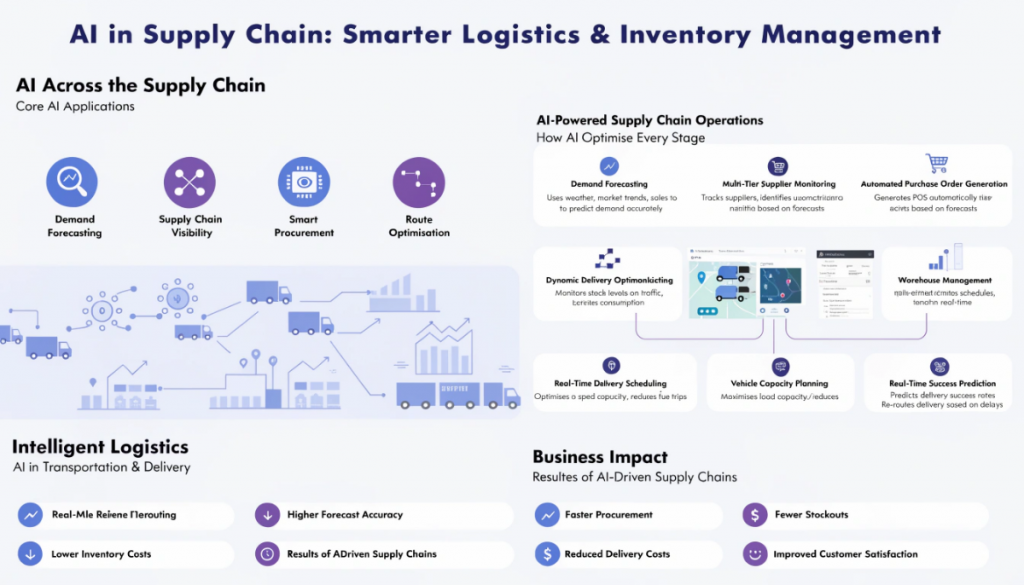
Supply chain is consistently the operational function where AI delivers the largest and most measurable financial impact. Here is what is actually happening:
AI-powered demand forecasting analyses not just historical sales data but also weather patterns, competitor pricing, regional events, social media trends and macroeconomic signals to produce projections that are significantly more accurate than traditional spreadsheet models
A pharmaceutical distributor achieving 92 percent demand forecast accuracy through AI avoids two of the most costly supply chain problems simultaneously: excess inventory tying up working capital and stockouts that push customers to competitors
Multi-tier supply chain visibility platforms use AI to track materials and goods across complex supplier networks in real time and surface early warning signals about delays, supplier financial stress or geopolitical disruptions before they reach the factory floor
Automated purchase order generation is now live in several large Indian companies where AI monitors stock levels against forecast demand and raises purchase orders without human intervention when predefined thresholds are crossed, saving dozens of procurement hours per week
Route optimisation in logistics uses AI to plan delivery routes dynamically based on real-time traffic, delivery time windows, vehicle capacity and fuel costs, which reduces per-delivery cost meaningfully when applied at the scale of hundreds or thousands of daily orders
Last mile delivery operations at large e-commerce companies use AI to batch orders by geography, predict delivery success probability and reroute drivers in real time when an address is unreachable, which directly improves both cost and customer satisfaction metrics
Inventory placement decisions in warehouse networks are increasingly AI-driven, with algorithms determining which products to store at which fulfilment centres based on predicted regional demand so that the distance between stock and customer is minimised before the order is even placed
Customer Service Operations: Where AI Delivers Fastest ROI
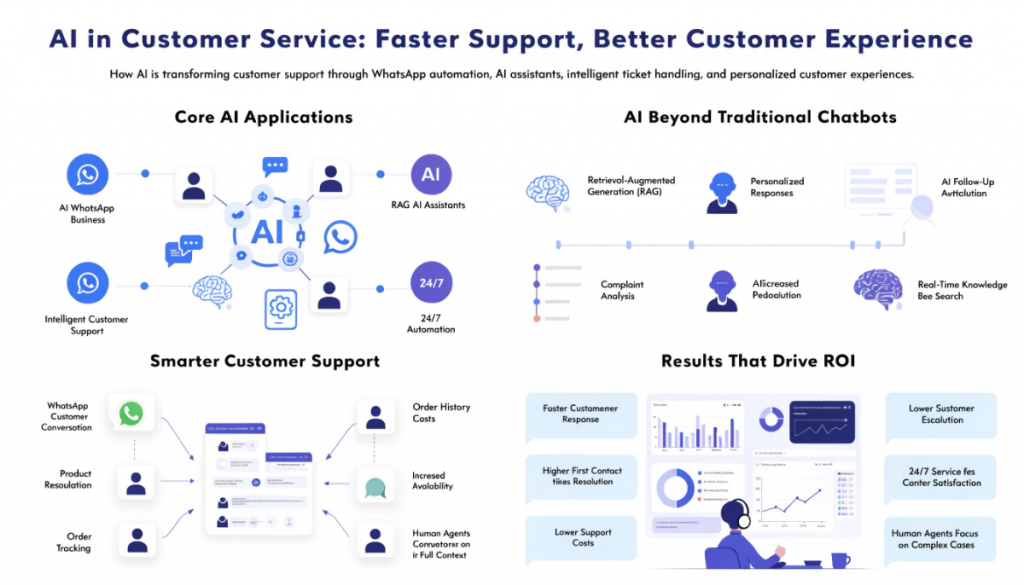
Customer service is where Indian businesses are seeing the single fastest return on AI investment in operations in 2026. Here is a clear breakdown of what is working:
AI-powered WhatsApp Business integrations are delivering measurably high ROI for Indian businesses because India runs on WhatsApp and the combination of an AI agent with the country’s dominant messaging platform means businesses can automate customer interactions at the channel customers actually prefer
RAG-based chat assistants, which use retrieval-augmented generation to pull accurate answers from a company’s own product catalogue, policy documents or knowledge base, are eliminating large volumes of pre-sale and post-sale support queries that previously required human agents
A jewellery marketplace deploying a RAG assistant saw customers getting accurate answers to complex inventory questions in natural language instantly, which reduced pre-sale support volume significantly and created a direct positive impact on conversion rates
AI in business operations at the customer service level has moved well beyond FAQ-style chatbots to systems that can process refunds, update orders, escalate to human agents with full context and follow up with customers autonomously across the resolution cycle
First contact resolution rates, which measure the percentage of customer issues resolved in a single interaction, have improved at companies that deployed AI customer service agents because the AI can access full customer history, account data and policy guidelines simultaneously in a way a human agent switching between systems cannot
Customer service teams that have integrated AI in business operations are not necessarily smaller but are focused on higher value interactions involving complex complaints, retention conversations and relationship-sensitive cases that benefit from human empathy and judgment
For Indian SMBs with limited customer service headcount, AI-powered WhatsApp and chat automation has been described as the single highest-ROI operational investment available in 2026 because it delivers 24/7 responsiveness without proportional headcount cost
Manufacturing and Quality Control: AI in Operations on the Shop Floor
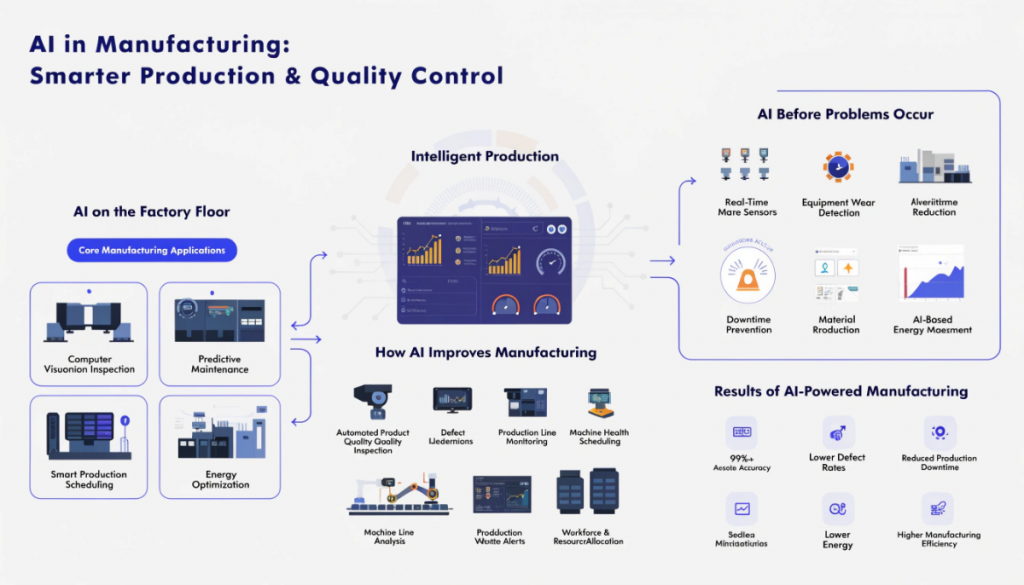
Manufacturing is one of the most data-rich environments in any business and AI in business operations is reshaping what happens on the production floor in ways that were not practically possible even two years ago. Here is what the actual results look like:
Computer vision systems using AI inspect products on production lines with more than 99 percent accuracy, catching defects that human inspectors miss due to fatigue, lighting variation or the sheer speed of modern production lines
A textile manufacturer in Surat reduced defect rates by 50 percent after deploying AI-based quality control on its production line, which represents not just a quality improvement but a significant reduction in material waste and rework cost that goes straight to the bottom line
Predictive maintenance is one of the most financially impactful applications of AI in business operations for manufacturers, using sensor data from machines to identify early signs of equipment wear and schedule maintenance before a breakdown occurs
A packaging company cutting unplanned downtime from 12 percent to 4.8 percent through AI-driven predictive maintenance illustrates the scale of the financial opportunity, since every percentage point of downtime in a manufacturing environment translates to significant lost output and recovery cost
AI-based production scheduling optimises machine utilisation, raw material consumption and workforce allocation simultaneously across a factory floor, which produces efficiency gains that traditional planning tools working with static data cannot match
Energy management in manufacturing has also become an AI application in operations, with systems analysing production patterns and energy pricing in real time to shift power-intensive processes to lower-cost time windows and reduce electricity spend without affecting output
For Indian manufacturing MSMEs, PwC and ORF data from 2026 suggests that AI adoption across the sector could unlock 11,300 to 12,500 crore rupees in additional value if adoption reaches 50 percent of manufacturing value-add potential, which frames the operational opportunity in economic terms that go beyond individual company results
Financial Operations and Compliance: How AI Handles the Number-Heavy Work
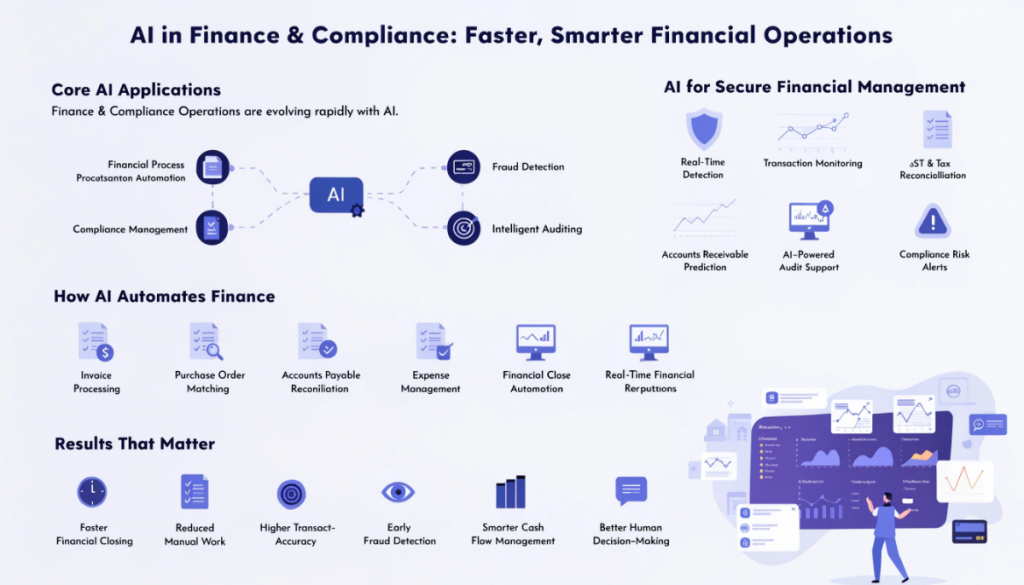
Finance and compliance are areas of business operations where errors are expensive and speed matters. Here is how AI in business operations is changing these functions:
Robotic process automation combined with AI handles invoice processing, purchase order matching, accounts payable reconciliation and expense management at speeds and accuracy levels that reduce the time from transaction to book from days to minutes in companies that have implemented it properly
AI-powered fraud detection in financial operations analyses millions of transactions in real time to identify anomalous patterns that could indicate fraud, money laundering or unauthorised activity, which is particularly relevant for banking, insurance and fintech companies handling large transaction volumes in India
Accounts receivable automation uses AI to predict which invoices are at risk of late payment based on customer payment history and behaviour patterns, enabling finance teams to prioritise collection follow-ups and intervene earlier rather than chasing overdue payments reactively
Tax compliance processes including GST filing reconciliation have been partially automated using AI in Indian businesses, with tools that match purchase and sales data, flag mismatches and generate reconciliation reports that would previously have required days of manual accountant time
Financial close processes at the end of each month or quarter, which involve consolidating data from multiple systems and producing accurate management accounts, have been compressed from weeks to days or even hours at companies that have fully deployed AI in their financial operations workflow
Audit support tools powered by AI review large volumes of transactions and documentation to identify items that require closer scrutiny, which lets audit teams focus their time on the 5 to 10 percent of transactions that actually need human judgment rather than manually reviewing everything
The risk in finance operations is not AI making wrong decisions autonomously but finance teams over-trusting AI outputs without the analytical skills to validate them, which is why professionals in this space need data literacy alongside domain expertise rather than one or the other
Building a Career Around AI in Business Operations: What Skills and Qualifications You Need
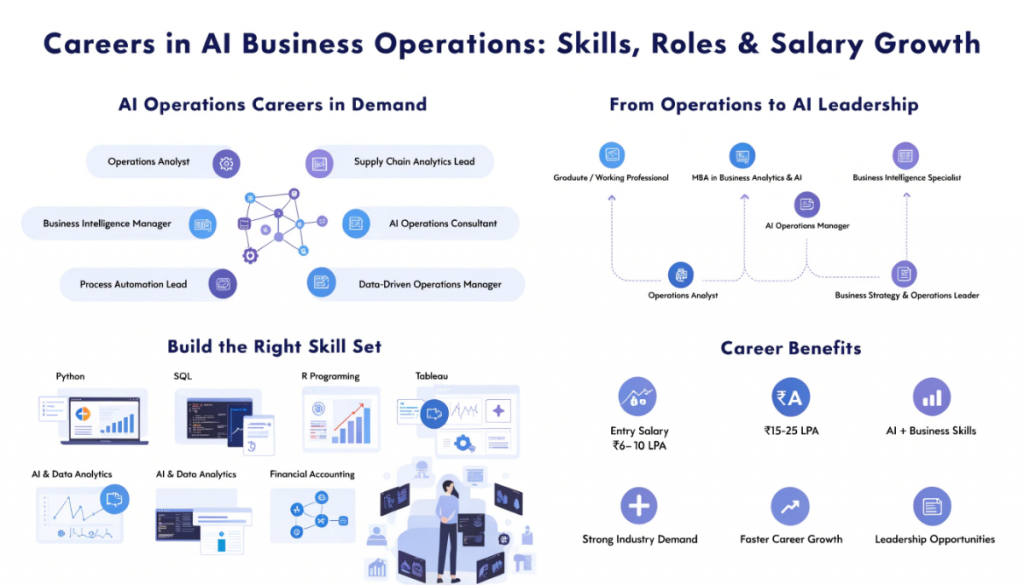
Understanding AI in business operations is one thing. Knowing how to position yourself for a career in this space is what actually matters. Here is a practical and grounded breakdown:
The roles growing fastest because of AI in business operations include operations analyst, supply chain analytics lead, business intelligence manager, AI operations consultant, process automation lead and data-driven operations manager, all of which require a combination of business domain knowledge and data literacy
AI literacy has become a baseline expectation at mid-level and senior operations roles in 2026, meaning professionals who can only manage operational processes without understanding how to apply or interpret AI tools are increasingly at a disadvantage relative to those who can do both
Prior experience in an operations function such as supply chain, manufacturing, finance or customer service combined with the ability to work with data and AI tools creates a profile that employers across sectors are actively prioritising in their hiring in 2026
An MBA in Business Analytics and AI trains professionals to use Python, R, SQL, Tableau and Power BI for data analysis alongside core management subjects including operations management, financial accounting and organisational behaviour, which builds exactly the hybrid profile that employers in AI-driven operations environments need
Entry level salaries for roles combining operations management with analytics depth range from 6 to 10 LPA in India, with five years of experience in AI-enabled operations roles commonly supporting packages in the 15 to 25 LPA range, which represents a meaningfully stronger trajectory than traditional operations roles without analytical depth
The eligibility to pursue an MBA in Business Analytics and AI is a bachelor’s degree in any stream with 50% marks, with 45% for reserved category candidates, no work experience required and no entrance exam, which means both fresh graduates and working operations professionals can access this qualification without disrupting their current employment
Professionals who combine genuine operational experience with formal AI and analytics training are in a stronger position than those who enter the field from a purely technical background without business context, because AI in business operations ultimately requires someone who understands both what the data is saying and what it means for how the business actually runs
Conclusion
AI in business operations in 2026 is not a promise about what technology might do eventually. It is a set of documented, measurable outcomes that companies across India and globally are already recording in supply chain, customer service, manufacturing, finance, HR and beyond.
The organisations getting the most out of it started with a specific operational problem, deployed AI against that problem, measured the result and scaled what worked.The professionals who will lead this space going forward are not those who simply understand AI as a concept but those who can identify where it creates real operational value, interpret the outputs it generates and make the management decisions that data alone cannot make.
If you are in operations today and want to stay relevant in the next five years, building AI and analytics capability alongside your domain expertise is not optional. It is the job.

Book Your
Free Session
Connect with our experts and get personalised guidance for your career, course selection, and future goals.
📖 Sources & References
✓ Verified 2026Verified AI in business operations trends, operational excellence, enterprise AI adoption, automation, supply chain innovation and workforce transformation based on recognised educational, regulatory and industry sources.
- World Economic Forum AI adoption trends, Future of Jobs research, operational transformation and workforce insights
- McKinsey & Company Research on AI in operations, supply chain optimisation, productivity and enterprise transformation
- PwC India AI implementation, manufacturing transformation, operational efficiency and business value studies
- NASSCOM India's AI ecosystem, enterprise technology adoption, digital operations and workforce reports
- Ministry of Electronics & IT (MeitY) Digital India initiatives, artificial intelligence policies and technology ecosystem development
- IBM Institute for Business Value Enterprise AI, operational automation, customer experience and business performance research
- Harvard Business Review AI leadership, operational strategy, innovation management and business transformation insights
- LinkedIn Workforce Insights Emerging AI operations roles, workforce trends, in-demand skills and career insights
- Shoolini Online Business Analytics and AI programmes, admission guidance and career-focused management education
- UGC India Recognition of higher education programmes, online learning regulations and academic quality standards