

If you are planning to build a career in computers or software and have just finished class 12, the first thing you need to sort out is the BCA eligibility criteria. A lot of students assume they may not qualify, especially those from arts or commerce, and end up not even trying.
This blog covers the BCA eligibility criteria clearly, covering everything from qualification and percentage to stream rules, mathematics requirements, age limit, entrance exams and documents so that you know exactly where you stand before you apply. No vague answers, no beating around the bush, just a straight breakdown of what most colleges across India actually expect.
Basic Qualification Required to Meet BCA Eligibility
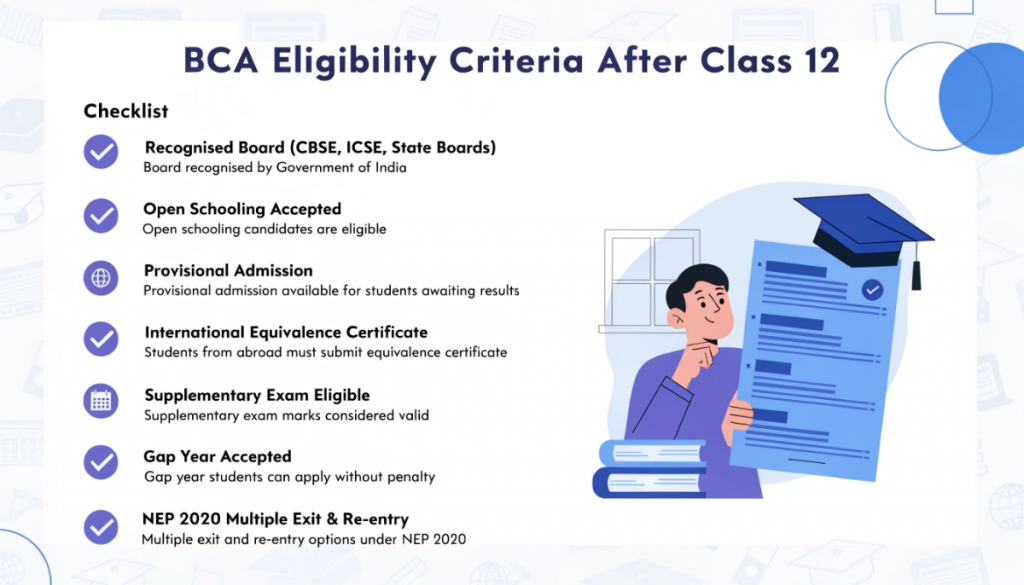
The starting point of BCA eligibility criteria is your class 12 result. Here is what you need to have:
You must have passed your 10+2 from a recognised board such as CBSE, ICSE or any state board
Boards like Maharashtra, UP, Rajasthan, Tamil Nadu, Karnataka and all other state boards are accepted as qualifying boards for BCA eligibility criteria
Students who studied through open schooling are also eligible as long as the board issuing their certificate is government recognised
If your class 12 result is still awaited, most colleges allow you to apply as a provisional candidate and submit your final marksheet once results are declared
International students with foreign board certificates such as IB or Cambridge A Levels need an equivalence certificate from the Association of Indian Universities to confirm their qualification meets the Indian 10+2 standard
Candidates who appeared in a compartment or supplementary exam are eligible as long as they hold a final passing certificate by the time admission closes
A gap year after class 12 does not affect your BCA eligibility criteria, and colleges rarely penalise students for a gap as long as the basic qualification is in place
The BCA course under NEP 2020 is available as a 3-year programme with multiple exit options, so students can also re-enter at defined stages using credits accumulated in the Academic Bank of Credits
Minimum Percentage That Satisfies BCA Eligibility Criteria
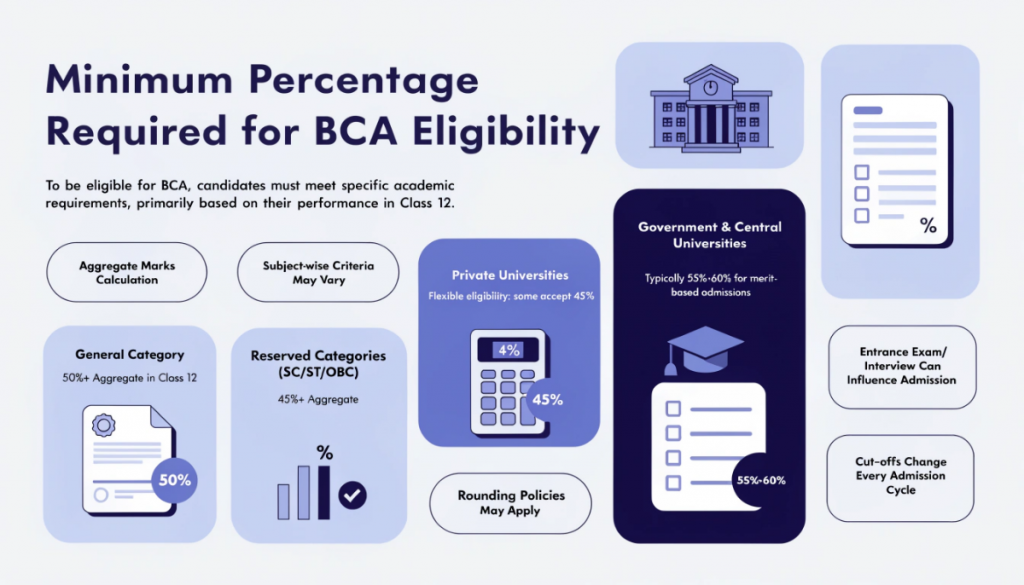
Percentage is usually the first concern students have when they look at BCA eligibility criteria. Here is the actual breakdown:
Most colleges and universities require a minimum of 50% aggregate marks in class 12 for general category candidates
Reserved category candidates including SC, ST and OBC applicants are typically eligible with 45% aggregate, as the UGC provides a 5% relaxation on the minimum score
Private universities tend to be more flexible and some accept students with as low as 45% even without category relaxation
Government and central universities follow stricter norms and some require 55% to 60%, particularly for merit-based selection without an entrance exam
The percentage is usually calculated on the aggregate of all subjects across all years or semesters of class 12 and not just the best scoring subjects
Some institutions calculate eligibility based on a specific set of subjects such as English, mathematics and one or two elective subjects, so the exact method can vary
A candidate scoring 49.6% may still be treated as meeting the 50% threshold at many colleges due to rounding policies, so it is worth confirming with the individual college
Students who score below the cut off on paper should still check whether the college factors in entrance exam performance or interview scores, as some private institutions do weigh these separately from the class 12 percentage
The cut off under BCA eligibility criteria can shift slightly from one admission cycle to the next depending on the number of applicants, so checking the current year notification is more reliable than going by numbers from a previous year
Which Streams Are Covered Under BCA Eligibility
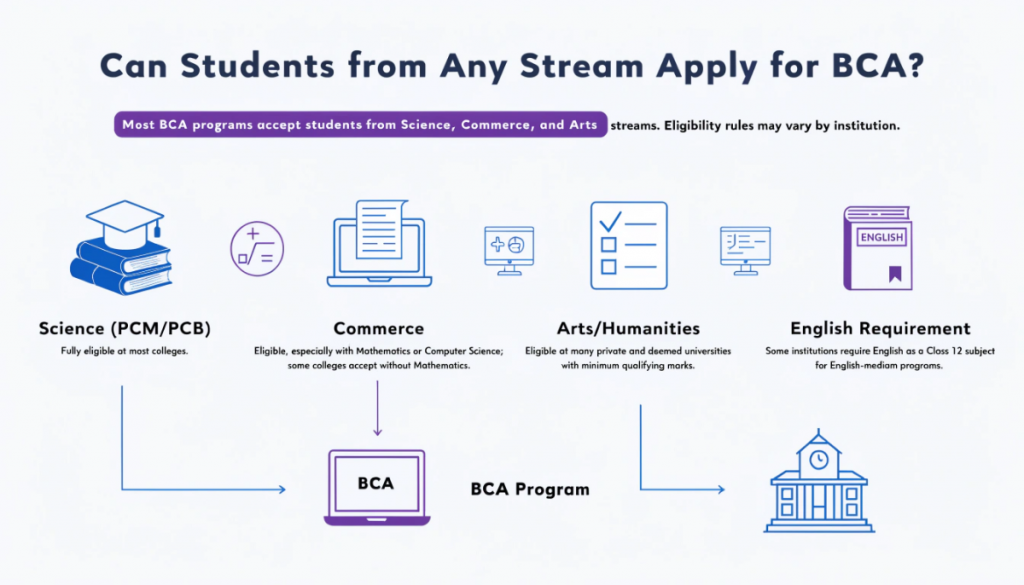
One of the most common questions around BCA eligibility criteria is whether students from all streams can apply. The answer is yes, and here is how it works for each:
BCA is open to students from science, commerce and arts streams and there is no stream restriction at most colleges
Science students with PCM or PCB background are the most straightforwardly eligible and face no subject-related restrictions at any type of institution
Commerce students with mathematics or computer science in class 12 are also considered strongly eligible at both private and government colleges
Commerce students without mathematics can apply at most private and deemed universities, though some central universities may be stricter about the maths requirement
Arts students can apply for BCA at several private and deemed universities, particularly those that accept students from any stream with a minimum percentage
Having English as a subject in class 12 is a common additional condition at institutions where the course is delivered entirely in English, so this is worth checking before applying
A change of stream between class 10 and class 12 does not affect BCA eligibility criteria since colleges look only at the final class 12 stream and marks
BCA Eligibility and the Mathematics Question
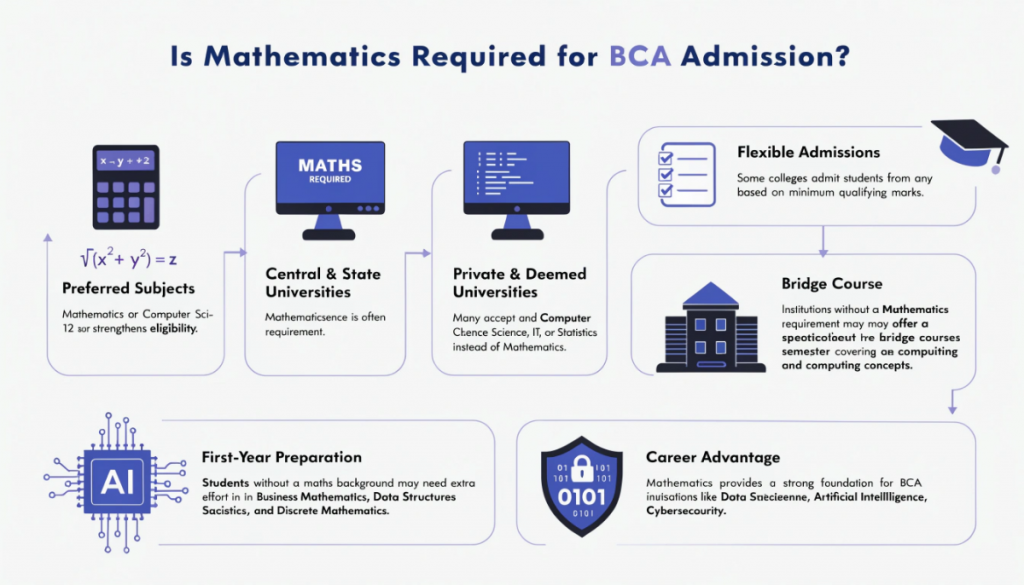
Mathematics comes up more than any other subject when students look at BCA eligibility criteria. Here is the clear picture:
Mathematics or Computer Science in class 12 is preferred by most colleges and is treated as a stronger eligibility profile
For central universities and some reputed state universities, mathematics at the class 12 level is often a firm requirement and not just a preference
Private universities and deemed universities are generally more flexible, and many accept students who had Computer Science, IT or Statistics instead of mathematics
Several colleges also accept students from any stream as long as the percentage requirement is met, treating mathematics as an added advantage rather than a mandatory condition
Institutions that do not require mathematics as part of BCA eligibility criteria often offer a bridge course in the first semester, which covers basic quantitative and computing concepts to bring all students to a common level
The BCA syllabus itself includes subjects like business mathematics, data structures and discrete mathematics, so students without a maths background should expect to put in extra effort in these areas in the first year
If you are targeting a specialisation in data science, artificial intelligence or cybersecurity, choosing a college that requires mathematics as part of BCA eligibility criteria actually works in your favour since the syllabus for these specialisations is heavily quantitative
Age Limit Under BCA Eligibility Criteria
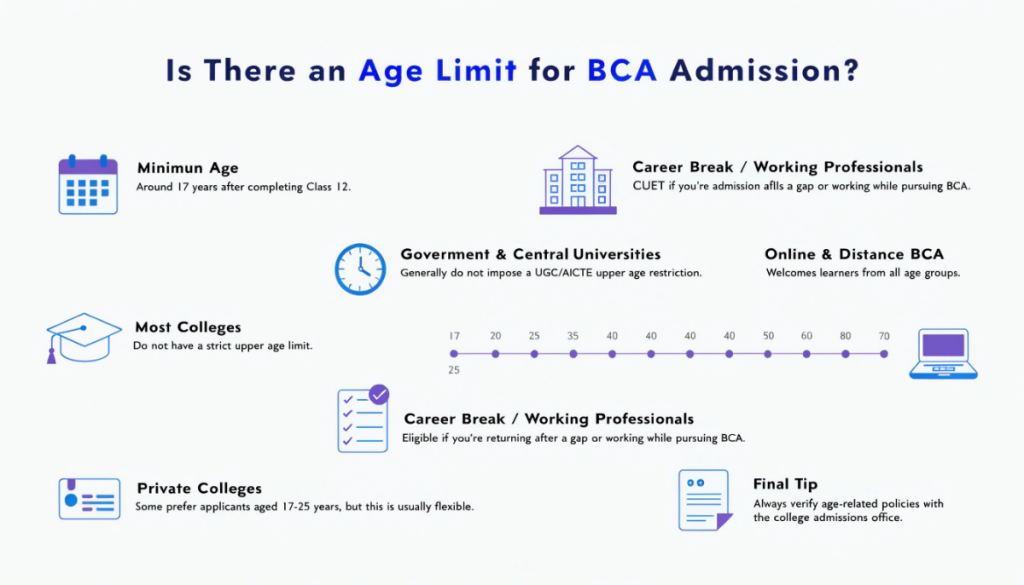
Age limit is not a major concern for most BCA applicants but it does come up often enough to deserve a clear answer. Here is what to know:
Most colleges across India do not enforce a strict upper age limit as part of BCA eligibility criteria
The general minimum age expected is around 17 years, which is the age at which a student who started schooling at the standard age would complete class 12
Some private colleges specify a preferred age bracket of 17 to 25 years for regular full-time BCA programs, though this is not a hard rejection rule at most places
Government institutions and central universities do not generally set an upper age limit and there is no UGC or AICTE mandate that caps the age for BCA admission
For CUET, which is the national entrance exam used by central universities, there is no upper age limit mentioned for BCA applicants
Students returning to education after a career break or gap of several years are eligible to apply for BCA and are not disadvantaged by age in the admission process at most institutions
If you are a working professional looking to switch to the IT field, the age bracket concern is less relevant for distance or online BCA programs which explicitly welcome all age groups
When in doubt about age eligibility, reaching out directly to the admissions office of your shortlisted college is the fastest way to get a definitive answer since age policies are rarely published prominently on admission pages
Documents and Additional BCA Eligibility Conditions to Know
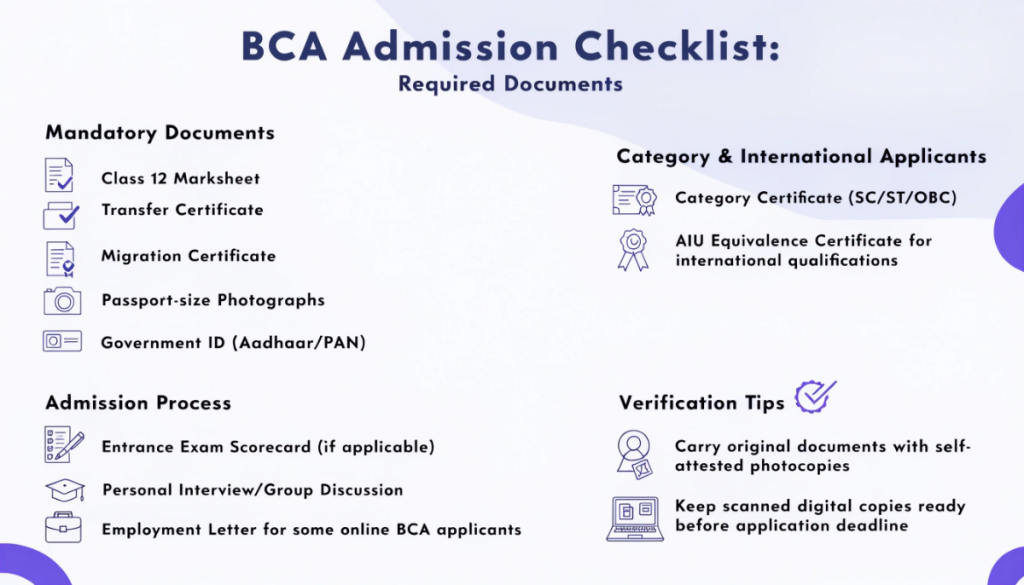
Beyond the basic academic requirements, there are a few practical conditions and documents that complete the BCA eligibility criteria checklist:
Class 12 marksheet is the primary document and must be from a recognised board for your BCA eligibility criteria to be considered valid
Transfer certificate and migration certificate are standard requirements at most colleges, particularly if you studied in a different state
Category certificate is required if you are claiming SC, ST or OBC relaxation on percentage or fees
An equivalence certificate from the Association of Indian Universities is required for students with international board certificates
Entrance exam scorecard where applicable needs to be submitted along with the application at the time of document verification
Passport-sized photographs and a government-issued identity proof such as Aadhaar or PAN are standard requirements across most BCA colleges
Some colleges conduct a personal interview or group discussion round, particularly when the number of applicants exceeds seats and the class 12 percentages are clustered closely together
For online or distance BCA programs, an additional document confirming professional status such as an employment letter may be asked for from working candidates, though this is optional at most institutions
Students claiming age relaxation or any special category benefit should carry the original certificate along with self-attested photocopies since most colleges retain the copies and return the originals after verification
Keep both scanned digital copies and physical photocopies ready well before the application deadline since submission requirements differ across colleges and a last-minute scramble for documents is easy to avoid with a little planning
Conclusion
BCA eligibility criteria in India in 2026 are genuinely accessible to a wide range of students. Pass class 12 from a recognised board, meet the minimum percentage your shortlisted college requires, check whether maths or computer science is a condition for that specific institution and confirm if an entrance exam applies. Stream is not a barrier at most colleges and even students from arts and commerce without mathematics have solid options available to them.
The core rule is simple: verify the official admission notice of each college you plan to apply to since small differences do exist, but the broad framework of BCA eligibility criteria remains consistent and achievable across most institutions in India.
📖 Sources & References
✓ Verified 2026Verified BCA eligibility criteria, admission requirements, mathematics eligibility, stream-wise admission rules and undergraduate programme regulations based on recognised educational and regulatory sources.
- UGC India Undergraduate degree regulations, admission eligibility norms and higher education guidelines
- Ministry of Education National education policies, undergraduate admission frameworks and academic qualification standards
- AICTE Technical education standards, computing education initiatives and quality assurance frameworks
- CUET UG Undergraduate entrance examination eligibility, admission procedures and candidate guidelines
- National Testing Agency National entrance examinations, application processes and admission resources
- Association of Indian Universities Equivalence certificates for international qualifications and higher education recognition
- National Career Service Technology career pathways, IT industry opportunities and employability resources
- NASSCOM Digital skills demand, software industry trends and future technology workforce reports
- Shoolini Online BCA admission guidance, eligibility information and computer applications programme resources
- National Education Policy 2020 Multiple entry-exit framework, Academic Bank of Credits and undergraduate education reforms

Book Your
Free Session
Connect with our experts and get personalised guidance for your career, course selection, and future goals.